Lyft · Study
Lyft Interview Process & Questions
TrueInterview
August 22, 2026 · 14 min read
Lyft's loop is built around small working programs rather than puzzle-style algorithms. The problems that come up most are a key-value store with transactions, a wrapper that returns exactly n items from a paginated source, and a scheduler that assigns jobs to the fewest workers. Several interviewers want a runnable main that runs test cases you wrote yourself. The design prompts come from a short list that repeats, and the hiring manager conversation is often unusually candid in both directions.
This guide breaks down each stage of the Lyft interview, what interviewers evaluate in each round, and how to prepare, with questions candidates were actually asked.
Verified: Based on 24 candidate-reported interview experiences, cross-checked against recent public accounts.
Lyft interview process
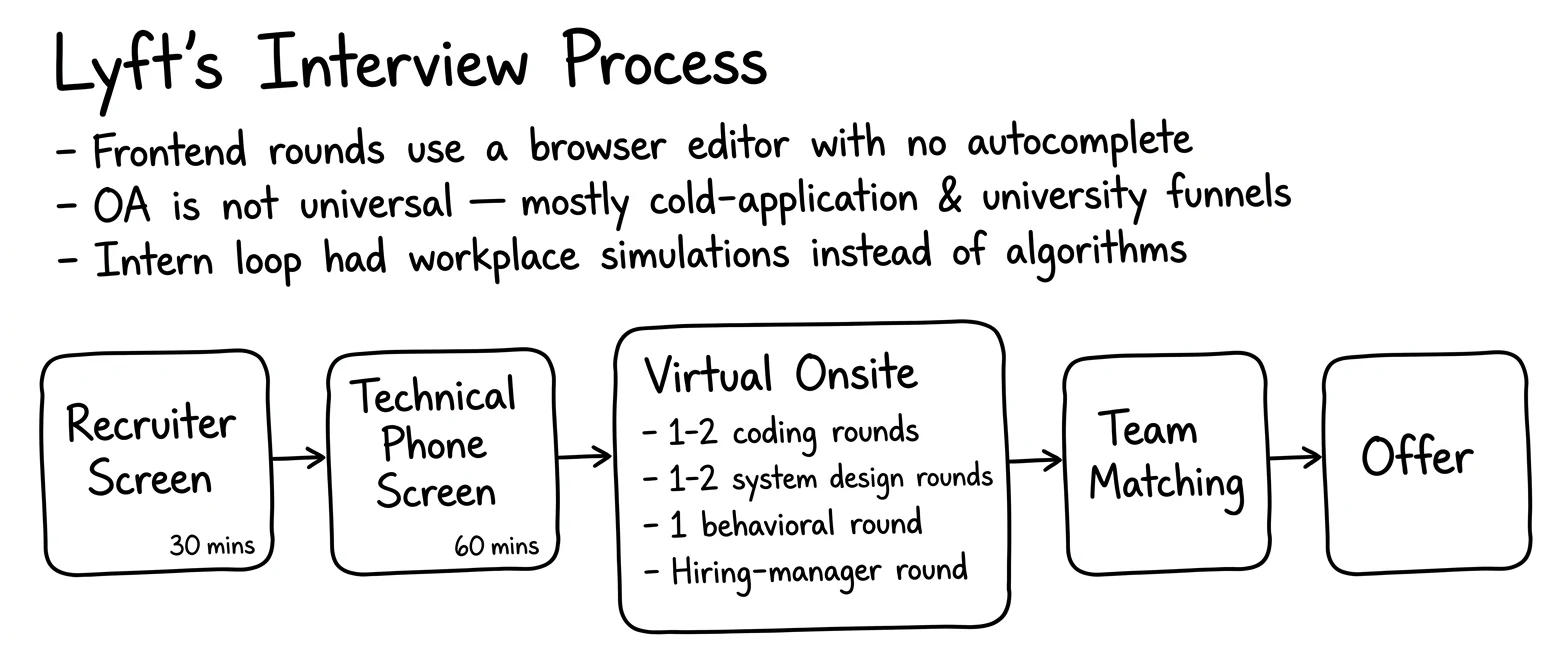
The structure is stable across teams while the content follows the track: Software Engineer candidates get coding, a hands-on build, system design and behavioral rounds; frontend candidates get browser UI builds; data and ML candidates get applied statistics and from-scratch model code. The usual sequence is a recruiter call, one technical screen, then a virtual onsite of three to six rounds, most often four or five, over typically four to six weeks.
Intern and some cold-application funnels add an online assessment before the screen. Senior candidates face a stricter screen, and their loops can include two system design rounds or a round that pairs a coding extension with a design discussion. Some backend loops also add a domain-expertise session on the candidate's own specialty.
Here's what the interview process can look like:
- Recruiter screen: A short call covering background, work authorization and the rounds ahead, with no technical questions.
- Online assessment (some funnels): Either a single grid-traversal problem or, for interns, two workplace simulations built around written feedback.
- Technical phone screen: One live problem, usually about an hour in a shared editor, often graded on a runnable program you test yourself.
- Onsite coding and laptop rounds: One or two practical builds, such as in-memory stores, schedulers and API wrappers, typically in a longer hands-on slot.
- System design interview: One or two rounds drawn from a small, recurring set of prompts and sketched on a shared canvas.
- Track-specific rounds: UI builds for frontend, business cases and ML design for data roles, and a deep domain session for some backend loops.
- Behavioral and hiring manager interview: Conflict, failure, decisions and inclusion questions, plus a manager conversation about the team.
Tip: Rehearse building a complete program, not just a function: the core logic, a
main, and four or five edge-case tests in one timed sitting. Several screens required exactly that, and one candidate with the right idea still failed because boundary bugs surfaced only on the second example.
Recruiter screen
The call is typically about 30 minutes and covers your background, current visa status and the plan for the interviews ahead. Nothing technical is asked. Use this call to get the onsite schedule in writing: one frontend candidate was told to expect five onsite rounds and found only four booked.
Interviewers evaluate:
- Track and level fit: Whether your recent scope maps to the opening, which sets the target level and the track-specific rounds.
- Authorization and location: Visa status and willingness to work under the hybrid in-office schedule.
- Motivation: A specific reason for Lyft and the team's product area, such as marketplace, mapping or driver tools.
Prepare a two-minute background summary and a short list of format questions to ask the recruiter.
Sample questions for the recruiter screen
Here are some questions reported by recent candidates:
- Walk me through your background and your current work authorization. Why Lyft?
Online assessment
The assessment is not universal. It shows up mainly in intern and some cold-application pipelines, and most experienced candidates go straight to a live screen. One recent assessment was a single problem: the classic rotting-oranges grid BFS, returning -1 when some cells can never be reached. The intern version had no algorithms at all. It had two practical tasks: drafting replies to product-manager comments in a shared document, then making targeted code changes in a simplified codebase based on review comments.
Interviewers evaluate:
- Clean traversal: A multi-source BFS that processes the grid level by level and catches unreachable cells.
- Acting on feedback: Changes that address each review comment precisely without rewriting unrelated code.
- Written communication: Clear, concise replies to product feedback that push back where warranted.
Practice multi-source BFS until it is automatic, and read every review comment twice before editing code.
Sample questions for the online assessment
Here are some questions reported by recent candidates:
-
Given a grid of empty, fresh and rotten cells, return the minutes until every fresh cell rots, or -1 if some never do.
-
Apply a set of code-review comments to a small project without breaking existing behavior.
Technical phone screen
The screen is one live problem with an engineer, most often about an hour in a shared editor, and the families repeat. Minimum window substring is the most frequent, reported in four recent screens. Pagination wrappers come next: a fetch_n over a fetch(page) source that returns items plus a next-page token, a wrapper that turns a read-only client's pages of numbers into an exact count of words, and a pagination API over an external page-based service under heavy traffic. Other screens covered a job scheduler parsed from a CSV-style stream, rotting oranges, interval merging, a max stack, an LRU-style cache for interns, and a parser for command lines in three different formats.
Several screens graded the whole program. Candidates wrote a main running their own test cases, sometimes with no harness and no sample tests supplied, and one interviewer held a strict clock with no extra minutes. Another said pure algorithm questions are becoming less common, and that state management across an abstraction boundary is what they want to see. Results move fast: one candidate got a next-steps email within 30 minutes, another a rejection the next day.
Interviewers evaluate:
- First-pass correctness: A senior candidate who knew the sliding-window approach but lost time to off-by-one errors on the result index was rejected here.
- Self-built tests: Cases for empty input, touching intervals, duplicate target characters and pages that don't align with the requested count.
- State across boundaries: Buffering leftovers between pages, fetching only when needed, and surviving an upstream call that fails or returns inconsistent data.
- Clarifying hidden rules: The scheduler's lowest-index tie-break changes the standard heap answer.
Drill the recurring families against a 45-minute timer, ending each with a printed pass/fail run.
Note: The job-scheduler screen only looks like the standard minimum-rooms problem. It requires converting
HHMMtimes to minutes, printing aJ0 W0-style assignment log, and reusing the lowest-index free worker. A single heap keyed on end time produces the wrong log, so keep a second heap of free worker indices.
Sample questions for the technical phone screen
Here are some questions reported by recent candidates:
-
Find the smallest substring of
sthat contains every character oft, including duplicates, or return an empty string. -
Implement
fetch_nover a paginated source, buffering extras between calls and surviving a flaky upstream. -
From lines of start time and duration, compute the minimum workers so no job waits, and print which worker took each job.
-
Parse command strings where lines have no arguments, key-value pairs or one bare value, with tests you write yourself.
Onsite coding and laptop rounds
The longer hands-on slot, often called the laptop round, typically runs around 90 minutes. The key-value store is the defining problem. Candidates have built it with input and output handling, with beginTransaction/commit/rollback across nested or sequential transactions, with versioned values, and with a follow-up asking for a second design of the same store. Other builds include five APIs implemented to an exact output format with in-memory storage only, a page-by-page transaction display, and a two-sum variant that reads from a file.
Pure algorithm rounds still appear: maximum circular subarray sum, and word ladder extended to return every shortest path. The scheduler often returns extended to recurring jobs and dependencies (a DAG with cycle detection and failure propagation), or solved with a min-heap of end time and worker index before moving straight into a crawler design in the same round.
Interviewers evaluate:
- Transaction edge cases: Rollback with no open transaction, empty commits, overwriting a key inside a transaction, and nested scopes that unwind correctly.
- Exact output: Matching the specified format exactly; these rounds check output, not ideas.
- Interface design: An API surface that absorbs the next requirement without a rewrite.
- Time management: The store has more depth than it first appears, and one rejected candidate ran out of time on its edge cases.
Build a transactional key-value store three ways under a timer: plain, versioned, and with nested rollback.
Tip: Before coding, sketch the transaction lifecycle in a few lines, as a stack of change logs or overlay maps. Candidates who started typing immediately reported mid-round rewrites when nested rollback arrived as a follow-up.
Sample questions for the onsite coding and laptop rounds
Here are some questions reported by recent candidates:
-
Build an in-memory key-value database with begin, commit and rollback that handles nested transactions.
-
Implement five APIs from an input specification, keeping all data in memory and matching an exact output format.
-
Return all shortest transformation sequences between two words, not just the length.
-
In-Memory Key-Value Store with Nested Transactions and Value Counts
System design interview
Most loops have one design round, some senior loops two, sketched on a shared online canvas. The charity donation site appears in four reports, with variations: integrating a payment SDK, handling payment failures, absorbing spikes during fundraising campaigns, guaranteeing no donation record is lost or misstated, and in one version a site open for exactly 24 hours that sends a confirmation email. The crawler family comes next: a distributed web crawler, one that grows mid-round from a single link to about a thousand coordinated devices, and an archive of encyclopedia content kept current on donated phones and spare computers. A news feed, a chat system and a distributed key-value store round out the list.
Grading lives in the follow-ups: how a payment retry stays idempotent, how a coordinator notices a donated device went offline, how content integrity is verified on untrusted hardware, and what happens under a network partition. One candidate covered the components cleanly and was rejected for thin answers on coordination and failure recovery. Another attributed a rejection to drawing boxes before probing requirements.
Interviewers evaluate:
- Requirements first: Who donates, to whom, how funds are tracked, and scale assumptions, before any architecture.
- Correctness under failure: Idempotency keys, queue-based processing, and retries that never double-charge or double-send email.
- Unreliable workers: Heartbeats, work reassignment and partitioning when clients churn.
- Trade-off reasoning: Fanout-on-write versus fanout-on-read for high-follower accounts, and quorum choices for a key-value store.
Rehearse the donation, crawler and feed prompts end to end, spending most of each session on failure modes.
Note: These prompts start small on purpose. A donation form turns into a payments-integrity problem and one crawler link turns into a thousand devices. Candidates who asked about scale and failure guarantees early did better than those who designed for the stated prompt alone.
Sample questions for the system design interview
Here are some questions reported by recent candidates:
-
Design a charity donation site open for 24 hours, with a static list of charities and a confirmation email after each donation.
-
Design a news feed and defend push, pull or hybrid fanout for accounts with millions of followers.
Track-specific rounds
Frontend screens are JavaScript-only, in a browser editor with no autocomplete: a live hh:mm:ss clock with leading zeros and cleanup on unmount, or drag-to-select across a 5x4 grid using mouse events. Frontend onsites included an interactive HTML and CSS build with buttons, score tracking and an input table, an integration round against a fake API with a long, unclear spec, a full Minesweeper game, and an autocomplete component where the design discussion was followed by a working implementation in the same session.
Data and machine learning screens split theory and code. One 75-minute screen spent 30 minutes diagnosing five train-versus-test error patterns and 45 on a one-hot encoder that handles unseen categories. A 45-minute screen asked how adding 10 to a logistic regression's bias changes precision and recall, then k-means from scratch. A data science loop covered SQL, pandas and conditional probability, then ML design for passenger churn with heavy schema discussion, stratified k-fold from scratch, and a root-cause case on shifts in surge pricing. One backend loop added an hour on low-level TLS internals.
Interviewers evaluate:
- From-scratch fluency: Model and UI code with no libraries, covering empty clusters, uneven folds and rare classes.
- Intuitive reasoning: The direction of a metric change explained plainly, not a recited formula.
- Structured business analysis: Hypotheses about supply, demand, competitors and product changes, each paired with the data that would test it.
- Design-then-build: Frontend candidates must turn the design they just discussed into working code.
Practice the standard algorithms and components in a bare editor, explaining trade-offs out loud.
Note: Clean code does not guarantee a pass. One candidate implemented k-means correctly with empty-cluster handling and was still rejected, and a data science loop ended after the third round, before the business case.
Sample questions for the track-specific rounds
Here are some questions reported by recent candidates:
-
Implement stratified k-fold cross validation when the fold count does not divide the data evenly.
-
Design an autocomplete component, then implement it with debouncing and keyboard navigation.
-
Investigate why surge pricing frequency shifted, and propose how to isolate the cause.
Behavioral and hiring manager interview
The behavioral round works through a set list: conflict with a colleague, communication breakdowns, a failure, a tough decision, ambiguity, and diversity, equity and inclusion, where interviewers want concrete actions rather than views. They anchor on a resume project and follow up until they reach a decision you made.
The manager conversation sometimes sits in the loop and sometimes follows it as a call. It covers projects, collaboration and team fit, and can be unusually transparent: managers have discussed team tenure, burnout risk and the stack, and in two recent loops told the candidate their onsite performance fell below expectations.
Interviewers evaluate:
- Specific ownership: Your own actions and outcomes, not the team's.
- Honest failure: A real mistake and what changed afterward.
- Inclusion in practice: Something you actually did to make a team more inclusive.
Prepare six to eight concrete stories, including one on inclusion, and bring your own questions about team health.
Sample questions for the behavioral and hiring manager interview
Here are some questions reported by recent candidates:
-
Tell me about a conflict with a colleague and how it was resolved.
-
What concrete steps have you taken to promote an inclusive environment?
-
Walk me through a project on your resume and the hardest decision in it.
How Lyft makes hiring decisions
Feedback from every round is combined into one decision, with the hiring manager closely involved. Rounds are weighed together, but a weak one can end a loop early: one data science candidate was stopped after three rounds. The target level comes from the opening and your scope, and senior candidates are held to a higher bar from the screen onward. Decisions are fast, with one offer arriving within a week of the onsite, but rejections typically carry little actionable detail. One internship process ended after about three months with a rejection attributed to headcount. Team-matching conversations may come before a final offer.
How to prepare for the Lyft interview
- Build the key-value store cold: Plain, versioned, and transactional with nested rollback, including rollback with no active transaction.
- Own the pagination wrapper: Buffer leftovers across pages, fetch lazily, and survive a failing upstream call.
- Drill the scheduler variant: Parse
HHMMinput, apply the lowest-index tie-break, print the assignment log, then extend to dependent jobs. - Make a test harness automatic: A
mainwith four or five self-chosen edge cases and printed results, assembled in minutes. - Keep the classics clean: Minimum window substring, rotting oranges, interval merge, max stack and LRU cache, bug-free on the first pass.
- Rehearse three designs deeply: The donation site, the crawler on unreliable hardware and the news feed, focused on failure and coordination.
- Practice in a bare editor: No autocomplete for frontend, no libraries for data and ML code.
- Prepare inclusion and failure stories: Both are asked directly, and both need concrete actions.
About working at Lyft
Lyft runs a rideshare marketplace in North America along with bikes and scooters, has owned the European ride-hailing app FreeNow since 2025, and is expanding through autonomous-vehicle partnerships. Hybrid roles typically require office attendance on Monday, Wednesday and Thursday, plus a few weeks a year of remote work. The engineering ladder uses T-levels, with T3 the common entry level and roles above T6 relatively rare.
Lyft hires engineers across its marketplace, mapping and platform organizations. Teams include:
- Marketplace: Real-time matching and dispatch between riders and drivers.
- Pricing: The models and systems that set the final price riders see.
- Mapping: Map data, routing, ETAs and localization that feed pricing and matching.
- Driver experience: The driver app, earnings and on-the-road tools.
- Core systems and platforms: Shared infrastructure, reliability and developer tooling.
Experience and education requirements
Postings ask for a computer science degree or equivalent experience, ranging from two or more years for some marketplace roles to five or more for senior positions. Python and Go appear most often, with Java and C++ for some backend and routing roles and Kotlin for Android tooling. Data roles expect SQL, Python, applied statistics and the ability to implement models from first principles.
FAQs about the Lyft interview
How long does the Lyft interview process take?
Typically four to six weeks from first call to decision. Offers have come within a week of the onsite. Internship pipelines have stretched to about three months.
What is the hardest round of the Lyft interview?
Candidates most often name the transactional key-value store, whose edge cases take longer than expected, and system design, where rejections followed thin failure handling or skipped requirements. For data roles, the open-ended business case was the weakest round in at least one rejected loop.
What language should I use?
Any mainstream language works for general coding rounds. Frontend rounds are JavaScript-only, and data rounds expect Python with pandas plus SQL.
How much does a Lyft software engineer make?
Recent San Francisco postings for Software Engineer roles listed base salary ranges of roughly $136K to $192K depending on level, with equity and benefits on top. One candidate with an offer found the total below peer offers, so competing numbers are worth bringing to negotiation.
Is the Lyft interview remote?
Yes. Recent loops ran virtually, with coding in a shared editor and design on a shared canvas. The job itself is typically hybrid, with three office days a week.