Study
Choosing Your Failure Stories for Big Tech Loops: A Prep Plan
TrueInterview
November 2, 2026 · 16 min read
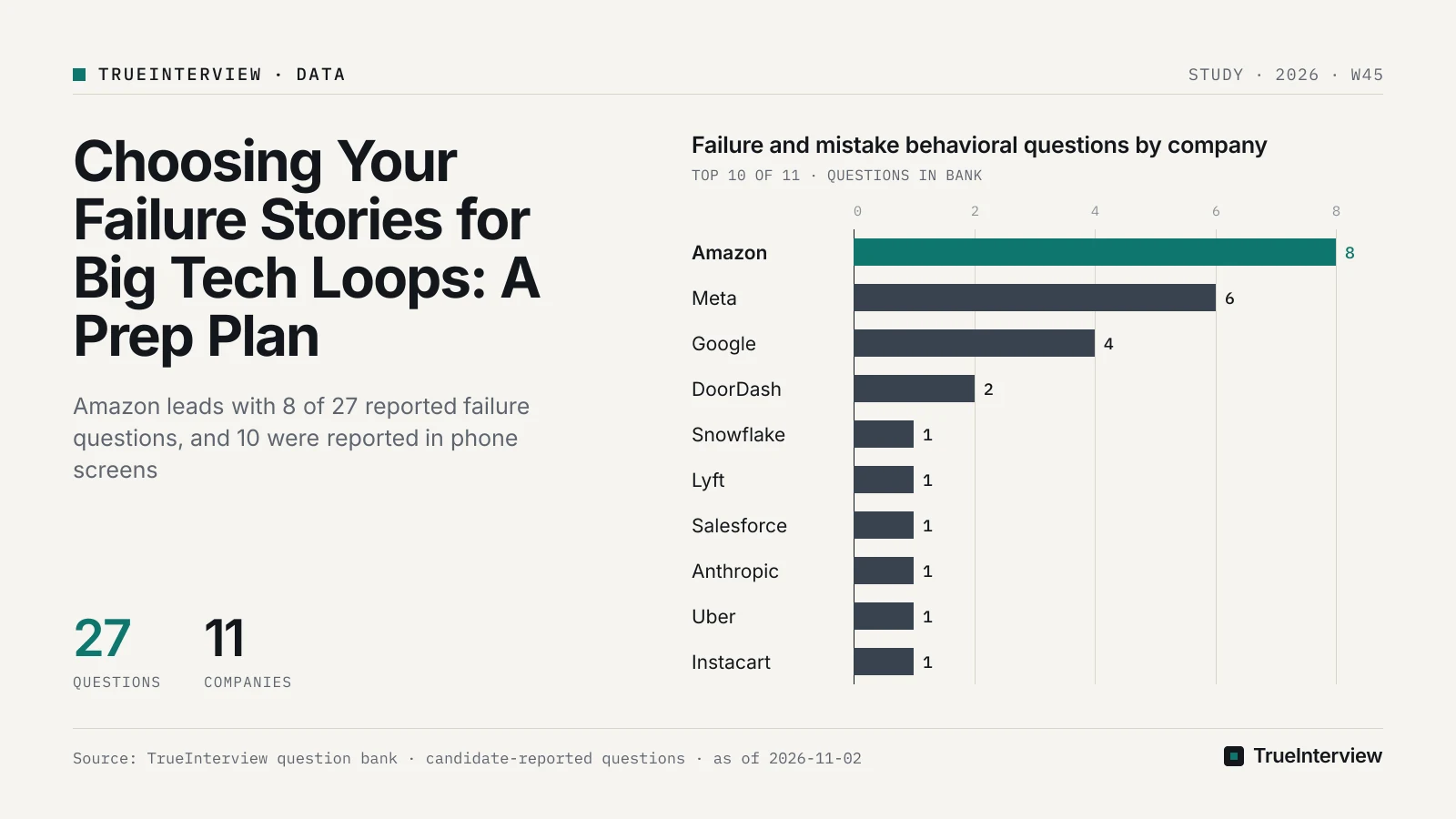
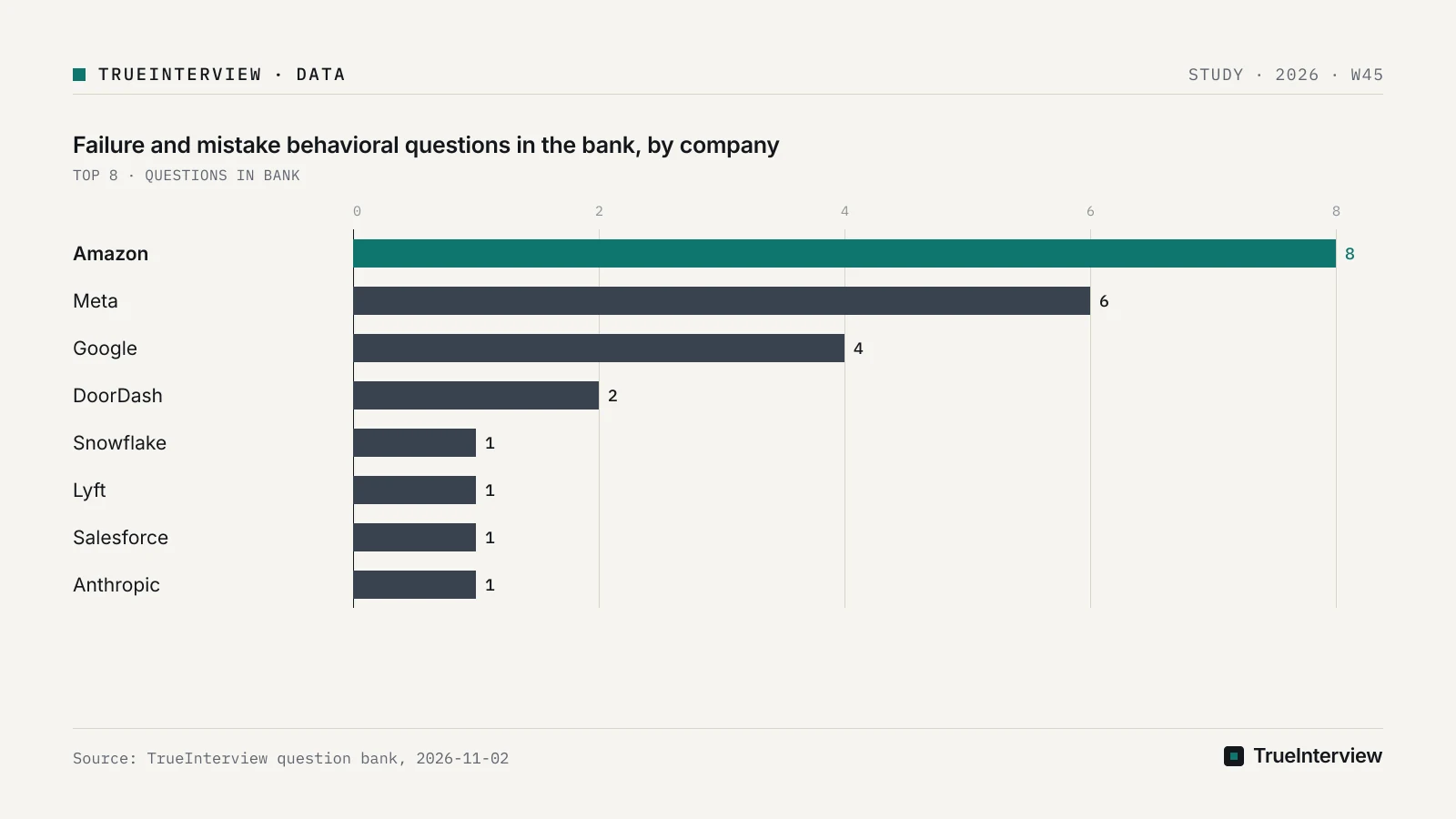
As of 2026-11-02, TrueInterview's bank holds 27 failure and mistake behavioral questions reported at 11 big-tech companies, led by Amazon with 8, Meta with 6 and Google with 4. Pick the story to fit the prompt your target company is reported to use: a missed deadline you own for Amazon, an AI-tool miss for its GenAI question, and a separate project wherever the miss is asked alongside conflict and a proud project. Prepare two or three stories that do not overlap, because at senior level choosing the wrong miss costs more than telling the right one imperfectly.
Disclosure: TrueInterview is an interview-preparation product and publishes this article. Facts about other products come from their public pages on the dates listed under Sources.
What do the reported failure prompts actually ask?
They ask for a handful of recognisable shapes, and each shape wants a different story. Of the 27 questions, 18 were reported in onsite rounds and 10 in phone screens, and one question can be reported in both. The list is current: 24 were last reported in the 12 months before 2026-11-02. The table sorts the titles by the story each one needs.
| Shape | Company: reported title | Round, last reported | Write-up links | Practise |
|---|---|---|---|---|
| AI-tool use, failure and trade-off | Amazon: GenAI Usage (How / Failure / Tradeoff) | Phone screen, 2026-10 | 37 | GenAI usage |
| Missed deadline | Amazon: Explain Tight-Deadline Delivery and a Missed Deadline | Not in our round examples | 17 | Tight deadline and a missed one |
| Bundled with a proud project and conflict | Snowflake: Proud Project / Conflict / Failure | Onsite, 2026-09 | 11 | Snowflake bundle |
| Bundled with a project, conflict and DEI | Lyft: Project, Conflict, Failure, and DEI | Onsite, 2026-07 | 11 | Lyft bundle |
| Plain failure | Amazon: Describe a failure and what you learned | Not in our round examples | 7 | Failure and lesson |
| Own a mistake | Amazon: Take Responsibility for Missed Deadlines and Mistakes | Not in our round examples | 3 | Take responsibility |
| Ownership | Uber: Describe ownership and failure | Onsite, 2026-10 | 3 | Ownership and failure |
| Bundled with a proud project and conflict | Google: Answer conflict, failure, and proud project questions | Phone screen, 2026-07 | 3 | Google bundle |
| Failed decision and trade-off | DoorDash: How do you discuss mistakes and trade-offs? | Onsite, 2026-03 | 2 by senior-or-above candidates | Mistakes and trade-offs |
| Failure with cross-functional conflict | Anthropic: Describe failure impact and resolve cross-functional conflict | Phone screen, 2026-06 | 2 by senior-or-above candidates | Failure impact |
| Cross-team miss | Meta: Describe cross-team collaboration and learning from failure | Onsite, 2026-03 | Not in our link data | Cross-team learning |
| Deployment mistake | Instacart: Discuss an Interesting Project and a Deployment Mistake | Onsite, 2026-09 | Not in our link data | Deployment mistake |
| Bundled with ownership and conflict | Salesforce: Answer ownership, conflict, and failure recovery questions | Phone screen, 2026-01 | Not in our link data | Failure recovery |
Write-up links count what candidates wrote up, not how often a company asks, and these are candidate-reported questions reconstructed for practice, not any company's official list. Meta files more questions than the one shown, but only that title is in our examples, so do not guess at the wording of the rest.
Our take: the thirteen titles collapse into four stories you actually need. You need a commitment you missed, a change you shipped that hurt someone, a judgment call whose impact crossed teams, and a tool output you trusted or caught. The bundled titles do not ask for a fifth kind of miss. They ask for the miss to come from a different project than your proud project and your conflict.
How do you build a short bank of failure candidates?
Start wide, then keep one candidate for each of the four story slots, each from a different project. Formation's guide suggests preparing "two or three failure stories across technical, leadership, and communication categories." The fourth slot, the AI-tool miss, exists because of Amazon's GenAI title, so fill it only if Amazon or another AI-heavy loop is on your list.
interviewing.io's blog recommends brainstorming 20-30 stories across all dimensions before filtering, and ending with 8-10 stories that show the target level. For a failure prompt, that means you list every miss you can remember, including the ones you would rather not tell, and only then choose. The miss you rejected first is often the one with the clearest stakes.
| Slot | Answers these shapes | Scope to aim for | Drop the candidate if |
|---|---|---|---|
| Missed commitment | Missed deadline, own a mistake, plain failure | An estimate or plan you set that slipped while other people waited on it | The slip had no decision of yours in it |
| Shipped change that hurt someone | Deployment mistake, ownership | A release you owned, how you detected the damage, the rollback and the check you added | Nobody outside your own task noticed |
| Judgment across teams | Cross-team miss, failure with conflict, failed decision and trade-off | A design or prioritisation call whose cost landed on another team | You cannot name the call you made |
| AI-tool miss | GenAI usage | A generated change or answer you trusted or caught, the guardrail since, and what it cost in speed | The tool is the villain and you are absent from the story |
Then assign projects. Write your proud project and your conflict story next to each candidate, and strike any candidate that shares a project with either. A bundled round hears all three answers back to back, and three answers from one project read as one story with three endings.
How big should the failure be?
Big enough that someone beyond your own task felt it, small enough that it does not disqualify you. Formation's guide warns, "Some are too trivial; others are too catastrophic." The guide recommends a story "that was significant, but one you owned, corrected, and learned from". Built In's guide sets the bar lower, at a real example with relatively low consequences.
The two guides disagree, and the reported titles lean toward misses that someone beyond you noticed. A missed deadline, a deployment mistake and failure impact across functions all imply that someone outside your desk noticed. In our view, a slip nobody else saw is a weak fit for those prompts, however well you tell it.
Our take: follow Formation's bar if you are senior, and Built In's if you are early in your career and facing a plain failure prompt. In both cases, name the decision that was yours and the step you took to repair it, such as the rollback you ran or the stakeholder you told first. Do not inflate a small miss into an outage; the follow-up questions on impact will find the gap.
How do you prepare Amazon's missed-deadline story?
Prepare it first if Amazon is in your loop, and build it around the estimate or decision you got wrong. Amazon's missed-deadline title is linked from 7 write-ups by senior-or-above candidates and 10 by junior, new-grad or intern candidates. Experienced candidates report it too, so a senior loop is no reason to skip it.
Amazon's Leadership Principles page gives the bar, in our reading rather than as Amazon's scoring rubric. Under Earn Trust, the page says leaders are "vocally self-critical, even when doing so is awkward or embarrassing." Under Insist on the Highest Standards, it says leaders ensure "that problems are fixed so they stay fixed." Under Deliver Results, the page says that despite setbacks, leaders rise to the occasion and never settle.
Built In's guide lists a missed deadline among acceptable examples, and it advises against excuses about tight timeframes, lack of resources or other factors beyond your control. The same guide says that deflecting responsibility may signal you will do the same at the new employer. Those excuses are the default shape of a deadline story, so cut them on purpose.
Build the story in this order:
- The commitment, who depended on it and the date it slipped to.
- The estimate or assumption you made that did not hold, stated as yours.
- When you knew it would slip, and when you told the people waiting.
- What you did to recover the work that was still recoverable.
- The planning or review change you made, and a later project where it held.
Our take: step three carries more weight than candidates expect. A deadline that slips is common; a deadline you knew was slipping and announced late is the part an interviewer will probe, so put the date you raised the risk in the story yourself.
How do you prepare a story about an AI tool that failed you?
Treat Amazon's GenAI title as three prompts in one: how you use a tool, where it failed you and what you traded off. It was reported in a phone screen as recently as 2026-10, so rehearse it before the first call. Its links come mostly from junior, new-grad or intern candidates, 32 against 5 from senior-or-above candidates.
The title is not a pure failure question, so the miss should be one part of a larger answer. Pick a real case where your own trust in a coding assistant or a GenAI feature let a wrong or risky result through a check, explain how it was caught and name the guardrail you added. Close on the trade-off: what the guardrail costs you in speed and why you accept that cost.
For juniors, the reported mix makes this the first story to write if Amazon is on the list. For senior candidates, the trade-off half matters more than the catch. In our view, a strong senior answer also covers how you decide which generated changes need a human review, and what evidence would make you loosen or tighten that rule.
Our take: avoid the story where the tool made a mistake and you spotted it. That casts you as a reviewer, not an owner. Choose a case where your own trust in the tool let something slip past a check, and show the process change.
Why rehearse a failure story before the phone screen?
Because candidates report failure prompts in phone screens, not only in onsites, so the first conversation can already ask for your miss. Phone-screen titles in the bank include Google's bundle, Anthropic's failure-impact prompt and Salesforce's ownership and recovery prompt, alongside Amazon's GenAI title. The round counts in the first section show how large that share is.
The Google and Salesforce phone-screen titles bundle the miss with conflict, ownership or a proud project, so a screen may ask for more than one prepared story. In our view, a weak pick costs more there, because the screen decides whether you reach the onsite rounds where you could balance it.
Our take: before your first screen, have one complete story ready that answers both a plain failure prompt and a bundled one. The missed-commitment slot usually fits both. Keep the AI-tool story ready as a second answer if Amazon is in the loop.
Which follow-up questions should you prepare for?
In our view, prepare for follow-ups on four points: your specific role in the miss, how large the consequence was, the mechanism you changed and whether the scope fits your level. Write a one-sentence answer to each, such as naming the estimate you set without checking a dependency, before you rehearse the full story. Follow-ups expose what the opening left out.
| Likely follow-up (our view) | What it tests (our view) | What to have ready |
|---|---|---|
| What was your part in it? | Ownership without hedging | One sentence naming your decision or blind spot |
| How bad was it, and who noticed? | Whether the stakes are real | The consequence in plain terms: who waited, what broke, for how long |
| What did you change afterwards? | Whether the fix outlived the incident | A process, check or habit, plus a later case where it held |
| Would you make the same call today? | Judgment at your level | The signal you missed, and what you now weigh differently |
Formation's guide, describing what to include in the story itself, asks: "Where did your own decisions or blind spots contribute? Don't sanitize it." A career counselor quoted in Built In's guide advises calling out what your role was and what you would do differently. Built In's guide also suggests showing how you applied the lesson in later situations.
Evidence answers the second and third follow-ups. interviewing.io's blog says gathering evidence is the step most candidates skip, and gives a project first rejected by teams and later adopted company-wide as an example of failure-recovery evidence. The same blog warns that if you cannot find evidence, the story may be less impactful than you remember. Before you rehearse, write down the date of the miss, the teams or users affected and the date your fix shipped.
How long should the answer run, and where does the time go?
Keep it under three minutes: one or two sentences on the miss and its impact, then the rest on what you did, the change you made and where you applied it later. Formation's guide recommends three minutes or less and says meandering feels evasive. Built In's guide says to keep the failure part concise and pivot quickly to how you resolved it and what you took away.
Built In's guide calls the lesson "The most important part of your answer", and recommends the STAR method, rehearsed until it feels natural. Formation's guide adds a tone rule: admit what went wrong, then show how you fixed it. It says to practise aloud because you should "Sound reflective, not defensive."
Our take: structure is the smaller lever. interviewing.io's blog says the leading reason for a no hire is "The wrong story, not the delivery." Choose the story first, using the slots above, then fit it to STAR. A perfectly structured answer about a miss with no stakes still answers the wrong question.
What changes at senior and staff level?
The prompts lean toward ownership, impact beyond your team and trade-offs. By self-reported level, write-ups link these questions 38 times from senior-or-above candidates and 67 times from junior, new-grad or intern candidates. Take out the GenAI question and the split is close to even, 35 junior links against 33 senior.
Uber's ownership prompt is linked only by senior-or-above candidates, all 3 of its write-ups. The Anthropic and DoorDash prompts are each linked from 2 write-ups by senior-or-above candidates, with no junior links reported. All three ask about ownership, impact beyond your team or a trade-off, which is where a senior story should sit. Staff-level data is thin: Snowflake's bundle has 6 senior-or-above links, and only 1 of them is staff-plus or manager.
For senior engineers, Formation's guide suggests technical-judgment misses, such as "an architectural choice that didn’t scale, or an assumption that didn’t hold." It also lists leadership gaps such as mis-scoping a project or under-communicating with stakeholders, and communication misses such as spotting a risk too late or escalating too slowly. Use those three categories for the judgment-across-teams slot.
interviewing.io's blog argues that "at senior+ levels, your story selection matters more than your story structure." The blog's analysis looked at mock interviews where the candidate passed but the interviewer recommended a down-level, and says those mistakes concerned story selection and content rather than delivery. The blog also warns that with broad experience, not all of your stories will carry the right leveling signal.
Our take: at senior level, drop any candidate that only shows individual carelessness, such as a typo in a config or a skipped test. Keep the miss where an assumption you made, a scope you set or a risk you sat on cost another team something. At staff level, pick a miss where your decision touched several teams or a roadmap, and spend the closing on the mechanism other teams now rely on, not only on what you learned.
Down-leveling note (our view): the failure answer carries level signal through its scope, alongside design depth and the project deep dive. A miss whose blast radius was your own ticket reads as mid-level even when told well. If you are targeting staff, the follow-up on what you changed should name something that outlived your involvement.
How we counted
Counts come from TrueInterview's question bank as of 2026-11-02 and cover failure and mistake behavioral practice questions filed under big-tech companies. TrueInterview says reports are written up right after the interview and checked against other reports of the same round. A question can be reported in more than one round, so round tallies do not add up to the question count. Level splits count write-up links by the level each candidate reported, not people, and say nothing about how often a company asks.
FAQ
Is it acceptable to say you have never failed?
No. Formation's guide calls saying you have never failed in an interview a red flag. The answer gives the interviewer nothing to assess and suggests you either cannot see your own mistakes or will not admit them. If nothing comes to mind, look at launches that slipped, incidents you were paged for and designs you later reworked. One of those almost always holds a decision you made that did not hold up, which is the raw material for the missed-commitment or judgment slot.
Can a junior candidate use a small mistake?
Yes, if it is real and you can show you applied the lesson since. Built In's guide advises picking "a real but low-stakes example of a mistake you made." For a junior candidate facing a plain failure prompt, a contained miss with a clear fix is enough. Still prefer one where a teammate or a user felt the consequence, because the specific titles, such as a missed deadline or a deployment mistake, assume someone noticed. Avoid stories about grades or coursework once you have work experience.
Should one story answer both a failure prompt and a mistake prompt?
Only when they come from different interviews. Amazon's titles include a plain failure prompt and a take-responsibility prompt that names mistakes and missed deadlines, as the table shows. The same missed-commitment story can answer either. If one interviewer asks for both, or for a failure and a conflict, switch to a second project. That is why the bank above keeps four slots rather than one polished answer.
Does a failure story need numbers?
It needs evidence, and numbers are the easiest kind. Name how long the slip lasted, how many users or teams were affected and when the fix shipped. If you cannot recover those details, interviewing.io's blog warns the story may be less impactful than you remember. Treat that as a filter: a candidate story without any recoverable evidence should drop to the bottom of your bank, behind a smaller miss you can describe precisely.
Is practising alone enough?
Rehearsing aloud on your own catches an answer that runs past three minutes or sounds defensive, but not a follow-up you did not anticipate. TrueInterview says it does not replace a mock interview and suggests booking one or two elsewhere before an onsite. Use a mock to test the four follow-ups in the table above, especially the question about your own part in the miss, since in our view that is the answer most easily softened under pressure.
Your practice plan
A three-week plan for someone working full time, built from the reported prompts:
- Week one, first evening. List every company in your loop and copy its reported failure prompt from the table, tagging each as missed commitment, shipped change, judgment across teams, AI-tool miss or bundle.
- Week one, rest of the week. Brainstorm every miss you can recall, keep one candidate per slot from a different project, and write the proud-project and conflict projects beside them so none overlap.
- Week one, weekend. If Amazon is in your loop, draft the missed-commitment story against Explain Tight-Deadline Delivery and a Missed Deadline and Take Responsibility for Missed Deadlines and Mistakes, putting the date you raised the risk in the story.
- Week two, first half. Write the AI-tool story and rehearse it as a phone-screen answer under three minutes against GenAI Usage (How / Failure / Tradeoff), closing on the guardrail and what it costs.
- Week two, second half. Run a bundled round aloud with three different projects, using Proud Project / Conflict / Failure and Project, Conflict, Failure, and DEI.
- Week three, first half. If you are senior or above, build the judgment-across-teams story and practise it against Describe failure impact and resolve cross-functional conflict and How do you discuss mistakes and trade-offs?.
- Week three, second half. Have a friend or a mock interviewer ask the four follow-up questions on every story, cut each clause that blames a deadline, a team or a tool, and add the later case where your fix held.
Sources
- TrueInterview question bank — failure and mistake behavioral at big-tech companies — counted 2026-11-02
- How to talk about failure in an interview · Formation Blog — checked 2026-11-02
- Stop memorizing STAR. Start selecting better stories. — checked 2026-11-02
- How to Answer ‘Tell Me About a Time You Failed’ | Built In — checked 2026-11-02
- Leadership Principles — checked 2026-11-02
- Real FAANG Interview Questions by Company · TrueInterview — checked 2026-11-02
- Interview prep compared: your application, end to end · TrueInterview — checked 2026-11-02
Last reviewed: 2026-11-02.