Study
Conflict and Feedback Questions: How Each Company Asks
TrueInterview
November 2, 2026 · 15 min read
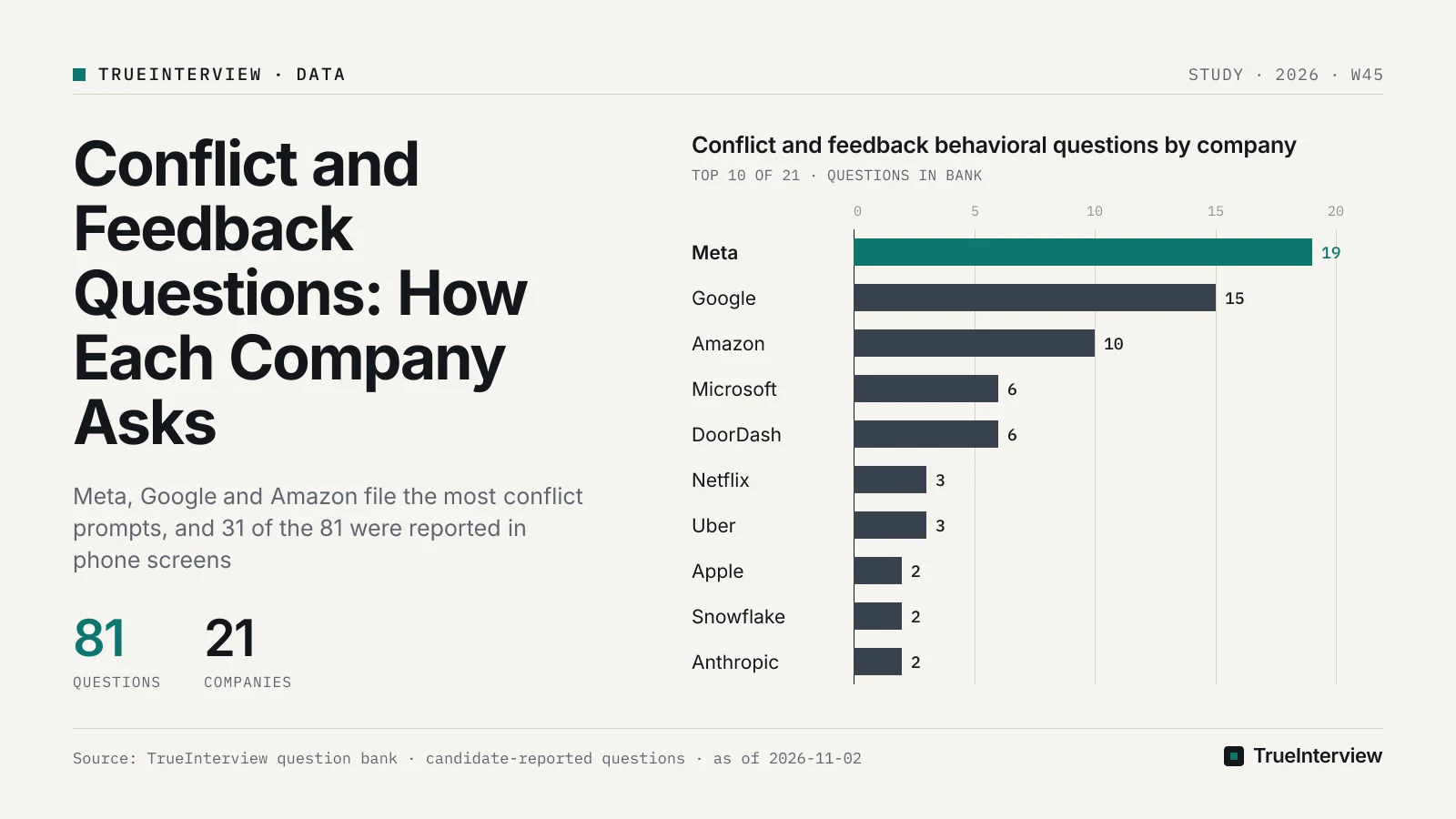
As of 2026-11-02, TrueInterview's bank holds 81 candidate-reported conflict and feedback questions from 21 big-tech companies, with Meta, Google and Amazon filing the most. Most of the most-linked prompts do not ask for a conflict on its own: they add criticism at Amazon, a failure at Snowflake and Lyft, or metrics and feedback at Pinterest. Candidates also meet these prompts early, in phone screens as well as onsites. Our recommendation is a small set of conflict stories, each carrying a measured result and a lesson, matched to your company's wording and ready before the first call.
Disclosure: TrueInterview is an interview-preparation product and publishes this article. Facts about other products come from their public pages on the dates listed under Sources.
Where are conflict and feedback questions reported, and how current are they?
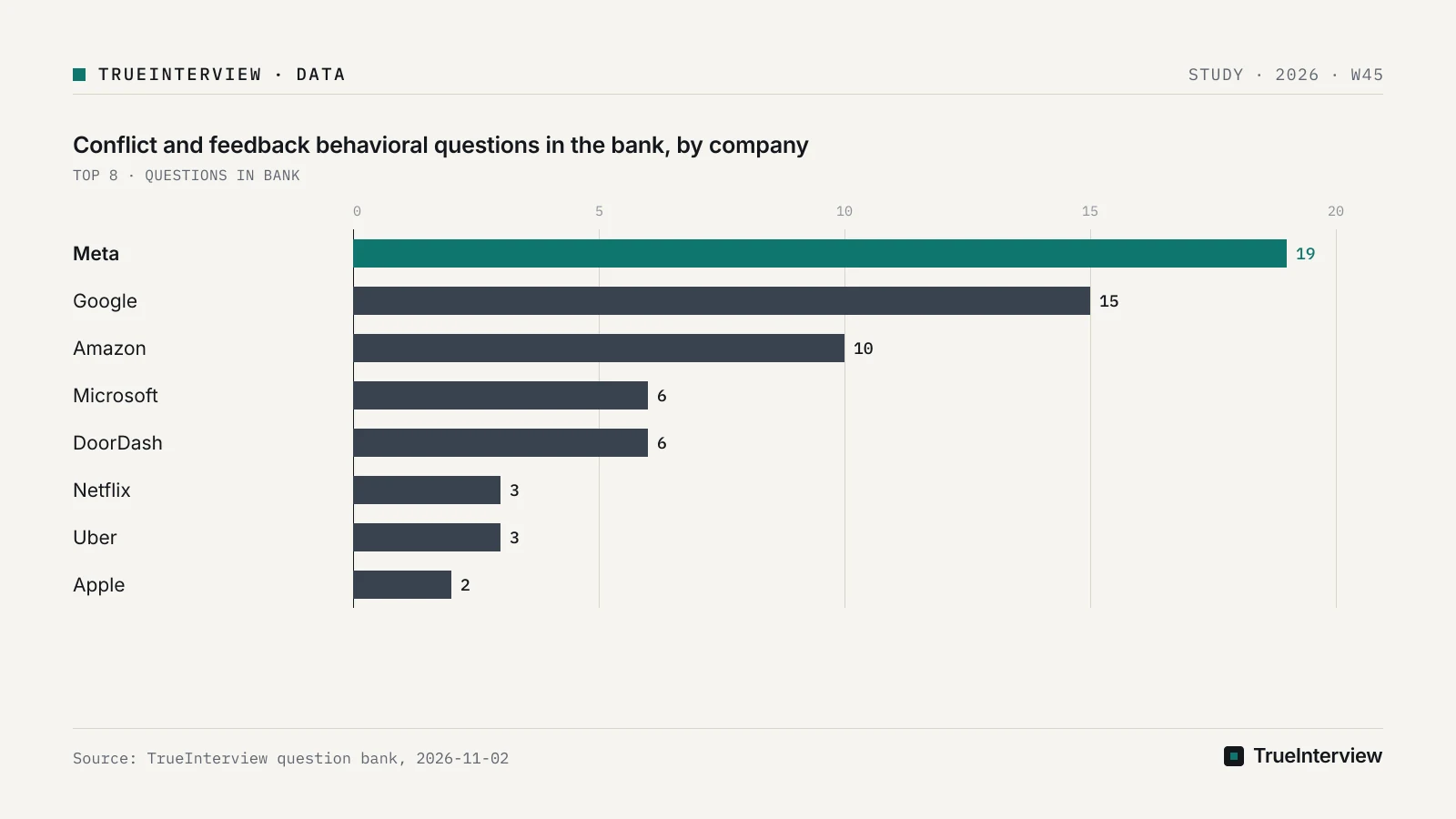
Meta files the most conflict and feedback questions in our bank with 19, followed by Google with 15, Amazon with 10, and Microsoft and DoorDash with 6 each. These counts measure what candidates reported and how many write-ups we collected, not how often a company asks, so read a low count as thin coverage rather than a company that skips the topic.
The set is current: 68 of the 81 questions were last reported within the 12 months before 2026-11-02. Write-up links appear in every quarter from 2025-Q4 to 2026-Q3, but the quarterly totals mostly track how many write-ups were collected, so they say nothing about conflict questions rising or falling. For your preparation, that means the prompts below are what candidates heard in the last year, and no company on the list is a safe bet to skip them.
How does each company phrase the conflict prompt?
Read the reported title before you pick a story, because the title tells you what the answer must carry besides the conflict itself. The table lists the most-linked prompts with their round and last-reported month. They are candidate reports reconstructed for practice, not any company's official question list.
| Company | Reported title | Round | Last reported | Write-up links | Besides the conflict, it asks for | Practise |
|---|---|---|---|---|---|---|
| Amazon | Handle Workplace Conflict and Criticism | Phone screen | 2026-10 | 19 | Handling criticism | Practise |
| Apple | Behavioral Prioritization and Stakeholder Fit | Phone screen | 2026-08 | 14 | Prioritization and stakeholder fit; the title implies the conflict without naming it | Practise |
| Amazon | Demonstrate leadership under disagreement | Not in our data | Not in our data | 13 | Leadership while you disagree | Practise |
| Snowflake | Proud Project / Conflict / Failure | Onsite | 2026-09 | 11 | A proud project and a failure | Practise |
| Lyft | Project, Conflict, Failure, and DEI | Onsite | 2026-07 | 11 | A project, a failure and DEI | Practise |
| Behavioral Deep Dive: Owned Project Metrics, Fast Decisions, Feedback, and Conflict | Onsite | 2026-09 | 11 | Owned metrics, fast decisions and feedback | Practise | |
| Uber | Describe Conflict and Impact | Onsite | 2026-10 | 11 | Impact | Practise |
| Describe a conflict with a colleague | Onsite | 2026-07 | 8 | Nothing else: a standalone prompt | Practise | |
| Meta | Project Success and Conflict Resolution Experience Discussion | Onsite | 2026-07 | Below the top eight | Project success | Practise |
| Anthropic | Explain How You Resolved a Professional Conflict | Onsite | 2026-09 | Below the top eight | The resolution | Practise |
| Oracle | Resolve Conflict Within a Team | Onsite | 2026-08 | Below the top eight | The team setting | Practise |
Read the sixth column as your story's checklist. Among the eight most-linked prompts, only Google's colleague prompt asks for the conflict alone, and Amazon's disagreement prompt adds leadership. For every other company in the top rows, a coworker-disagreement story with no result and no lesson answers half of the title.
Why prepare conflict as part of a bigger story?
Because the most-linked prompts are bundles. Most of the eight most-linked titles either add a second theme to the conflict or, like Apple's, frame it as prioritization across stakeholders, so a story that ends when you and a coworker agreed leaves the interviewer without the project result, the failure or the stakeholder trade-off the title asks for.
For each conflict story, write down the outcome with a number, what went wrong or what you learned, and who the stakeholders were. The Muse's STAR guide tells candidates to "hammer home the point about any results you achieved and quantify them when you can". Techinterview.org's behavioral guide says the Result part of a STAR answer should include metrics and business impact whenever possible. For the failure-flavoured prompts at Snowflake and Lyft, The Muse's STAR guide advises ending on what you learned or the steps you took to improve.
Our take: generic advice builds a large bank of single-purpose stories, one per question type. The reported titles argue for fewer, thicker stories. A disagreement story that already contains a metric, a misstep and named stakeholders answers Uber's impact prompt, Snowflake's failure prompt and Apple's stakeholder prompt with a change of emphasis, not a new story, and that is the version a candidate with a full-time job can actually rehearse.
Are conflict questions asked in phone screens or only onsite?
Both, and earlier than most candidates plan for. Onsites account for 50 of the questions and phone screens for 31, with 1 reported in an online assessment; a question can be reported in more than one round. Amazon's criticism prompt and Apple's stakeholder prompt were both reported in phone screens, so your first conflict story needs to be ready before the recruiter schedules the first call.
A phone screen also leaves less room for a long story. The Muse's guide quotes a career coach: "Sometimes people provide too much detail and their answers are too long." The coach's fix is to "Focus on just one or two sentences for each letter of the acronym."
Our take: rehearse a short and a long version of every story. The short version fits a phone screen and answers the title in the first breath; the long version, with the metrics and the stakeholder detail, is for onsite deep dives such as Pinterest's.
What does Amazon listen for in a disagreement question?
Amazon publishes its bar, and it covers both directions of a conflict: challenging a decision and then committing, and hearing criticism without getting defensive. Amazon says it uses its Leadership Principles every day when discussing ideas or deciding how to solve problems. Among the companies in this set, Amazon is the one whose published criteria this article draws on, so it is where you can map your story to written wording most directly.
Amazon's Leadership Principles page says, "Leaders are obligated to respectfully challenge decisions when they disagree, even when doing so is uncomfortable or exhausting." The same principle, Have Backbone; Disagree and Commit, adds that leaders do not compromise for the sake of social cohesion, and "Once a decision is determined, they commit wholly." Amazon's Earn Trust principle asks leaders to listen attentively, speak candidly and treat others respectfully, and to be vocally self-critical even when doing so is awkward or embarrassing. Amazon's Are Right, A Lot principle says leaders seek diverse perspectives and work to disconfirm their beliefs.
Map Demonstrate leadership under disagreement to Disagree and Commit: you challenged a call, argued with data, listened to the counterargument and committed fully once the decision was made, which is the shape techinterview.org's guide also describes for a disagreement answer. Map Handle Workplace Conflict and Criticism to Earn Trust: you received criticism, said what you got wrong and named what you changed. Amazon gets its own section here because its published principles are among this article's sources, not because it files the most questions; Meta and Google file more.
What do Meta, Google and the other companies listen for?
Read them through their reported wording, because none of the sources behind this article publishes Meta's, Google's or another company's criteria for a conflict answer. The wording is enough to choose the story: Meta's reported prompt joins conflict resolution to project success, while Google's asks only for a conflict with a colleague.
For Meta's Project Success and Conflict Resolution Experience Discussion, lead with the project; it is one title among the Meta questions in this set, so check the others on the practice bank before you settle on a single framing. That prompt is linked from 2 write-ups by machine-learning, AI, research or data-science candidates and 5 by software engineers, so candidates on both tracks report it. Our view is that the shipped outcome carries the answer and the conflict is the obstacle you cleared on the way; a story where the conflict is the whole point will feel thin against that title.
For Google's Describe a conflict with a colleague, the standalone wording puts all the weight on the resolution, and the other Google questions in this set deserve the same check before you commit to one story. Techinterview.org's guide says conflict questions assess emotional intelligence and collaboration skills. Our expectation is that, with no second theme to fill the time, follow-ups probe what you heard from your colleague and what you changed in response.
Anthropic's Explain How You Resolved a Professional Conflict is linked from 5 senior-or-above write-ups and 2 junior-or-below ones, and 3 of its links come from machine-learning, AI, research or data-science candidates. Oracle's Resolve Conflict Within a Team sets the conflict inside a team, so a story where you mediated between teammates fits it better than one about your manager. For Microsoft, DoorDash and Netflix, this set shows counts but no most-linked title, so start from the standalone colleague story and extend it with a measured result.
Our take: matching a company's values works when you have its wording in front of you, as with Amazon here. Where you do not, match the reported title, because the title is the most direct evidence of what candidates were asked.
How should you answer a feedback or criticism question?
Prepare a dedicated story for it rather than stretching a disagreement story. The most-linked prompt in the set, Amazon's Handle Workplace Conflict and Criticism, names criticism outright, and staff-plus or manager write-ups include Handle feedback, change pivots, and conflict and How do you manage performance and disagreements?. A story about a coworker who disagreed with you answers neither.
Prepare one story where you received hard feedback and one where you gave it, each ending with what changed afterwards. For the received story, the self-critical standard in Amazon's principles above is the bar: name the mistake plainly. For the given story, Amazon says leaders "take seriously their role in coaching others", so show how you delivered the feedback and what the other person did with it. Feedback prompts reach machine-learning candidates too: Answer behavioral questions on projects and feedback is linked from 2 machine-learning or AI write-ups and 1 software-engineer write-up.
Techinterview.org's guide says failure questions evaluate self-awareness, accountability without blaming others, learning, and applying the lesson going forward, and the same guide warns against defensive language, blaming others or choosing a trivial failure. Our take: we would expect a criticism story to be judged on the same points, so end it with evidence that the change stuck, such as how the next project or the next review went differently.
What sinks a conflict answer?
A story told so that you were right. Techinterview.org's behavioral guide puts it plainly: "Interviewers evaluate how you handle disagreement, not who was right." A story that ends with you vindicated shows the outcome but hides what the interviewer is scoring: how you listened, what you weighed and what you changed.
The same guide advises describing the conflict objectively without villainizing the other person, and resolving it by understanding the other perspective, finding common ground and using data. The Muse's guide warns against a vague or glossed-over account of what you did, which is the usual failure in conflict stories: "we talked it through" instead of the specific concession or experiment.
Our take: rewrite any story in which you are simply proven right. Add the moment you understood the other side's concern and the thing you changed because of it. Amazon's Are Right, A Lot wording, quoted above, rewards exactly that move, and it reads well at every other company too.
What changes at senior and staff level?
The prompts get heavier rather than rarer. Write-ups link these questions 113 times from candidates who reported a senior, staff-plus or manager level and 98 times from candidates who reported junior, new-grad or intern. Both groups see conflict prompts; what changes is how much the prompt asks the story to carry.
Several prompts appear only in senior-or-above write-ups: Pinterest's deep dive (11), Handle conflict, priorities, and harsh clients (5, 1 of them staff-plus or manager), Describe resolving a conflict with a teammate (4), Describe handling conflict and a proud project (4) and Describe handling ambiguity and resolving design conflicts (3). Apple's stakeholder prompt leans senior with 10 senior-or-above links against 4 junior-or-below, and Uber's impact prompt with 8 against 3. Amazon's criticism prompt runs the other way, with 15 links from junior, new-grad or intern write-ups and 4 from senior-or-above. Read together, the plain criticism prompt is the clearest junior-leaning title, several bundled prompts appear only in senior write-ups, and bundled prompts such as Lyft's and Snowflake's still reach junior candidates.
Techinterview.org's guide says that for senior and staff-level roles, interviewers want to see influence without authority, written communication such as RFCs and design docs, and decisions that considered multiple stakeholders. Software engineers account for most links (166), with machine-learning engineers next (26), and ML and AI candidates report the senior bundles too: Apple's stakeholder prompt has 4 links from them and Handle conflict, priorities, and harsh clients has 3.
Our take: at senior and staff level, your conflict story should cross a team boundary, include a written proposal, and end with a measured result that someone outside your team cared about. A disagreement inside your own team is a mid-level story.
Down-leveling note (our view): in behavioral rounds the level signal sits in scope, and the project deep dive and design-conflict prompts carry most of it. A senior candidate who answers Pinterest's deep dive with a team-internal disagreement and no metric reads below level; the same story told with the cross-team stakeholders, the design doc and the outcome reads at level. Put your largest-scope story where the prompt is a deep dive.
Worked example: one disagreement story reused across companies
Start from an Amazon loop and reuse the work elsewhere. For Amazon, build the disagree-and-commit story and the criticism story mapped to the principles above. Then take the disagreement story into Pinterest's onsite deep dive, which asks for owned project metrics, fast decisions, feedback and conflict in one prompt, by adding the project's metrics and how quickly you decided.
The Amazon version of the story is about the challenge and the commitment: what you argued, what data you brought, what the other side said, and how you executed once the call went against you or for you. The Pinterest version keeps that spine but opens with the metric you owned and closes with the measured outcome and the speed of the decision. For Uber's Describe Conflict and Impact, the same story leads with the impact and treats the disagreement as the turning point.
How we counted
The counts come from TrueInterview's question bank as of 2026-11-02, covering the conflict and feedback set of 81 questions. A write-up link means a candidate's interview write-up points to the question; link counts are not write-up counts and do not measure how often a company asks. Level and role splits use the level and role candidates reported for themselves, and the titles are candidate reports reconstructed for practice, not official questions.
FAQ
How do you structure a conflict story with STAR?
The Muse's guide describes STAR as a format for telling a story by laying out the situation, task, action and result. For a conflict, spend the Situation and Task on the disagreement and what was at stake, the Action on how you listened and what evidence you used, and the Result on the measured outcome and what changed in how you work. Keep the setup brief, as the coach quoted above advises, so the action and the result get most of your time.
Which companies ask about conflict questions most often?
No count of reported questions can answer that. Our bank shows where candidates reported conflict and feedback prompts, and Meta, Google and Amazon file the most, but the counts reflect how many write-ups were collected rather than how often each company asks. The practical reading is that every company in the set has candidates reporting these prompts, so plan for one in each loop and prepare to the wording your company's candidates report.
Is the disagree-with-your-manager question an Amazon question?
Techinterview.org's guide lists a Disagree and Commit prompt about a time you disagreed with your manager or team. In our bank, Amazon's most-linked disagreement prompt is Demonstrate leadership under disagreement, and other companies report disagreement prompts too, such as Google's colleague prompt and Oracle's team prompt. Prepare the story for every loop, and for Amazon frame it in the Disagree and Commit wording: you challenged the decision respectfully, then committed fully once it was made.
Are conflict questions only asked of senior candidates?
No. Write-up links split close to evenly between candidates who reported senior-or-above levels and those who reported junior, new-grad or intern levels, as the level section above shows. What differs is the shape: Amazon's plain criticism prompt leans junior, while some bundled deep dives with metrics and stakeholders appear only in senior write-ups. If you are interviewing at senior or above, prepare the bundled version; in our view, a plain disagreement story risks reading as a lower-scope answer.
Do machine-learning engineers get the same conflict questions?
In the reports we have, yes. Machine-learning and AI candidates link the same prompts as software engineers, including Apple's stakeholder prompt and Anthropic's professional-conflict prompt, as the sections above show. Nothing in the reported titles is specific to ML work, so the preparation is the same: a disagreement story and a feedback story with a measured result. If your projects involve model launches, a disagreement over an evaluation metric or a launch threshold makes a natural conflict story.
Your practice plan
- First, write a disagreement story and a criticism story in STAR form, each ending with a measured result and what you changed afterwards, and rehearse the short version against Describe a conflict with a colleague.
- Before your recruiter call, look up your target company's reported prompts in the practice question bank and note what each title bundles with the conflict.
- If Amazon is on your list, practise Demonstrate leadership under disagreement and Handle Workplace Conflict and Criticism, and label each story with the principle it shows.
- Next, extend the disagreement story with a project result, a failure and named stakeholders, then answer Proud Project / Conflict / Failure and Describe Conflict and Impact with it.
- Write a story in which you gave hard feedback, and practise it on Answer behavioral questions on projects and feedback.
- In the last week, if you are interviewing at senior or above, run the full Pinterest behavioral deep dive and Describe handling ambiguity and resolving design conflicts, adding cross-team stakeholders and the written proposal.
- Read the candidate interview write-ups for your company and round, and cut any story detail that does not answer the reported title.
Sources
- TrueInterview question bank — conflict and feedback behavioral at big-tech companies — counted 2026-11-02
- STAR Method: How to Use This Technique to Ace Your Next Job Interview | The Muse | The Muse — checked 2026-11-02
- Behavioral Interview: STAR Method, Leadership Principles, Conflict Resolution — Amazon, Google, Meta Patterns – techinterview — checked 2026-11-02
- Leadership Principles — checked 2026-11-02
Last reviewed: 2026-11-02.