Tesla · Study
Tesla Software Engineer Interview Process
TrueInterview
July 24, 2026 · 12 min read
Tesla Software Engineer loops are short and run by the hiring team, so a single 60-minute call often decides the outcome. Interviewers take a working solution and add a constraint, such as constant extra memory, a trie instead of a hash set, or a new operator family, and that second attempt carries the grade: one candidate with bug-free code was told it was not optimal. Most screens are small runnable systems (a scheduler, an event bus, a cache, a transaction store) rather than list problems, and at senior level the deciding factor shifts to how deeply you can explain your own past systems.
This guide breaks down each stage of the Tesla Software Engineer interview, what interviewers evaluate in each round, and how to prepare, with questions candidates were actually asked.
Verified: Based on 16 candidate-reported interview experiences, primarily from 2025 Q2 through 2026 Q2, cross-checked against recent public accounts.
Tesla Software Engineer interview process
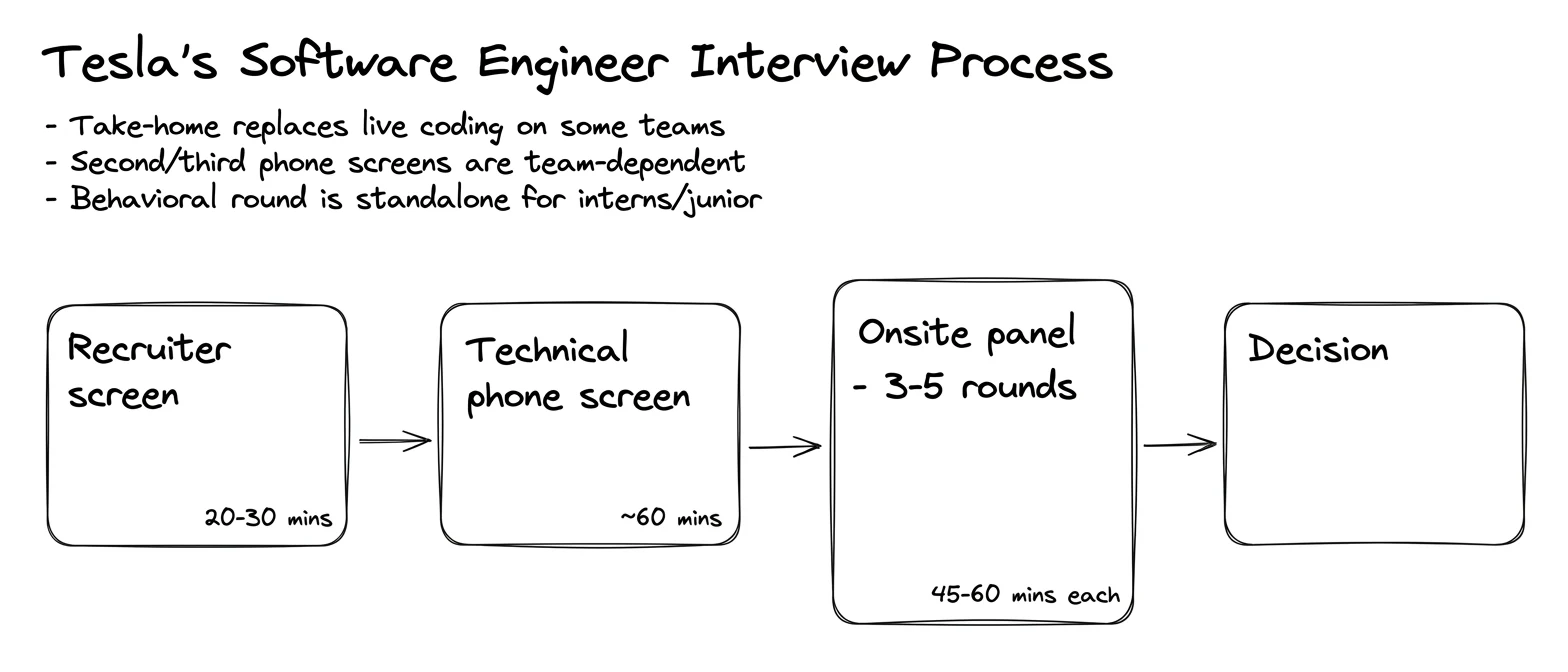
Each team hires for itself, so the format follows the team: infrastructure groups test concurrency, backend groups favor object-oriented exercises or a take-home, and senior loops center on distributed-systems design. Reported processes range from one technical call to a phone screen plus four onsite rounds. Most candidates are contacted by a recruiter rather than applying cold.
Intern and new-grad loops are usually two or three calls: recruiter, technical and sometimes a standalone behavioral round. Mid-level candidates typically get one or two technical screens with a short design discussion attached. Senior loops open with a design-heavy screen, then an onsite of three to five rounds of 45 to 60 minutes.
Here's what the interview process can look like:
- Recruiter screen: A 20- to 30-minute call on your resume, motivation and competing offers; some teams add an early hiring manager call.
- Technical phone screen: About 60 minutes of live coding in a shared editor, sometimes opened by one behavioral question.
- Low-level design interview (most mid-level loops): Build a small runnable component and extend it through follow-ups.
- Take-home assignment (some teams): An offline simulation program in place of live coding.
- System design interview (senior, and as a tail segment for others): Contention, idempotency and failure handling in the team's domain.
- Onsite project deep dive: A graded interrogation of your past systems plus fundamentals.
- Behavioral and hiring manager interview: Disagreement, criticism, failure and pace, sometimes as a separate round.
Tip: After the first working version, state its complexity and propose the better version before the interviewer asks. The follow-up constraint is the scored question.
Recruiter screen
The call covers a resume walkthrough, your favorite project, your top qualities, what you know about the mission and whether you hold competing offers. Recruiters reroute actively: one candidate contacted about a role requiring relocation was moved to other openings instead of being dropped. Some teams schedule a short hiring manager conversation before any technical round. The technical screen usually follows within days, though rescheduling is common.
Interviewers evaluate:
- Hands-on ownership: Whether the projects you name are ones you built, not ones you were near.
- Mission fit: A specific reason for this team's product, not general interest in electric vehicles.
- Pace tolerance: Willingness to work in a fast, high-ownership, mostly in-office environment.
- Logistics: Location, relocation and competing timelines.
Prepare a two-minute walkthrough of one project with numbers attached, and a concrete reason for the team.
Sample questions for the recruiter screen
Here are some questions reported by recent candidates:
- Walk me through your resume.
- What is your favorite project, and why?
- What are your top qualities, and do you have competing offers?
Technical phone screen
The screen runs about 60 minutes in a shared editor, often with the interviewer's camera off, and coding starts within minutes. Expect one medium problem with a hard follow-up, or two shorter problems. Candidates call the selection arbitrary: a positional-feedback word-guessing game, the first rectangle placement on an obstacle grid, all shortest word-ladder paths, a rotated-array minimum extended to a circular variant. One screen paired a word ladder with a GROUP BY query.
Follow-ups tighten constraints rather than change topic. One screen demanded an in-place permutation check in O(1) extra memory and a recursive power function using only the call stack, with Pythonic style graded. Another grew the grid problem into a 2D prefix sum, then partitioning grids too large for one machine. An intern wrote Dijkstra in Java, then fixed a planted bug in another implementation's edge updates and compared it with A* and Bellman-Ford.
Interviewers evaluate:
- Reaching the optimal form: A bug-free fuzzy word ladder lost signal because the trie-based version was never reached.
- Respecting the stated constraint: An iterative or naive power function fails a round that asked for logarithmic recursion.
- Reading the feedback model: In the guessing game, letter frequencies mislead because feedback counts exact positions only.
- Time management: A candidate who sank the hour into nested-dictionary extraction never reached the optimization discussion.
Practice medium problems in graphs, grids, bit manipulation and binary search, each with a constrained second pass.
Note: The screen often stays friendly while going badly. Candidates who treated the added constraint as a bonus question were rejected after the call.
Sample questions for the technical phone screen
Here are some questions reported by recent candidates:
-
Decide whether an unsorted array is a permutation of 1 to N in linear time and constant memory, then write logarithmic-depth recursive exponentiation.
-
Find the first top-left cell, scanning row by row, where an H by W panel fits on all-zero grid cells, then make each check O(1).
-
Transform one word into another where each step changes, inserts or deletes one character, then speed up neighbor search with a trie.
-
Find a secret six-letter word through a guess API returning exact positional matches, minimizing the worst-case remaining candidates.
Low-level design interview
The signature round for this track: build a small component with a clean API and runnable code, then extend it. Reported prompts: a scheduler that runs tasks at set times and accepts new ones while running; an event bus that gains multiple listeners, then unsubscribe; a cache evicting expired items first, then lowest priority, then least recently used; a key-value store with nested transactions; and a calculator that grows into a small interpreter with variables and functions.
Infrastructure teams add concurrency. A GPU-infrastructure round asked for worker processes pulling tasks from a shared queue, each needing exclusive use of one GPU from a fixed pool, in Python multiprocessing, with follow-ups on a worker crashing mid-task, graceful shutdown, the GIL, and semaphores versus a locked list.
Interviewers evaluate:
- Pinning down semantics first: What an inner undo reverts, how ties break, whether past-due tasks run immediately.
- One structure per policy tier: A map for lookup, a heap on expiry, ordered priority buckets for recency.
- Designs that survive the next requirement: Hard-coded precedence breaks once logical and bitwise operators arrive.
- Thread safety: Waking a sleeping scheduler when an earlier task arrives; releasing resources in a finally block.
Practice building each component in 30 minutes, then adding two unannounced follow-ups without a rewrite.
Tip: Walk a three-item example through the policy before coding. Candidates who did so caught the tie and empty-state cases the interviewer was about to raise.
Sample questions for the low-level design interview
Here are some questions reported by recent candidates:
-
Implement a scheduler with schedule and start that runs tasks at given times and accepts earlier tasks while waiting.
-
Build an event bus with emit and subscribe, then many listeners per event, then unsubscribe of one callback.
-
Write eviction for a cache that removes expired items, then the lowest priority, then the least recently used.
-
Model a store with nested transactions where undoing an inner transaction leaves outer changes intact.
Take-home assignment
A minority of backend teams replace live coding with an offline program after a background call. The reported task read a room map from standard input and simulated a robot through walls, turn tags and jumpers, printing the exit direction or loop if it cycled. The sample was ambiguous about loop detection, and that edge case decided the submission.
Interviewers evaluate:
- Correct cycle detection: State includes position and direction, not position alone.
- Robust parsing: Inputs beyond the examples are handled.
- Testing beyond the samples: Immediate exits, jumper chains and loops the statement does not show.
Write those tests before submitting.
Sample questions for the take-home assignment
Here are some questions reported by recent candidates:
-
Simulate a robot through a grid of walls, turn tags and jumpers read from standard input, and output its exit direction or detect an infinite loop.
System design interview
Senior loops make design a full round, sometimes in the phone screen. One Bellevue senior loop covered seat reservation with double-booking prevention, reconciliation across bank files, a payment processor and transaction records, and a remittance-file pipeline with enrichment and notification. Below senior level, design is a 10- to 15-minute tail: distributing a grid computation, or a rollback key-value store weighing a versioned log against snapshots.
Interviewers evaluate:
- Contention handling: What happens when two requests race for one seat or record.
- Idempotency: Preventing duplicate consumption from a message queue and replay after partial failure.
- Failure modes you raise yourself: Gateway outages, dependency failures, retries in workflow orchestration.
- Trade-offs with reasons: Log versus snapshot, read-write locks versus copy-on-write.
Practice payments and booking designs, tracing a duplicate message and a dead dependency through each.
Note: A senior candidate whose screen moved to a system he had never built designed from scratch, and later concluded he should have anchored it in his own systems, which is what the panel was probing.
Sample questions for the system design interview
Here are some questions reported by recent candidates:
-
Design seat reservation that prevents double booking, including the API and seat-map experience.
-
Design reconciliation between bank files, a payment processor and internal transaction records.
-
Design a remittance-file processing pipeline with enrichment, notification and fault tolerance.
-
Balance Backend Availability, Maintainability, and Scalability
Onsite project deep dive
Onsite rounds mix resume interrogation with fundamentals and a whiteboard problem. In the senior loop, one round took a framework the candidate used heavily down to fault-tolerance patterns; another ranged over GraphQL trade-offs, what happens when a browser loads a page, API gateway failures, compiler versus interpreter, and how long fire takes to spread from a target node through a binary tree. A mid-level onsite was a single problem, ranking peers in a cyclic transfer graph by direct and indirect contribution, and a buggy propagation ended in rejection.
Interviewers evaluate:
- Depth on your own decisions: Why this design, what you rejected, what broke in production.
- Framework internals: How a tool you claim behaves under failure, not only how to call it.
- Fundamentals on demand: Networking, runtimes and language trade-offs explained quickly.
- Graph modeling: Convergence and double counting when the graph has cycles.
Prepare two projects you can defend three layers down: the numbers, the failure and the rejected alternative.
Note: The feedback on a rejected senior candidate was insufficient depth on past projects, not a failed problem.
Sample questions for the onsite project deep dive
Here are some questions reported by recent candidates:
-
Explain how a framework you use heavily handles failure, and how you would prevent duplicate consumption in its consumers.
-
Walk through loading a URL end to end, then handle an API gateway failure.
-
Given a binary tree and a target node, return the time for fire starting there to reach every node.
-
Discuss Distributed-System Experience with Go, Java, Spark, and Elasticsearch
Behavioral and hiring manager interview
Behavioral questions appear at every stage and sometimes fill a round. One intern's third call was entirely behavioral: a project deep dive, why Tesla, the mission, fast-paced work, learning quickly, disagreeing with a manager, criticism and biggest failure. The candidate was rejected despite a solid technical round. Elsewhere a hiring manager closes with team context and an informal conversation.
Interviewers evaluate:
- Mechanism in conflict stories: The data you gathered and the compromise reached.
- Owning failure: A real failure, its cost and what changed afterwards.
- Response to criticism: Specific feedback and the change it produced.
- Speed of learning: Picking up an unfamiliar stack under deadline.
Prepare five stories, each ending in a measurable outcome.
Sample questions for the behavioral and hiring manager interview
Here are some questions reported by recent candidates:
-
Tell me about a time you disagreed with a leader, and how you handled it.
-
What is your biggest professional failure, and how do you handle criticism?
-
Investigate Recurring Bugs and Prevent the Same Failure from Returning
How Tesla levels and evaluates Software Engineer candidates
The hiring manager and the team's interviewers decide. Rounds are not averaged: one weak screen ends most loops, and a behavioral round can override strong coding. Level is set from the opening and refined by design and project-depth performance. Some organizations are dense with staff engineers, so senior candidates should ask about scope and growth. Turnaround is uneven, with rescheduled screens and a week or more of silence. A reapplication wait of about six months is commonly cited; confirm with your recruiter.
Tip: Keep other processes running. Several candidates heard nothing for a week or more after rounds that felt positive.
How to prepare for the Tesla Software Engineer interview
- Treat every follow-up as the real question: State complexity and deliver the better version unprompted.
- Build small systems from scratch: A timed scheduler, an event bus, a multi-tier eviction cache and a nested-transaction store, each with two extensions.
- Know concurrency primitives: Locks, semaphores, heartbeats, crash cleanup and threading versus multiprocessing in Python.
- Prepare for arbitrary problems: Cyclic graphs, grid prefix sums, bit tricks and word-transformation searches.
- Keep SQL fluent: GROUP BY aggregation shows up inside algorithmic screens without warning.
- Prepare two projects three layers deep: Trade-offs, failure modes and rejected alternatives.
- Anchor design prompts in systems you built: Then cover contention and idempotency.
About the Tesla Software Engineer role
Software engineers work close to hardware and operations: vehicle firmware, Autopilot and AI infrastructure, energy products, factory systems and internal platforms such as payments. Teams are small, own services end to end and pick their own stack (Python, C++, Go and Java all appear); on-site work is the norm.
| Level | Primary focus | Impact scope |
|---|---|---|
| P1 (Associate Engineer) | Well-scoped features under guidance | A component within one team |
| P2 (Engineer) | Independent ownership of features and services | A team's systems |
| P3 (Senior Engineer) | Design, reliability and mentoring | Several services or a product area |
| P4 (Staff Engineer) | Technical direction across teams | An organization's architecture |
Tesla hires Software Engineers across most of the company. Teams include:
- Vehicle software and firmware: Embedded platform, infotainment and over-the-air updates.
- Autopilot and AI infrastructure: Fleet data, training and inference infrastructure, GPU scheduling.
- Energy software: Platforms for Powerwall, Megapack, Supercharger and the Tesla app.
- Factory software: Production systems and manufacturing data.
- Business and finance platforms: Payments, reconciliation and internal applications.
Software Engineer experience and education requirements
Postings ask for a computer science or related degree, or equivalent proven ability, and strong programming in Python, C++, Go or Java. A mid-level firmware posting asks for about two years with Linux; senior postings ask for four or more. You choose the interview language, but style is graded and Python dominates the reports.
FAQs about the Tesla Software Engineer interview
How long does the Tesla Software Engineer interview process take?
Usually three to eight weeks. Single-screen processes resolve fastest; senior onsite loops and rescheduling add time.
What is the hardest round of the Tesla Software Engineer interview?
For most candidates, the technical phone screen, where the optimality follow-up ends the most loops. For senior candidates, the onsite project deep dive.
Is there an online assessment?
None of the reported loops for this track included one, though some early-career candidates describe a timed assessment of about 90 minutes. Some backend teams use a take-home instead.
How much does a Tesla Software Engineer make?
Posted US base ranges vary widely by team and seniority, for example about $133K to $293K for a vehicle firmware role and $118K to $390K for an AI inference role, plus cash and stock awards. One candidate found a backend range below other large technology companies, so confirm pay early.