Study
Is a Small, Safe Failure Story Best for Big Tech in 2026?
TrueInterview
October 19, 2026 · 15 min read
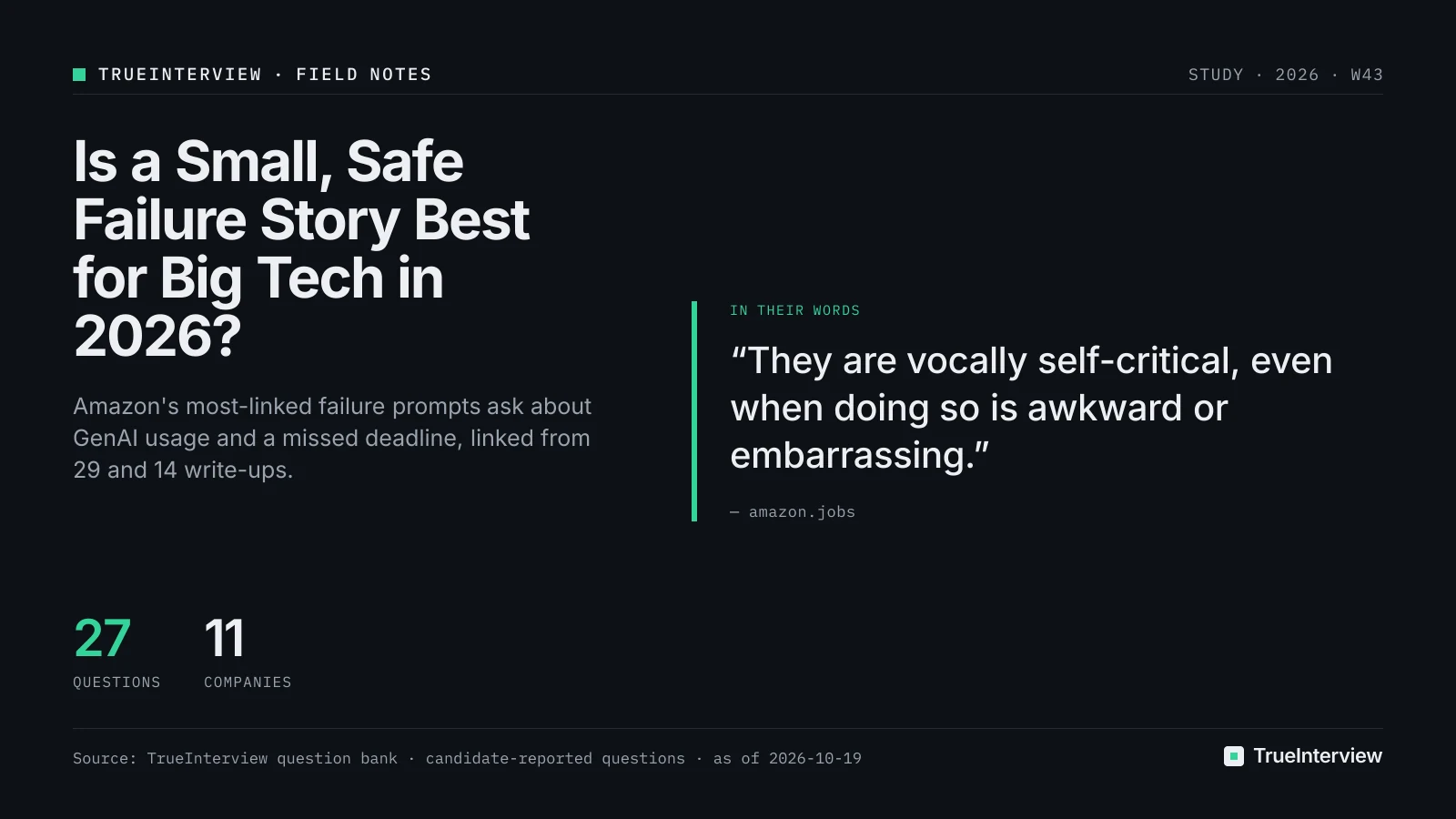
No. As of 2026-10-19, TrueInterview's bank holds 27 failure and mistake behavioral questions reported at 11 big-tech companies, and 25 of them were last reported in the previous 12 months. The most-linked titles ask for a missed deadline or a failure with GenAI tools, and others name a deployment mistake or failure impact. Our take: bring a real miss with visible consequences that you owned, fixed so it stayed fixed and can show you applied later. A small, safe slip with a tidy ending has nothing to say to those prompts.
Disclosure: TrueInterview is an interview-preparation product and publishes this article. Facts about other products come from their public pages on the dates listed under Sources.
Should you pick a low-stakes mistake?
Partly. The generic guides set a sensible ceiling, with no disasters and nothing unethical, and Built In's guide also sets a floor. Built In's guide recommends a "real example with relatively low consequences that highlights a valuable lesson". The same guide rejects trivial mistakes, naming a wrong time zone on a calendar invite, as firmly as it rejects epic failures. The reported prompts decide where inside that range you should aim.
What the belief gets right is the ceiling on damage. Optim Careers' article says "it's safest to pick a time when you misjudged something". Career coach Madeline Mann tells CNBC that the failure "doesn't have to be catastrophic". Zippia's guide warns against failures that involve unethical behavior, and Optim Careers' article warns against examples that show a pattern of mistakes or a character flaw.
What it gets wrong is the happy ending. Built In's guide says that if you could not rectify the situation, you should talk about what you did in the aftermath. One of Zippia's sample answers ends with the customer leaving: "Despite my efforts, they chose to switch to a competitor". Optim Careers' author says the sample answers on that page were prepared using Text Blaze AI, so read them as templates rather than as evidence of what interviewers reward.
Our take: aim for the upper part of the range Built In describes, and set the size of the story by the prompt you expect. A mistake so small that nobody else noticed cannot answer a title that names a missed deadline, a deployment mistake or failure impact. A partial recovery, such as a rollback that limited the outage to one region, is fine to tell as it happened; an ending polished to make the story safe is not.
What do candidates report being asked at big tech?
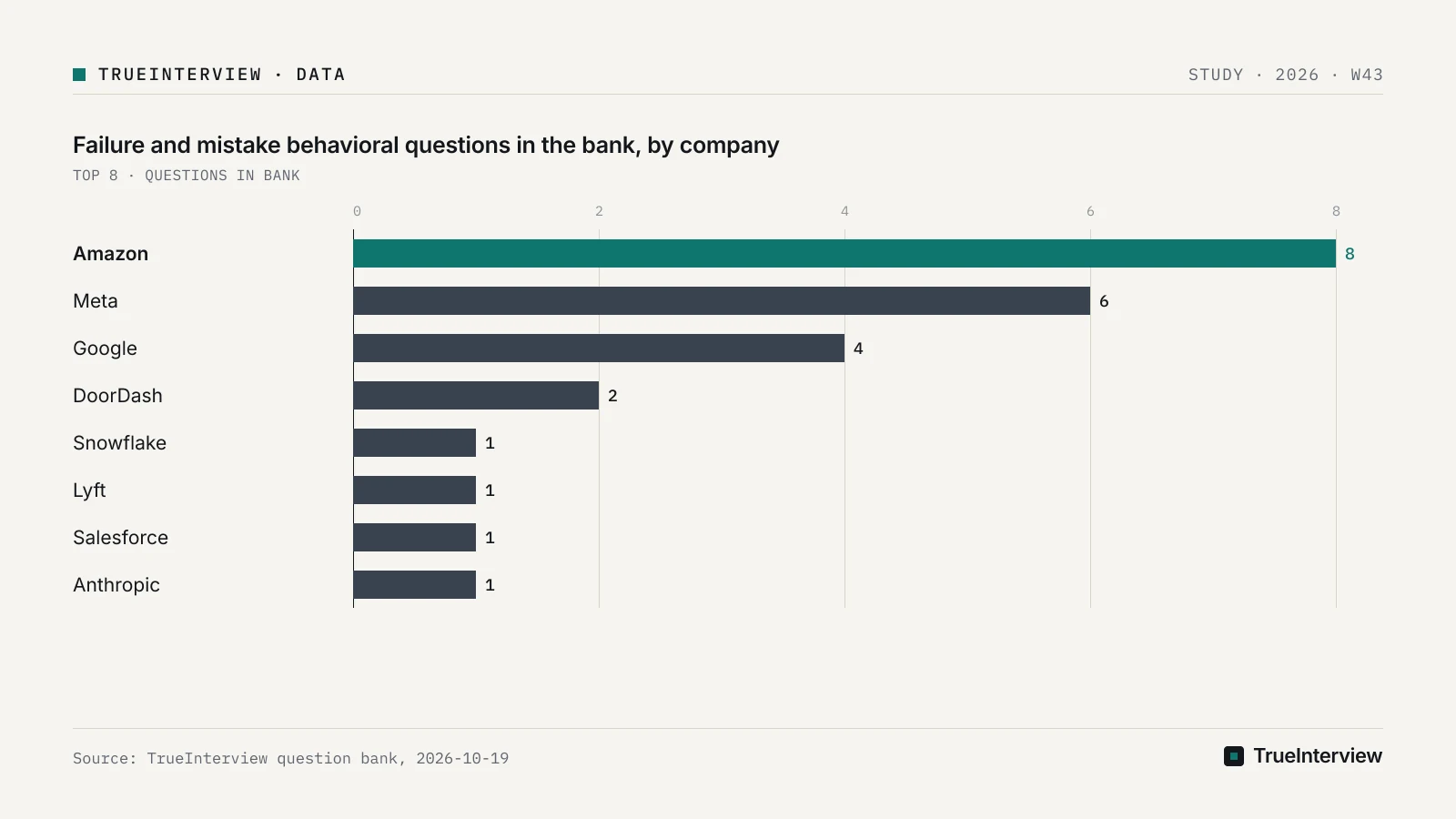
Specific variants, not the generic prompt. Most of the 27 sit at Amazon 8, Meta 6, Google 4 and DoorDash 2, with one each at Snowflake, Lyft, Salesforce, Anthropic, Uber and Instacart, and the remaining question comes from an eleventh company. Of these questions, 18 were reported in onsites and 10 in phone screens, and a question can appear in both rounds.
| Company | Reported question | Round, last reported | Write-up links | Practise |
|---|---|---|---|---|
| Amazon | GenAI Usage (How / Failure / Tradeoff) | Phone screen, 2026-09 | 29 | GenAI usage |
| Amazon | Explain Tight-Deadline Delivery and a Missed Deadline | Not in our round examples | 14 | Missed deadline |
| Lyft | Project, Conflict, Failure, and DEI | Onsite, 2026-04 | 9 | Project, conflict, failure and DEI |
| Meta | Describe cross-team collaboration and learning from failure | Onsite, 2026-05 | 4 | Cross-team collaboration and failure |
| Snowflake | Proud Project / Conflict / Failure | Onsite, 2026-07 | 3 | Proud project, conflict, failure |
| DoorDash | Answer feedback, conflict, and failure questions | Onsite, 2026-04 | 2 | Feedback, conflict and failure |
| DoorDash | How do you discuss mistakes and trade-offs? | Not in our round examples | 2 | Mistakes and trade-offs |
| Amazon | Describe a failure and what you learned | Not in our round examples | 2 | Failure and lesson |
| Answer conflict, failure, and proud project questions | Phone screen, 2026-07 | No link count in our data | Conflict, failure, proud project | |
| Anthropic | Describe failure impact and resolve cross-functional conflict | Phone screen, 2025-12 | No link count in our data | Failure impact |
| Salesforce | Answer ownership, conflict, and failure recovery questions | Phone screen, 2026-01 | No link count in our data | Failure recovery |
| Instacart | Discuss an Interesting Project and a Deployment Mistake | Onsite, 2026-09 | No link count in our data | Deployment mistake |
| Uber | Describe ownership and failure | Onsite, 2026-03 | No link count in our data | Ownership and failure |
Two things follow for your preparation. The phone-screen rows at Amazon, Google, Anthropic and Salesforce mean the failure story can arrive in your first behavioral conversation, so have it ready before the onsite. And the titles name the miss they want, so a generic story leaves you improvising the fit live.
These are candidate-reported questions reconstructed for practice, not any company's official question list, and a link count measures what candidates wrote up rather than how often a company asks.
Is the failure question a standalone prompt?
Rarely, among the titles listed in the table. Titles are reconstructed for practice, so a combined title may summarise separate prompts asked in one round. Only one row in the table, Amazon's Describe a failure and what you learned, asks for a failure on its own. The Lyft, Snowflake, Google, DoorDash and Salesforce titles pair it with conflict, a proud project, feedback or ownership, and Meta's pairs it with cross-team collaboration.
In a bundled round the interviewer hears your proud project, your conflict and your miss back to back. If all three come from the same project, the round sounds like one story told three ways, and the interviewer learns less about your range than they would from three projects.
Our take: keep the three answers on separate projects. The conflict story is about a disagreement with a person, the proud project is about scope and result, and the failure is a miss you owned. If you only have one large project, split it by phase and make sure the failure is not the same event as the conflict.
Is the lesson the point of the answer?
Only when you can show the lesson applied. Built In's guide says "The most important part of your answer is what you learned from the mistake". Mann tells CNBC the result should cover how you "changed your approach to prevent future errors". A lesson with no later use reads as a confession, not as evidence that you changed.
Built In's guide also says to give examples of how you applied the lesson to later situations in your career. Amazon's Insist on the Highest Standards principle says leaders ensure that "problems are fixed so they stay fixed". That phrase is the bar for your closing lines: the mechanism you changed, such as a pre-release check, a rollback runbook or a review step for AI-generated code, and one later case where it caught a repeat.
On structure, the guides offer three versions. Zippia's guide recommends STAR. Optim Careers' article says to use CARL, for context, action, results and learning, with an optional S for solution. Mann tells CNBC the answer needs context, action and result.
Our take: use CARL with the S. The learning slot forces the lesson, and the solution slot is where the fix that stayed fixed goes, which STAR tends to squeeze into one closing sentence.
Which ownership mistakes sink a failure answer?
Blaming someone else, or the schedule. Zippia's guide says shifting blame "undermines your accountability and may suggest a lack of self-awareness". Built In's guide warns that deflecting responsibility and making excuses may signal that you will do the same in their organization. Mann tells CNBC that seeming defensive or passing blame could raise red flags.
Built In, Zippia and Mann all warn about this trap, which makes it the cheapest point to win. Built In's guide advises against excuses about "tight timeframes, lack of resources or other factors beyond your control". Career counselor Tom Dowd, quoted by Built In, says "Call out what your role was and what you would do differently".
Our take: write the one sentence that names your own role, and say it early. Then reread the story and cut any clause that starts with the deadline, the staffing or another team. Keep the fact that the launch date moved up; drop the sentence that says the moved date is why the release broke.
Does one polished story fit every company?
No, because the variants differ by company and round, as the table above shows. Instacart's title names a deployment mistake, Anthropic's pairs failure impact with cross-functional conflict, and DoorDash's asks about mistakes and trade-offs. Amazon's two most-linked titles go another way again, which the worked example below takes apart. Match the story to the variant, using this table.
| Variant you may get | Where candidates reported it | Story to bring | Follow-ups to prepare (our view) |
|---|---|---|---|
| Missed deadline | Amazon | A date you actually missed, and who it affected | Your role in the slip, and what you would re-scope earlier |
| Deployment or production mistake | Instacart onsite | A release you shipped that broke something for users | How you detected it, how you rolled back, the check you added |
| Failure impact with cross-functional conflict | Anthropic phone screen | A miss that cost another team time or trust | How you disclosed it, and how you repaired the working relationship |
| GenAI usage, failure and trade-off | Amazon phone screen | A time an AI tool, or your use of it, produced a bad result | How you caught the output, what review you now apply, what you gave up |
| Mistakes and trade-offs | DoorDash | A trade-off you chose that turned out wrong | The options you rejected, and the signal you missed |
| Ownership and failure recovery | Uber onsite, Salesforce phone screen | A failure in something you owned end to end | Ownership language, and the recovery steps in order |
Our take: if your loop is at Amazon, prepare the missed-deadline and GenAI stories first. If the company bundles failure with other behavioral prompts such as conflict, a proud project, feedback or ownership, as at Lyft, Snowflake, Google, Salesforce and DoorDash, prepare three stories from different projects. If the prompt mentions impact, deployment or recovery, use a story with production or cross-team consequences and a concrete fix.
How does this play out in an Amazon loop?
Take Amazon, which accounts for 8 of the bank's 27 failure questions. A wrong-time-zone invite answers neither of the two most-linked prompts. The GenAI title asks how you used a tool, where it failed and what you traded off, and the deadline title asks for a deadline you missed, not one you nearly missed.
A prepared candidate brings a real missed deadline and states the impact in one sentence: what slipped, by how much, and who waited. The next sentence names the candidate's own role, without the timeline excuse that Built In's guide advises against. The answer closes with the change that kept the problem from recurring, and one later project where that change held.
That shape fits Amazon's published principles. Amazon's Earn Trust principle says leaders are "vocally self-critical, even when doing so is awkward or embarrassing". The fix-so-it-stays-fixed close maps to Insist on the Highest Standards, cited above. For the GenAI variant, the same arc applies: the bad output, how you caught it, the review step you added, and the speed you gave up to add it.
Who does the small, safe story still work for?
Early-career candidates facing the generic prompt, and anyone whose honest best example is small. Built In's guide says the example could even be "a potential failure that was remedied before things went wrong". Mann tells CNBC that missing a data point or misunderstanding a direction could count as a failure.
If your best real miss is a data point you overlooked before a launch review, tell that story with its fix rather than inflating it into an outage. A padded story comes apart when the interviewer asks how many users were affected or who noticed first, and a small miss with a real fix survives those questions.
Our take: the small story works only for the generic prompt, such as Amazon's Describe a failure and what you learned. Junior candidates report the specific prompts too: most links to the missed-deadline and GenAI questions come from junior, new-grad or intern write-ups. So even in a new-grad loop, keep one story with a consequence someone else felt. At senior level a small story signals that your scope was small, which is the opposite of what the loop is checking.
What changes at senior and staff level?
The level split shows who wrote the reports more than what seniors are asked. Write-ups link these questions 24 times from candidates who reported a senior, staff-plus or manager level and 52 times from junior, new-grad or intern candidates. Levels are self-reported, and the raw split mostly reflects the mix of write-ups collected.
Within that mix, the titles differ. Amazon's GenAI usage question is linked from 4 senior-or-above write-ups and 25 junior-or-below ones, and the missed-deadline question from 3 and 11. The Lyft bundle runs 4 to 5, and Meta's cross-team title 2 to 2. Both DoorDash titles are linked only from senior-or-above write-ups, 2 each, which is a small sample. Snowflake's bundle has 2 senior-or-above links, 1 of them staff-plus or manager.
Read that as a lean, not a rule: the bundled and trade-off variants draw relatively more senior reports, and the GenAI question draws mostly junior ones. Amazon's Bias for Action principle says "We value calculated risk taking", and a strong senior failure story can be a calculated risk that did not pay off.
Our take: at senior and staff level, bring a decision or trade-off you owned that affected other teams, with the consequence stated plainly and the mechanism you changed afterward. Expect the interviewer to push on four things: the real consequence, your specific role, what you changed, and how and when you told the people affected.
Down-leveling note (our view): the behavioral round carries level signal through the scope of your stories, alongside design depth and the project deep dive. A failure whose blast radius was your own task reads as mid-level. If you are targeting staff, the miss should involve a decision that crossed team lines, and the fix should be a change other teams now rely on.
How we counted
Counts come from TrueInterview's question bank as of 2026-10-19 and cover 27 failure and mistake behavioral practice questions reported at 11 big-tech companies. TrueInterview says reports are written up right after the interview and checked against other reports of the same round. A question can be reported in more than one round, so round tallies do not sum to the question count. Level splits count write-up links by the level each candidate reported, and a link count measures what candidates wrote up, not how often a company asks.
FAQ
Why do interviewers ask you to describe a time you failed?
To see how you behave when work goes wrong. Built In's guide says hiring managers ask "not to shame you, but because they want to know how you react in those situations". Optim Careers' article says that no one writes about failure on a resume, which is why the question is worth asking. Mann tells CNBC that interviewers are looking for "honesty, adaptability and resilience". So pick the story where your actions after the miss were the most concrete: the rollback you ran, the person you told first, the check you added.
Is it acceptable to say I have never failed?
No. Zippia's guide says claiming you have never failed "raises doubts about your honesty and self-reflection". Even if it feels safe, it leaves the interviewer nothing to assess and throws away your chance to show how you recover. If you truly struggle to find a story, look at launches that slipped, incidents you were paged for, or a design you later had to rework. One of those is likely a real failure you can own.
How long should the failure part of the answer be?
Short. Built In's guide says to keep the explanation of the failure as concise as possible and then pivot to how you resolved it and what you took away. Give the miss and its impact in a sentence or two, then spend the rest of your time on what you did, the change you made, and where you applied it later. If the interviewer wants more detail on the failure, they will ask, and that follow-up is a good sign.
Can a new grad use a failure from school or a side project?
Yes, if it is real and you owned it. Junior, new-grad and intern candidates account for most of the write-up links to these questions, as the level section shows, so the prompts you face will be the same specific variants. A group project that missed its deadline or a side project that shipped with a bug you caused carries the same structure as a work failure: a miss, your role, the fix and a later application. Choose the one where someone else felt the consequence, such as teammates who lost a demo or users who hit the bug, and avoid a story about a grade. Once you have an internship, prefer a failure from that work, since it is closer to what the interviewer will see you do.
Should I reuse my failure story for "biggest mistake" questions?
Yes, when the prompt asks for the same thing: a miss you caused, its impact and the fix. DoorDash's How do you discuss mistakes and trade-offs? names mistakes directly in its title. In our view the same arc, plus the trade-off behind the decision, is a safe way to answer it. Where it breaks is the bundled round: if the same interviewer asks for a failure and a mistake, or a failure and a conflict, use a second project. Keep a backup story with a different kind of consequence, such as a deployment problem against a missed date, so you can switch when the prompt names one.
Your practice plan
A three-week plan for someone working full time. TrueInterview says the first few questions at every company are free, with no card needed.
- First week, first evening. Write three failure stories from different projects: a missed deadline, a deployment or production mistake, and a time an AI tool or your use of it produced a bad result. State each one's impact in a single sentence.
- First week, second evening. Draft CARL answers, with the solution line, for Explain Tight-Deadline Delivery and a Missed Deadline and GenAI Usage (How / Failure / Tradeoff).
- First week, weekend. Audit your story bank so failure, conflict and proud project come from different projects, then rehearse Proud Project / Conflict / Failure and Answer conflict, failure, and proud project questions back to back.
- Second week, first half. Practise the consequence variants: Discuss an Interesting Project and a Deployment Mistake and Describe failure impact and resolve cross-functional conflict, saying how you detected the problem and how you told the people affected.
- Second week, second half. Record an answer to Describe ownership and failure, then cut every clause that blames a deadline, resources or another person, and move the sentence that names your role earlier.
- Third week, first half. If you are interviewing at senior or staff level, build a trade-off story and practise How do you discuss mistakes and trade-offs? and Answer feedback, conflict, and failure questions.
- Third week, second half. Add a closing line to every story naming the mechanism you changed and one later situation where it prevented a repeat, then run Project, Conflict, Failure, and DEI as a full mock round.
Sources
- TrueInterview question bank — failure and mistake behavioral at big-tech companies — counted 2026-10-19
- How to Answer ‘Tell Me About a Time You Failed’ | Built In — checked 2026-10-19
- Tell Me About a Time You Failed 9 Examples to Steal — Optim Careers — checked 2026-10-19
- How to answer 'Tell me about a time you failed' in a job interview, says career expert — checked 2026-10-19
- How To Answer “Tell Me About A Time You Failed” (With Examples) - Zippia — checked 2026-10-19
- Leadership Principles — checked 2026-10-19
- Real FAANG Interview Questions by Company · TrueInterview — checked 2026-10-19
- Interview prep compared: your application, end to end · TrueInterview — checked 2026-10-19
Last reviewed: 2026-10-19.