Robinhood · Study
Robinhood Interview Process & Questions
TrueInterview
July 24, 2026 · 11 min read
Robinhood draws on a small, stable question bank: a job scheduler and a trading system for design, a dependency-graph "load factor" problem for phone screens, and a social-payments command parser for object-oriented design. The difficulty is in the follow-ups. Interviewers plant bugs and ban print statements, swap the problem mid-round, and press on failure handling. The project deep dive can decide the loop by itself, and passing the bar does not guarantee an offer, because team matching comes afterwards and "no team match" is a common result.
This guide breaks down each stage of the Robinhood interview, what interviewers evaluate in each round, and how to prepare, with questions candidates were actually asked.
Verified: Based on 30 candidate-reported interview experiences, cross-checked against recent public accounts.
Robinhood interview process
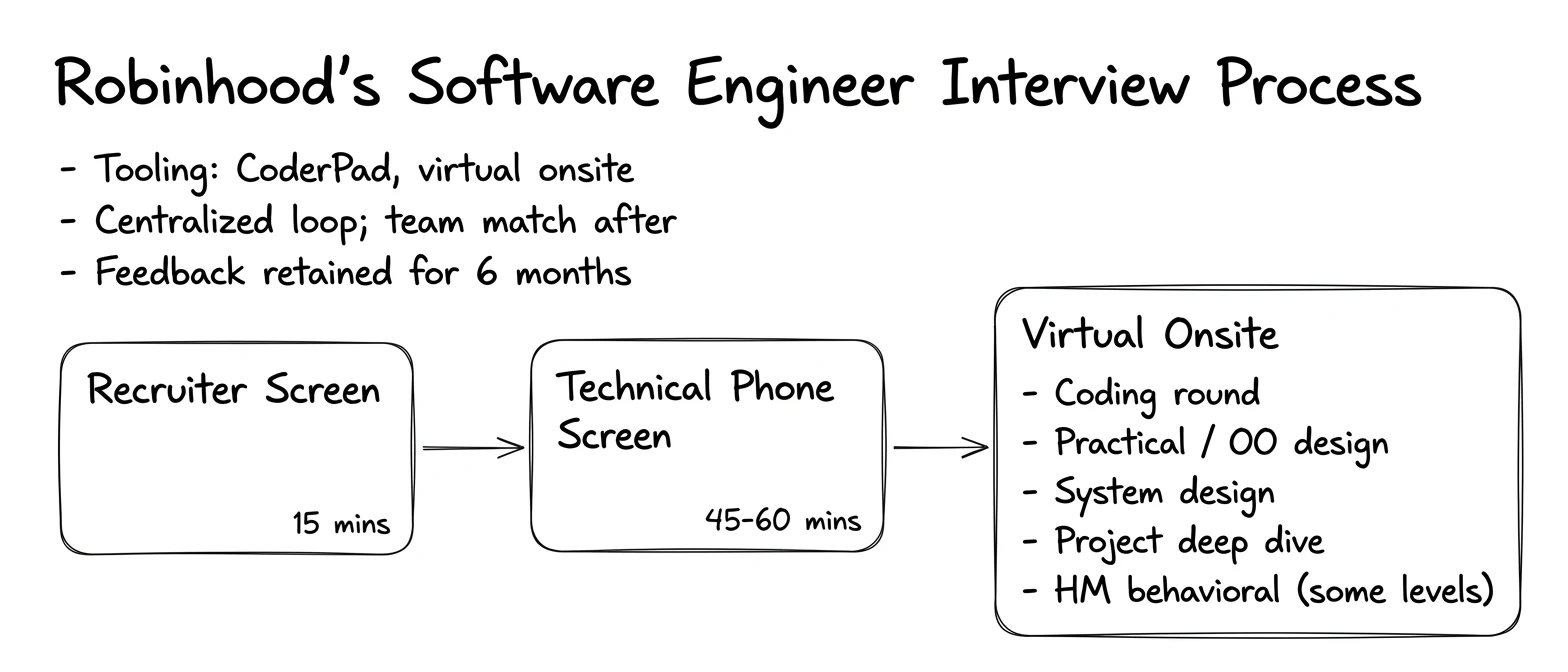
Hiring is centralized: you interview with engineers from across the company, and a team is picked afterwards. The usual sequence is a recruiter call, a 45–60 minute technical screen, and a virtual onsite of three or four one-hour rounds, typically over four to six weeks. Some reported loops ran past two months because rounds were rescheduled. Cold applicants and new grads often take an online assessment first, and some candidates sit the whole loop as three separate phone rounds instead of one onsite day.
Tracks share the structure but not the content. Software Engineer loops cover coding, object-oriented design, system design and a project deep dive. Frontend Engineer loops swap in a UI build and a client-side design. Mobile candidates code live in Xcode or Android Studio. At senior level, the screen itself can be system design, and some loops have two design hours.
Here's what the interview process can look like:
- Online assessment (cold applicants, early career): A timed test of about four coding tasks, mostly rule-heavy data processing.
- Recruiter screen: A 15–30 minute call on motivation, your strongest project, work authorization and pay.
- Technical phone screen: 45–60 minutes of live coding in a shared editor, or system design for some senior candidates.
- Coding interview: A practical, finance-flavored problem, or a UI or mobile build on client tracks.
- Object-oriented design (Software Engineer): A runnable payments model built from text commands.
- System design interview: A job scheduler or trading system, or a client-side app for frontend roles.
- Project deep dive and behavioral: One owned system, sometimes presented from slides.
Tip: Prepare each known prompt with its follow-ups. One candidate finished the planned problem and was handed a new one in the same hour.
Online assessment
Cold and early-career applicants often start here; referred candidates usually skip it. The test has about four tasks from easy to hard, sometimes each with its own timer. Problems are long, rule-heavy specs, such as course prerequisite paths or courses that students share, and they test boundaries more than advanced algorithms.
Interviewers evaluate:
- Literal rule-following: A misread tie-break fails the hidden cases.
- Boundary handling: Empty input, duplicates and disconnected data.
- Code quality: One senior assessment graded quality as well as correctness.
Practice multi-rule string and graph problems against a strict timer, and write your own edge-case tests before submitting.
Sample questions for the online assessment
Here are some questions reported by recent candidates:
-
Given course prerequisites, produce a deterministic order in which to take the courses.
-
Find the middle course of each student's course path.
Recruiter screen
The call is 15–30 minutes and is a real filter. Expect a self-introduction, your most impactful project and your role in it, why Robinhood, your top three offer criteria, salary expectations, other interviews, visa status and relocation. Another call took about 15 minutes, covered only "Why Robinhood?" and sponsorship, and ended in a rejection the next day.
Interviewers evaluate:
- Specific motivation: A real product or engineering reason, not "fintech is exciting."
- Ownership: Your own part in your best project, stated in one sentence.
- Logistics: Sponsorship, location and competing deadlines.
Prepare a two-minute introduction and a specific "Why Robinhood?", and ask which rounds and focus areas to expect.
Sample questions for the recruiter screen
Here are some questions reported by recent candidates:
-
Tell me about yourself and the most impactful project you led.
-
What are the top three things you weigh when comparing offers?
Technical phone screen
The screen is 45–60 minutes with an engineer in a shared editor. The most common problem is a dependency graph. You compute the minimum total time to run tasks with given processing times and dependencies, which is the longest path in topological order, or you count how often each node is triggered from an entry point. A second family counts referrals over a tree, then asks for the top three with a size-three heap, an iterative DFS, and streaming updates through parent pointers as new users join.
Some senior candidates get the job scheduler as a design screen instead. Android candidates rebuilt findViewById and designed a two-screen URL viewer; one received an offer after this screen alone. A data screen combined SQL on account-state changes with Python sessionization.
Interviewers evaluate:
- Debugging without tools: One interviewer hid a second bug in working code and banned print statements.
- Graph edge cases: Tasks missing from the dependency pairs, multiple start nodes and cycles.
- Driving follow-ups: Using spare time on complexity and extensions without being asked.
Practice topological sort and subtree counting until you can write them with every edge case, then practice finding a planted bug by hand.
Note: The planted bug in one screen was a missing
maxin the earliest-start update. The code is correct on a single chain and wrong when two predecessors feed the same task. The candidate found it but ran out of time before the solution was polished.
Sample questions for the technical phone screen
Here are some questions reported by recent candidates:
-
Return the minimum time to finish all tasks, given each task's processing time and dependency pairs, with unlimited parallelism.
-
Compute each user's total direct and indirect referrals, then the top three, then keep counts current as users join.
Coding interview
The onsite coding hour is practical, and it is graded on code that runs from start to finish. Software Engineer candidates most often get a fractional-share inventory: process fractional buys and sells, track each ticker in a hashmap, reject oversells, and avoid floating-point drift. More than once, an interviewer swapped this problem in after the candidate solved the planned one. Others include a top-three referral leaderboard and packing strings into fixed-width rows.
Frontend candidates build a weekly calendar grid in which clicking a slot opens an event dialog. Android candidates implemented two methods inside a large stock-trading app. iOS candidates built a 50-row table whose timers run only while each row is visible.
Interviewers evaluate:
- Finished code: A placeholder comment for an edge case counts as missing.
- Money invariants: No overselling and exact handling of fractional quantities.
- One source of truth: On the calendar, keeping both a grid and an events object, or using
useEffectwhereuseMemobelonged, made one round borderline. - Platform fluency: One Android candidate who had prepared only general algorithm problems struggled with the existing framework.
Practice the domain problems until they run on the first try. Client candidates should rebuild the calendar or timer app from scratch.
Sample questions for the coding interview
Here are some questions reported by recent candidates:
-
Apply a sequence of fractional buy and sell orders to an inventory, rejecting any sale larger than the holding.
-
Build a React weekly calendar in which clicking a slot creates a named event.
Object-oriented design interview
Software Engineer candidates parse text commands for a social payments app: register a user, send a friend request, accept it by its stored ID, and send money between friends. At the end, print every user's balance. Candidates expected to write 150–200 working lines. Transfers must never overdraw an account, and duplicate requests and unknown users have to be rejected.
Interviewers evaluate:
- Encapsulation: One interviewer questioned whether a balance-adding method should be public.
- Validation placement: Which class owns the duplicate and unknown-user checks.
- Invariants: Overdraft is impossible by design, not just checked in one caller.
Build the full processor once against a timer, then rerun it with duplicate, self-transfer and non-friend inputs.
Sample questions for the object-oriented design interview
Here are some questions reported by recent candidates:
-
Parse sign-up, friend request, acceptance and transfer commands, then print every final balance.
System design interview
The job scheduler is the prompt reported most often. It covers recurring jobs, SLAs, timeouts, conditional writes, alerts for missed runs, retries, and jobs still running when the scheduler restarts. Candidates are expected to argue at-least-once against exactly-once execution and to model job states as a state machine. Trading prompts are the other common family: an order system calling an external exchange API, broker-to-exchange order routing as a state machine that never loses an order, a real-time price service for 1-day to 1-year charts, and a secure trading app on AWS.
Frontend candidates design a photo album that syncs across devices, with uploads and sorting by city. A Staff Security Engineer loop had separate hours on permissions, audit logging and service authentication.
Interviewers evaluate:
- Failure semantics: Stuck jobs, dead workers, retry storms and partial outages, raised before you are asked.
- State modeling: Explicit lifecycle states for jobs and orders.
- Storage choices: One rejected candidate traced the loss to a weak case for a time-series database over precomputed rollups.
- Money correctness: Idempotency keys and one reliable source of truth for portfolios.
Rehearse the scheduler and an order lifecycle until you can walk through their failure modes without notes.
Tip: High-level designs tend to look alike, so the reliability discussion is what separates candidates. Bring up failure and recovery early, and plan what you will cover in the deep dive. An unplanned stretch lets the interviewer steer you into edge cases you haven't prepared.
Sample questions for the system design interview
Here are some questions reported by recent candidates:
-
Design a job scheduler that enforces SLAs, retries failures, alerts on missed recurring runs and survives restarts.
-
Design order routing from broker to exchange so that no order is ever lost.
Project deep dive and behavioral interview
One hour on a system you owned, sometimes presented from slides. Interviewers probe trade-offs and, on backend tracks, how you ensured idempotency in your own distributed system. They keep going until your contribution is clearly separate from the team's, and some have asked for links to pull requests. Behavioral questions on challenges, conflict and hindsight often fill the second half.
Interviewers evaluate:
- Reasoning: One rejected candidate described what was built rather than why.
- Correctness guarantees: How you proved your system behaved under failure.
- Honest hindsight: A real mistake and what you would change.
Prepare one project you can defend from architecture down to code, with the alternatives you rejected and pull requests you can share.
Note: Candidates rejected after an all-phone loop of three rounds pointed to the project discussion, not to coding or design.
Sample questions for the project deep dive and behavioral interview
Here are some questions reported by recent candidates:
-
Present a past project and explain how you guaranteed idempotency across its services.
-
Describe a conflict on a project and what you would do differently now.
How Robinhood makes hiring decisions
Feedback from all rounds is combined after the loop. Candidates who pass go to team matching, and their result stays valid for about six months. Frontend candidates whose design and deep-dive rounds went well have been told that no team was available. Rejections usually arrive within a day or two. Encouraging signs such as compensation talks have still ended without an offer, and one role moved from California to Toronto late in the process.
Tip: Keep other processes going until you have a written offer, and confirm the location and level by email.
How to prepare for the Robinhood interview
- Drill the graph family: Load factor as a longest path, trigger counts, and referral counts with the top-three and streaming follow-ups.
- Debug without printing: Have someone break one line of your working code, then find the bug by hand.
- Finish the money problems: Write the fractional inventory and the transfer processor end to end.
- Own two designs: A job scheduler and an order lifecycle, each with states, retries, idempotency and alerting.
- Defend a storage choice: Argue a time-series database against precomputed rollups for price data.
- Build your deep dive: One project with slides, the alternatives you rejected, and pull requests you can share.
- Prepare in your stack: Client candidates should rebuild the calendar, photo album or timer app in their own framework.
About working at Robinhood
Robinhood builds brokerage, options, crypto, retirement and banking products on real-time market data. Its engineering problems center on correctness: transfers that never double-apply, orders that are never lost, and prices that stay live through partial outages. Backend teams use mainly Python and Go, the web uses React, and the mobile apps are native. Most roles are hybrid, with at least three days a week in Menlo Park, Bellevue or New York, and some roles are based in Toronto.
| Level | Primary focus | Impact scope |
|---|---|---|
| IC3 | Delivering scoped features with guidance | Tasks within one team |
| IC4 | Owning features and services end to end | One team's systems |
| IC5 (Senior) | Leading projects and designing for reliability | A team and its neighbors |
| Staff and Senior Staff | Technical direction across several teams | An organization |
Robinhood hires engineers across its product lines. Teams include:
- Brokerage: Trading, execution and routing, clearing, and tax and regulatory reporting.
- Crypto: Trading, custody and wallets, and blockchain integrations.
- Banking and credit cards: Money movement, cards and cash products.
- Security: Access control, audit pipelines and service authentication.
- Infrastructure and developer platforms: Shared compute, data and tooling.
Experience and education requirements
Postings ask for strong computer science fundamentals. Backend roles add Python or Go and relational databases, web roles add React, and mobile roles add native iOS or Android. Interns must be enrolled in a degree program, and Senior Staff postings ask for ten or more years of experience. Recent Menlo Park postings list base pay of about $136K–$150K, $162K–$200K and, for senior roles, $214K–$230K, plus equity and bonus.
FAQs about the Robinhood interview
How long does the Robinhood interview process take?
Typically four to six weeks. Rescheduled onsites and team matching have pushed some processes past two months.
What is the hardest round of the Robinhood interview?
For senior candidates, system design and its failure-handling follow-ups. Below senior, the phone screen ends more loops, because of the planted bugs and chained follow-ups. For frontend candidates, the calendar build.
Is there an online assessment?
Usually, for cold applicants and early-career candidates: about four timed coding tasks. Referred candidates often go straight to the recruiter call.
What happens if there is no team match?
Your passing feedback stays valid for about six months, so a later opening can pick you up without a new loop.