Robinhood · Study
Robinhood Frontend Engineer Interview Process
TrueInterview
July 31, 2026 · 14 min read
Robinhood's client loop is built from things you would actually ship: a weekly calendar in React, a table of timers in Xcode, two methods inside an existing Android trading app, a photo album that syncs across devices. There is little algorithm grinding; the deciding signal is how state is organized, and interviewers ask outright which object is the source of truth. The other surprise is the ending: candidates who rated their design and project rounds as strong were still told there was no team match, with feedback banked for six months.
This guide breaks down each stage of the Robinhood Frontend Engineer interview, what interviewers evaluate in each round, and how to prepare, with questions candidates were actually asked.
Verified: Based on 29 candidate-reported interview experiences, primarily from 2025 Q2 through 2026 Q2, cross-checked against recent public accounts.
Robinhood Frontend Engineer interview process
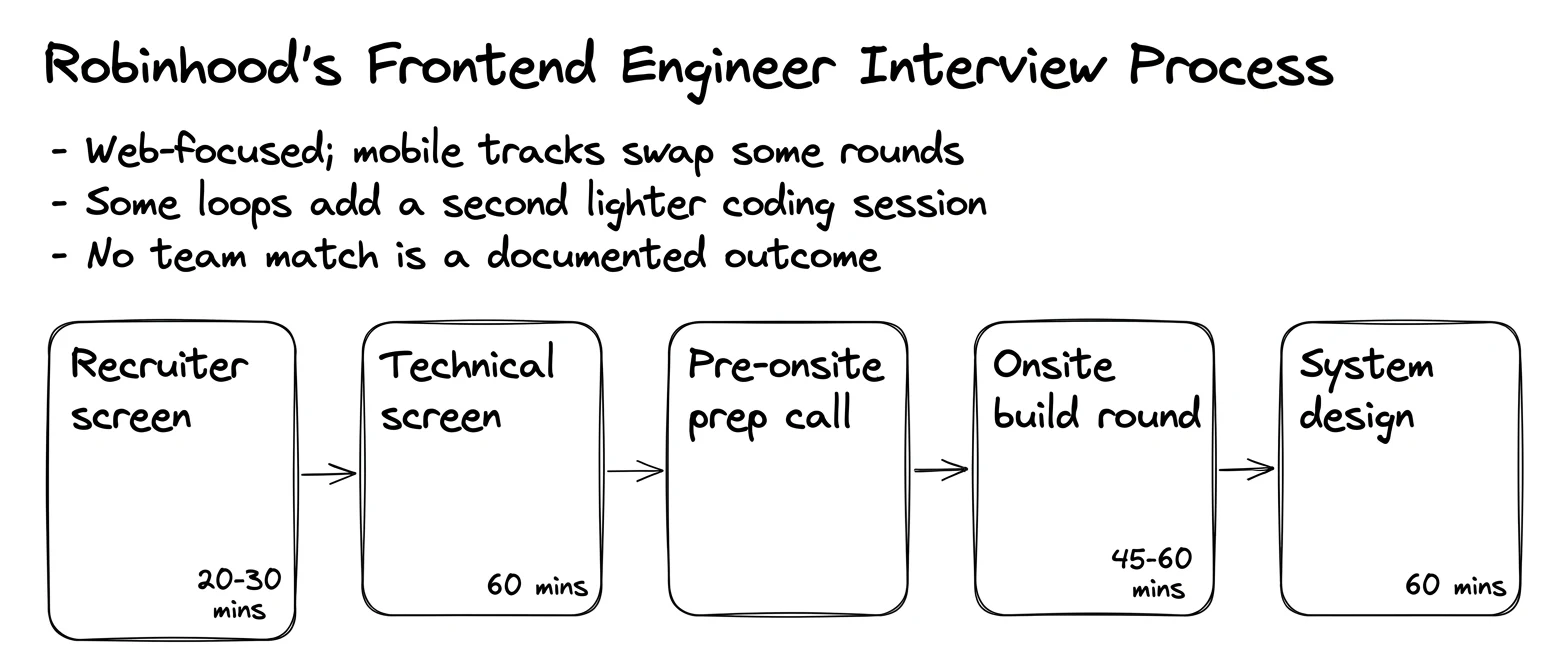
The loop is centralized: interviewers often come from other teams, and team matching happens after the onsite. The title covers three platforms: web candidates build React components and design client data layers, while iOS and Android candidates code live in Xcode or Android Studio. Expect a recruiter call, one technical screen, and a virtual onsite of three to five hour-long rounds.
Entry and mid-level loops (IC3 and IC4) are mostly one build round, one client design round and a project deep dive. Senior and staff loops add a second coding or design hour and a hiring manager round, and staff engineers running mobile rounds push on testability.
Here's what the interview process can look like:
- Recruiter screen: 15 to 30 minutes on background, platform, motivation, work authorization and compensation expectations.
- Technical phone screen: About an hour of platform-specific practical coding, such as DOM and component work on web or a view-hierarchy primitive on Android.
- UI coding interview (web): A 45-to-60-minute React build, most often an interactive weekly calendar, sometimes followed by a lighter string-placement problem.
- Mobile platform interview (iOS and Android): An hour building a runnable app or completing methods inside a large existing codebase.
- Frontend system design interview: An hour on a client-centered design, most often a cross-device photo album.
- Project deep dive: An hour of technical retrospective on a system you owned.
- Hiring manager interview (mainly mobile and senior loops): Past projects, conflict, prioritization and production incidents.
Tip: Ask the recruiter which rounds your onsite includes and what each focuses on. Candidates report those hints matching the real sessions closely, and the answer tells you whether to prepare one coding hour or two.
Recruiter screen
The recruiter call lasts 15 to 30 minutes: your most impactful project and your role in it, why Robinhood, the three factors you would weigh in an offer, other processes, salary expectations, visa status, relocation and tech stack. Android candidates have also been asked a few high-level framework questions here.
The call is evaluated: one candidate was rejected the day after a 15-minute call covering only motivation and sponsorship. In several processes a second short call before the onsite walked through the lineup and what each interviewer would look for.
Interviewers look for:
- Specific motivation: A reason tied to Robinhood's products rather than fintech in general.
- Platform clarity: Which client stack you ship in day to day.
- Concise impact story: One or two minutes on a project, with your own decisions and a result.
Prepare a short why-Robinhood answer that names a product surface you would want to build, plus a 90-second project summary.
Sample questions for the recruiter screen
Here are some questions reported by recent candidates:
-
Why Robinhood, and why are you leaving your current role?
-
Walk through your most impactful project and what you personally owned.
-
What are the top three factors you will use to evaluate an offer, and where else are you interviewing?
Technical phone screen
The screen runs about 60 minutes with an engineer and is practical rather than algorithmic. Web candidates typically get JavaScript, DOM and component exercises, often starting from a small base project and adding functionality in escalating parts, with subscription lifecycle and re-render behavior coming up early. Code generally has to work without IDE support.
The best-documented mobile screen is Android. The candidate implemented findViewById by recursively walking a view hierarchy and returning the first match or null, then discussed duplicate IDs, complexity and caching. The second half was a two-screen app: the first takes a URL, the second shows the fetched HTML on top and a rendered web view below, discussed through activities, intents, layout and asynchronous fetching. That candidate received an offer.
Interviewers look for:
- Platform fundamentals without scaffolding: Traversing a view tree or the DOM, and wiring events by hand.
- Asynchronous correctness: Fetching off the main thread, then updating the UI safely and handling failures.
- Incremental delivery: Each part working before the next is added, since later parts build on earlier ones.
- Clear reasoning about trade-offs: Complexity, duplicate IDs and when a cache is worth it.
Practice building small features in plain JavaScript or your mobile platform's framework without autocomplete, finishing each part before extending it.
Sample questions for the technical phone screen
Here are some questions reported by recent candidates:
-
Implement Android's
findViewById(int id)by searching the view hierarchy recursively, then discuss duplicate IDs and caching. -
Build a two-screen app: enter a URL on the first screen, then show the page's HTML source on the top half of the second screen and a rendered web view below.
UI coding interview
Web candidates get a 45-to-60-minute React build, most often a weekly calendar from a mockup: seven day columns, hourly rows, and a dialog to create a named event when a cell is clicked. The work is turning events into a two-dimensional grid without recomputing on every render, and interviewers ask when to use useMemo versus useEffect for that derivation.
Reports from 2026 describe the same arc: events kept in one piece of state and a derived grid in a second, the interviewer saying not to keep two sources of truth, and time lost refactoring to a single canonical object. One candidate then reached for useEffect after the interviewer hinted at useMemo, and that round was rated borderline. Some loops add a lighter session: place strings into fixed-width rows, then greedily into the row with the most space, and report the emptiest row.
Interviewers look for:
- One source of truth: Events stored once, with the grid derived from them.
- Correct derivation: A memoized selector for derived data, with a clear reason why an effect is the wrong tool.
- A working feature first: Click, dialog and rendered event before any polish; visual fidelity is not graded.
- Reasoning about re-renders: What re-renders when one event is added, and how keys and memoization limit it.
Build the calendar from scratch several times until you can state its data model in one sentence before writing any JSX.
Note: Candidates often think they lost this round on time, but the problem was the data model. The calendar works with duplicated state, so the source-of-truth question arrives mid-build and the refactor eats the remaining minutes. State the canonical shape and the derivation before coding.
Sample questions for the UI coding interview
Here are some questions reported by recent candidates:
-
Build an interactive weekly calendar with seven day columns and hourly rows, where clicking a slot opens a dialog to create a named event.
-
Explain whether the grid should be derived with
useMemoor synchronized withuseEffect, and refactor if your state is duplicated. -
Pack a list of strings into rows of fixed width, first arbitrarily and then always into the row with the most room, and return the row with the most empty space.
Mobile platform interview
Mobile candidates spend an hour building live in Xcode or Android Studio, and the code has to run. The iOS exercise is a table view of 50 rows, each showing a timer that starts when the row scrolls into view, pauses when it scrolls out, and stops for good when tapped. The interviewer asks for a working app first and optimization second; the intended refinement is a pool of timers that only updates visible cells instead of 50 running at once.
The Android exercise is a partially built stock trading app with networking, models and UI wired, where you implement placeOrder(ticker, quantity, price) and cancelOrder(orderId) against the provided service, handling asynchronous responses, network failures, invalid parameters and order state conflicts, then refactor for testability. A staff engineer ran it in one loop, which also had a separate Android project round. A candidate who had prepared only general algorithms in Python struggled with the codebase and was rejected the next day.
Interviewers look for:
- Lifecycle correctness: Which callback starts a timer or request, which tears it down, and whether you invalidate to avoid leaks and retain cycles.
- Threading discipline: Network work off the main thread, with UI updates back on it.
- Error paths: Failed requests, invalid input and an order cancelled while it is still being placed.
- Reading unfamiliar code quickly: Finding the service interface and following existing patterns.
- Testable structure: Seams for injecting the service and checking state changes once the feature works.
Practice building a small app from an empty project in under an hour, and extending an app whose code you have not seen.
Tip: Stay with the concurrency tools you use every day. A candidate who switched to an unfamiliar approach mid-round said it cost the clarity that decided the loop.
Sample questions for the mobile platform interview
Here are some questions reported by recent candidates:
-
Build a 50-row table view where each row's timer runs only while visible and stops permanently on tap, then make it scroll smoothly.
-
Implement placing and cancelling an order inside an existing Android trading app, covering network failures, invalid quantities and conflicting order states.
-
Design an iOS Timer App with Consistent State and Asynchronous UI Updates
Frontend system design interview
The design hour stays on the client. The recurring prompt has three mockups: an album list with covers and names, an album page for adding photos and renaming, and a photo detail page, all synced across devices in real time. Strong sessions define a small API (fetch albums, fetch photos), normalize the client cache so photos are not duplicated under albums, sort photos by city in either order, and design a chunked upload with a processing queue plus conflict handling across devices.
Variants include a calendar system, a photo management app with albums, and for mobile loops a real-time portfolio screen with offline support. Expect questions on subscription lifecycle, throttling high-frequency price updates and restoring state after navigation. Candidates rate this round well more often than any other, so it rarely differentiates.
Interviewers look for:
- State management and normalization early: Entities keyed by ID, with views derived from them; the interviewer has flagged this as a key point.
- Sync and conflict handling: What happens when two devices rename the same album, and how missed events are recovered after reconnecting.
- Upload design: Chunking, retries, progress and server processing shown in the UI.
- Sorting and paging as cache questions: Where a sort by city runs and how it stays correct when new photos arrive.
Practice two or three client designs end to end, from the API through a normalized store to rendered views, including sync and upload.
Sample questions for the frontend system design interview
Here are some questions reported by recent candidates:
-
Design a photo album app with an album list, an album page that supports uploads and renaming, and a photo detail page, synced across devices.
-
Sort an album's photos by city in descending order, and explain where the sort runs and how it survives new uploads.
-
Design a real-time portfolio or quote screen that stays current under streaming updates and works offline.
Project deep dive
This hour is a technical retrospective on one system you owned: architecture, state management and why, scaling or sync problems, teamwork, and what you would rebuild. Some candidates brought slides, and interviewers pressed on correctness, such as how idempotency was guaranteed. Frontend candidates usually rate it well, but candidates have been rejected after describing what was built without the reasoning behind each decision.
Interviewers look for:
- Decisions with alternatives: The option you rejected and the evidence that settled it.
- Individual contribution: What you designed, wrote and decided, separated from the team's work.
- Self-awareness: A real failure, its cause and what you changed.
- Correctness thinking: How the client stayed consistent with the server under retries, reconnects and partial failure.
Choose a client project with a hard state or sync problem and rehearse the reasoning behind every major choice.
Note: A strong deep dive does not offset a weak build round. Web candidates who rated both design and the deep dive as strong hires and coding as borderline still did not receive an offer.
Sample questions for the project deep dive
Here are some questions reported by recent candidates:
-
Walk through the architecture of a system you built, the trade-offs you made and what you would do differently now.
-
How did you handle scaling or synchronization problems, and how did the team divide the work?
-
Describe an unexpected problem during the project, the steps you took and what you learned.
-
Critique a Recent Engineering Project and Explain What You Would Redo
Hiring manager interview
Mobile and senior loops report a separate final hour with the hiring manager; in web loops these questions are often folded into the deep dive. It covers conflict over design choices, prioritization and a production issue debugged under pressure, with follow-ups until each story has specific actions and a result.
Interviewers look for:
- Ownership under pressure: What you did first in a production incident and how you confirmed the fix.
- Constructive disagreement: How a design dispute was settled and what you did after the decision.
- Prioritization: A concrete trade-off between competing work, with the reason.
Prepare five or six stories, including a production incident and a design conflict, each with your own actions and numbers.
Sample questions for the hiring manager interview
Here are some questions reported by recent candidates:
-
Tell me about a time you debugged a production issue under pressure.
-
Describe a conflict with a teammate over a design choice and how it was resolved.
How Robinhood levels and evaluates Frontend Engineer candidates
Round ratings are weighed together after the onsite, and one borderline coding round can outweigh two strong ones. The bar for structure and testability rises at senior and staff levels. Passing does not guarantee an offer: team matching follows the loop, and web candidates who cleared design and the deep dive were told no team was available, with feedback valid for six months. In another process the role moved from California to Toronto late, after immigration and compensation talks had started. Rejections usually arrive within a day or two.
Tip: Keep other processes moving until an offer is in writing, and ask the recruiter whether your feedback can be reused for a different team within the six-month window.
How to prepare for the Robinhood Frontend Engineer interview
- Build the weekly calendar from memory: A single event store and a memoized grid within 45 minutes, and explain why
useEffectis the wrong tool for derivation. - Rehearse in your strongest stack: Mobile rounds run in Xcode or Android Studio, so practice extending an unfamiliar app with networking, callbacks and error handling.
- Ship working code before refining it: Every build round grades a running feature first and optimization or testability second.
- Design two client data layers end to end: A synced photo album and a real-time quote or portfolio screen, covering normalization, upload, conflicts and subscriptions.
- Prepare a deep dive with explicit reasoning: One client project, its rejected alternatives, a failure and what you would change.
- Treat the recruiter call as a round: Have a product-specific reason for Robinhood and ask which rounds and focus areas your loop includes.
About the Robinhood Frontend Engineer role
Client engineers build the surfaces customers trade on: the mobile apps, the web app, and Robinhood Legend, the advanced platform for active traders with real-time data, charting and options and futures tools. Web roles use TypeScript, React with Redux, Next.js and Node.js; Android uses Kotlin, Jetpack Compose, coroutines and Flow; iOS uses Swift. Postings list in-office attendance at least three days a week.
| Level | Primary focus | Impact scope |
|---|---|---|
| IC3 | Well-scoped features with guidance | Parts of one product surface |
| IC4 | Owning features end to end, including state and data design | A product area within a team |
| IC5 (Senior) | Leading projects, setting client architecture and mentoring | A team's surfaces and adjacent teams |
| IC6 (Staff) | Cross-team technical direction, such as performance and frontend platform | Several products or a platform |
Robinhood hires Frontend Engineers across its product and platform teams. Teams include:
- Robinhood Legend: Advanced trading for active traders, with charting, customizable workspaces and a staff-level focus on runtime performance.
- Frontend Platform: Shared tooling, build systems and infrastructure for the web app and Legend.
- Brokerage and futures on mobile: Native iOS and Android trading flows, including futures.
- Banking and money products: Full-stack product work on banking features with a strong React component.
Frontend Engineer experience and education requirements
Web postings ask for one to two years with modern web technologies at entry level, three or more years for mid-level product roles, and eight or more (six in modern web) for staff; senior mobile postings ask for about six years of native work. A computer science degree is not a hard requirement, and candidates code in the stack they list.
FAQs about the Robinhood Frontend Engineer interview
How long does the Robinhood Frontend Engineer interview process take?
Usually a few weeks from the recruiter call to a decision when the schedule holds, but rescheduling is common: one process ran past two months, with the onsite pushed back several weeks. Post-onsite decisions typically arrive within a day or two.
What is the hardest round of the Robinhood Frontend Engineer interview?
For web candidates, the UI coding round: rejections trace to duplicated state in the calendar, not to the design or the deep dive. For mobile candidates, the platform round, where asynchronous handling, error paths and lifecycle teardown must all be right in one hour inside unfamiliar code.
Which framework or language should I use?
The one you ship in. Web build rounds expect React, with hooks such as useMemo discussed directly; mobile rounds run in Xcode with Swift or Android Studio with Kotlin. Candidates who prepared in a different stack reported losing time and clarity.
How much does a Robinhood Frontend Engineer make?
Posted base salary ranges for recent web roles include about $166K to $195K for a Web Engineer and $187K to $220K for a Senior Frontend Engineer in the highest-cost US zone, and $217K to $255K for a Staff Web Engineer. Lower-cost US zones run roughly 10% to 15% lower, and Toronto staff postings list CA$179K to CA$210K. Offers add equity and bonus on top of base.