Study
Is the Big Tech OA Just a LeetCode Test in 2026?
TrueInterview
November 2, 2026 · 15 min read
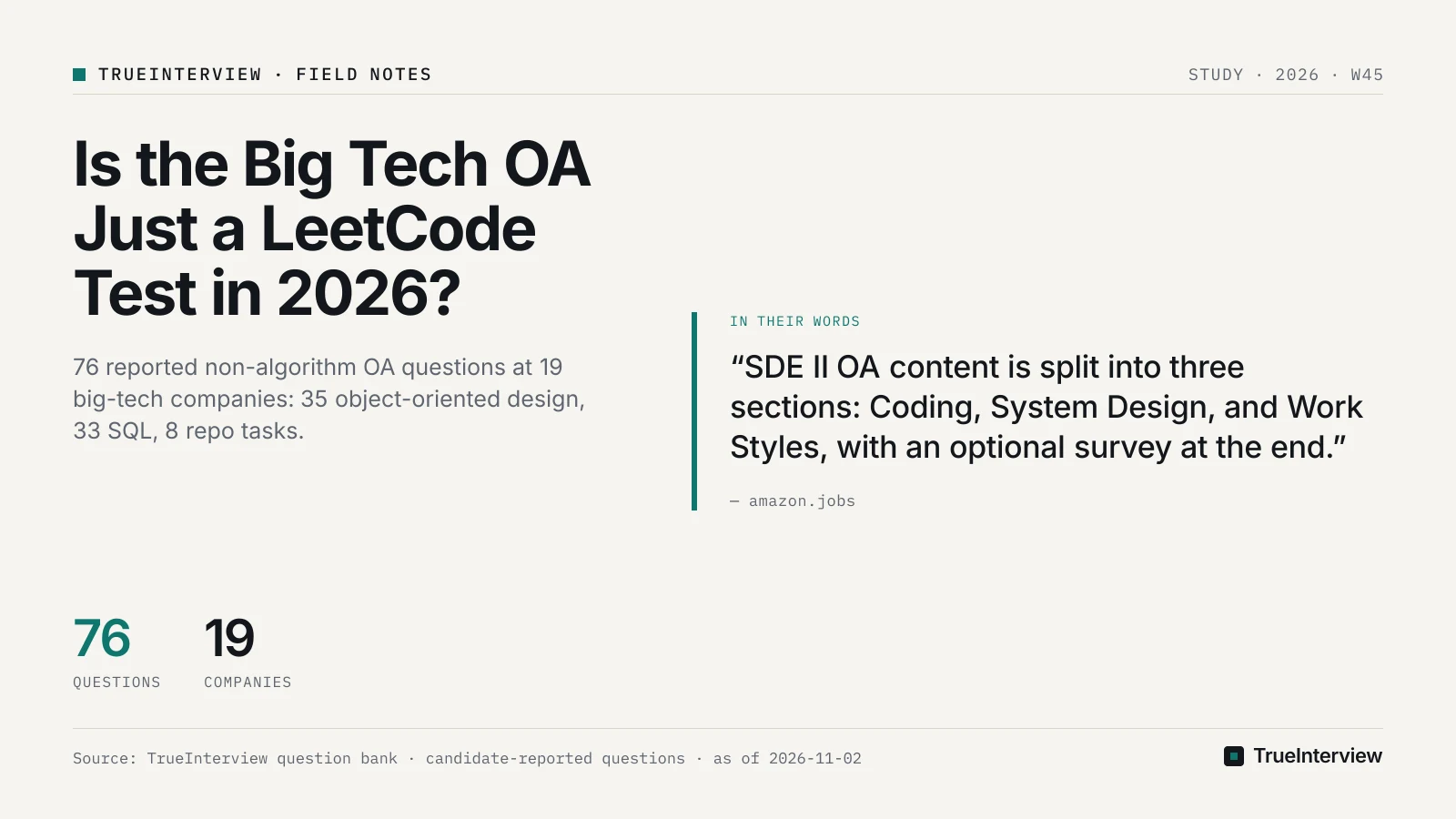
No. LeakCode's guide describes the typical large-tech online assessment as "2-3 algorithmic coding problems in 70-120 minutes". But as of 2026-11-02, TrueInterview's bank holds 76 non-algorithm OA questions reported at 19 big-tech companies: 35 object-oriented design questions, 33 SQL questions and 8 multi-file repo tasks. Our take: which format you meet depends far more on the company than on your algorithm skill, so identify your target's OA format before you open another algorithm list.
Disclosure: TrueInterview is an interview-preparation product and publishes this article. Facts about other products come from their public pages on the dates listed under Sources.
What does the LeetCode belief get right?
It is right about the timed coding section, which official prep pages and guides still describe in algorithm terms. Amazon's SDE II prep page gives its coding challenge "90 minutes for 2 questions". LeakCode reports that Amazon OAs in 2025-2026 cluster around one medium array problem and one medium graph or DP problem. If your target's reported OA questions are all algorithmic, timed LeetCode-style practice at medium difficulty is the right preparation.
Fundamentals also show up outside the coding problems. LeakCode says some companies add multiple-choice sections on data structures, complexity or debugging. Even HackerRank, which argues for moving past algorithm puzzles, writes: "Someone still needs to reason about complexity, correctness, and tradeoffs at a basic level."
Our take: keep algorithms as the floor of your OA preparation. The belief fails when it becomes the ceiling, because it says nothing about the object-oriented build, SQL query or repo task that candidates at Coinbase, Airbnb, Anthropic, Meta and ByteDance report in the same slot. For the wider question of how far algorithm practice carries you through the whole loop, see Is LeetCode still enough for big tech interviews in 2026?.
What does the bank show instead?
A second OA family that is current and lives almost entirely in the OA round. Of the non-algorithm OA questions in the bank, 47 were last reported within the 12 months before 2026-11-02. All 76 were reported in the OA round, and only a handful of those questions were also reported in onsite (3), take-home (2) or phone-screen (1) rounds. Look up your target company's reported OA format in the table below before your next study session.
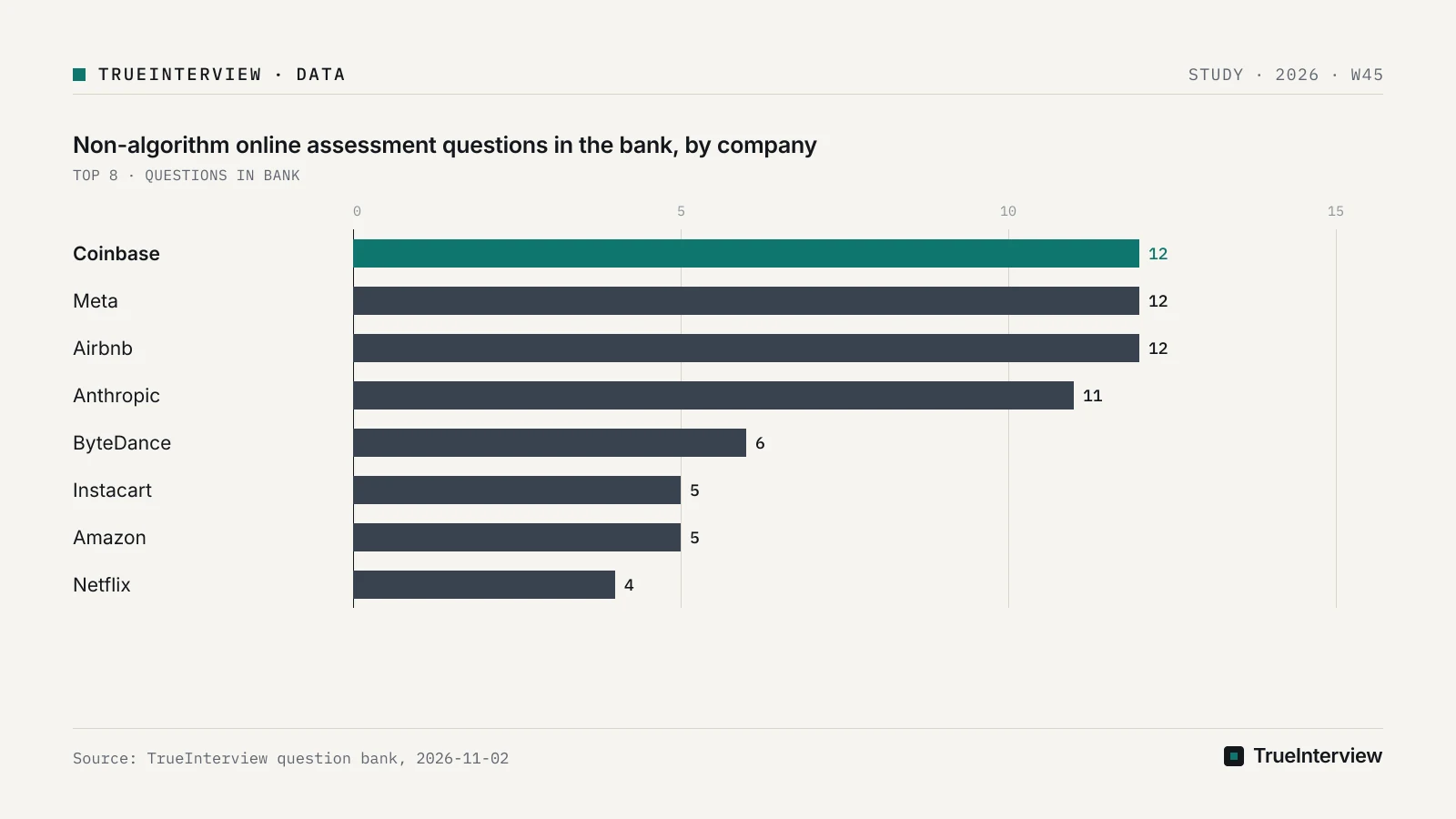
The company split is where the belief breaks down. The companies with the most non-algorithm OA questions in the bank are Coinbase, Meta and Airbnb (12 each), Anthropic (11), ByteDance (6), Instacart and Amazon (5 each), Netflix (4), Stripe (3) and Databricks (2). The format mix inside each company matters more than the total:
| Company | Object-oriented design | SQL | Multi-file repo | What to drill first |
|---|---|---|---|---|
| Coinbase | 10 | 0 | 2 | Progressive OOD builds |
| Airbnb | 11 | 1 | 0 | Progressive OOD builds |
| Anthropic | 10 | 1 | 0 | Progressive OOD builds |
| Meta | 5 | 7 | 0 | SQL and OOD, split evenly |
| ByteDance | 0 | 5 | 1 | SQL |
| Instacart | 4 | 0 | 1 | OOD builds plus a repo rehearsal |
These are candidate-reported questions reconstructed for practice, not any company's official question list. The counts show what candidates reported, not how often a company asks a format, so read each row as a direction for your first week of preparation rather than a probability.
Our take: Coinbase, Airbnb and Anthropic candidates report almost nothing but object-oriented design in this slot, so an algorithm-only plan leaves the most-reported format at those companies untouched. Meta is the one company in the table where you genuinely need both SQL and OOD. ByteDance is the cleanest SQL target.
What is a progressive object-oriented design OA?
It is one class-based system, such as a bank, an in-memory database or a file system, that you extend level by level as new requirements arrive. It is the most-linked non-algorithm shape in the bank: Progressive Banking System is linked from 19 candidate write-ups from Meta and Airbnb. It was last reported in an Airbnb OA in 2026-10, so this is a live format.
The recurring builds fall into three problem families: ledgers, in-memory storage and state machines. The most-linked ones, with the design decisions that decide whether your later levels pass:
| Question | Companies and write-up links | Our design advice |
|---|---|---|
| Progressive Banking System | Meta, Airbnb: 19 | Keep one account store and one transaction log as the source of truth, and validate every transfer (unknown account, insufficient funds, same account) before any state changes |
| In-Memory Database | Coinbase, Anthropic: 9 | Store a map of records to field maps, and decide early how you would represent time and snapshots so that a later requirement of that kind does not force a rewrite |
| Recipe Manager | Anthropic, Coinbase: 8 | Keep entities separate from the query methods, so new queries add code without touching storage |
| Bank System with Transfer/Accept and Merge | Anthropic: 5 | As the title suggests, model a transfer awaiting acceptance as its own object with a state, and set a clear rule for history and open transfers when two accounts merge |
| In-Memory File System | Airbnb: 5 | Parse paths once into a tree of directory nodes, and keep size and metadata on the node |
| Bank System | Coinbase: 4 | Practise the same ledger core: an account store, a transaction log and validation before mutation |
The family reaches beyond banks and storage. Payment State Machine was last reported in a Stripe OA in 2026-10. There, the decisions that matter are an explicit transition table and what your code does when the same event arrives twice. LeakCode says Bloomberg OAs use HackerRank and focus on OOP design problems such as an event system, a calendar or a basic LRU cache.
Our take: build one banking system end to end under a timer before you touch a list of small OOP exercises. The skill being tested is extending your own design without rewriting it, and small exercises never make you live with a design across levels. Once the ledger build feels routine, the in-memory database is the next best use of an evening.
Where does SQL show up in the OA?
SQL is almost as common as object-oriented design in the bank, at 33 questions, and Meta and ByteDance hold the largest SQL counts in the company table: Meta has 7 SQL OA questions and ByteDance has 5 among its 6 non-algorithm OA questions. The rest are spread across other companies, including a Pinterest example below. If your target is Meta or ByteDance, SQL deserves its own track; elsewhere, check your company's own reports before deciding how much SQL to practise.
The reported examples are standard analytics queries. Longest Consecutive Login Days per User was last reported in a ByteDance OA in 2026-07. It is a gaps-and-islands problem: deduplicate login dates per user, subtract a per-user ROW_NUMBER from each date, and the largest group per user is the streak. Top Two Categories by Engagement Rate per Country was last reported in a Pinterest OA in 2026-09. It needs a grouped ratio per country and category, a cast before dividing so integer division does not zero the rate, and a rank partitioned by country with a stated rule for ties.
Our take: SQL is the cheapest OA format to close. Window functions over partitions and grouped ratios cover both examples, and the failures that sink submissions are ties, duplicates and integer division rather than syntax.
Are AI-assisted and repo OAs replacing algorithm OAs?
Not yet. Multi-file repo tasks are 8 of the 76 non-algorithm OA questions, and they sit at a few companies such as Amazon, Instacart, OpenAI and Coinbase. They are real and recent, so treat them as a company-specific format rather than the new default. Note what the evidence does not show: no source here confirms which of these OAs let you use an AI assistant, beyond what titles such as Instacart's AI-pairing assessment imply, so read your invite or ask your recruiter whether AI tools are allowed.
AI Assistant Repo Bug-Fix was last reported in an Amazon OA in 2026-10 and is linked from 17 candidate write-ups. Full-Stack AI-Pairing Assessment was last reported in an Instacart OA in 2026-06. Time-Based Key-Value Store with Production Testing was last reported in an OpenAI OA in 2026-09 and is also filed under ByteDance and Uber, though only 1 candidate write-up links to it.
The pressure behind the format is plain. HackerRank's blog says "A candidate with a model open in another tab can produce a clean, working solution to almost any standard algorithm question in under a minute." HackerRank's proposed Plan/Build/Review framework lets candidates build with AI tools present and then probes the reasoning behind their decisions in Review. Fixing existing code is not new either: LeakCode says Microsoft OAs typically include a debugging round where candidates fix existing code instead of writing new code.
Our take: if your target is Amazon, Instacart or OpenAI, rehearse a repo task properly: run the tests first, reproduce the failure, read the call path, and make the smallest fix before you refactor anything. Everywhere else, a single rehearsal is enough. For how these rounds differ at senior level, see AI-assisted vs LeetCode interviews.
What do graders push on beyond the algorithm?
Tests across every stage of the task, and at Amazon, sections that are not coding at all. LeakCode says "OAs are scored on test cases passed, not code quality or explanation." Our reading for progressive builds: a design that breaks at a later level costs you every test from that level on, so structure is how you earn points there.
Amazon's SDE II prep page is the clearest official example of an OA that is wider than LeetCode: "SDE II OA content is split into three sections: Coding, System Design, and Work Styles, with an optional survey at the end." Only the 90-minute coding challenge is timed, but Amazon recommends reserving two hours for the whole OA. Amazon says the OA lets it see coding skills and learn about systems thinking, leadership styles and preferred ways of working. Amazon's prep page also says to expect syntactically correct code, not pseudo code. That structure is Amazon's SDE II OA only, so do not assume another company or level uses the same sections.
LeakCode advises getting a working brute-force submission in the first 15-20 minutes, even if it is slow. The OOD equivalent is passing the first level cleanly before you design for the last one.
Our take: across formats, graders push on four things an algorithm list does not train: requirements that arrive in stages, state that must stay correct across those stages, an existing codebase you did not write, and, at Amazon, non-coding sections. For an OOD target that means rerunning earlier levels' tests after each change; for a repo target, reading the code before editing it.
Who does the LeetCode belief still work for?
Early-career candidates whose target company runs an algorithm OA and has no reported non-algorithm format. CodeSignal's CEO says that for early talent or new graduates, assessments focus on foundational coding, algorithms and data structures. LeakCode says Google uses CodeSignal for university recruiting with standardized problem sets. For those candidates, algorithm practice remains the main track.
The belief also depends on role. CodeSignal's CEO says assessments differ by role, so a front-end engineer gets a front-end assessment that asks them to build components. And it misleads juniors at OOD-heavy companies: as the next section shows, most write-up links to these non-algorithm questions come from junior candidates, not seniors.
Our take: if you are a new grad targeting Coinbase, Airbnb or Anthropic, the belief is wrong for you too, because junior candidates wrote most of the reports behind the progressive builds.
What changes at senior and staff level?
Fewer senior candidates report these formats, but seniors do report them. Candidates who self-reported a senior, staff-plus or manager level account for 23 write-up links to these questions, against 95 from candidates who self-reported junior, new-grad or intern levels. That reflects who wrote and linked reports, not your odds, and some builds are reported mostly by senior candidates, so prepare those first.
Worker / Employee Grant Management was last reported in an Anthropic OA in 2026-07. It is linked from 4 senior-or-above write-ups, 1 of them staff-plus or manager, and 1 junior. Versioned File System, last reported in a Netflix OA in 2026-05, is linked from 3 senior-or-above write-ups and 1 junior. Bank System splits 2 and 2. The most-linked build skews the other way: Progressive Banking System has 2 senior-or-above links against 17 junior, and In-Memory Database has 2 against 7.
Our take: the questions above with the most senior-reported links are object-oriented builds, so at senior level that is the non-algorithm format we would prepare first, and its multi-level extension is close to day-to-day design work. Treat it as a chance to show clean, extensible structure: domain objects separate from the command layer, validation at the boundary, and each invariant enforced in one place. For a versioned store, decide early whether a version is a full snapshot or a diff, because every later level inherits that choice.
Down-leveling note (our view): none of the evidence here shows a company setting level from an OA result, so we treat the OA as a gate. In our view, level is more likely to be set by the design round's depth, the project deep dive and the scope of your behavioral stories. Amazon's System Design and Work Styles sections, described above, are the exception worth preparing seriously, because they ask how you think and work rather than only whether your code passes.
Which OA format should you drill for your target company?
Pick one primary format from your company's reported split, and keep algorithms running underneath it. Use the table below; if your company is not in it, default to algorithm practice plus a single object-oriented build, which covers the most-linked non-algorithm shape.
| Target | Primary drill | Add on |
|---|---|---|
| Coinbase | Progressive OOD builds | A repo bug-fix rehearsal |
| Airbnb or Anthropic | Progressive OOD builds | A single SQL refresher |
| Meta | SQL and OOD, split evenly | Algorithm practice |
| ByteDance | SQL window and grouping queries | Algorithm practice |
| Amazon | Algorithm practice | A repo bug-fix rehearsal, plus the System Design and Work Styles sections |
| Instacart | Progressive OOD builds | An AI-pairing or repo rehearsal |
| OpenAI | Algorithm practice | A repo rehearsal built around its reported example |
| Not listed | Algorithm practice | A single progressive OOD build |
A worked example: take an Airbnb invite. Airbnb's reported questions are almost all object-oriented design (see the company table), the latest Progressive Banking System report came from an Airbnb OA, and In-Memory File System is linked from 5 Airbnb write-ups. So your first week goes to the banking build, level by level under a timer, your second to the file system, and SQL gets a single refresher. A ByteDance invite flips the plan: its reported questions are mostly SQL, so the same weeks go to window and grouping queries, starting with Longest Consecutive Login Days per User.
Ignore questions that no write-up links to as evidence of what a company asks. Task Management System III, for example, is linked from 0 candidate write-ups.
How we counted
The counts come from TrueInterview's database as of 2026-11-02 and cover candidate-reported questions reconstructed for practice that we file as non-algorithm OA questions. The company, round, recency and level splits come from the same filing, and some filed questions have no linked write-up at all, such as Banking System (Progressive OOD). A count measures what candidates reported and which write-ups we collected, not how often a company asks a format, and a write-up link count is not the number of interviews held. Level comes from the candidate's own self-reported description, as in the senior and junior link counts above.
FAQ
How many problems and how much time does a big-tech OA give you?
It depends on the platform and the company. CodeSignal's General Coding Framework has four questions and roughly 70 minutes, with the first two typically foundational and the last two more advanced and involving optimization. Amazon's SDE II coding challenge, described above, has fewer questions and more time per question, and it sits inside a longer OA with non-coding sections. For a progressive object-oriented build, budget your time by level rather than by problem, and bank the early levels before you design for the later ones.
Is partial credit given on an OA?
On CodeSignal's General Coding Framework, yes: CodeSignal says partial credit is given for incomplete answers. Its CEO says maybe 1 percent of candidates finish all four questions, and that companies may move forward with the top 10, 20 or 30 percent depending on how many roles they need to fill. The CEO also says the GCF is rarely the only signal used to evaluate a candidate, and names jumping between questions as one of the biggest mistakes candidates make. Work the questions in order, and submit a partial solution that passes some tests before moving on.
Which platforms do big-tech OAs use?
The sources we checked name HackerRank and CodeSignal. Amazon suggests getting comfortable coding within HackerRank before its SDE II OA. LeakCode's guide names HackerRank for Bloomberg and CodeSignal for Google's university recruiting, as covered above. Before your OA, do one timed session in the editor your invite names, because an unfamiliar test panel, input format or autocomplete costs minutes you cannot spare in a timed section.
Should you stop practising LeetCode-style problems?
No. HackerRank's blog argues that LeetCode-style interviews "were already a weak signal before AI," yet the same post insists on fundamentals, as quoted earlier. Algorithms remain the floor for every OA format in this article: a progressive build still needs the right data structure at each level, and a SQL query still needs to handle duplicates and ties correctly. Keep a steady algorithm habit, and add the format your target company's candidates report instead of replacing one with the other.
Will these exact questions appear in my OA?
Not necessarily. These are candidate-reported questions reconstructed for practice rather than any company's question list, as the company section notes. Use them to learn the format and the design decisions each family tests. Expect your own OA to change names, entities and level requirements even when the shape is the same, which is why practising the extension habit beats memorising any single solution.
Your practice plan
This is a three-week plan for someone working full time, with one weekday session and one longer weekend session each week.
- Today, find your target in the company table and the decision table, and write down your primary format and your add-on. If your company is missing, choose algorithm practice plus a single object-oriented build.
- In the first week, if your primary format is object-oriented design, build Progressive Banking System from scratch under a timer, extending the same classes at each level instead of rewriting, and rerun every earlier test after each level.
- In the second week, build In-Memory Database; for Airbnb swap in In-Memory File System, and for Anthropic add Bank System with Transfer/Accept and Merge.
- If SQL is your primary format, write Longest Consecutive Login Days per User and Top Two Categories by Engagement Rate per Country without looking anything up, then rewrite each with a different window function and test ties, duplicates and empty groups.
- If your target is Amazon, Instacart or OpenAI, work AI Assistant Repo Bug-Fix or Full-Stack AI-Pairing Assessment: run the tests, reproduce the failure, read the call path and make the smallest fix before anything else.
- If you are interviewing at senior or staff level, add Worker / Employee Grant Management or Versioned File System, then review your finished code as if a teammate had to add the next level tomorrow.
- In the final week, take a full mock in your primary format under the real time limit, in the editor your invite names; for Amazon, reserve the full block Amazon recommends and prepare the System Design and Work Styles sections as well.
Sources
- OA Online Assessment Questions: Complete Guide (2026) | LeakCode — checked 2026-11-02
- TrueInterview question bank — non-algorithm online assessment at big-tech companies — counted 2026-11-02
- Online Assessment Prep: Software Development Engineer II — checked 2026-11-02
- Is Leetcode Dead? - HackerRank Blog — checked 2026-11-02
- Advice from CodeSignal CEO, Tigran Sloyan, on prepping for tech interviews & assessments | CodeSignal — checked 2026-11-02
Last reviewed: 2026-11-02.