Study
AI-Assisted vs Traditional Coding Interviews: What Changes
TrueInterview
October 11, 2026 · 15 min read
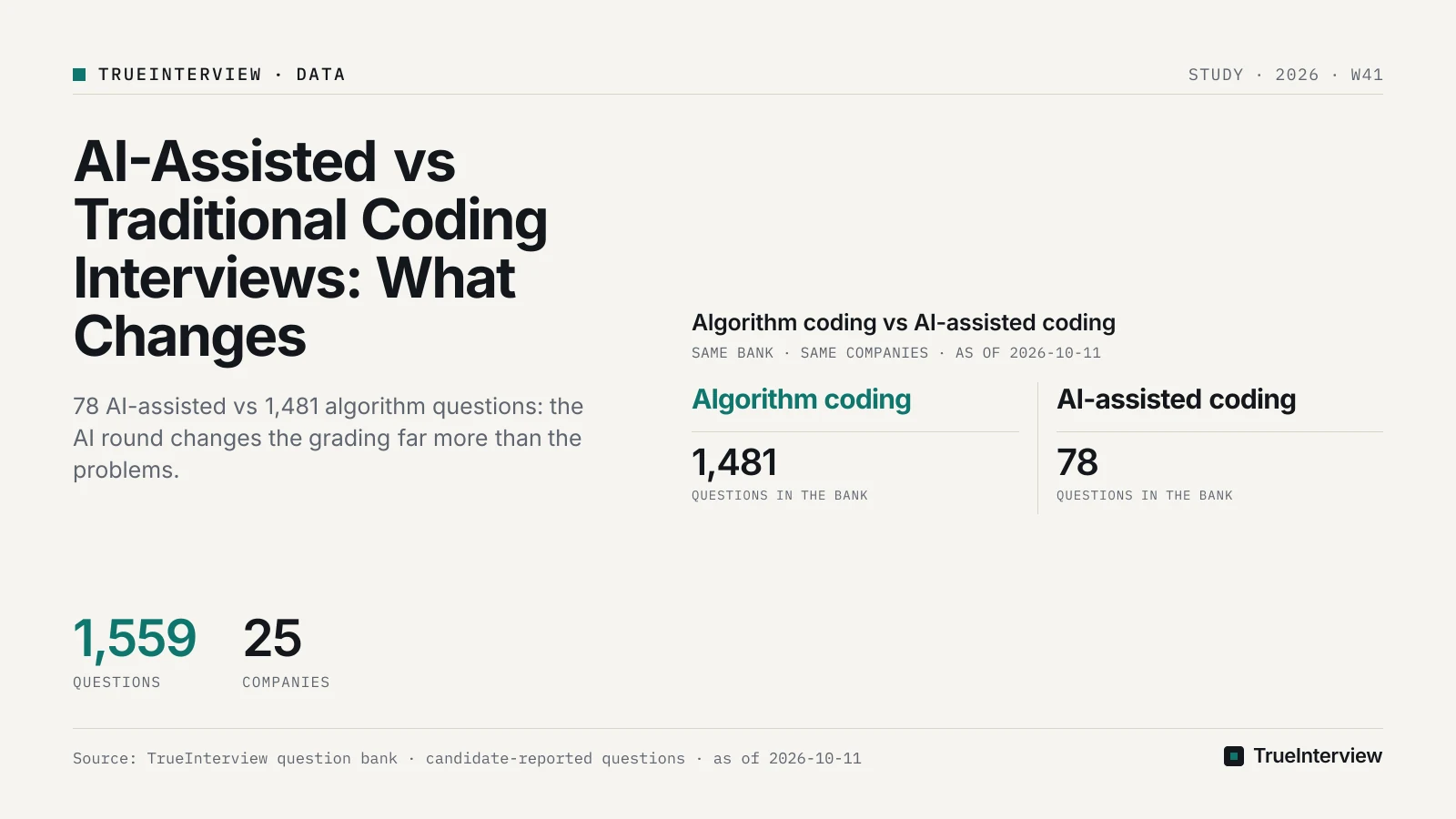
As of 2026-10-11, TrueInterview's bank holds 1,559 candidate-reported coding questions from 25 big-tech companies, and 78 of them are AI-assisted coding rather than classic algorithm questions. The problems overlap more than the label suggests: LRU Cache, a textbook data-structure problem, is linked from 24 write-ups at 7 companies, and at Apple it is reported as an AI-assisted phone-screen question, last seen 2026-09. What changes is the grade. A traditional round scores whether you can produce a known algorithm, and an AI-assisted round scores how you frame the task, catch the tool's mistakes and keep ownership of the result.
Disclosure: TrueInterview is an interview-preparation product and publishes this article. Facts about other products come from their public pages on the dates listed under Sources.
How do the two formats compare side by side?
The traditional round is still the default, and the AI-assisted round is a targeted variant of it rather than a replacement. Read the table by row: the problems overlap, while the tools, the grading and the round where each format shows up do not.
| Criterion | Traditional (algorithm) round | AI-assisted round |
|---|---|---|
| What you build | A known algorithm from a blank editor; Vinit Shahdeo's Substack says this tested "a narrow band of ability" | Vinit Shahdeo's Substack describes a multi-file codebase where you fix a bug, implement a core feature, then optimize |
| Tools allowed | Cerebras's blog describes the classic setting as no AI tools, little context and recall under time pressure | Cerebras's blog says candidates in designated AI rounds are told in advance that AI is allowed and expected |
| What is graded | A gayle.com blog post on Google's process describes a qualitative judgment of how you solved it, how long it took, your mistakes and the help you needed | Cerebras's blog lists problem framing, verification, judgment, communication and ownership |
| Round where reported | Phone screen first: 907 algorithm-format questions reported there, 463 onsite and 258 in the OA | Onsite: 64 of the 78 AI-assisted questions were reported for the onsite |
| Senior share of links | Close to even across the whole coding bank: 1,333 senior-or-above against 1,240 junior-or-below links | Uneven by subtype: AI/ML build 37 against 14 and code review 6 against 2, while debugging is 44 against 45 |
| Companies leading | Graph-heavy loops: Google (graphs 41), Uber (graphs 39) and ByteDance (graphs 33) | Named examples at Apple (phone screen), Meta (onsite) and Stripe (onsite) |
| Best for | Every loop as the base layer, and any loop whose next step is a phone screen or OA | A round the recruiter has confirmed as AI-assisted, a debugging or AI/ML-build onsite slot, and senior candidates who want the coding hour to show judgment |
Traditional round: it carries your phone screen and OA in almost every loop, so it gets most of your hours, ordered by the topic counts below.
AI-assisted round: it is rarer and concentrated in the onsite, so it gets a fixed block of four to six sessions on problems you have already solved, such as LRU Cache and Maze Solver.
Is the AI-assisted round a new question bank?
Partly. Textbook problems such as LRU Cache and a grid maze search show up in assisted form, so your existing practice on them carries over with a tool added to the loop. The largest assisted subtypes, AI/ML build and debugging, are build-and-repair tasks that need their own reps, which the preparation section orders by subtype count.
LRU Cache, two ways
LRU Cache is filed under Meta, Microsoft, Amazon, Oracle, ByteDance, Apple and LinkedIn, and its write-up links split evenly at 12 senior-or-above and 12 junior-or-below. In the classic version you write a hash map over a doubly linked list and state the constant-time bound. In the assisted version the tool writes that in seconds, and the round turns on whether you read the output closely enough to see a get call that never moves the key to the front, or an eviction that unlinks the node but leaves it in the map.
Those are the defects Cerebras's blog has in mind when it says strong candidates "notice when generated code changes an interface, ignores a constraint, handles only the happy path, or adds complexity that the problem does not need." Before you read the generated code, say the invariant aloud (every key in the map is also in the list, and the head is the most recent entry), then check each method against it.
Maze Solver and Mako Template Engine
Maze Solver is an AI-assisted onsite question at Meta, last reported 2026-09, and all 24 of its write-up links come from Meta, 18 of them from senior-or-above candidates. The core is breadth-first search over a grid. Before trusting a generated search, test it on an exit that cannot be reached and on a start cell that is already the goal, because those are the branches a happy-path answer skips.
Mako Template Engine is an AI-assisted onsite question at Stripe, last reported 2026-06. It is the least textbook of the three, and that is useful: it stretches the assisted round toward reading and changing an unfamiliar module, which is the work you would review in a normal week.
Our take: the label AI-assisted makes the format sound like a new subject to study. For textbook titles it behaves like a grading change applied to familiar problems, so rerun them under the new rules before hunting for a separate list. Reserve the new material for the build and repair subtypes, where reading unfamiliar code is the skill being tested.
What does each round actually grade?
Both rounds grade how you work, but the material differs: your own code in one, the tool's code in the other. In a traditional round you are judged on code you produced; in an AI-assisted round you are judged on code you accepted. Cerebras's blog says AI output is often subtly wrong and that, as a result, "verification has become one of the strongest signals in an interview".
The traditional rubric was never only about the right answer. A webcoderspeed.com guide says most FAANG coding interview failures are process failures rather than algorithmic ones, and an ex-Google, ex-Meta interviewer quoted by codingcareer.de says, "The interview is a conversation, not an exam." If your classic practice is silent and timed, you are training half the rubric.
The assisted rubric adds a second layer. Cerebras's blog says evaluation covers how you frame a request, provide context, break work into verifiable steps, recognize an incomplete or wrong answer, and decide when to challenge the tool. Vinit Shahdeo's Substack says the interviewer can see the entire AI conversation, including every prompt, every accepted response and every ignored suggestion. Treat the transcript as a work product: a vague prompt such as asking the tool to solve the whole problem reads worse than a scoped one that names the data structure and the test you will run.
Cerebras's blog also says a candidate who catches and corrects a polished-looking mistake often gives a stronger signal than one who produces a lot of code without showing understanding. Our take: most advice frames the assisted round as a prompting test. Prompting is cheap and every candidate can do it. The scarce skill is refutation, so a session where you wrote fewer prompts and rejected more output is usually the stronger one.
Who gets which format, and how do you confirm it?
Most candidates get the traditional round, and some get both. Classic algorithm questions took 87% to 95% of write-up links in each of the last four quarters, while AI-assisted questions took 7%, 11%, 13% and then 5%. Read those as shares of what candidates reported, not as how often companies run each format.
The quarterly link totals mostly reflect how many write-ups were collected, so the shape is a rise through mid-2026 followed by a drop, not a clean growth curve. Plan for the assisted round as one onsite slot at most, unless a recruiter tells you otherwise. If the AI-assisted examples above (Apple, Meta, Stripe) are at companies on your list, make those titles your rehearsal set; otherwise keep one session.
Company signals are mixed. Vinit Shahdeo's Substack reports that Meta started rolling out AI-enabled coding interviews in late 2025 and that Google is piloting a Gemini-assisted format for software engineering candidates. An AI lab on your list does not by itself mean an assisted round: Infection Spread Simulation is linked from 34 write-ups from OpenAI and Anthropic and is reported at OpenAI as a classic coding phone-screen question, and Web Crawler is linked from 17 Anthropic write-ups. For those loops, simulation and graph traversal come first.
Ask the recruiter which rounds allow an assistant before you split your hours. ExtraBrain's blog notes that some interviews allow notes, search, documentation or AI assistance while others explicitly prohibit outside help. These four questions settle what to practise.
| Ask the recruiter | Why it matters | What to do with the answer |
|---|---|---|
| Is any coding round AI-assisted, and which one? | One loop can contain both formats | If none, put every coding hour on the algorithm list |
| Which assistant is provided, and may I bring my own tools? | The rules differ by company and platform | Practise with the same kind of tool, chat-only if that is what you will get |
| Is the task one problem or a multi-file codebase? | A codebase task rewards reading speed over recall | Add repository-reading and debugging reps |
| Is there still an unassisted algorithm round? | Assume yes until told otherwise | Keep at least one unassisted timed session every week |
How should your preparation differ?
Traditional preparation is a topic list ordered by round; AI-assisted preparation is a verification habit run on problems you already know. For phone screens, the algorithm reports lead with graphs (155), hashing (119), strings (116) and arrays (86). Onsites lead with graphs (97) and strings (73), and OAs lead with arrays (54).
That order is the backbone of your first week. If your next round is a screen, graphs and hashing come before anything else; if it is an OA, start with arrays and strings.
For the assisted block, order by subtype. Across the 78 AI-assisted questions, AI/ML build leads with 22, then debugging 19, implementation 13, object-oriented build 10, frontend build 5, data build 5 and code review 4. Among the 64 reported for the onsite, debugging leads with 18 and AI/ML build follows with 16. If your onsite is next, those two subtypes are where the assisted reps go.
| Prep element | Traditional round | AI-assisted round |
|---|---|---|
| Unit of practice | One unseen problem, blank editor, timed | One problem you have solved before, with an assistant, narrated aloud |
| Order | By round: graphs and hashing for screens, arrays for OAs | By subtype: debugging first, then AI/ML build |
| Success check | Passes your tests and you can state the complexity | You named a defect in generated code and fixed it |
| Debrief note | Which pattern you missed | Which suggestion you rejected, and why |
Two habits carry over from the strongest reports. Vinit Shahdeo's Substack says the best candidates spend the first five to ten minutes reading, asking clarifying questions and forming a plan before they prompt, and that strong candidates read every line, run tests and look for edge cases the AI missed. In practice that means a written plan and two clarifying questions before the first prompt, and a test run after every generated block.
Two opinions dominate this topic. An ex-Google, ex-Meta interviewer quoted by codingcareer.de says, "Over-preparation is LeetCode hard, hands down." One engineer's Medium post argues that code reviews can be a better way to evaluate candidates than coding exercises. The first is a view about how candidates prepare and the second is a view about how companies should interview, and the bank's counts settle neither: they show what candidates report facing, not which opinion is right. Our take: for your own preparation, follow the first and treat the second as a direction of travel. Drop the hard-problem grind, keep medium-difficulty classics in graphs, hashing, strings and arrays, and add code reading as a layer on top, because the classic round is what most write-ups in the bank describe.
What changes at senior and staff level?
The senior skew in the assisted format is specific rather than general. By candidates' self-reported levels, AI/ML-build questions draw more than twice as many senior-or-above links as junior-or-below ones, and code review leans the same way, while debugging and implementation are level-neutral. If you are senior or staff, weight your assisted block toward building and reviewing.
Several questions are linked only from senior-or-above write-ups: AI Code Craft Challenge: Delayed-Delivery Workflow Engine (10), Distributed Mode and Median (8), Design Cluster Message Aggregation (7) and ML Coding from Scratch (4). The workflow engine and the from-scratch ML task are build problems, the kind where an assistant can write the bulk and you are judged on decomposition and the checks you put around it.
On the algorithm side, the senior share is highest for math (69 against 43), binary search (65 against 48) and intervals (67 against 50), and dynamic programming leans junior at 59 against 91. A senior candidate short on evenings can trade some dynamic-programming depth for interval problems without leaving the reported range.
Staff-plus and manager evidence is thin. Titles such as Trapping Rain Water, Encode And Decode, Service Dependency Topological Order, File Profiler, Minimum Meeting Rooms and Stack Trace Reconstruction each carry one link from those write-ups. Read them as the range a staff loop can span, from a classic array problem to a service-dependency ordering task, not as a pattern.
An interviewer's guide on joshpaulchan.com says, "I expect higher levels to operate more autonomously." Our take: in an assisted round, autonomy is visible in the transcript. At staff level you set the plan before the first prompt, scope each request to one verifiable step, and correct the tool when it drifts. Lines typed count for little next to how you directed and corrected the work.
Down-leveling note
This is our view, not a reported finding. In a traditional loop the level signal sits mostly in system design depth, the project deep dive and behavioral scope, and a coding round rarely lifts you a level, though a weak one can pull you down. In an AI-assisted round some of that signal moves into the coding hour: a senior candidate who accepts generated code without reading it looks mid-level, and one who catches the tool's mistake and explains the trade-off looks senior.
How we counted
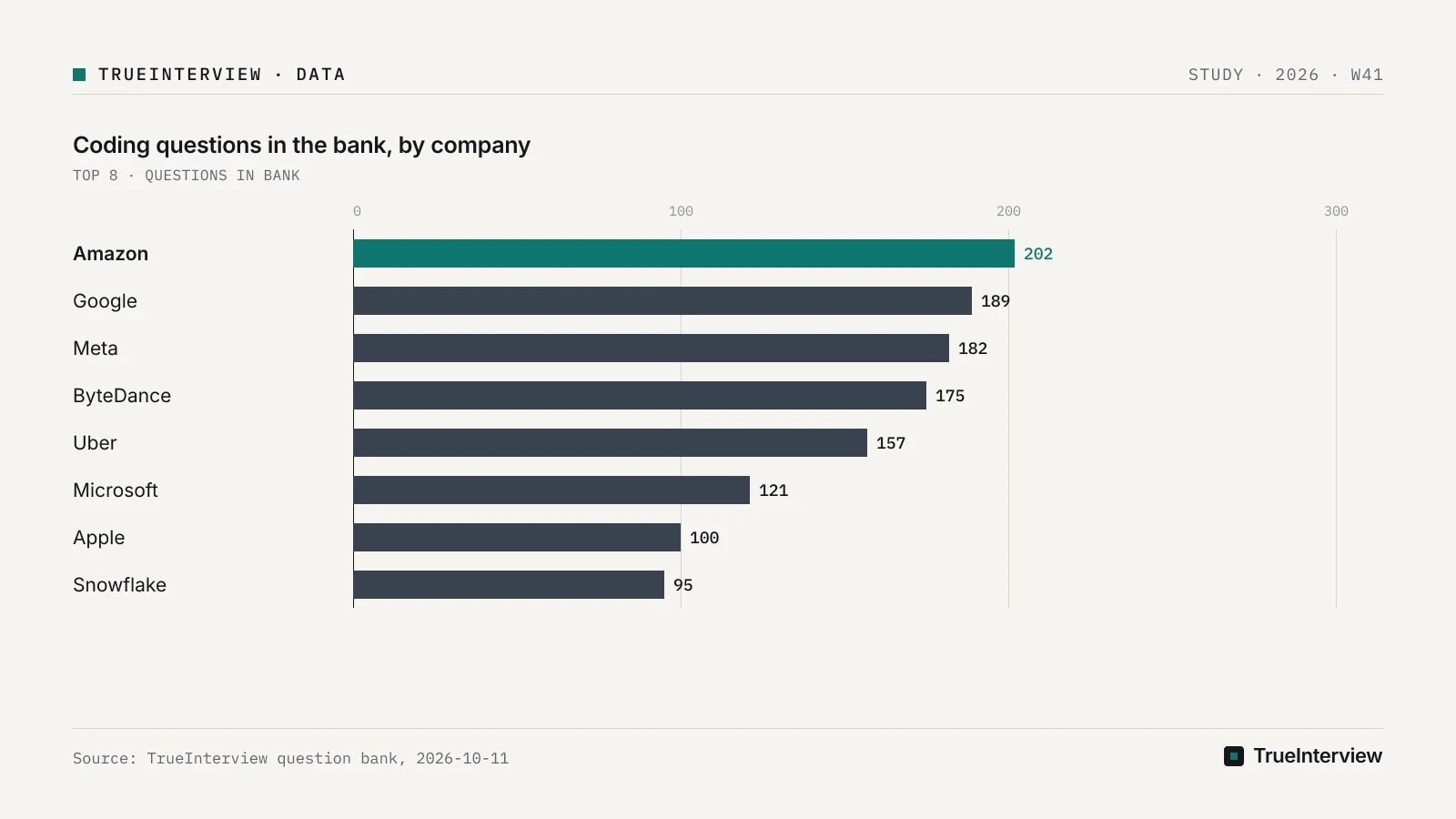
Counts are questions filed in TrueInterview's bank as of 2026-10-11 and the candidate write-ups that link to them; levels are the candidates' self-reported levels, and a question can be reported in more than one round. These are candidate-reported questions reconstructed for practice, not any company's official question list. Link counts measure what candidates wrote up, not how often a company asks a question.
FAQ
Is LeetCode still relevant in 2026?
Yes, for nearly every loop. The format split above shows the classic algorithm round dominating what candidates report, and some AI-assisted examples, such as LRU Cache, are familiar algorithm titles. The ex-FAANG interviewer quoted by codingcareer.de says most real questions they ran or sat in on were array and string problems with clean two-pointer or sliding-window thinking. Keep medium-difficulty graph, hashing, string and array problems as the core, and rerun two or three of them with an assistant each week rather than abandoning the list.
Are AI assistants allowed during coding interviews?
Only in rounds that say so. Cerebras's blog says its AI-assisted rounds are announced in advance, which means every other round should be treated as unassisted. ExtraBrain's blog puts the rule plainly: "If a coding assessment or live interview forbids AI help, respect that rule." Vinit Shahdeo's Substack reports that over 35,000 AI-assisted interviews have been conducted on CoderPad alone, so the format is real. Ask the recruiter which rounds allow an assistant and which tool it will be.
Are AI-assisted coding interviews more common for senior candidates?
Not as a whole; the skew is limited to two subtypes, covered in the senior and staff section above. Maze Solver at Meta is the clearest single example of a senior-heavy assisted title. If you are earlier in your career, debugging and implementation are the safer assisted reps; if you are senior or staff, weight building and reviewing.
Is the AI-assisted format growing?
The evidence is mixed. Final Round AI's report says Q1 2026 saw an increase in AI-assisted interviews. TrueInterview's quarterly shares rose and then fell, and the totals behind them mostly track how many write-ups were collected. Plan for a real format that is still a minority of reported questions, and revisit your split if a recruiter confirms an assisted round.
Should I practise code review instead of LeetCode?
Practise both, with code review as the smaller block. One engineer's Medium post argues that as teams rely on generated code, the ability to read it quickly and identify subtle defects becomes more valuable. That is the same skill an assisted round grades, so a review rep doubles as assisted-round practice. It does not replace the algorithm list, which still carries the rounds you are most likely to face.
Your practice plan
A three-week plan for someone working full time: four evenings of about ninety minutes each week, plus one longer weekend session.
- In week one, build the classic base on graph problems: Number of Islands (Plain and Streaming), reported at Uber's phone screen in 2026-08 and linked from 18 write-ups, then Topological Sort / Course Schedule for Ads, reported at Netflix's phone screen in 2026-07. Course Schedule itself is linked from 22 write-ups across 7 companies.
- Finish week one with intervals: Minimum Meeting Rooms, reported at Amazon's phone screen in 2026-08. Solve it unassisted and say the complexity out loud before you code.
- In week two, run LRU Cache twice: once in a blank editor, then with an assistant while you narrate every prompt and every suggestion you reject. Write down the defect you caught.
- Run Maze Solver the same way, scoping each prompt to one helper, and test the generated search on an unreachable exit before you accept it.
- In week three, take Mako Template Engine as a reading and debugging rep: read the module and plan before the first prompt.
- If OpenAI or Anthropic is on your list, add Infection Spread Simulation and Web Crawler unassisted, because the bank files them as classic coding questions.
- After every assisted session, review the transcript for a plan written before the first prompt, at least one rejected suggestion and tests you ran. Keep one unassisted timed session every week. TrueInterview says AI pairing has its own workspace alongside coding, SQL, system design and object design, and the question bank and candidate write-ups hold the rest of the titles.
Sources
- TrueInterview question bank — coding at big-tech companies — counted 2026-10-11
- AI Coding Interviews in 2026: What No One Tells You Before You Walk In — checked 2026-10-11
- AI-Native Engineering Interviews at Cerebras — checked 2026-10-11
- Okay, folks, here's how the Google interview process really works — Gayle Laakmann McDowell — checked 2026-10-11
- Common Coding Interview Mistakes — 15 Patterns That Cost Candidates Offers | Webcoderspeed — checked 2026-10-11
- FAANG Interview Insights: A Conversation with Ihab A. (Ex-Google, Ex-Meta) - Guides - codingcareer — checked 2026-10-11
- LeetCode Interview AI Assistant for Coding Interviews | ExtraBrain | ExtraBrain — checked 2026-10-11
- Medium — checked 2026-10-11
- A Staff Engineer's Guide to Conducting Interviews | joshpaulchan — checked 2026-10-11
- Big Tech companies - Tech Interview Trends Report for Q1 2026 — checked 2026-10-11
- Real FAANG Interview Questions by Company · TrueInterview — checked 2026-10-11
Last reviewed: 2026-10-11.