Study
Is LeetCode Still Enough for Big Tech Interviews in 2026?
TrueInterview
October 11, 2026 · 16 min read
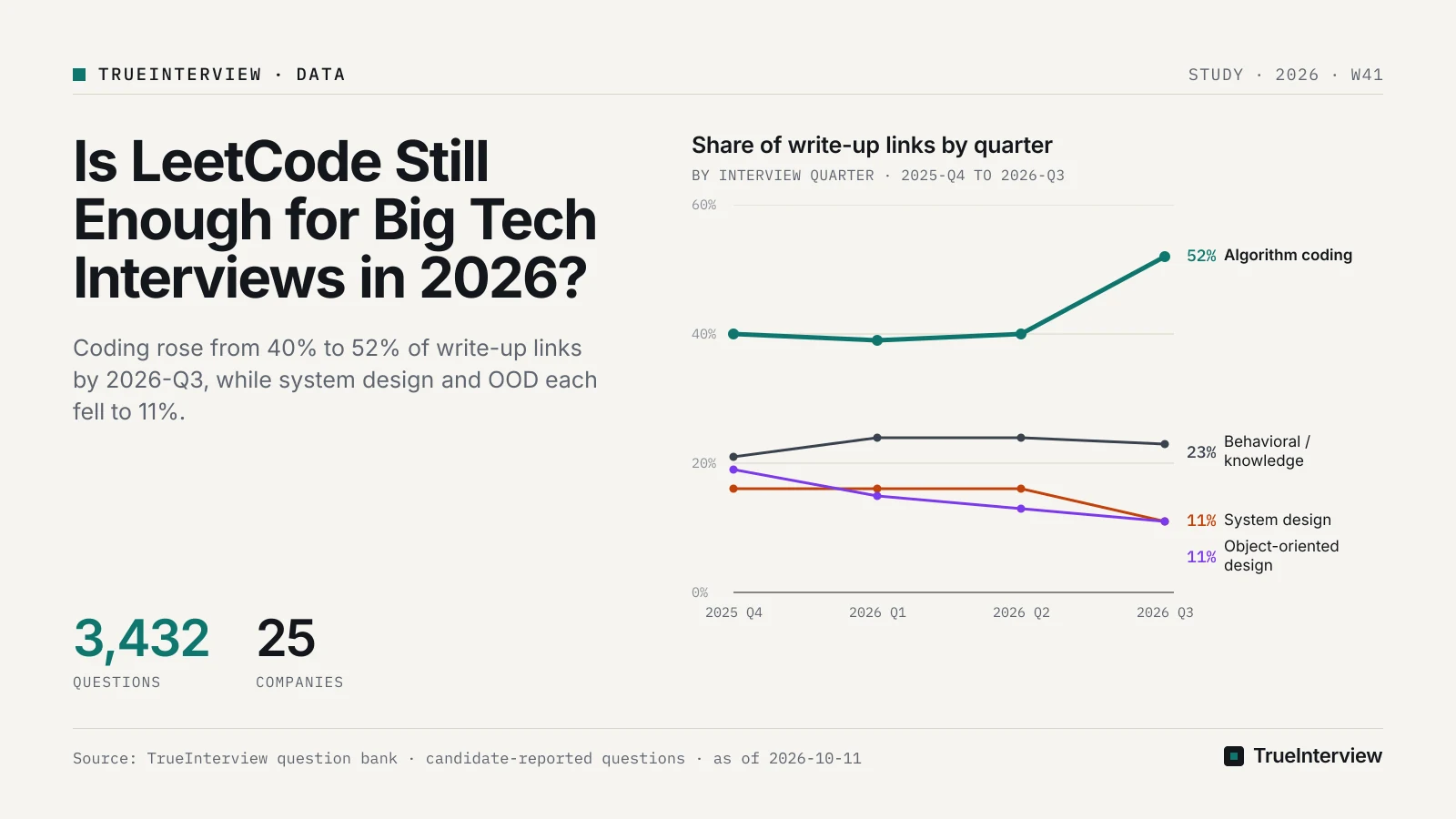
No, though it is still the largest single gate you have to clear. As of 2026-10-11, TrueInterview's bank holds 3,432 candidate-reported questions from 25 big-tech companies, and 1,481 of them are algorithm coding, with behavioral and knowledge, system design, object-oriented design, SQL and AI-assisted coding making up the rest. Coding's share of write-up links reached 52% in 2026-Q3, so the format is not fading. Our take: treat LeetCode as a floor you must clear, then spend the remaining hours on the formats that decide senior offers: system design, object-oriented design and behavioral.
Disclosure: TrueInterview is an interview-preparation product and publishes this article. Facts about other products come from their public pages on the dates listed under Sources.
Quick verdict: who is LeetCode-only prep enough for?
LeetCode-only preparation is close to enough for an online assessment and a junior phone screen, and well short of enough for a senior or staff onsite. Coding draws just over half of the write-up links from candidates who reported a junior, new-grad or intern level, and just over a third of the links from senior-or-above candidates. For senior-or-above candidates, LeetCode covers a smaller part of the reported loop.
| Your situation | Is LeetCode-heavy prep enough? (our view) | What to add first (our view) |
|---|---|---|
| Online assessment at any level | Mostly | Timed sets in arrays, strings, hashing and greedy; SQL or class design only if the invite names them |
| Junior or new-grad phone screen | Close | Narrating your approach aloud and two or three behavioral stories |
| Senior phone screen | No | One design walk-through and a project story you can defend under follow-up questions |
| Senior or staff onsite | No | System design, object-oriented design and behavioral stories with team-wide scope |
| Meta loop for a data-adjacent role | No | SQL and statistics, treated as first-class rounds |
| Amazon loop at any level | No | Leadership Principles stories, rehearsed against follow-up questions |
| Coding-heavy targets such as Uber | Closest of the big six | One object-oriented design rep a week |
The rows that follow back each verdict with counts. If you only read one row, read yours, and plan the next week from its last column.
What does the LeetCode belief get right?
The belief gets the gate right. Algorithm coding is the largest format in the bank by a wide margin, and its share of write-up links has held at about 40% for three quarters before rising in 2026-Q3. Nothing in the reports suggests big tech has dropped algorithm rounds, so a plan that cuts coding to make room for design is a plan that fails the screen.
Shares are the honest way to read a trend here, because the number of write-ups collected changes from quarter to quarter. The table shows each format's share of write-up links by the quarter of the interview.
| Share of write-up links | 2025-Q4 | 2026-Q1 | 2026-Q2 | 2026-Q3 |
|---|---|---|---|---|
| Coding (algorithm) | 40% | 39% | 40% | 52% |
| Behavioral / knowledge | 21% | 24% | 24% | 23% |
| System design | 16% | 16% | 16% | 11% |
| Object-oriented design | 19% | 15% | 13% | 11% |
Our take: read the latest quarter's jump as evidence that coding is not leaving, not as proof that it is growing. One quarter can move with the mix of companies whose write-ups arrived, and behavioral held between 21% and 24% of links throughout. The drop in system design and object-oriented design to 11% each is worth watching, but it does not change the senior picture in the level counts below.
Interviewers say the same thing about why coding stays. Steve Huynh, who conducted nearly 1,000 interviews at Amazon, around 600 of them as a Bar Raiser, writes in The Pragmatic Engineer that technical skills are the ante that gets you into the game, but not what wins the hand. That is the right reading of the latest quarter: the ante went up, and the hand is still played in the other rounds.
What does the bank show instead?
Everything outside algorithm coding is where loops differ, and it is not one block: behavioral and knowledge (824), system design (475), object-oriented design (355), SQL (219) and AI-assisted coding (78) sit beside the 1,481 coding questions, and their mix changes by company, by round and by the candidate's level. Each of those three cuts changes what you should practise next.
By company
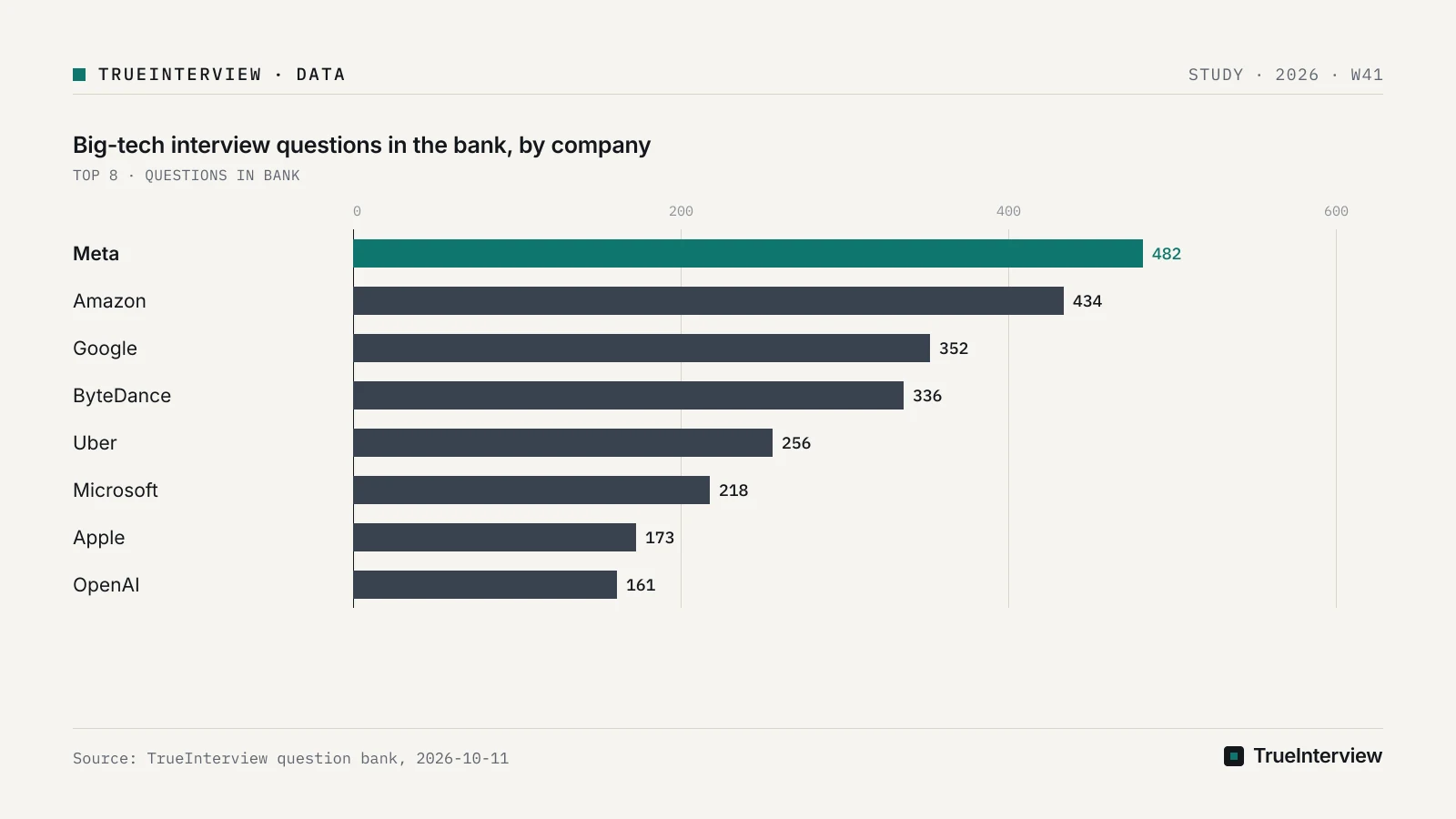
Your target company's format mix should set your hours, because FAANG is not one process. The table lists the questions filed under each of the six largest companies by format, then the largest subtypes inside their non-coding questions.
| Company | Coding | Behavioral / knowledge | System design | Object-oriented design | SQL | Largest non-coding subtypes |
|---|---|---|---|---|---|---|
| Meta | 171 | 148 | 75 | 15 | 62 | SQL, statistics 58, behavioral 39 |
| Amazon | 195 | 114 | 50 | 44 | 24 | behavioral 53, object-oriented design 38, ML fundamentals 26 |
| 189 | 86 | 39 | 30 | 8 | behavioral 39, object-oriented design 26, statistics 24 | |
| ByteDance | 174 | 81 | 37 | 21 | 22 | SQL, ML fundamentals 19, object-oriented design 18 |
| Uber | 154 | 39 | 34 | 23 | 3 | object-oriented design 21, statistics 20, behavioral 7 |
| Microsoft | 119 | 32 | 30 | 31 | 4 | object-oriented design 25, behavioral 11, ML fundamentals 7 |
Three readings matter for preparation. Among Meta's non-coding subtypes, SQL (62) leads statistics (58) and behavioral (39), so a Meta candidate in a data-adjacent role who prepares only LeetCode skips the subtype the bank files most often for Meta. Statistics and SQL are data-role subtypes, so confirm with your recruiter whether your loop includes them before you spend an evening on either. Google files 8 SQL questions, which frees those hours for design and behavioral. Microsoft files slightly more object-oriented design questions (31) than system design questions (30), so a Microsoft plan needs a class-design rep that a generic system design plan will not give you.
Design questions also differ by company. Meta's 75 design questions lean toward ads, recommendation and ranking ML (14), A/B testing and experiment design (9) and news feed and social graph (5). Google's 39 lean toward news feed and social graph (4), chat and messaging (3) and A/B testing (3). If you prepare one generic social-feed answer for both, you have prepared for Google's list and missed most of Meta's.
By round
The round you are in changes both the coding topic order and the non-coding formats you meet. A question can be reported in more than one round, so read these as separate lists rather than parts of one total.
| Round | Coding questions and top topics | Other-format questions and top subtypes |
|---|---|---|
| Online assessment | 258: arrays 54, strings 40, hashing 40, greedy 25 | 81: SQL 30, object-oriented design 27, behavioral 5 |
| Phone screen | 907: graphs 155, hashing 119, strings 116, arrays 86 | 720: SQL 132, statistics 113, behavioral 105, object-oriented design 95 |
| Onsite | 463: graphs 97, strings 73, hashing 72, arrays 61 | 758: object-oriented design 197, behavioral 130, statistics 93, SQL 61 |
The OA is the one round where LeetCode-style practice covers most of what candidates report, and its topic order differs from later rounds: arrays and strings first, graphs not in the top four. From the phone screen on, graphs lead. At the onsite, the bank files more other-format questions than coding questions, before counting the 336 onsite design questions, which lean toward ads, recommendation and ranking ML (45) and LLM, RAG and AI infrastructure (28). Our take: once you pass the OA, switch your queue to graphs first and start your first design walk-through the same week.
By level
Coding is the only large format whose write-up links are close to even across levels; SQL is also even, but on just 7 links per side. Candidates self-report their level in write-ups, and the split below compares links from senior, staff-plus or manager candidates with links from junior, new-grad or intern candidates.
| Format | Senior-or-above links | Junior-or-below links |
|---|---|---|
| Coding (algorithm) | 1,196 | 1,136 |
| Behavioral / knowledge | 798 | 477 |
| System design | 676 | 132 |
| Object-oriented design | 477 | 307 |
| SQL | 7 | 7 |
System design is the sharpest skew, at roughly five senior links for every junior one. Every candidate faces the coding gate; the formats where senior-or-above links pull ahead of junior-or-below links are the ones LeetCode does not train. The bank does not break out mid-level candidates separately.
Is your LeetCode mix even the right LeetCode?
Probably not, if it follows a generic pattern list. Graphs are the most reported coding topic at 227 of 1,481 coding questions, ahead of hashing (203), strings (198), arrays (185), greedy (118) and trees (113), while dynamic programming ranks seventh at 110. A queue that front-loads dynamic programming spends your best weeks on a topic that sits behind six others.
Level makes the gap wider. Dynamic programming draws 59 links from senior-or-above candidates against 91 from junior-or-below candidates, and two-pointers 65 against 79. Math (69 against 43), binary search (65 against 48) and intervals (67 against 50) lean the other way, so a senior candidate should rehearse interval and binary-search problems before a second pass through dynamic programming. Ihab, a FAANG interview coach interviewed by CodingCareer, names the usual waste directly: "Over-preparation is LeetCode hard, hands down."
Company tags are the other trap. "Merge Intervals" is filed under 12 big-tech companies in the bank, yet no candidate write-up links to it. Compare three coding questions with real write-up evidence:
- Course Schedule is filed under 10 companies, including Apple, Amazon, Google, Meta and Uber, and linked from 22 write-ups, 10 of them by senior-or-above candidates. It is a dependency graph: build the graph, run a topological sort with Kahn's algorithm, and report a cycle when nodes remain.
- Merge Two Interval Lists is filed under 12 companies and linked from 20 write-ups, 10 by senior-or-above candidates. Both lists arrive sorted, so a two-pointer sweep that emits overlaps and advances the interval that ends first solves it in linear time.
- Infection Spread Simulation was reported at OpenAI in a phone screen, last in 2026-06, and is linked from 34 write-ups across OpenAI and Anthropic. It reads as a grid simulation; multi-source breadth-first search, one layer per time step, is the standard approach.
Our take: a question tagged with a dozen companies is not evidence that it came up. Build your next two weeks from questions candidates actually wrote up, and rehearse each aloud from the first clarifying question to the complexity analysis.
Who can still prepare mostly with LeetCode?
LeetCode-heavy preparation still works for an online assessment, for junior and new-grad candidates, and for coding-heavy targets. Coding is 154 of Uber's 256 filed questions, 189 of Google's 352 and 174 of ByteDance's 336, against 171 of Meta's 482. If your loop is an OA at Uber, LeetCode-style practice is most of the job.
For junior candidates, even sources that call LeetCode central add a short list. Thita's guide says, "For junior / new grad roles LeetCode is a necessary core of preparation, but still not enough on its own." Google is also testing a change aimed at exactly this group: Business Insider reports that, for more junior candidates, one technical round will be replaced with an interview on open-ended engineering challenges. Business Insider reports that the pilot covers junior to mid-level roles in select US teams, so check with your recruiter which format your loop uses.
LeetCode-only preparation does not work for an Amazon loop at any level. Amazon's largest non-coding subtype is behavioral (53), and the Leadership Principles Standard Set is linked from 30 write-ups. Steve Huynh's account in The Pragmatic Engineer describes the common outcome: "The technical bar was met, but the hiring decision was made in the behavioral round." Our take: at Amazon, write your stories before you finish your graph problems, because the stories take longer to get right.
What changes at senior and staff level?
At senior level the reported evidence shifts from algorithms to design prompts and story questions. Questions linked only from senior-or-above write-ups, with none from junior-or-below candidates, include "Design GPU Inference Serving System" (22), "Describe your most impactful project" (18), "Design an Ads Frequency Cap System" (13) and "Durable Key-Value Store Serialization" (13). None of these is a LeetCode problem.
These are the senior-weighted prompts worth rehearsing, with the decisions an interviewer is likely to push on, stated as general engineering practice:
- Design Job Scheduler is linked from 21 write-ups, 16 of them by senior-or-above candidates. The decisions are how a job runs at least once without running twice (idempotent jobs plus a lease on each claim) and what happens when the scheduler node dies mid-dispatch.
- Durable Key-Value Store Serialization is linked from 13 write-ups, all by senior-or-above candidates, and is filed under 9 companies including OpenAI, Amazon and Google. Expect to defend the on-disk format and the recovery path: a write-ahead log, checksums, and what a reader does with a torn final record.
- Design Payment System is linked from 27 write-ups at OpenAI and ByteDance, 23 of them by senior-or-above candidates. The decisions are idempotency keys on every request and a double-entry ledger that lets you reconcile after a partial failure.
- Rate Limiter is linked from 25 write-ups across 6 companies, including Google, Amazon and Microsoft. The decisions are the counting algorithm (token bucket or sliding window) and where the counter lives once you have more than one server.
Topic skew at senior level also extends past design. Concurrency questions draw 21 senior-or-above links against 6 junior-or-below, and motivation questions 150 against 43. Prepare a concurrency follow-up for your coding rounds and a clear answer to why this company and this level.
For staff candidates, the pattern moves toward behavioral depth. Questions linked from staff-plus or manager write-ups include "Behavioral / BQ Question Pack" (10), "Culture & Behavioral Interview Questions" (4), "Traditional Behavioral" (3), "Design GPU Inference Serving System" (2) and "Design Job Scheduler" (2). These are small counts from self-reported levels, so treat them as a direction rather than a rule.
Which rounds carry the down-leveling risk?
Our take: our data cannot show which round sets your level, but the working rule we would plan around is that coding decides whether you get an offer while design depth, the project deep dive and the scope of your stories decide the level. Interview Copilot's blog describes the same split, with coding deciding whether to hire and system or product design deciding the level. One Medium write-up on interviewer feedback describes scope of impact, whether your examples concern your team, your org or the company, as a scorecard category. If you are aiming for senior, every story you tell should name a decision you owned and the trade-off you accepted.
Does AI-assisted coding replace LeetCode?
No. AI-assisted coding is now a distinct reported format, but the bank holds 78 such questions against 1,481 algorithm coding questions. It is a round to rehearse in its own right, added to your coding plan rather than replacing it.
Two recent examples show the shape. LRU Cache was reported at Apple in an AI-assisted phone screen, last in 2026-09; with an assistant, the work shifts from writing the hash map and doubly linked list to checking that eviction and update-on-read are correct. Maze Solver was reported at Meta in an AI-assisted onsite, also last in 2026-09.
Google is piloting a version of this. Business Insider reports that Google will permit an approved AI assistant in its code comprehension round, and that interviewers will evaluate AI fluency, including prompt engineering, output validation and debugging. The Pragmatic Engineer piece says that some companies are adding AI-assisted interview types while others keep pre-AI formats. Our take: add two or three AI-pairing sessions in which you direct the assistant, test its output and explain what you rejected. Verifying generated code is the skill being scored, and LeetCode practice does not train it.
Worked example: three weeks for a senior candidate targeting Meta and Uber
Take a senior engineer with a full-time job and two targets, Meta and Uber. Graphs lead both companies' coding questions: 24 of Meta's 171 and 39 of Uber's 154. So week one starts with graph problems such as Course Schedule, then moves to interval problems such as Merge Two Interval Lists, rehearsed aloud.
Week one also takes Meta's non-coding half seriously. If the role is data-adjacent, the SQL and statistics counts in the company table mean a timed SQL set belongs in the same week as graphs.
Week two is design. Meta's lean toward ads and recommendation means practising a prompt such as "Reels / Short Video Recommendation", where the decisions are candidate retrieval versus ranking and how fresh the features must be. Uber's design questions lead with maps, ride-hailing and delivery (7), so add one dispatch or location-indexing prompt.
Week three is behavioral and AI pairing. Uber's Onsite BQ + Hiring Manager + Project Deep-Dive is linked from 32 write-ups, 26 of them by senior-or-above candidates. Finish with one AI-assisted session on Maze Solver. That plan spends the same three weeks a generic problem-count plan would, in the order the reports point to.
How we counted
The counts come from TrueInterview's bank as of 2026-10-11, and 2,729 of the 3,432 questions were last reported within the 12 months before that date. They are candidate-reported questions reconstructed for practice, not any company's official question list. A count is how many questions candidates reported, not how often a company asks them.
Design families are assigned from question titles, and 41 design titles match no family. Levels are what candidates reported about themselves. Link counts are write-up links, not distinct write-ups. Quarterly totals were 609, 1,625, 1,744 and 1,207 links from 2025-Q4 to 2026-Q3 and mostly reflect how many write-ups were collected, which is why the trend table uses shares.
FAQ
Is LeetCode still relevant in 2026?
Yes. Interview Copilot's blog cites interviewing.io's 2025 survey, in which none of the 52 FAANG respondents said their company had moved away from algorithmic questions. Relevance is not the same as sufficiency, though. LeetCode remains the entry ticket at every level, and at senior level the design and behavioral rounds carry most of the level signal, so relevance argues for keeping a weekly coding block rather than making it the whole plan.
Is FAANG moving away from LeetCode?
Not in the reported data, though the problems are shifting. The same interviewing.io survey, as Interview Copilot's blog reports it, found that 58% of FAANG interviewers adjusted the kinds of algorithmic questions they ask toward problems harder to search or feed to an AI assistant, while keeping the format. Google's document, per Business Insider, describes its new process as "human-led, AI-assisted". Expect less-familiar variants of familiar topics, which rewards understanding over memorised solutions.
How much LeetCode is enough for FAANG?
No source in this article has outcome data on problem counts, so treat any number as a guideline. Copilot Interview's guide suggests "roughly 150–250 well-understood practice problems, 8–12 realistic mock interviews, and — for senior roles — a dozen system-design walkthroughs." Steve Huynh writes in The Pragmatic Engineer that "your 80th hour of LeetCode will give you almost nothing you didn't already have at 60." Our view: stop adding problems once you can solve an unseen medium aloud inside a normal interview slot, then move the hours to design.
What are FAANG interviews like in 2026?
Copilot Interview's guide describes an onsite of four to six rounds: two to four coding rounds, one system-design round for mid and senior levels, and one or two behavioral or leadership rounds. In TrueInterview's bank, candidates report questions from phone screens (1,789), onsites (1,557), online assessments (347) and take-homes (5). A few companies now add an AI-assisted round alongside the traditional coding rounds. Your recruiter can confirm your exact loop.
Your practice plan
The worked example above is one instance for Meta and Uber. This is the general version for someone working full time; swap in your own company row in the second step.
- First half of week one, coding in round order. If your next step is an OA, run timed sets in arrays, strings, hashing and greedy, the OA's leading coding topics. Otherwise start with graphs, then intervals and binary search, and practise Infection Spread Simulation aloud from clarifying questions to complexity.
- End of week one, your company's format mix. Write down your target's row from the company table and split the remaining time in proportion to it. Browse its reported questions in the practice question bank.
- Week 2, two design walk-throughs. Start with Rate Limiter, reported across 6 companies, then one prompt from your target's leading design family. For each, write down the two decisions you expect to defend before you draw a box.
- Week 2, one object-oriented design rep. Use a storage prompt such as Durable Key-Value Store Serialization, which only senior-or-above candidates linked, and defend the on-disk format and recovery path.
- Week 3, behavioral stories. Rehearse Culture & Behavioral Interview Questions; for Amazon, add the Leadership Principles Standard Set; for Google, the Behavioral Round (Googliness Themes), reported in a Google phone screen in 2026-08; at staff level, the Behavioral / BQ Question Pack.
- Week 3, your project deep dive. Run the Project Deep Dive (Resume Drill), linked from 47 write-ups at ByteDance, and be ready to name the trade-off you would reverse today.
- Last two days, one AI-pairing session and one mixed mock. Pair with an assistant on LRU Cache or Maze Solver, then run one timed coding problem and one design prompt back to back.
Sources
- TrueInterview question bank — big-tech interview at big-tech companies — counted 2026-10-11
- Learnings from conducting ~1,000 interviews at Amazon — checked 2026-10-11
- FAANG Interview Insights: A Conversation with Ihab A. (Ex-Google, Ex-Meta) - Guides - codingcareer — checked 2026-10-11
- Is LeetCode Enough to Crack FAANG Interviews in 2026? — checked 2026-10-11
- Google Plans to Let Software Engineers Use AI in Job Interviews - Business Insider — checked 2026-10-11
- Do Senior Engineers Still Have to Grind LeetCode? What the 2026 Data Says — Interview Copilot — checked 2026-10-11
- Medium — checked 2026-10-11
- The Complete FAANG Interview Prep Guide (2026) — checked 2026-10-11
Last reviewed: 2026-10-11.