Study
Hiring Manager vs Behavioral Round at Senior and Staff Level
TrueInterview
October 26, 2026 · 17 min read
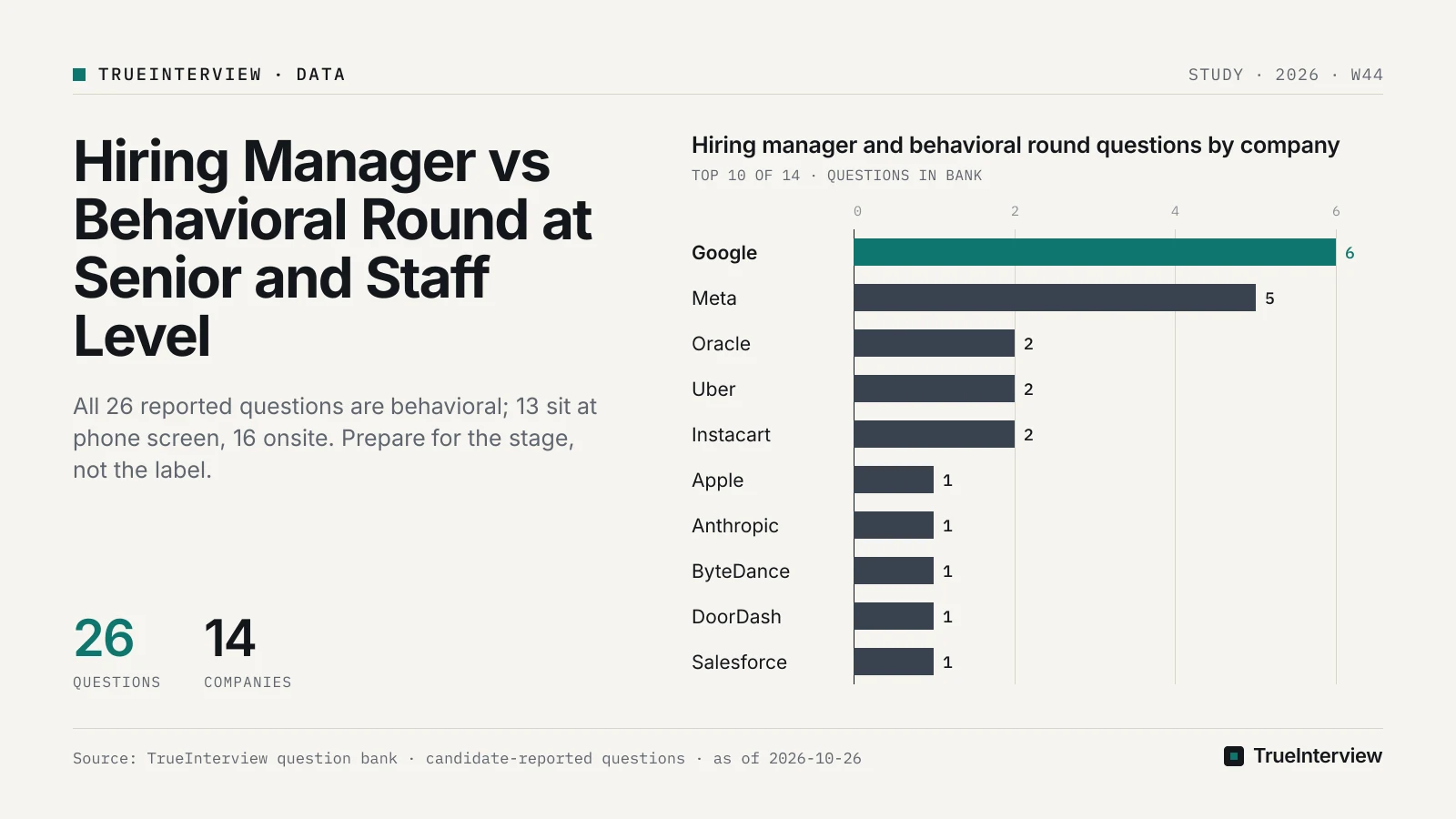
As of 2026-10-26, TrueInterview's bank holds 26 candidate-reported hiring manager and behavioral round questions from 14 big-tech companies, and all 26 are behavioral in subtype. Candidates report them at phone-screen stage (13) as well as onsite (16), so the label does not tell you whether the round is an early gate or a final check. Our take: prepare for the stage and the evidence rather than the label. One bank of six deep stories serves both rounds, and the hiring manager (HM) round adds a drill into your scope, your strongest resume claim and your fit with the team's problems.
Disclosure: TrueInterview is an interview-preparation product and publishes this article. Facts about other products come from their public pages on the dates listed under Sources.
How do the hiring manager round and the behavioral round compare?
Treat them as the same story bank examined by two different people: an interviewer scoring competencies and the manager who would own your work. The behavioral interviewer scores how you acted in past situations. The hiring manager decides whether your experience fits the team's problems and whether you are a safe hire at the level on offer. The table sets out where practitioners draw the line between the two.
| Criterion | Behavioral round | Hiring manager round |
|---|---|---|
| Who sits across | An interviewer scoring competencies; some companies label it a bar raiser round, as in Oracle's reported set | The manager of the team you would join, who tests whether your experience matches that team, per PracHub's guide |
| What gets scored | Communication, decision-making, initiative, adaptability, leadership and problem-solving, per Hello Interview's Google guide | Resume depth, technical judgment, behavioral questions, team fit, motivation and leveling, per PracHub's guide |
| Evidence asked for | Firsthand past events, probed with follow-up questions about how you behaved, as Acara's blog describes | The same past events, checked against what this team needs from you in the job |
| How deep it goes | Follow-ups on one story at a time | Can turn one resume claim into a technical conversation (see the caveat below) |
| Best for | Polishing structure, timing and the one-sentence headline | Defending your biggest resume claim and showing you understand the team's problems |
Verdict, behavioral round: treat it as the format test. Each story needs a headline, your own actions and a result, delivered inside a few minutes.
Verdict, hiring manager round: treat it as the content test. The same stories must hold up when the manager picks one line and keeps asking why.
A tech lead commenting on a Taro forum thread said: "The hiring manager round is almost always sort of behavioral round." The combined round titles in our bank point the same way, so the extra preparation for the HM round is depth on the stories you already have, rather than a second set of scripts.
Does the round's label change what you are asked?
Less than the name suggests, because companies merge the labels themselves. Salesforce's Hiring Manager + Behavioral Rounds, DoorDash's Hiring Manager Behavioral Round and ByteDance's Hiring Manager / Final Behavioral Round each put both names on one reported title.
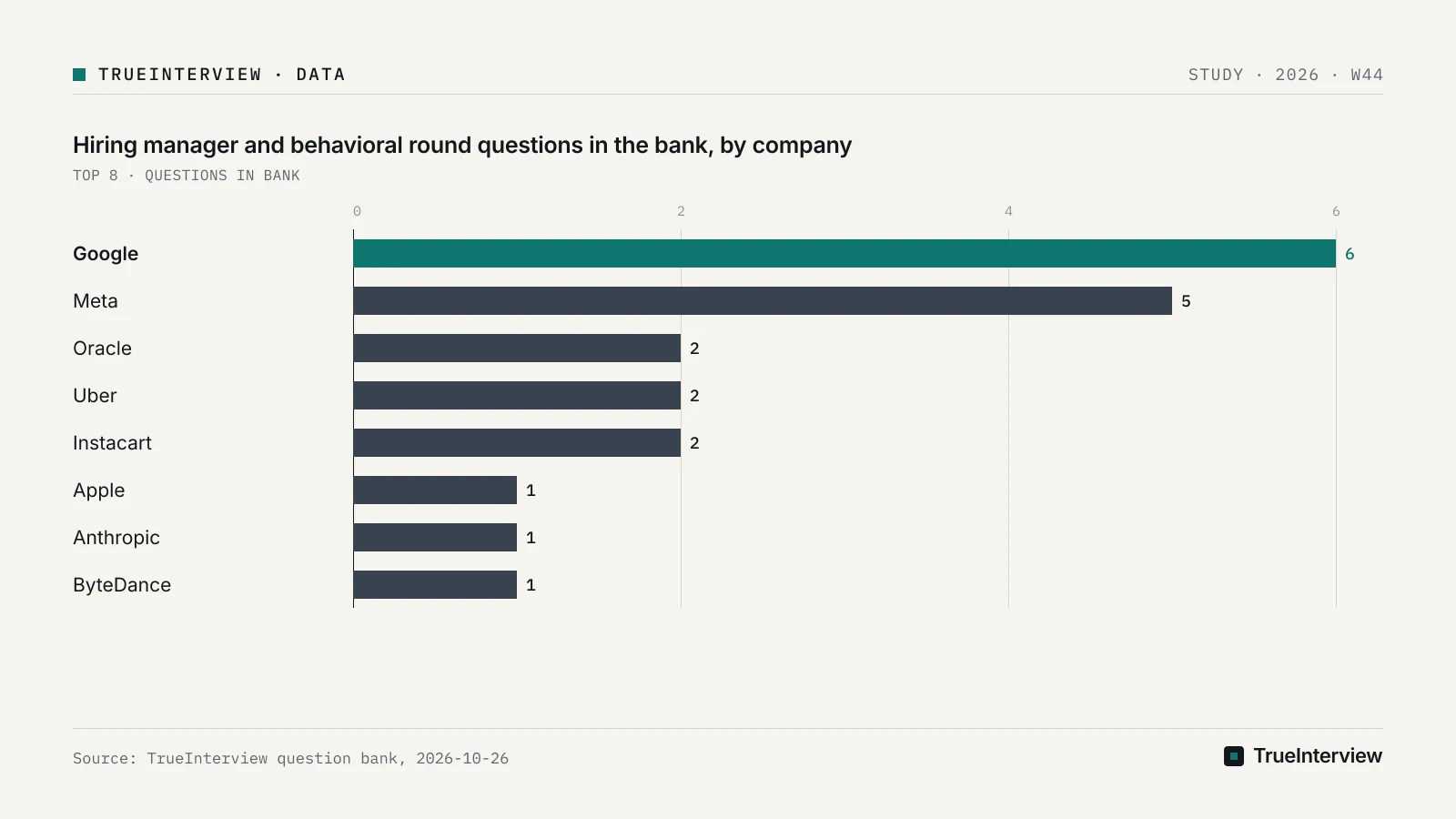
Our subtype tags cannot separate the two rounds either. All 26 questions in this set, including the 16 reported onsite, are tagged behavioral, so the bank gives no sign that one label brings a different kind of opening question.
Our take: build one story bank and use it in both rounds. Two separate scripts split your rehearsal time and leave you with two thinner versions of the same stories.
The behavioral label does not rule out technical depth. Vinit Shahdeo's Substack says some managers spend the whole hour on projects and collaboration, while others pull one line off your resume and go deep enough to turn it into a mini technical interview. Read the subtype as a description of the question, not of every follow-up.
Which companies report these rounds, and at what stage?
Of the 26 questions, 16 carry an onsite report and 13 a phone-screen report, and a question can carry both. In the table below, the dated example for Anthropic, DoorDash, ByteDance, Stripe, Meta and Google was reported onsite, while the dated example for Oracle, Salesforce, Apple and Coinbase was reported at phone-screen stage.
| Company | Reported title (practice page) | Stage | Last reported | Write-ups linked | Senior-or-above vs junior links |
|---|---|---|---|---|---|
| Anthropic | Hiring Manager Round — Behavioral & Collaboration | Onsite | 2026-07 | 24 | 22 vs 2 |
| Apple | Behavioral Prioritization and Stakeholder Fit | Phone screen | 2026-08 | 14 | 10 vs 4 |
| Oracle | Behavioral & Bar Raiser BQ Set | Phone screen | 2026-09 | 14 | 8 vs 6 |
| Salesforce | Hiring Manager + Behavioral Rounds | Phone screen | 2026-09 | 14 | 11 vs 3 |
| DoorDash | Hiring Manager Behavioral Round | Onsite | 2026-09 | 13 | 11 vs 2 |
| ByteDance | Hiring Manager / Final Behavioral Round | Onsite | 2026-07 | 8 | 4 vs 4 |
| Stripe | Resolve conflicts and prioritize with stakeholders | Onsite | 2026-06 | 7 | Not split |
| Meta | Describe cross-team collaboration and learning from failure | Onsite | 2026-05 | 4 | 2 vs 2 |
| Describe conflict resolution and stakeholder management | Onsite | 2026-05 | Not counted | Not split | |
| Coinbase | Describe cross-team collaboration on past projects | Phone screen | 2026-05 | Not counted | 2 senior-or-above, 1 of them staff-plus or manager |
By number of questions in this set, Google leads with 6 and Meta has 5, followed by Oracle, Uber and Instacart with 2 each. These are counts of what candidates reported, not of how often a company runs the round. They are also recent: 23 of the 26 questions were last reported within the 12 months before 2026-10-26.
If your loop is at Google or Meta, you have several reported titles to rotate through, so practise all of them before you specialise. At a company with one reported title, practise that title once and put the rest of your time into story depth, because the title only names the theme the interviewer opens with.
Is the hiring manager round a formality?
Not as a rule, and the stage decides how hard it is. In our bank, 13 of these questions carry a phone-screen report, so the round often sits before or alongside the technical loop rather than after it. A round that comes early is a gate. A round that comes after the onsite still has a decision to make.
The formality view comes from one commenter on Taro, who said a hiring manager round after the onsite is generally a formality that signals you passed. The same Taro commenter said that such a round still checks for last-minute red flags, and that a round placed before the core technical interviews will be "a rigorous behavioral interview screening round most likely". One Taro poster reported a loop in which the hiring manager meeting came after the recruiter screen and before the technical interview and system design discussion.
PracHub's guide says the hiring manager interview may be an early screen, a final-loop round or both. PracHub's guide also warns: "The manager may like you personally and still lack enough evidence to hire you." At the other end, Vinit Shahdeo's Substack says the hiring manager round is often the one that decides the offer; treat that as one author's view, not a rule.
Our take: ask your recruiter where the round sits and what it covers. If it comes before the technical rounds, prepare it as a gate with polished stories. If it comes after, prepare it as a calibration of scope and team fit, where a vague answer can still cost you the level.
What does the hiring manager round add on top of behavioral questions?
A risk assessment tied to one team. Vinit Shahdeo's Substack argues the hiring manager is not testing you the way a panel does but is assessing risk. Acara's blog says hiring managers want to know how a candidate is likely to perform in the job six months in. Both point at the same preparation: evidence that your past work predicts this team's work.
The sharpest part of that assessment is the resume drill. Vinit Shahdeo's Substack says the manager will not ask about the boring lines but will pick the most impressive claim and drill into it. The same Substack post advises leaving off anything you cannot defend for five minutes.
The manager also expects you to engage with the job itself. One ML engineer commenting on Taro said to ask thoughtful questions that cannot be googled, such as the current challenges the team is facing. The same Taro commenter said to pay careful attention when the manager describes the job and its duties. For the opening question, Vinit Shahdeo's Substack says "Tell me about yourself" should be a ninety-second narrative rather than a biography, and that an answer about why you are leaving should stay on what you are moving toward.
Our take: the resume drill is where experienced candidates have the most to lose, because their best bullet usually summarises a team effort. Circle the most impressive line on your resume and rehearse five minutes on it: the decision you made, the numbers before and after, the alternatives you rejected and what broke along the way. Then read the job description and write down two problems the team probably has, so your questions show you have thought about their work.
How many stories do you need, and how should you tell them?
Six deep ones. PracHub's guide puts it directly: "Prepare six deep stories, not twenty shallow ones." Vinit Shahdeo's Substack recommends six to eight strong stories that each flex to cover several questions. The target is narrower than it looks, because the titles candidates report keep returning to a small set of themes.
| Theme | Reported titles (company, stage) | Story to prepare (our view) |
|---|---|---|
| Stakeholder prioritization and fit | Behavioral Prioritization and Stakeholder Fit (Apple, phone screen); Resolve conflicts and prioritize with stakeholders (Stripe, onsite) | A time you cut or reordered work between competing requests and defended the call |
| Conflict | Describe conflict resolution and stakeholder management (Google, onsite); the Stripe title above | A technical disagreement you resolved, including the position you gave up |
| Cross-team collaboration | Describe cross-team collaboration and learning from failure (Meta, onsite); Describe cross-team collaboration on past projects (Coinbase, phone screen); Anthropic's hiring manager round, titled Behavioral & Collaboration (onsite) | A migration or launch that depended on another team's roadmap |
| Learning from failure | The Meta title above | An incident or missed goal you owned, and what changed afterwards |
| Tradeoffs in leadership | Answer leadership questions on tradeoffs and collaboration, linked from a staff-plus or manager write-up | A design or staffing decision where you chose one cost over another |
| Your strongest resume claim | No title of its own; it is the hiring manager drill described above | The project behind your most impressive bullet, at five-minute depth |
PracHub's guide says that for each story you should know the scope, your personal ownership, the hardest decision, the alternatives you rejected, the measurable result and what you would change now. For structure, PracHub's guide suggests Context, Scope, Tension, Decision, Execution, Impact, Reflection, a variant of STAR with reflection added. PracHub's guide also advises opening with a one-sentence headline and letting follow-ups control depth, rather than delivering an eight-minute monologue.
On timing, Vinit Shahdeo's Substack says the situation needs one or two sentences of context, and targets two to three minutes per story. The same Substack post names the common failure: most of the answer spent on the situation, a rushed sentence on the action and nothing on the result. Amazon's interview tips page advises using metrics or data where they apply and referencing recent situations. The same Amazon page asks candidates to describe the specific steps they took and how they contributed.
Our take: tag each of your six stories with every theme it can answer, then check that each theme has at least two stories behind it. A cross-team migration story, for example, can usually answer collaboration, prioritization and tradeoff prompts, which frees the other stories to cover conflict and failure.
What changes at senior and staff level?
The rounds probe scope as well as conduct. Candidate write-ups link these questions 80 times from candidates who reported a senior, staff-plus or manager level, and 32 times from candidates who reported a junior, new-grad or intern level. These are reported links, not interview frequency, but they show experienced candidates meeting these rounds far more often in the write-ups.
The level column in the company table shows where the skew is strongest. Hiring manager titles at Anthropic, DoorDash and Salesforce are linked mostly by senior-or-above candidates, though ByteDance's hiring manager title is split evenly, as is Oracle's bar raiser set. That skew reflects who wrote these rounds up, not how any company calibrates them. Our take: if you are applying at senior level, rehearse every story at senior scope regardless of the round's name.
The author of Hello Interview's Google guide, a Google senior manager, writes: "Even for non-management roles, I seek evidence of leadership potential." The same guide says that at Google, junior interviews focus mainly on coding while senior roles involve system design, architecture and leadership. PracHub's guide says that in a migration story a senior engineer should also explain the roadmap, dependencies, operational risk and how the team made better decisions. PracHub's guide also advises calibrating against the target job description and recruiter guidance rather than one universal ladder.
Staff-level evidence is thin. Staff-plus or manager write-ups link three titles once each: Anthropic's hiring manager round, Answer leadership questions on tradeoffs and collaboration, and Describe cross-team collaboration on past projects. With one link apiece, read that as a direction rather than a pattern: tradeoffs and collaboration across teams.
Our take: at senior and staff level, the stories themselves set your level. Each one should show a tradeoff you owned, influence across teams, the roadmap and operational risk, and how the team decided better because you were there. A story told as a list of tasks you completed reads as mid-level, however large the project was.
Down-leveling note (our view): in these rounds the level signal sits in behavioral scope and the resume drill. A loop with strong technical rounds and task-level stories is the profile that tends to end in a lower-level offer, so rehearse your two biggest stories at the scope of the level you are applying for.
Do ML engineers and other roles face the same rounds?
Yes, these rounds are not limited to software engineers. By role on the write-up, links come from Software Engineer (89), Machine Learning Engineer (11), Frontend Engineer (3), and 2 each from Site Reliability Engineer, Product Manager, Backend Engineer and Full-Stack Engineer candidates. ML candidates should prepare the same story bank.
Some titles draw a visible ML share. Apple's Behavioral Prioritization and Stakeholder Fit is linked from 5 write-ups by machine-learning, AI, research or data-science candidates and 7 by software-engineer candidates. Salesforce's Hiring Manager + Behavioral Rounds is linked from 2 and 12 respectively.
Our take: if you are an ML or AI candidate, make sure one of your six stories is about a model or data decision that affected another team, such as a launch you delayed for an evaluation gap. Stakeholder prompts at Apple are where that story pays off.
Worked example: Anthropic's onsite round versus Oracle's phone screen
Same story bank, different depth. Anthropic's hiring manager round is an onsite title last reported 2026-07, and its write-up links lean heavily senior. Oracle's Behavioral & Bar Raiser BQ Set is a phone-screen title last reported 2026-09, linked from 14 write-ups split 8 senior-or-above and 6 junior.
For Anthropic, the title names collaboration, so a senior candidate would lead with the cross-team story, such as a migration. Tell it in the Context, Scope, Tension, Decision, Execution, Impact, Reflection order from the story section, name the alternative you rejected, and add the roadmap, dependencies and operational risk. Expect the manager to pick one claim in that story and push on it.
For Oracle, the round comes earlier in the process and its write-ups are split more evenly by level. The same story bank works, but the job is different: a crisp headline, a clean answer inside two to three minutes, and follow-ups that you let the interviewer drive.
Our take: the stories stay the same; depth and framing change with the stage. Rehearse each of your six stories twice, once as a short phone-screen answer and once as an onsite deep dive.
Which round should you prepare first?
Prepare by the stage your recruiter confirms, not by the round's name. If the hiring manager or behavioral conversation is a phone screen, as in the dated examples from Oracle, Salesforce, Apple and Coinbase, treat it as a gate with tight headlines and short stories. If it is onsite or final, as in the dated examples from Anthropic, DoorDash, ByteDance, Meta, Google and Stripe, expect scope and team-fit calibration plus a drill into one resume line.
If the invite does not say where the round sits, send your recruiter these three questions before you start rehearsing:
| Ask your recruiter | Why it matters | What to do with the answer |
|---|---|---|
| Is the hiring manager round before or after the technical rounds? | An early round acts as a screen; a late one calibrates scope and fit | Early: polish headlines and timing. Late: deepen the scope of your two biggest stories |
| Does it cover resume depth, technical judgment or leveling? | PracHub's guide lists all three as possible content | If yes, rehearse the five-minute defense of your strongest resume claim first |
| Is there also a separate behavioral or bar raiser round? | If so, the hiring manager round will lean toward team fit and your resume | Split rehearsal: format and timing for one, depth and team problems for the other |
How we counted
Counts come from TrueInterview's question bank as of 2026-10-26: 26 hiring manager and behavioral round questions at 14 big-tech companies, and one question can be reported in more than one round. Level and role counts are links from candidate write-ups using the level and role candidates reported themselves, and quarterly totals mostly reflect how many write-ups were collected, so compare shares rather than totals. TrueInterview says reports are written up right after the interview and checked against other reports of the same round. These are candidate-reported questions reconstructed for practice, not any company's official question list.
FAQ
Is the hiring manager round tough?
Expect it to be hardest in two situations: when it comes early in the process and acts as a screen, and when your resume carries a claim the manager can drill into. Expect a lighter conversation only after your recruiter has confirmed it is a post-onsite chat, and even then bring your full story bank, because a vague answer at that stage can still affect the level you are offered. The formality section above sets out what each source says.
What is a behavioral round in an interview?
Amazon's interview tips page says "Our interviews are rooted in behavioral-based questions which ask about past situations or challenges". Acara's blog adds that with hypothetical questions, interviewees can make up the answer they think the interviewer wants to hear. In practice, a behavioral round asks you to describe a real situation, what you personally did and what happened, and then tests that account with follow-up questions. Answer with one dated event, the two or three steps you personally took and a before-and-after metric.
Does the hiring manager round include technical questions?
It can. PracHub's guide says the hiring manager interview can include technical judgment alongside resume depth and leveling, and Vinit Shahdeo's Substack says some managers take one resume line deep enough to make it a mini technical interview. Neither source says how often that happens. Rehearse the technical decisions behind your biggest claim: the design you chose, the numbers before and after, and what you would build differently now. If the manager stays on projects and collaboration instead, the same rehearsal makes your story answers more concrete.
Has the format of these rounds changed recently?
Our data cannot show a change in content. Every question in this set is tagged behavioral, so behavioral questions hold 100% of links in each quarter from 2025-Q4 to 2026-Q3 by construction. What the bank does show is recency: 23 of the 26 questions were last reported within the 12 months before 2026-10-26. What does vary is the label and the stage: some companies combine hiring manager and behavioral rounds in one title, and the same kind of question appears at phone-screen and onsite stage. Re-check with your recruiter for your own loop, since a process can change between your first call and your onsite.
Should I use STAR for both rounds?
Amazon's interview tips page says Amazon uses the STAR method as a framework for clear answers. That describes Amazon's own process, but the structure works anywhere as long as you add reflection, as PracHub's guide recommends. For the behavioral round, keep the situation short and spend your time on action and result. For the hiring manager round, lead with scope and the alternatives you rejected, since those are the parts a manager is most likely to push on.
Your practice plan
A three-week plan for someone working full time:
- Today: email your recruiter the three questions in the table above, and note whether your round is a phone screen or onsite.
- First week: draft six stories with scope, ownership, hardest decision, rejected alternatives, measured result and what you would change. Test the prioritization ones against Behavioral Prioritization and Stakeholder Fit and Resolve conflicts and prioritize with stakeholders.
- First week, second half: test your cross-team and failure stories against Describe cross-team collaboration and learning from failure and Describe cross-team collaboration on past projects.
- Second week, onsite-stage rounds: rehearse the five-minute defense of your strongest resume claim and a ninety-second introduction, then practise Hiring Manager Round — Behavioral & Collaboration, Hiring Manager Behavioral Round and Hiring Manager / Final Behavioral Round at deep-dive length.
- Second week, phone-screen rounds: practise Behavioral & Bar Raiser BQ Set and Hiring Manager + Behavioral Rounds against a timer, with one headline sentence per story.
- Third week: run timed answers on Describe conflict resolution and stakeholder management and any title you have not used yet. TrueInterview says it does not sell mock interviews with human engineers and suggests booking one or two elsewhere before an onsite.
- Before you start: TrueInterview says the first few questions at every company are free, with no card needed.
Sources
- TrueInterview question bank — hiring manager and behavioral round at big-tech companies — counted 2026-10-26
- Software Engineer Hiring Manager Interview: Questions, Signals, and Seniority | PracHub Knowledge Hub — checked 2026-10-26
- Google Interview Process: A Comprehensive Insider's Guide | Hello Interview — checked 2026-10-26
- Behavioral Interviews: What Hiring Managers Need to Ask | Acara Solutions — checked 2026-10-26
- What to expect when meeting with hiring manager? — checked 2026-10-26
- Hiring Manager Round: A Prep Guide for Software Engineers — checked 2026-10-26
- Amazon recruiting manager shares tips for a successful interview — checked 2026-10-26
- Real FAANG Interview Questions by Company · TrueInterview — checked 2026-10-26
- Interview prep compared: your application, end to end · TrueInterview — checked 2026-10-26
Last reviewed: 2026-10-26.