Capital One · Study
Capital One Software Engineer Interview Process
TrueInterview
July 24, 2026 · 14 min read
Capital One screens Software Engineers with an automated four-problem assessment, then a Power Day of about four one-hour rounds of which only one is conventional coding. The others are a banking system design, a case round that often ends with debugging someone else's code, and a themed behavioral hour, all weighed together. Even the coding round is unusual: the problem arrives in parts that build on each other, and you write your own test harness. Banking knowledge matters more than at most technology companies, because accounts, transfers, card authorization and fraud checks recur in nearly every round.
This guide breaks down each stage of the Capital One Software Engineer interview, what interviewers evaluate in each round, and how to prepare, with questions candidates were actually asked.
Verified: Based on 24 candidate-reported interview experiences, primarily from 2025 Q4 through 2026 Q3, cross-checked against recent public accounts.
Capital One Software Engineer interview process
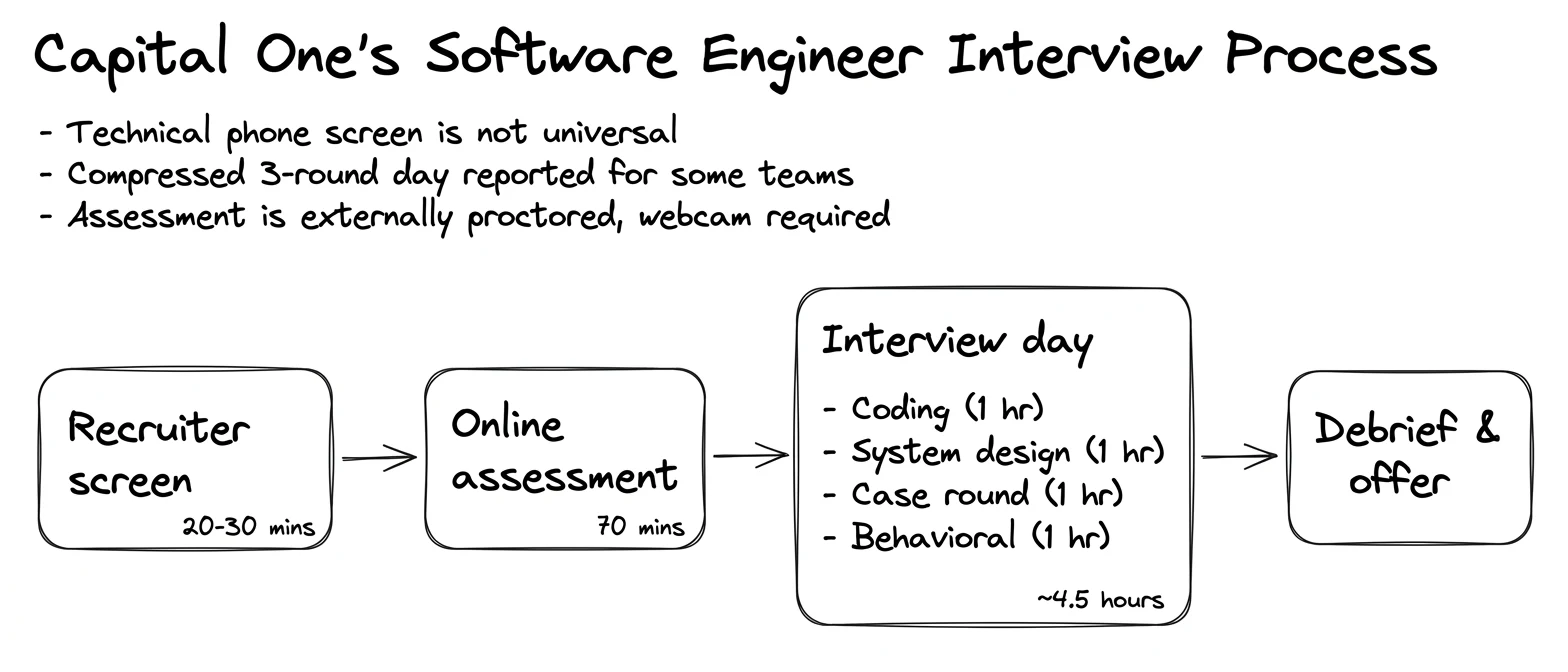
Capital One runs one standardized Software Engineer loop and matches most candidates to a team afterward, so the shape barely changes between hiring organizations. Candidates take the online assessment, sometimes a behavioral phone screen, and then the Power Day: about four and a half hours, on one day or split over two. The process typically takes four to eight weeks.
Level changes the weight of the rounds more than their number. New graduates and Associate candidates get one design round that can lean toward object modeling and behavioral questions about learning and teamwork. Senior and Lead candidates have reported two system design rounds and questions about leading uncooperative teammates.
Here's what the interview process can look like:
- Online assessment: Four auto-graded problems in 70 minutes, proctored by webcam with an ID check, scored out of 600.
- Recruiter call and phone screen (not every candidate): Logistics and prep materials, sometimes followed by a 45-to-60-minute behavioral screen with a senior engineer.
- Coding interview (Power Day): One hour on a multi-part implementation problem, often a banking system, plus your own test harness.
- System design interview (Power Day; two at senior levels): One hour designing a money-moving system such as online banking or a credit card platform.
- Case interview (Power Day): One hour on a business and technical scenario, usually virtual card numbers, ending in code tracing or debugging.
- Behavioral interview (Power Day): One hour of themed STAR sets with layered follow-ups, now including AI usage.
Tip: Ask the recruiter for the preparation materials and the optional prep call. Candidates report they describe the actual Power Day round mix, and the case can closely resemble the practice example recruiting shares.
Online assessment
The assessment arrives by email, sometimes with no recruiter contact first, and runs on CodeSignal: four problems in 70 minutes, webcam and microphone on, photo ID captured before starting. Scores are out of 600; one candidate was told about 400 advances, and reported scores include 534 and 512. A two-problem variant exists, and sets rotate heavily, so candidates in the same month saw different problems. The platform says correctness counts more than runtime, yet hidden tests still time out quadratic solutions on the last problem.
The first two problems are short string or array tasks: reorder a string by alternating front and back characters, regroup W, D and L characters into repeated WDL blocks, or count case-insensitive triplets whose ends match. The last two are long simulations to follow exactly: sort each concentric matrix layer clockwise, apply reverse, swap and rotate commands, place fixed shapes on a grid in row-major order, or assign packages round-robin to warehouses with capacities and closures. Pair counting recurs constantly: fragments whose concatenation equals a target, cross-list pairs summing to a value, or integers that are rotations of each other. Rejections arrive in about three days; advancing candidates often wait one to three weeks, and a recruiter follow-up speeds it up.
Interviewers evaluate:
- Following the specification exactly: Wrap-around pointers, tie-breaks (higher index wins) and reset rules when every warehouse is closed decide the score.
- Grid edge cases: Single-row, single-column and single-cell inner layers, and shapes that cross the boundary.
- Optimizing the last problem: Hash-map pair counting instead of comparing every pair; one brute force passed 14 of 20 tests for 140 of 300 points.
- Pacing: Banking the two short problems, then the medium simulation, then the hardest one.
Practice timed sets of two short string tasks plus two long simulations, keeping the last 20 minutes for optimization.
Note: A strong score does not guarantee an interview. A candidate with 512 of 600 was rejected about three days later without speaking to anyone, while others advanced with less. Treat the score as a gate and use a referral or recruiter follow-up to move forward.
Sample questions for the online assessment
Here are some questions reported by recent candidates:
-
Sort each concentric border of an n-by-m matrix clockwise from its top-left corner and write the values back along the same path.
-
Assign packages round-robin to warehouses, skipping closed or full ones and resetting the pointer when none are available.
-
Count ordered pairs of string fragments whose concatenation equals a given password.
Recruiter call and phone screen
The recruiter call covers level, location, timeline and the hiring organization, then explains the assessment and the Power Day. Several candidates then had a 45-to-60-minute screen with a senior engineer that, despite its technical label, was entirely behavioral and situational: a walkthrough of your current project, a problem you root-caused yourself, a difficult-stakeholder story, and a hypothetical in which the infrastructure team is blocking your work. The screen also checks level, so Senior and Lead candidates should frame projects around architecture, cross-team dependencies and performance impact.
Interviewers look for:
- Root-cause clarity: How you narrowed the problem, the hypothesis you discarded and why the fix holds.
- Unblocking without friction: How you state the need, when you escalate and how you keep the relationship.
- Scope that fits the level: Ownership and impact matching the role you applied for.
- Structured answers: Situation, your actions and a measurable result, kept concise.
Prepare a two-minute project walkthrough and one debugging story you can explain three levels deep.
Sample questions for the recruiter call and phone screen
Here are some questions reported by recent candidates:
-
Describe a hard technical problem you resolved: the root cause, how you debugged it and the fix.
-
Your work is blocked by the infrastructure team; how do you get unblocked without creating friction?
-
Why Capital One, and why this move now?
Coding interview
The coding round lasts an hour in a shared editor. Problems are medium at most but segmented: a specification arrives in three or four building parts, and you write a harness that runs the interviewer's input list and prints output comparable to theirs. Candidates say the harness took longer than the core classes. The most frequent prompt is a banking system built in increments: create accounts and deposit, then transfer, then return the top N accounts by activity, with alphabetical tie-breaks. Others include a bank class with deposit, withdraw and transfer that rejects invalid amounts and overdrafts, a Transaction class, and a linked-list element-removal variation with a complexity discussion.
Interviewers evaluate:
- Clarifying definitions early: Whether activity means operation count or money moved, whether failed transfers count (they do not), and which errors return -1.
- Incremental design: Part-one code that extends to transfers and ranking without a rewrite.
- Self-built testing: A harness that parses the given operations and checks expected outputs quickly.
- Unprompted edge cases: Duplicate accounts, transfers to self, missing accounts and insufficient funds.
- Clean state: Balances and activity counters updated only after a transaction succeeds.
Practice a multi-part banking simulation end to end in 45 minutes, harness included.
Tip: Write the harness right after part one, not at the end. Candidates who left it until later spent the final minutes on input parsing and left the top-N ranking unfinished.
Sample questions for the coding interview
Here are some questions reported by recent candidates:
-
Extend a banking implementation with CREATE_ACCOUNT, DEPOSIT and TRANSFER returning balances or -1, then add TOP_ACTIVITY.
-
Implement a bank account class with deposit, withdraw and an atomic transfer, rejecting invalid amounts and overdrafts.
-
Remove every matching node from a linked list, then walk through edge cases and complexity.
System design interview
Every reported design prompt involved money, opened broad, and gained requirements as it went. Prompts include online banking with checking, savings, mortgage and auto loan accounts, entitlement-based access, internal and external transfers and daily-to-monthly statistics; a credit card system with login, fraud-checked authorization, monthly credit bureau reports and real-time limit decisions; and a banking app integrating a third-party payment provider. Senior candidates had two rounds: a highly reliable account balance service and a cross-region event processing platform. Associate rounds can lean toward object design; at Senior the discussion moves to idempotency, exactly-once posting, concurrency and multi-region failure.
Interviewers evaluate:
- Breadth first: Entities, services and the main read and write paths before any deep dive.
- Financial correctness: Idempotent payments, an immutable ledger with audit trail, and atomic transfers.
- Separated paths: Reporting kept off the transaction write path, with a stated pre-aggregation choice.
- Security and fraud: Per-account authorization and where the fraud check sits without hurting latency.
- Steering the deep dive: Proposing topics such as payment idempotency and asking which the interviewer wants.
Rehearse two banking designs end to end, each with a ledger, an idempotency-key strategy and a reporting pipeline.
Note: The interviewer keeps adding requirements, such as another account type, an external payment rail or a credit-limit decision. A generic web template with no ledger or failure story struggles to absorb them.
Sample questions for the system design interview
Here are some questions reported by recent candidates:
-
Design online banking with several account types, entitlement checks, internal and external transfers, and periodic statistics.
-
Design a credit card platform with fraud-checked authorization, monthly bureau reports and real-time limit-increase decisions.
-
Design an account balance service that stays correct under concurrent updates and partial failures.
-
Design Credit-Card Authorization, Limit Decisions, and Reporting
Case interview
The case round is specific to Capital One and the one candidates prepare for least. The most-reported version uses virtual card numbers in three parts: discuss benefits and drawbacks for cardholders and the issuing bank; apply a rule sheet in which certain digits of the card number and transaction ID encode network, merchant binding, single or multi use, online or in person, and charge or authorization, deciding aloud whether each payment is valid; then debug code implementing those rules. The planted bugs were || where && belonged, >= instead of > at an amount threshold, and digit extraction with a modulo that reads the wrong position.
Other forms include explaining an unfamiliar block of code without writing any, rolling virtual card numbers out across regions with different regulations, and designing a customer chatbot with success metrics.
Interviewers evaluate:
- Structured business reasoning: User and issuer views, fraud and regulatory trade-offs, technical feasibility.
- Precise rule application: Counting digit positions from the correct end and evaluating compound conditions correctly.
- Reading unfamiliar code: Tracing execution aloud and catching boolean and boundary errors.
- Narration: Thinking aloud throughout; long silences read as being stuck.
- Design instincts: Separating parsing from validation once the bugs are fixed.
Practice by writing a card-product rule sheet, judging payments against it aloud, then reviewing an implementation for off-by-one and boolean errors.
Sample questions for the case interview
Here are some questions reported by recent candidates:
-
What are the benefits and challenges of virtual card numbers for customers and for the bank?
-
Given digit-encoding rules, decide whether a 150-dollar online charge on a given card is valid.
-
Find the bugs in virtual-card validation code, then propose a better object structure.
Behavioral interview
The behavioral hour uses themed sets, commonly learning something new, challenging the status quo and facing a hard challenge, each with several follow-ups on outcomes and lessons. Other reported prompts cover conflict, setting an objective for your team and, for Senior candidates, leading an uncooperative teammate; new graduates get why computer science, why Capital One and teamwork. AI questions now appear regularly; answers treating AI as an assistant whose drafts are always reviewed landed well. Some interviewers type throughout with little feedback, so keep adding detail until redirected.
Interviewers look for:
- Story fit: A story that answers the question asked; forced near-matches cost candidates.
- Depth under follow-up: Your own actions, what changed and what you would do differently.
- Challenging the status quo: A concrete process or design you questioned, with evidence and result.
- Leadership at level: Setting objectives and bringing a reluctant teammate along at Senior and Lead.
- Judgment with AI: Specific uses, review habits and limits.
Prepare six to eight quantified stories mapped to these themes plus one AI-usage example.
Sample questions for the behavioral interview
Here are some questions reported by recent candidates:
-
Tell me about a time you challenged the status quo and what happened.
-
Tell me about leading someone who was uncooperative.
-
How do you use AI in your daily engineering work, and where does it improve productivity?
How Capital One levels and evaluates Software Engineer candidates
The target level is set from your resume and the requisition before the Power Day, and all four rounds are scored against it. Interviewers submit independent feedback that a hiring discussion pools; the case and behavioral rounds count as much as coding, so strong code does not offset a weak case. Team matching typically follows the offer. Decisions are fast: offers have arrived one to three days after the Power Day, so long silence is telling. Many engineering postings state that Capital One will not sponsor new applicants for employment authorization.
Tip: Scope stories carry the level decision. Candidates whose examples described individual tasks were read as more junior than the role, so frame Senior and Lead examples around systems, teams and measured impact.
How to prepare for the Capital One Software Engineer interview
- Drill four-problem simulation sets: Matrix layers and commands, round-robin allocation with closures, grid placement and pair counting under a 70-minute clock.
- Build a banking system in increments: Create, deposit, transfer and top-N activity with exact return codes and tie-breaks in one extensible code base.
- Write a test harness every time: Parse an operation list and print comparable output in under ten minutes.
- Learn money-movement basics: Idempotency keys, ledgers, authorization versus posting, fraud checks in the payment path, reporting off the write path.
- Rehearse the virtual-card case: Argue user and issuer trade-offs, apply digit-encoded rules aloud and hunt boolean and boundary bugs.
- Map stories to the behavioral themes: Learning, status quo, challenges, conflict and team leadership, each with numbers and a lesson.
- Use the recruiter: Request the prep materials and prep call, and follow up after the assessment.
About the Capital One Software Engineer role
Capital One Software Engineers build cloud-native services, almost entirely on AWS, for card, banking and enterprise platforms, in agile teams paired with product managers. Work centers on Java, Python and JavaScript microservices, data pipelines, and web and mobile front ends. Since the Discover acquisition closed in May 2025, much engineering effort has gone into moving debit and then credit cards onto the Discover network. Most roles are hybrid, in hubs such as McLean, Richmond and Plano.
| Level | Primary focus | Impact scope |
|---|---|---|
| Associate Software Engineer | Defined features with guidance, often via the Technology Development Program | A component of one team's product |
| Software Engineer | Features owned end to end, including testing and deployment | A team's services |
| Senior Software Engineer | Component design, mentoring and code review | Several services and their integrations |
| Lead Software Engineer | Technical direction and architecture decisions for a team | A team or related teams |
| Senior Lead Software Engineer | Architecture across a portfolio of projects | A line-of-business platform |
| Distinguished Engineer | Enterprise technical strategy and standards | Multiple organizations |
Capital One hires Software Engineers across its technology organization. Teams include:
- Card Technology: Card acquisition, servicing, authorization and rewards, plus the Discover network migration.
- Enterprise Platforms Technology: Shared platforms such as developer tooling, mobile CI/CD and regulatory-compliance systems.
- Retail and digital banking: Checking and savings accounts, payments and the mobile banking app.
- Capital One Software: The enterprise arm selling data-security and cloud data products, including Databolt tokenization.
Software Engineer experience and education requirements
Technology Development Program and Associate roles require a bachelor's degree, completed or finishing before the start date, preferably in computer science, engineering, information systems or mathematics, plus intermediate programming in languages such as Python, Java, JavaScript, SQL or C#; recent postings add experience with interactive AI tooling beyond code completion. Experienced roles list years of open-source framework and agile experience. Posted base salaries include $135K for program associates in McLean ($123K in Plano and Richmond) and $158.6K to $181K for Senior Software Engineers in McLean, plus performance incentives.
FAQs about the Capital One Software Engineer interview
How long does the Capital One Software Engineer interview process take?
Typically four to eight weeks. Advancing candidates wait one to three weeks after the assessment for the Power Day, and offers have followed within one to three days. Assessment rejections usually arrive within about three days.
What is the hardest round of the Capital One Software Engineer interview?
Most candidates name the case interview, which combines business reasoning, rule tracing and debugging unfamiliar code in a format other companies do not use. Among technical rounds, the multi-part coding round causes the most time trouble because of the harness.
Is there an online assessment?
Yes, for nearly all candidates: four problems in 70 minutes, proctored and scored out of 600. Sets rotate, and a high score is necessary but not sufficient.
What programming language should I use?
Any mainstream language works; Python and Java are most common. Choose the one in which you can write a parser and test harness fastest.
Is the Power Day remote?
Both virtual and in-person Power Days are reported, run on one day or split across two.