Amazon · Study
Amazon Research Scientist Interview Process
TrueInterview
July 24, 2026 · 15 min read
Amazon grades scientists on two axes at once. Every loop round carries a named science competency (breadth, depth or application) plus two or three assigned Leadership Principles, and interviewers expect the behavioral stories themselves to contain machine learning content. In one reported five-round loop, principle questions took so much of the fourth hour that only about 15 minutes were left for coding, and a strong depth round did not rescue the outcome. The breadth bar is also unusually wide: one hour can move from least-squares assumptions to rotary position embeddings, and coding includes numerical code such as a stable contrastive loss written from scratch.
This guide breaks down each stage of the Amazon Research Scientist interview, what interviewers evaluate in each round, and how to prepare, with questions candidates were actually asked.
Verified: Based on 20 candidate-reported interview experiences, primarily from 2026 Q1 through 2026 Q3, cross-checked against recent public accounts.
Amazon Research Scientist interview process
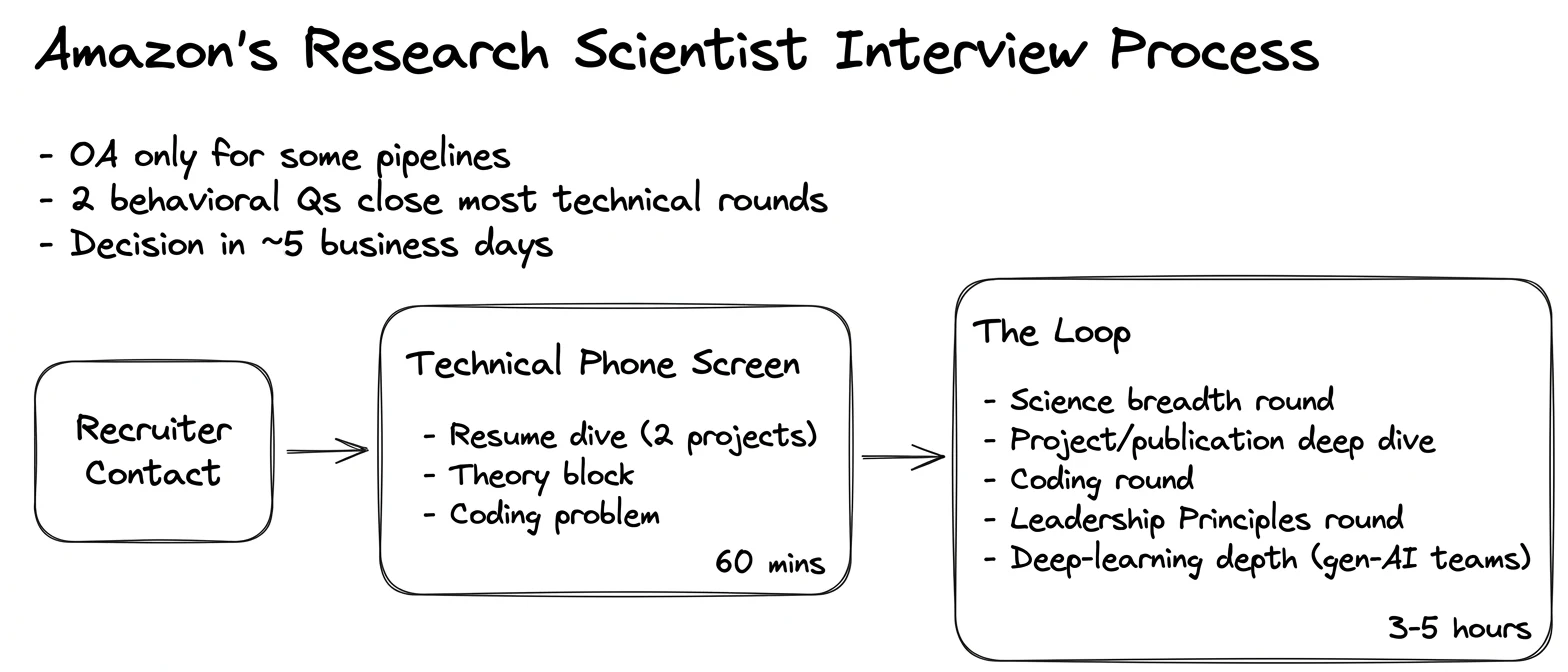
Amazon interviews Research Scientists and Applied Scientists against the same science competencies, and most recent reports come from Applied Scientist loops on ads, seller services, search and generative-AI teams. Hiring is team by team, so the theory follows the team: ads and seller teams lean on classical statistics, experimentation and ranking, while generative-AI and post-training teams ask about LoRA, RLHF, GRPO, KV caching and distributed training.
The skeleton is a recruiter call, an online assessment in some pipelines, one or two technical phone screens of 30 to 60 minutes, and a loop of three to five back-to-back rounds of about an hour each. Interns reported two phone screens and no loop. Manager-level screens split the hour between project leadership and people management, and senior loops weight the scope of past work more heavily.
Here's what the interview process can look like:
- Recruiter call: Background, level and team fit (generative-AI recruiters ask about post-training and agent work), with a preview of the rounds that is often inaccurate.
- Online assessment (some pipelines): Two sittings, a written check on applied ML infrastructure and a mix of resume-based ML questions with a standard coding problem.
- Technical phone screen (one or two): A two-project resume dive, a theory block and a coding problem, sometimes after 30 minutes of principle questions.
- Science breadth interview: Graduate-level ML and statistics, from regularization to transformer variants, with derivations on the board.
- Science depth interview: Your most complex project or your papers, one at a time, defended decision by decision.
- Science application interview: An open-ended product problem such as an agentic solution or an evaluation framework for generated images.
- Coding interview: Classic mediums or numerical code written from scratch, inside a round that also covers principles.
- Bar Raiser interview: An hour, often entirely behavioral, with a trained interviewer from outside the hiring team.
Tip: Plan each loop hour as two halves. Keep every story to a three-minute core with an ML result in it, and assume the technical half may not start until minute 25 or later; a candidate who ran out of prepared stories by round four lost most of the coding time.
Online assessment
Some recruiter-sourced pipelines start with an online assessment in two sittings. The first is a written knowledge check on applied ML infrastructure: parameter-efficient fine-tuning, how an inference engine such as vLLM serves large models, and approaches to image-text embedding. The second combines ML questions tied to your resume with a plain coding problem; the reported one was merging overlapping intervals. Referred and intern candidates often skip it.
Interviewers evaluate:
- Hands-on infrastructure knowledge: Why low-rank adapters cut memory, what an inference engine does with the cache, how a dual-encoder embedding is trained.
- Consistency with your resume: The methods you list are methods you can explain.
- Clean baseline coding: A correct sort-then-merge interval solution with edge cases handled.
- Precision in writing: Mechanism-level explanations rather than long surveys.
Review fine-tuning, inference serving and contrastive embedding training at the level of mechanisms, and keep standard array and interval problems fast.
Sample questions for the online assessment
Here are some questions reported by recent candidates:
-
Explain the main parameter-efficient fine-tuning techniques and when each beats full fine-tuning.
-
Compare approaches to building joint image-text embeddings.
-
Given a list of intervals, merge all overlapping ones.
Technical phone screen
Screens run 30 to 60 minutes, usually in three segments: two resume projects (the data, training problems and why the design was chosen), a theory block, and one coding problem discussed rather than run. Statistics-heavy teams such as ads ask about least-squares assumptions and what breaks without each, squared loss as a Gaussian likelihood, log loss from the Bernoulli likelihood, impurity versus permutation importance, Adam versus momentum SGD, precision, recall and AUC for imbalanced fraud data, A/B test power, and bagging versus boosting. Generative-AI teams ask about LoRA variants, RLHF and PPO, KV caching, RoPE and ALiBi, efficient attention, grouped-query attention, and GRPO: why it drops the critic, what that costs, how to parallelize it, and how to design the reward.
Coding is usually a classic medium such as the minimum of a rotated sorted array, or short numerical code such as a bootstrap confidence interval with a loop-free follow-up. One rejected candidate instead got an original dynamic program on batching with padding costs. Interns reported a second screen that walked through each publication. A manager-level screen asked for compute and memory latency of an MLP block at batch sizes 1 and 256 on given hardware, and which is memory-bound.
Interviewers evaluate:
- Formula-level theory: Deriving a loss from a likelihood or writing the rotation behind RoPE, not describing it.
- Hands-on recency: For post-training teams, evidence you have run GRPO-style training and fixed its instabilities.
- Project ownership: Which decisions were yours, and why the alternatives lost.
- Reasoning on unfamiliar problems: A clear DP state and recurrence for a problem not on any standard list.
Prepare a one-minute derivation for each core loss and optimizer, and two resume projects you can defend for 15 minutes each.
Note: The recruiter's preview is frequently wrong. One candidate was promised 30 minutes of ML and 30 of coding with no behavioral questions, spent the first 30 minutes on principles, rushed the project dive and a sliding-window click counter, and was rejected the next day.
Sample questions for the technical phone screen
Here are some questions reported by recent candidates:
-
Split an ordered list into contiguous batches, each costing a fixed overhead plus padding up to its longest item, to minimize total cost; give state, recurrence and a worked example.
-
Why does GRPO remove the critic, what does that cost, and how would you design the reward?
-
Implement bootstrap sampling for a mean and confidence interval, say which statistics it estimates poorly, then remove the loop.
Science breadth interview
The breadth round is an hour of graduate-level fundamentals, usually paired with two principles. It starts classical and moves forward: bias and variance with detection and fixes, L1 versus L2 with the geometry of sparsity, CNN receptive fields drawn by hand, a logistic-regression update derived on the board, then LoRA, retrieval-augmented generation and LLM agents. A generative-AI hour asked for transformer internals, AdamW's decoupled weight decay, PPO's clipped objective, VQ-VAE codebook collapse, the RoPE formula written out, and a dual-encoder model compared with a vision-language model that uses a resampler.
Method history counts too: one candidate felt a weak comparison of a small and a large model from the same text-embedding family hurt the round.
Interviewers evaluate:
- Derivations, not definitions: Why log loss suits classification, why decoupled weight decay helps generalization, how stride changes a receptive field.
- Range across eras: Classical statistics answered as carefully as diffusion noise schedules.
- Trade-off reasoning: When to choose L1 over L2, or a smaller embedding model over a larger one.
- Honest limits: Reasoning from first principles where your knowledge ends, rather than a confident guess.
Practice deriving each standard topic out loud in under three minutes, from linear models through current alignment methods.
Sample questions for the science breadth interview
Here are some questions reported by recent candidates:
-
How do you detect overfitting versus underfitting, and what would you change in each case?
-
Draw a small CNN, explain its receptive field and derive the logistic-regression update step.
-
Compare a small and a large model from the same text-embedding family: what you gain and what you pay.
-
ML Breadth Orals — Linear / Logistic / Random Forest / Optimizers
Science depth interview
The depth round is a full hour on your most complex project or your publications, often paired with Dive Deep, Deliver Results or Earn Trust. Interviewers read the resume in advance and choose: problem framing, data cleaning, baselines, class imbalance, why that backbone, metrics, deployment, and what you would do with more compute. Interns had each publication taken in turn.
Applied teams care where the work went. A manager candidate spoke for 10 to 15 minutes on a search-ranking project, then took questions on business motivation, offline and online metrics, A/B design, and debugging an online result that missed the offline gain. Several candidates called this their strongest round, but it is also where scale is judged: a machine learning candidate passed every round on content and was told the projects lacked the impact expected for the target level.
Interviewers evaluate:
- Personal contribution: Your decisions separated from your collaborators' and your advisor's.
- Justified choices: Why that model, loss and baseline, and what failed.
- Self-identified limitations: The weakness you raise before being asked.
- Measured impact: Offline and online metrics and the effect on customers or revenue.
Write a decision log for one flagship project (choice, alternatives, evidence) and rehearse it at 2, 10 and 30 minutes.
Tip: Lead with the project that has the largest measured business effect, not the most elegant method. Scope is read as a level signal, and the strongest-round reports came from candidates who chose their most impactful work.
Sample questions for the science depth interview
Here are some questions reported by recent candidates:
-
Why did you choose this backbone, how did you handle class imbalance, and what would you do with more resources?
-
Your model's online A/B result fell short of the offline gain: how do you find out why?
-
For each publication, what was your specific contribution and how did you choose the baselines?
-
Applied Science Manager Phone Screen — Project Deep-Dive + Leadership BQ
Science application interview
The application round hands you an open-ended product problem and watches you turn it into a science plan. Reported prompts: propose agentic AI solutions for a hypothetical project and defend their viability; design a multi-turn search agent that handles long context; architect an AI chatbot across intent detection, dialogue management, generation and a knowledge base; and build an evaluation framework that checks whether a text-to-image system spells a brand name correctly and places it naturally. Ads and search teams ask for ranking pipelines instead.
The round is often paired with Think Big or Invent and Simplify. There is no single right architecture; the grade comes from framing, a measurable evaluation plan and a credible launch path. One candidate answered the brand-name case with OCR accuracy, embedding-based semantic checks and a human review protocol.
Interviewers evaluate:
- Problem framing: A vague product goal turned into an ML task with a target metric and stated assumptions.
- Evaluation design: Automatic metrics, a human protocol, and how the two are reconciled.
- Methods applied with judgment: Retrieval, agents and fine-tuning used where they help, with failure modes named.
- Launch realism: Latency, cost, monitoring and what ships first.
Practice an agent, a generation-quality evaluation and a ranking system end to end in 40 minutes each, starting with the metric.
Sample questions for the science application interview
Here are some questions reported by recent candidates:
-
Design an evaluation framework that measures whether generated images spell a brand name correctly and place it naturally.
-
Design a multi-turn search agent and explain how it handles long conversation context.
-
Architect an AI chatbot, including fallback behavior, evaluation and continuous learning.
Coding interview
Coding appears in one or two loop rounds, sometimes the hiring manager's, and shares the hour with principle questions. Two families appear. Classic mediums: meeting rooms with a min-heap after a warm-up two-sum, weighted random pick with prefix sums and binary search, or average salary per manager over an org tree. Numerical code from scratch: a Bayesian classifier applied to scenarios, an InfoNCE loss in PyTorch with a stable log-sum-exp in both directions, a NumPy mean and variance followed by maximum-likelihood questions, or sigmoid, softmax and attention by hand.
Some interviewers improvise the task from the discussion, but expectations are consistent: correct code, edge cases such as all-zero weights or a single element, complexity, and the statistics behind the numbers.
Interviewers evaluate:
- Numerical stability: Subtracting the maximum before exponentiating, and stable variance formulas.
- Vectorization: Replacing loops with array operations when asked.
- Statistical grounding: Linking sample mean and variance to their maximum-likelihood estimators.
- Edge cases and complexity: Stated without prompting.
Write softmax, attention, cross-entropy and a contrastive loss from memory in NumPy and PyTorch, and keep heap, prefix-sum and tree mediums under 20 minutes.
Note: Coding is the segment that gets squeezed. In one loop the principle questions left roughly 15 minutes for the NumPy task and its MLE follow-ups, and the candidate could not follow the interviewer's reasoning in the time left.
Sample questions for the coding interview
Here are some questions reported by recent candidates:
-
Implement a numerically stable InfoNCE loss for a batch of image and text embeddings in both directions.
-
Write a NumPy function for the mean and variance of an array, then relate it to maximum-likelihood estimation.
-
Given an org tree with salaries, compute the average salary of each manager's direct reports.
Bar Raiser interview
The Bar Raiser is an experienced interviewer from outside the hiring team who guards the hiring bar and has an effective veto at the debrief. For scientists the round is usually entirely behavioral, covering principles such as Customer Obsession, Learn and Be Curious and Insist on the Highest Standards. One candidate described an interviewer who repeatedly said the answers missed what was wanted, and left worn down. Other loops ended with a behavioral-only round of three questions with long follow-ups: a calculated risk, disagreeing with a manager, going above and beyond for a customer. Across one five-round loop, ten different principles were assigned.
Interviewers evaluate:
- Science in the story: A disagreement about an evaluation metric beats one about meeting schedules.
- Specifics under follow-up: Dates, data and your exact role, three questions deep.
- What happened after you committed: How you mitigated the risk you had raised.
- Results with numbers: The measured outcome and what you would change now.
Prepare 10 to 12 stories, each tagged with two or three principles and each containing an ML decision, and rehearse their follow-up layers.
Sample questions for the Bar Raiser interview
Here are some questions reported by recent candidates:
-
Tell me about a time a client or decision maker proposed a plan that was far too aggressive.
-
Describe a decision you made with incomplete information and how you later validated it.
-
Tell me about a time a teammate's work did not meet the bar and what you did.
-
Make an Important Decision Before Every Option Can Be Explored
How Amazon levels and evaluates Research Scientist candidates
Each interviewer writes feedback against the assigned competencies and principles before a debrief led by the Bar Raiser, where the Bar Raiser and hiring manager settle the outcome. The target level is set before the loop and checked against the scope of your projects and stories, so clean technical answers can still end in a rejection for insufficient impact. Candidates describe the stories as counting at least as much as the technical answers. Decisions have arrived as soon as the next day, and recent rejections in ML and science pipelines carried cooldowns of six to twelve months for the same role.
Tip: Feedback relayed by different recruiters after a rejection was reported as inconsistent, one citing coding and another design breadth. Treat it as a hint, not a diagnosis.
How to prepare for the Amazon Research Scientist interview
- Write ML-flavored principle stories: Prepare 10 to 12 stories that each contain a modeling, data or evaluation decision, with a three-minute core.
- Drill derivations across the whole syllabus: Least-squares and logistic losses from likelihoods, regularization geometry, optimizers, attention, RoPE and the PPO and GRPO objectives.
- Match theory to the hiring team: Ads and seller teams test statistics and experimentation; generative-AI teams test fine-tuning, alignment and distributed training in hands-on detail.
- Code ML primitives from memory: Stable softmax, attention, cross-entropy and InfoNCE, plus vectorized statistics, in NumPy and PyTorch.
- Keep unfamiliar DP in practice: State, recurrence and a worked example for partition problems you have not seen.
- Build a decision log for your flagship project: Choices, rejected alternatives, metrics and measured business effect, at several lengths.
- Rehearse open application problems: An agent, a generation-quality evaluation and a ranking system, each opened with the metric.
- Prepare every screen for every format: The recruiter's preview is often wrong, so be ready for principles, theory and coding in any hour.
About the Amazon Research Scientist role
Amazon scientists work on applied problems inside product teams: they survey the literature, run experiments, build prototypes and often write production code, then measure results through A/B tests alongside engineers who scale the models. Research Scientist roles lean toward modeling research and Applied Scientist roles toward shipped systems, but both are interviewed against the same science bar. Scientists share the company's level ladder with engineers.
| Level | Primary focus | Impact scope |
|---|---|---|
| L4 (Applied or Research Scientist I) | Well-scoped modeling and experiments with guidance | Components of one team's science |
| L5 (Applied or Research Scientist II) | Owning a science problem from framing to launch | A team's models and roadmap |
| L6 (Senior Applied or Research Scientist) | Setting technical direction and mentoring scientists | Several teams or a product area |
| L7 (Principal Applied or Research Scientist) | Long-range science strategy and standards | An organization |
Amazon hires Research Scientists across its consumer, cloud and devices businesses. Teams include:
- Artificial General Intelligence (AGI): Foundation models, post-training, multimodal systems and agents.
- Amazon Web Services AI: Models and services for cloud customers, and automated reasoning.
- Amazon Ads: Ad ranking, bidding, measurement and generative creative tools.
- Stores search and personalization: Product search ranking, recommendations and experimentation.
- Selling Partner Services: Science for seller tools, catalog quality and seller growth.
- Alexa and devices: Conversational assistants and language understanding.
Research Scientist experience and education requirements
Research Scientist hires typically hold a PhD in computer science, machine learning, statistics or a related quantitative field. Applied Scientist postings usually accept a PhD, or a master's degree plus about four years of relevant experience, along with several years of building models for business applications. Intern postings require enrollment in a master's or PhD program and programming in Python, Java or C++, with top-venue publications preferred. Python is the default interview language, with NumPy and PyTorch expected for numerical tasks.
FAQs about the Amazon Research Scientist interview
How long does the Amazon Research Scientist interview process take?
Usually several weeks from the first recruiter call to a decision. Slow recruiter scheduling is the usual delay; decisions can follow the final interview by a day.
What is the hardest round of the Amazon Research Scientist interview?
The science breadth round, for its range and its demand for derivations rather than definitions. The Bar Raiser is next, and candidates describe it as the most draining hour.
How much does an Amazon Research Scientist make?
Approximate total annual compensation for Amazon scientists in the United States:
- L4: ~$245K
- L5: ~$320K
- L6: ~$405K
Packages combine base salary, a sign-on bonus paid over the first two years, and stock that vests over four years on a back-loaded 5%, 15%, 40%, 40% schedule, which drives most of the increase between levels.
What happens after a rejection?
Recent rejections in science and ML pipelines carried six-month to twelve-month cooldowns for the same role, and feedback was brief and sometimes inconsistent. One candidate noted that engineering roles had no cooldown at the time, so a parallel application there is worth considering.