Study
Is 'Why Do You Want to Work Here' Just a Warm-Up in 2026?
TrueInterview
October 18, 2026 · 11 min read
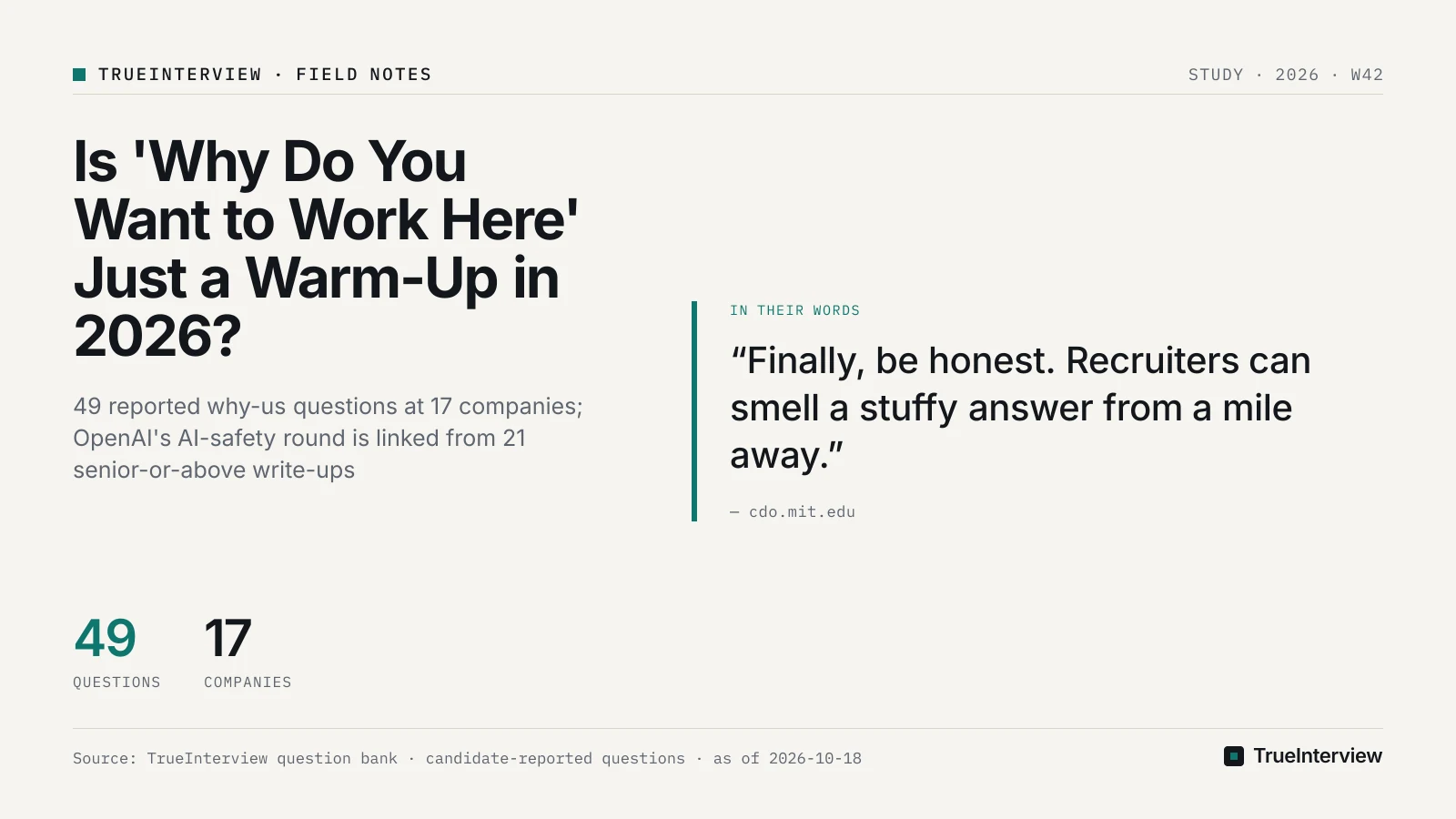
No. As of 2026-10-18, the TrueInterview question bank holds 49 motivation and why-us questions reported at 17 big-tech companies, and at OpenAI candidates report a dedicated hiring-manager behavioral question on why OpenAI, AI safety and AGI, linked from 21 write-ups, all by candidates who reported a senior-or-above level. Our take: treat why-us as a position you defend under follow-ups, prepared at two depths, rather than a one-paragraph pitch you recite once.
Disclosure: TrueInterview is an interview-preparation product and publishes this article. Facts about other products come from their public pages on the dates listed under Sources.
Myth 1: Is why-us a warm-up asked once, at the recruiter call?
No. Candidates report these questions in phone screens 29 times, onsite 18 times and in an online assessment 3 times, and one question can carry more than one round. Forty of the 49 were last reported in the 12 months before 2026-10-18. Plan for the question at the first call and again with a hiring manager; in our view the hiring-manager pass needs more evidence.
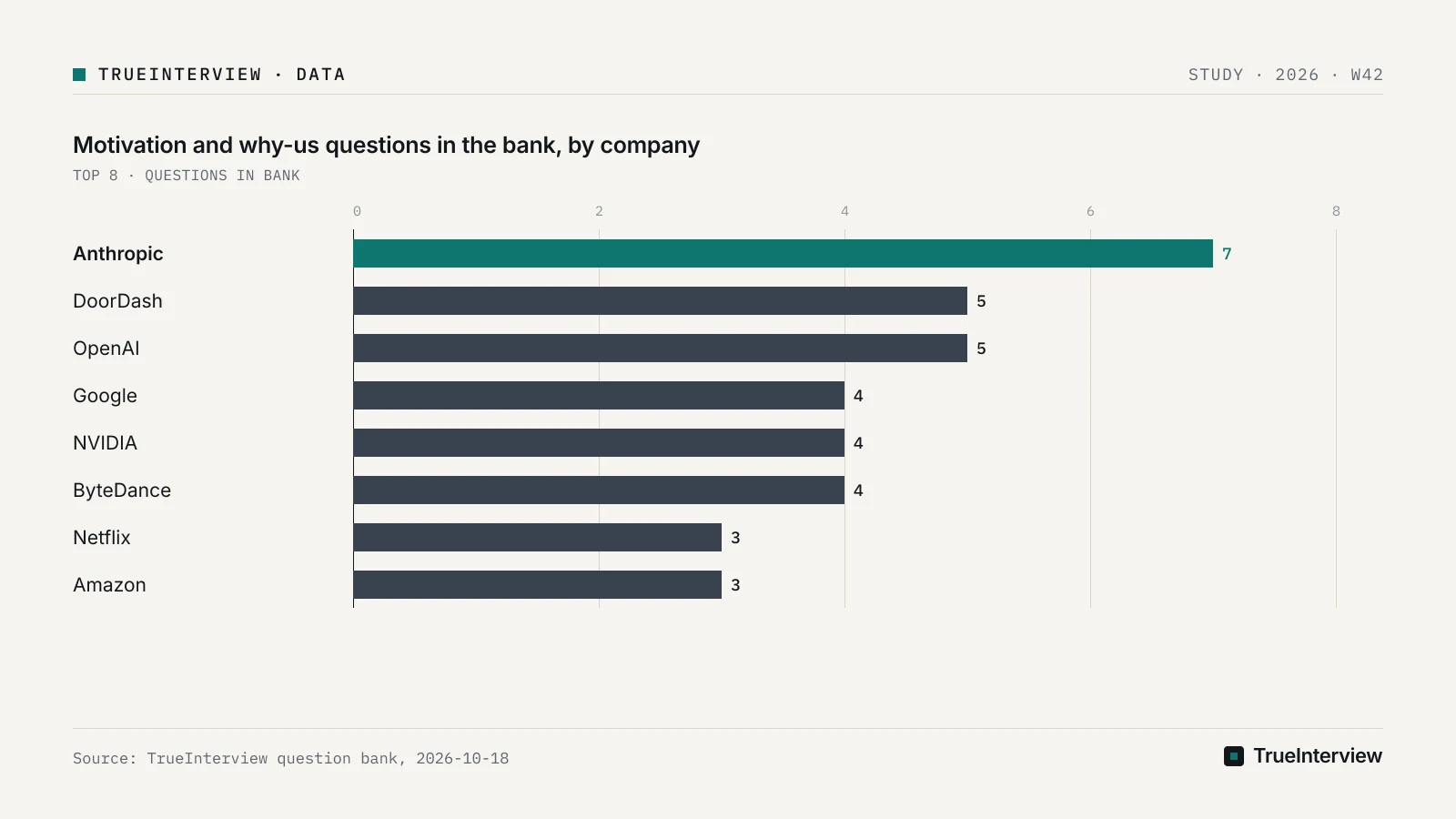
The named formats show how the depth changes from round to round. These are the most-linked motivation formats in the bank:
| Reported format | Company | Reported round | Last reported | Write-up links |
|---|---|---|---|---|
| Culture & Behavioral Interview Questions | Anthropic, DoorDash | onsite (Anthropic) | 2026-09 | 44 |
| HM BQ — Why OpenAI / AI Safety / AGI | OpenAI | onsite | 2026-09 | 21 |
| Recruiter / HR Screen | Robinhood, OpenAI | phone screen (Robinhood) | 2026-10 | 14 |
| Recruiter Screen — Why Anthropic Deep-Dive | Anthropic | recruiter stage, per its title | not listed | 14 |
| Hiring Manager Behavioral | Stripe | onsite | 2026-07 | 13 |
| Netflix Culture / Domain Manager Rounds | Netflix | phone screen | 2026-06 | 13 |
| Hiring Manager Screen | Airbnb | phone screen | 2026-06 | 12 |
| Core Values Behavioral Round | Airbnb | not listed | not listed | 10 |
The belief gets one thing right: the phone screen is where the question shows up most, so the short version matters. What it misses is that the same company often comes back to it. Airbnb candidates report both a hiring-manager screen and a separate core-values round, and OpenAI candidates report a recruiter screen and an onsite hiring-manager round. Build one core answer and cut it two ways: a one-minute version for the recruiter and a five-minute version, with evidence, for the hiring manager.
Myth 2: Is a good answer mostly facts about the company?
No. The MIT Sloan career office's post says an answer must cover three things, ending with "why you’ll be successful in this position (to showcase your relevant skills)". The same post says that third part makes you "stand out compared to everyone else that sticks only to one of the first two points".
| Part of the answer | What it proves | What to put in it |
|---|---|---|
| Why this company | You did the research | One current bet or plan of the company and why it matters to you |
| Why this role | You fit | The team's problem and the closest problem you have already solved |
| Why you will succeed | You will deliver | One result with a number, and the decision behind it |
For the first row, the MIT post advises researching the company's current situation, future plans, mergers and acquisitions, and reputation beforehand. For the third row, if you lack directly relevant experience, the MIT post suggests transferable skills and school achievements. Our take: the third row is where most answers lose the interviewer, because it is the only part that cannot be copied from the careers page.
Myth 3: Is the AI-lab mission question only for researchers?
No. OpenAI's hiring-manager question on why OpenAI, AI safety and AGI is linked from 17 write-ups by software engineers and 3 by machine-learning, AI, research or data-science candidates. Across all 49 questions, links come mostly from Software Engineers (158), with Machine Learning Engineers (14) and Research Scientists (3) far behind. If you write backend code and your loop is at a lab, this round is yours too.
The safety view is the part that gets probed. Titles linked only from senior-or-above write-ups include Explain Your Motivation and Practical Approach to AI Safety (4), Explain your perspective on AI safety (4) and Why Anthropic and its values? (3). At Anthropic the deep-dive starts early: its recruiter-stage why-Anthropic question is linked from 11 senior-or-above write-ups and 3 junior, new-grad or intern write-ups, so it reaches every level.
Our take: saying you care about AI safety is a claim an interviewer will test, and on its own it gives the interviewer nothing to evaluate. Write one page before the loop that answers the follow-ups a hiring manager is likely to push on, phrased as your own view:
- Why this lab rather than another lab with a similar mission.
- One trade-off between shipping speed and safety work that you would accept, and one you would not.
- A past decision of yours, outside AI if necessary, where you chose the slower or safer path and what it cost.
Myth 4: Is reciting the company's values the safe answer?
No. Our view is that published values work as a rubric, and reciting them back is the weakest way to meet it. The MIT post warns that if asked why this position specifically, "don’t drone on about how you cherish the company values".
Some companies publish the values they say they work by, and behavioral questions are a natural place to probe them. Netflix's culture page lists judgment, described as "you make wise decisions despite ambiguity; you use data to inform your intuition", and candor, which includes admitting mistakes openly and sharing learnings widely. Netflix's culture page also states that "Netflix is not for everyone" and that its team is driven by performance, not seniority or tenure. Amazon's principles page says the company uses its Leadership Principles every day when discussing ideas or deciding how to solve a problem, and its Customer Obsession principle says "Leaders start with the customer and work backwards".
Our take: Netflix's own warning that it is not for everyone is an invitation to say what you are trading off by choosing it. Pick two published values, attach one real story to each, and name the cost you accepted in that story. A candidate who can say what they gave up reads as someone who chose the company, rather than someone applying everywhere.
Myth 5: Is motivation judged only in a conversation with a person?
No. Candidates report Google's Hiring Assessment (GHA / Work Styles) at the online-assessment stage, last reported 2026-09, and Amazon's Work Simulation & Work Style Assessment at the same stage, last reported 2026-07. Fit can be screened before any human conversation, so the questionnaire is part of your why-us story.
Our view: answer work-style items the way you will later describe yourself to a hiring manager. If your motivation story is about owning ambiguous problems end to end, answering the questionnaire as someone who prefers clearly defined tasks is a mismatch worth avoiding, as a sensible precaution.
Myth 6: Can you script the perfect answer and recite it?
No. The MIT career office and Anthropic's guidance both point at honesty and your own reasoning. The MIT post puts it bluntly: "Recruiters can smell a stuffy answer from a mile away". Anthropic's candidate guidance says "We want to see your actual experience and how you think—not AI-generated responses".
Anthropic's guidance encourages candidates to use Claude to research Anthropic, practise answers and prepare questions, and says live interviews are "all you–no AI assistance unless we indicate otherwise". Use tools to research and rehearse where a company allows it, then rebuild the answer from notes in your own words.
What changes at senior and staff level?
Level-tagged links to these questions come 155 times from candidates who reported a senior, staff-plus or manager level and 44 times from junior, new-grad or intern candidates. That gap reflects which write-ups the bank holds, not proof that companies ask senior candidates more. What the data does show is which formats senior candidates report.
Culture & Behavioral Interview Questions, reported at Anthropic and DoorDash, is linked from 40 senior-or-above write-ups, 4 of them staff-plus or manager, against 4 junior ones. Staff-plus and manager write-ups also link Anthropic's recruiter-stage deep-dive, and Explain motivation and mission alignment (6) appears only in senior-or-above write-ups.
Our take: at senior and staff level the question moves from enthusiasm to judgement. A new grad can carry the answer with curiosity and transferable skills. A senior candidate is expected to defend a position on the company's direction, name the trade-offs they would accept, and point to past decisions as proof.
Down-leveling note (our view): the level signal in a loop sits mainly in design depth, the project deep dive and the scope of behavioral stories. A why-us answer made only of excitement and company facts adds to a mid-level reading in the hiring-manager round. An answer that names a decision you owned and its cost adds to a senior one.
Worked example: a senior engineer at OpenAI versus Anthropic
Take a senior software engineer interviewing at OpenAI. The reports point to two passes at the question: a recruiter or HR screen first, then the onsite hiring-manager round on why OpenAI, AI safety and AGI (both in the table above). This outline is our illustration, built from those formats rather than from any candidate's words.
- Recruiter screen, one minute. One thing OpenAI is doing now that you researched, why this team matches what you have built, and one result with a number.
- Hiring-manager round, five minutes. The same three parts, then the one-page safety view from the AI-lab section: why this lab, which trade-offs you accept, and the past decision that shows it.
Compare Anthropic, where the reported recruiter-stage format is itself a why-Anthropic deep-dive (see the table). There the longer version must be ready from the first call, and the follow-ups on values and safety can come before you meet an engineer.
How we counted
The counts come from TrueInterview's question bank as of 2026-10-18: questions candidates reported in interview write-ups, filed by company, round and subtype, and linked to the write-ups they came from. These are candidate-reported questions reconstructed for practice, not any company's official question list. Level and role counts use each candidate's self-reported level and role, and a link count is the number of write-ups that point to a question, not how often a company asks it.
FAQ
How do I structure an answer to 'why do you want to work here'?
Use three parts in this order: why this company, why this role, and why you will succeed in it. The first shows research, the second shows fit, and the third, a specific past result, is what most candidates leave out. Keep a one-minute version for a recruiter and a longer version with evidence for a hiring manager.
How is 'why OpenAI' or 'why Anthropic' different from 'why Google'?
At OpenAI and Anthropic, candidates report named why-us formats that probe mission and AI safety, such as OpenAI's hiring-manager question on why OpenAI, AI safety and AGI and Anthropic's recruiter-stage why-Anthropic deep-dive. Expect to explain why this lab rather than another, what your own view on safety is, and how your past decisions reflect it. At Google, by contrast, candidates also report fit being screened through a work-style assessment at the online-assessment stage, so consistency matters as much as depth.
What should a senior or staff candidate do differently from a new grad?
A new grad can lean on curiosity, transferable skills and school projects. A senior or staff candidate should show judgement: a view on where the company or team is going, which trade-offs they would accept to get there, and a past decision they owned that proves it. In our view, interviewers at this level listen for scope and reasoning, as the senior-level section above explains.
What are the most common bad answers?
Four patterns fail most often in our view. Reciting the company's values when asked about the role; listing company facts without saying why you will succeed; a memorised paragraph that collapses at the first follow-up; and, at AI labs, a one-line claim about caring for safety with no position behind it.
Can I use AI to prepare my answer?
It depends on the company's stated policy, so check it before each loop. Anthropic's published candidate guidance encourages AI for research and practice but allows none in live interviews unless stated otherwise. Even where tools are allowed for preparation, use them to find facts and rehearse follow-ups, then say the final answer in your own words, because the question is checking how you think.
Your practice plan
A three-week plan for someone preparing alongside a full-time job:
- Week one, first two evenings: write the three-part answer for your target company on one page, with one numbered result in the third part. Then cut it to one minute and rehearse it against the Recruiter / HR Screen practice question.
- Week one, rest of the week: research the company's current plans and published values. Map two values to one real story each, and rehearse with the Core Values Behavioral Round or the Netflix Culture / Domain Manager Rounds.
- Week two: expand the answer to five minutes for a hiring manager and practise it with the Hiring Manager Behavioral question, asking a friend to push on every claim with "why".
- Week two, AI-lab loops only: write your one-page AI-safety view and rehearse it with Why OpenAI / AI Safety / AGI, Explain your perspective on AI safety and the Why Anthropic recruiter deep-dive.
- Week three, if your loop opens with an assessment: review the Google Hiring Assessment work-styles question or the Amazon work-style assessment, and check that your answers match the story you will tell later.
- Week three, final days: run both versions end to end twice, out loud, from bullet points only, and cut any sentence you could not defend under a follow-up.
Sources
- TrueInterview question bank — motivation and why-us at big-tech companies — counted 2026-10-18
- 3 Tips for Answering “Why Do You Want to Work Here” (+ Examples) – Career Development Office | MIT Sloan School of Management — checked 2026-10-18
- Netflix Culture Memo - Careers at Netflix — checked 2026-10-18
- Leadership Principles — checked 2026-10-18
- Guidance on Candidates' AI Usage \ Anthropic — checked 2026-10-18
Last reviewed: 2026-10-18.