Tesla · Study
Tesla Machine Learning Engineer Interview Process
TrueInterview
July 24, 2026 · 11 min read
Tesla's Machine Learning Engineer track is decided almost entirely on the phone. One to three hour-long screens with a team engineer made every reported call. Each blends hands-on coding with rapid oral theory. The coding is shaped by the vehicle domain: NumPy kernels, waypoint tensors and reward functions rather than puzzle lists. The theory questions arrive late in the hour, sound conversational, and are where most rejections happen. The team you are routed to (planning, sensing, cell quality, data) sets the subject matter.
This guide breaks down each stage of the Tesla Machine Learning Engineer interview, what interviewers evaluate in each round, and how to prepare, with questions candidates were actually asked.
Verified: Based on 6 candidate-reported interview experiences, primarily from 2025 Q3 through 2026 Q2, cross-checked against recent public accounts.
Tesla Machine Learning Engineer interview process
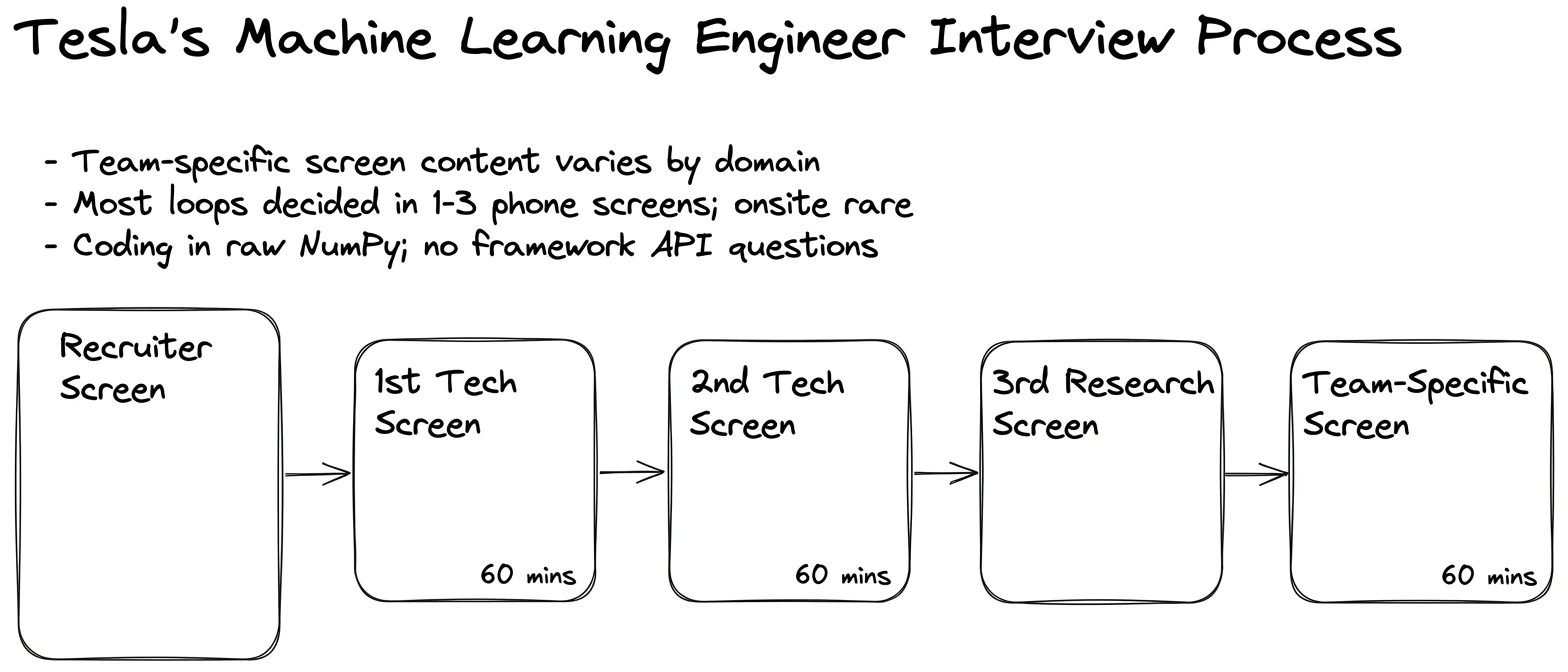
Tesla hires ML engineers team by team, and each team runs its own screens. The skeleton is a recruiter call, one to three technical phone screens of about an hour each, and, for candidates who clear them, an onsite panel of typically three to five rounds. The process usually takes four to eight weeks. Junior candidates are often decided after a single screen. Experienced candidates sit two or three screens that move from implementation toward research-level questions, and senior loops add ML system design at the onsite.
Here's what the interview process can look like:
- Recruiter call: A short conversation about background, which team's problem space fits, and availability.
- Technical phone screen (coding): About 60 minutes that open with a graded project discussion and then a domain-shaped NumPy or tensor problem.
- ML theory and research screen: An hour of oral fundamentals (transformers, CNNs, activations, RL, importance sampling), sometimes paired with a second implementation.
- Team-specific technical screen: The team's own domain, from reward shaping and agent modeling to computer vision, statistics cases or SQL.
- Onsite panel (when reached): Typically three to five back-to-back rounds covering ML system design, coding, a project deep dive and a hiring-manager conversation.
Tip: Treat the final fifteen minutes of every screen as the scored part. Candidates who finished the coding cleanly were still rejected when a short conceptual question exposed a gap.
Recruiter call
Most candidates on this track are approached by a recruiter. The short first call covers background, why Tesla, relocation, and which team your experience maps to: perception, planning and simulation, sensing, controls, cell quality, data, or ML infrastructure. That routing decides everything downstream. The first technical screen usually follows within one to two weeks.
Interviewers look for:
- Fit to a concrete team problem: A clear statement of which models you have trained and shipped, and on what data.
- Hands-on ownership: Evidence that you built the systems on your resume rather than supervised them.
- Motivation: A specific reason to work on autonomy, robotics or energy.
- Logistics: Willingness to work on site in Palo Alto, Austin or a factory location, since remote options are limited.
Prepare a two-minute summary of your strongest ML project: model choice, data and measured result.
Sample questions for the recruiter call
Here are some questions reported by recent candidates:
- Walk through your background and the ML project you are proudest of.
- Why Tesla, and which team's work interests you?
Technical phone screen
The first technical call runs about an hour in a shared editor, usually in Python with NumPy. Every reported screen opened with a graded discussion of past work: why one model over another, what went wrong in training, how you knew it generalized.
The coding half is domain-shaped. One candidate wrote vectorized NumPy to compute distances between coordinate points. Another implemented a 2D convolution forward pass from scratch with stride and padding across multiple input channels, plus unit tests against hand-calculated cases, and advanced. A planning team gave a suffix sum over the waypoint axis of a [batch, num_waypoint, 2] tensor that had to return [batch, num_waypoint]. A sensing screen took a streaming moving average and required a recursion-and-stack solution instead of a queue. That constraint broke the candidate's fluency and ended in rejection.
Interviewers evaluate:
- Shape discipline: Stating input and output shapes up front and reducing or broadcasting along the right axis.
- Index arithmetic: Output-size formulas, padding and stride boundaries that hold at the edges.
- Vectorization: Removing Python loops when asked is treated as part of the answer, not an extension.
- Testing habits: Writing small hand-checked cases (an identity or edge-detector kernel) while coding.
Practice writing convolution, cumulative and distance kernels in raw NumPy without library helpers, then vectorize them.
Note: Interviewers routinely remove the tool you would reach for. Recursion instead of a queue, no framework calls, a parameter count without the formula in front of you. Candidates who had memorized the standard solution rather than the mechanism ran out of time.
Sample questions for the technical phone screen
Here are some questions reported by recent candidates:
-
Implement the forward pass of conv2d with stride, padding and multi-channel kernels, and write unit tests for it.
-
Given a
[batch, num_waypoint, 2]tensor, compute a reversed cumulative sum along the waypoint axis and return[batch, num_waypoint]. -
Write vectorized NumPy that computes pairwise distances between sets of 2D points.
-
Implement a moving average over a data stream using recursion and a stack rather than a queue.
ML theory and research screen
Candidates who advance report a mostly oral call that moves quickly from easy to sharp. One covered autoregressive models and the Transformer: scaled dot-product and multi-head attention, softmax in the attention weights, and how gradients flow back through it. A later call asked for importance sampling from its mathematical basis through its variance behavior and its use in reinforcement learning, with nothing implemented.
Other loops fold theory into a coding hour, for example a transformer walkthrough, then a convolutional layer's parameter count, then a NumPy convolution. Sensing screens asked CNN versus MLP, why ResNet skip connections help, and whether y = 0.01x works as an activation function. That last question decided one interview: the candidate's answer missed that stacked linear layers collapse into one linear map, and the interviewer's tone cooled for the rest of the call.
Interviewers evaluate:
- Derivation over recall: Producing a parameter count, a gradient path or a variance argument without a formula sheet.
- Why, not what: Explaining why non-linearity, residual connections or attention scaling are needed, not just naming them.
- Mathematical ownership: Comfort with the probability and linear algebra behind the methods on your resume.
- Honest limits: Saying plainly what you do not know beats a confident answer that collapses under one follow-up.
Write out, by hand, the attention equations, a convolution parameter count, and the importance-sampling estimator with its variance, and explain each aloud.
Sample questions for the ML theory and research screen
Here are some questions reported by recent candidates:
-
Explain multi-head scaled dot-product attention and how backpropagation flows through the softmax.
-
Explain importance sampling, its variance properties, and where it appears in reinforcement learning.
-
Compare a CNN with an MLP, and explain how ResNet's skip connections help training.
-
Is
y = 0.01xa usable activation function? Why or why not?
Team-specific technical screen
Every team grafts its physical problem onto the interview. A motion-planning candidate's first screen covered modeling other agents' intent in a multi-agent driving simulation. The second covered GRPO versus PPO and learned versus hand-crafted rewards, then a reward on [batch, num_waypoint, 2] samples at 10 Hz that keeps a vehicle at a speed limit. The follow-up asked what breaks when the limit changes over time, such as exploiting reward lag or oscillating around transitions. Controls-adjacent rounds have covered Model Predictive Control with braking logic in Python.
Non-autonomy teams test differently. A cell-quality screen was a single statistics case: pass/fail inspection counts from several production lines, the right test for comparing proportions across more than two groups, the null hypothesis, the assumptions, and what the p-value means for a decision on the floor. A data-engineering screen asked for a cleaning and validation pipeline for messy sales CSVs, then SQL: a running total that resets monthly, a recursive reporting chain, and a conditional daily summary.
Interviewers evaluate:
- Physical failure modes: Naming what the vehicle or line actually does when the model or reward is wrong.
- Reward and metric design: Penalties that are smooth, bounded and hard to exploit.
- Data hygiene: Validating cleaned data with row counts, format checks, value ranges and outlier flags.
- Statistical framing: Choosing a test that fits categorical data, with its hypothesis and assumptions stated.
Ask the recruiter which team you are interviewing with, then prepare that team's domain as seriously as the ML fundamentals.
Note: One planning interviewer came across as aggressive. The candidate who stayed on the technical content rather than reacting to tone completed both rounds.
Sample questions for the team-specific technical screen
Here are some questions reported by recent candidates:
-
Implement a reward from 10 Hz waypoint samples that penalizes deviation from a speed limit, then explain how it fails when the limit changes.
-
Compare GRPO and PPO, and discuss when a learned reward beats a heuristic one.
-
Given pass/fail counts across several production batches, test whether failure rates differ and turn the result into a decision.
-
Compute each store's cumulative sales with the total resetting at the start of every month.
Onsite panel
No report in this set reached an onsite: the phone stage is where this track is decided. Where one follows, it typically runs three to five rounds: an end-to-end ML system design (for example, a training-data pipeline from fleet video under on-vehicle latency limits), another coding round, a project deep dive, and a hiring-manager conversation about ownership. AI-organization roles may add a research presentation.
Interviewers evaluate:
- End-to-end design: Data collection, labeling, training, evaluation and on-vehicle deployment as one system.
- Hardware constraints: Inference latency, memory and compute budgets on the car or robot.
- Pace and drive: Concrete stories of shipping hard things under tight timelines.
- Ownership: Specific contributions you personally made, separated from the team's.
Prepare one ML system design end to end for an autonomy problem and one project story that holds up under five levels of "why".
Sample questions for the onsite panel
Here are some questions candidates report at this stage:
-
Design a pipeline that turns fleet data into training sets for a perception model.
-
Describe the hardest technical problem you solved and what you personally did.
-
Describe a conflict with a teammate and the work you are proudest of.
How Tesla levels and evaluates Machine Learning Engineer candidates
The hiring manager and the team's interviewers decide; candidates describe no separate committee, so one engineer's read of a single screen can end the process. The target level is set from experience before the loop and tested by how deep the theory and design answers go. Feedback timing is inconsistent: some candidates advanced after one strong screen, others waited without word, and team matching on Autopilot and AI teams adds weeks.
Tip: Keep other processes alive. Silence after a screen is common, and a rejection usually comes without detailed feedback.
How to prepare for the Tesla Machine Learning Engineer interview
- Rebuild core ops in NumPy: Implement conv2d, cumulative sums, pairwise distances and attention from scratch, then vectorize every loop.
- State shapes before coding: Write the input and output shapes, including the batch dimension, as the first line of every answer.
- Explain fundamentals at derivation depth: Activations and non-linearity, residual connections, softmax gradients, parameter counts and importance-sampling variance.
- Prepare one project for interrogation: Every screen opens with it, so know every design choice, failed attempt and evaluation metric.
- Learn the team's domain: Reward shaping and multi-agent simulation for planning, CNNs and noise models for sensing, proportion tests for quality, window and recursive SQL for data.
- Practice under constraints: Re-solve familiar problems with the obvious structure removed, such as recursion instead of a queue or no library calls.
- Name physical failure modes: For any reward or model, say what the vehicle or production line would actually do when it goes wrong.
About the Tesla Machine Learning Engineer role
ML engineers at Tesla sit close to hardware: the people who train networks often also write the code that captures sensor data and runs inference on the vehicle or robot, with fleet data at unusual scale. Teams are small and favor generalists who span model, data pipeline and deployment.
| Level | Primary focus | Impact scope |
|---|---|---|
| P1 Associate Engineer | Implementing well-scoped model and data tasks | Own components |
| P2 Engineer | Owning training or evaluation pieces end to end | A feature or model |
| P3 Senior Engineer | Leading a model or pipeline through deployment | A team's area |
| P4 Staff Engineer | Setting technical direction across models | Several teams |
| P5 Senior Staff Engineer | Cross-organization architecture | An organization |
| P6 Principal Engineer | Long-range technical strategy | Across Tesla |
Tesla hires Machine Learning Engineers across several teams, which include:
- Autopilot and Full Self-Driving: End-to-end networks for perception, planning and control trained on fleet video.
- Optimus: Vision, foundation models and control for the humanoid robot, plus agentic computer-use work.
- AI infrastructure: Training clusters, RL training infrastructure, and model optimization for deployment.
- Simulation and planning: Multi-agent simulation, reward design and evaluation for driving policies.
- Sensing and cell engineering: Sensor modeling and statistical quality control for battery manufacturing.
Machine Learning Engineer experience and education requirements
Tesla's leadership has said that educational background matters less than evidence of exceptional ability, and AI roles are known for demanding coding tests rather than credential filters. In practice, candidates bring strong Python and NumPy, a deep learning framework, and solid probability and linear algebra. Postings value experience shipping models to production, and for Optimus and planning roles, post-training or RL methods such as PPO, GRPO or RLHF. C++ helps for on-vehicle inference work.
FAQs about the Tesla Machine Learning Engineer interview
How long does the Tesla Machine Learning Engineer interview process take?
Usually four to eight weeks from recruiter call to decision. Single-screen outcomes come faster; onsite loops with team matching take longer, and feedback can stall without notice.
What is the hardest round of the Tesla Machine Learning Engineer interview?
The screen that combines a from-scratch implementation (index arithmetic, tests, vectorization) with rapid theory, where one weak conceptual answer changes the interviewer's posture.
Is there an online assessment?
Not in the reported ML loops; screening is live with a hiring-team engineer. Expect runnable Python with NumPy in a shared editor. Framework fluency was not tested directly, and data roles use SQL.
How much does a Tesla Machine Learning Engineer make?
Posted base-pay ranges for AI and Optimus machine learning roles span roughly $140K to $420K a year depending on level and location. Packages add stock awards on top of base, and stock is a large share of senior compensation.