Tesla · Study
Tesla Interview Process & Questions
TrueInterview
July 24, 2026 · 12 min read
At Tesla the hiring team runs the whole loop. The same job title can lead to a GPU-pool concurrency problem, a SQL screen, a NumPy convolution or a statistics case, depending on which engineers pick up the call. Correct code is often not enough to pass. Interviewers add a constraint once you have a working answer: O(1) memory, recursion and a stack instead of a queue, a trie instead of brute force. One candidate whose solution had no bugs was still told it was not optimal. Your past projects get questioned in unusual depth, and a senior candidate who cleared every design round was rejected for explaining his own past work too shallowly.
This guide breaks down each stage of the Tesla interview, what interviewers evaluate in each round, and how to prepare, with questions candidates were actually asked.
Verified: Based on 22 candidate-reported interview experiences, cross-checked against recent public accounts.
Tesla interview process
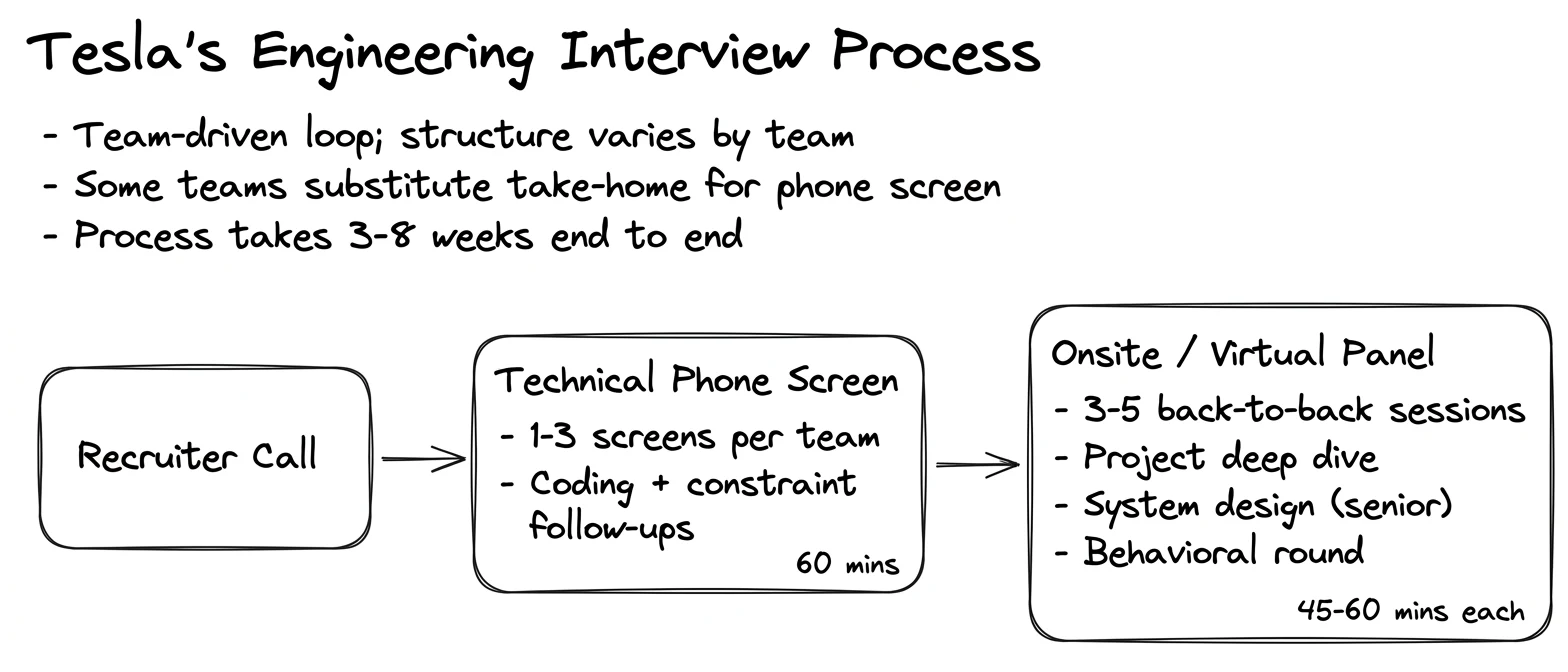
There is no company-wide question bank or fixed loop. A recruiter routes you to a team, and that team chooses the format. Reported processes range from a single technical call to three phone screens. A senior loop ran a design phone screen followed by four onsite rounds. Many candidates were decided entirely by phone.
Interns reported three calls: recruiter, technical and behavioral. Mid-level Software Engineer candidates mostly get one or two 60-minute coding or design screens, and a few backend teams use a take-home instead. Senior candidates get several system design rounds. Machine Learning Engineer candidates get screens that mix coding with ML theory.
Here's what the interview process can look like:
- Recruiter screen (sometimes plus a hiring-manager call): A short call covering your resume, your favorite project, location and any competing offers.
- Technical phone screens (one to three): 60-minute calls in a shared editor that start coding within minutes, often with two problems or coding plus SQL or theory.
- Low-level design and concurrency: Small runnable systems such as a scheduler, a cache or a transactional store, extended step by step.
- ML, data and domain screens (non-SWE tracks): NumPy coding, ML or RL theory, SQL, or a statistics case tied to the team's physical domain.
- Onsite or virtual panel: Typically three to five rounds of 45–60 minutes with the target team: system design, project deep dives and fundamentals.
- Behavioral and hiring-manager interview: Questions on disagreement, criticism, failure and pace, as a standalone round or folded into technical calls.
Tip: Budget each hour as one-third baseline, one-third testing, one-third follow-up. In the reports, poor outcomes came more often from running out of time before the constraint follow-up than from a wrong first version.
Recruiter screen
Many candidates were contacted by a recruiter rather than applying cold. The call is non-technical: your resume, your favorite project and why, your top qualities, why Tesla, and whether you hold competing offers. Recruiters actively redirect candidates. One candidate who could not relocate was matched to other openings rather than dropped. On some teams the next call is a 30–45 minute hiring-manager conversation about the team's projects and mutual fit.
Interviewers evaluate:
- Ownership of a project: Your exact role in your favorite project, not the team's result.
- Mission and pace fit: Why Tesla specifically, and whether you expect the demanding pace.
- Logistics: Location, relocation and competing deadlines.
- Team routing: Which team's problems match your background, because that team designs your loop.
Prepare a two-minute project story with your own contribution and a measurable result.
Note: Some recent final rounds reportedly ask for a one- to two-page write-up of your most significant technical achievement, though most candidates did not mention one. Ask the recruiter early, and ask for the pay band too: one backend candidate found the range well below comparable tech companies only after the take-home.
Sample questions for the recruiter screen
Here are some questions reported by recent candidates:
- Walk me through your resume. What is your favorite project, and what did you personally build?
- Why Tesla? Do you have any competing offers?
Technical phone screens
Each screen runs about 60 minutes in a shared online editor, and coding starts within minutes. Some open with one behavioral question. Problems are chosen ad hoc rather than from a standard list. Reported prompts include all shortest word-ladder paths, a fuzzy ladder that allows inserts and deletes, LC 843's positional-match word guessing, and minimum in a rotated array with a circular extension. Another was the first obstacle-free placement of a solar panel on a grid. One Python screen had two problems: an O(1)-memory permutation check using XOR and a recursive power function using only the call stack.
The follow-up is the main test. Expect a better complexity (prefix sums for the panel grid, a trie for the fuzzy ladder) or a debugging task such as fixing a planted bug in Dijkstra's edge relaxation. Some calls end on scaling the computation across machines. SQL also appears in general screens.
Interviewers evaluate:
- Optimality, not just correctness: One candidate's working fuzzy word ladder was marked down for not reaching the trie optimization.
- Fluency under a new constraint: Rebuilding a familiar solution when the obvious data structure is off limits.
- Code quality: One Python screen explicitly graded idiomatic style.
- Algorithm understanding: Why Dijkstra works, how it compares with A*, and when Bellman-Ford is needed.
Practice medium problems on a 35-minute timer, then answer a constraint variant aloud.
Note: A few backend teams send a take-home instead: simulate a robot through a grid room with walls, direction tags and jumpers, and print the exit direction or
loop. The sample was ambiguous about loop detection, and that edge case decided the result. Test beyond the given samples.
Sample questions for the technical phone screens
Here are some questions reported by recent candidates:
-
Find the shortest transformation where each step may change, insert or delete one character, then optimize it with a prefix tree.
-
Check whether an array is a permutation of 1 to N in linear time and O(1) extra memory.
-
Write Dijkstra in Java, then find and fix the bug in a provided implementation's edge update.
Low-level design and concurrency
Many Software Engineer screens center on a small system coded in one sitting and extended with each new requirement. Reported prompts: a scheduler that runs tasks at set times and accepts new ones while running, and an event bus that gains multiple listeners and then unsubscribe. Others: a cache that evicts expired items first, then lowest priority, then least recently used; a key-value store with nested transactions; and a calculator that grows into a small interpreter. Infrastructure teams add concurrency. One screen had Python worker processes share a fixed GPU pool with exclusive access, then probed crashes while holding a GPU, shutdown, and the GIL.
Interviewers evaluate:
- Semantics before code: Pinning down inner versus outer rollback or same-time tasks on a worked example.
- A structure for each rule: A map, heap and ordered set so every eviction tier stays efficient.
- Extensibility: Whether the third requirement fits without rewriting the first.
- Failure paths: Cleanup in
finally, heartbeats and shutdown for shared resources.
Practice building runnable versions of these systems in 40 minutes.
Tip: Trace a concrete example through the policy before writing any class. That early walkthrough is what surfaces the duplicate-priority and empty-transaction edge cases interviewers probe.
Sample questions for the low-level design and concurrency round
Here are some questions reported by recent candidates:
-
Implement
evictItem()for a cache ranked by expiry, then priority, then recency. -
Build a store with nested transactions where undo reverts only the innermost open transaction.
-
Ensure no two workers ever hold the same GPU, and recover when one dies holding it.
ML, data and domain screens
Non-SWE tracks keep the 60-minute phone format, with content drawn from the team's physical problem. Machine Learning Engineer screens pair NumPy coding with oral theory. Reported tasks include a suffix sum over a [batch, num_waypoint, 2] trajectory tensor, a speed-limit reward from 10 Hz samples, and a conv2d forward pass with unit tests. Theory covers attention, GRPO versus PPO, importance sampling, and for sensing roles whether y = 0.01x works as an activation. Data Engineer screens combine cleaning a messy sales CSV with window, recursive and conditional SQL. A cell quality screen was a statistics case comparing pass/fail rates across production lines.
Interviewers evaluate:
- Derivation depth: Why a linear activation collapses a network. Naming the concept earned no signal.
- Shape and index discipline: Padding, stride and batch shapes kept correct, then vectorized.
- Tests as you go: One conv2d candidate advanced after hand-calculated test cases.
- Physical failure modes: What a reward exploits, or what a statistical test assumes about production data.
Prepare to derive, not recite, every method on your resume.
Sample questions for the ML, data and domain screens
Here are some questions reported by recent candidates:
-
Write a speed-limit reward over batched waypoints, then explain what breaks when the limit changes.
-
Compute a per-store running sales total that resets each month.
-
Decide whether failure rates differ significantly across several battery production lines.
Onsite panel and system design
Panels typically run three to five rounds of 45–60 minutes with the target team, in person or virtual. The senior loop in the reports had four onsite rounds after a seat-booking design screen. Topics were a framework deep dive with duplicate Kafka consumption, a reconciliation system across bank files and a payment processor, a remittance-file pipeline, and a mixed round on GraphQL, API gateway failures, compiler versus interpreter and a binary-tree burn problem. Below senior level, design appears in the last minutes of a coding screen, such as splitting a grid scan across machines.
Interviewers evaluate:
- Contention: How double booking or duplicate processing is prevented when requests race.
- Fault tolerance: Retries, idempotency and dependency failures.
- Depth on your own systems: The why behind past decisions, rejected alternatives and failure modes.
- Fundamentals breadth: Runtimes, networking and storage choices.
Rehearse two of your own systems at code level before the panel.
Note: The rejected senior candidate's feedback cited shallow explanations of his past projects. He had let a design screen drift onto a system he had never built rather than steering it back to his own experience.
Sample questions for the onsite panel and system design
Here are some questions reported by recent candidates:
-
Design a seat-booking system that prevents double booking, including the API and seat map.
-
Design a reconciliation system across bank files, processor records and internal transactions.
Behavioral and hiring-manager interview
Behavioral questions run through the process: openers on screens, an onsite segment, and on some loops a full hour. The intern loop's third call was entirely behavioral. It covered a project deep dive, why Tesla, working at a fast pace, a disagreement with a manager, criticism and your biggest failure. Tone varies from friendly to blunt, and some interviewers kept cameras off.
Interviewers evaluate:
- Disagreement handled with data: How you made your case to a leader and what you committed to afterward.
- Response to criticism: A specific piece of feedback and what you changed.
- Honest failure: A real mistake with its cost, not a polished success story.
- Drive: Tight deadlines and shifting priorities, with concrete outcomes.
Prepare six to eight stories that separate your role from the team's.
Sample questions for the behavioral and hiring-manager interview
Here are some questions reported by recent candidates:
-
Tell me about a time you disagreed with a leader. How did you handle it?
-
How do you handle criticism? What is your biggest professional failure?
-
Investigate Recurring Bugs and Prevent the Same Failure from Returning
How Tesla makes hiring decisions
The reports describe no central committee. The hiring team and its manager decide, so the weighting depends on the team. One weak area is often decisive. An intern was rejected after strong technical rounds and a demanding behavioral call. A sensing candidate's process ended on shallow ML answers. A senior candidate was rejected over the depth of his own project explanations. Level follows the scope your deep dives demonstrate. Timing is uneven: screens were rescheduled, interviewers joined late, and a week or more of silence was common. Tesla publishes no reapplication rule, and another team runs its own process.
Tip: Ask for the decision timeline after every round and keep other processes moving. Silence after a round that felt positive did not signal the outcome.
How to prepare for the Tesla interview
- Expect the constraint follow-up: Redo each practice solution with O(1) memory, without the obvious data structure, or across machines.
- Build small runnable systems: A timed scheduler, a three-tier eviction cache and a nested-transaction store, each in 40 minutes.
- Drill bounded-resource concurrency: Pool access, crash cleanup, shutdown, locks versus semaphores and the GIL.
- Keep SQL warm on every track: Resetting running totals, recursive hierarchies and conditional aggregation all appeared.
- Rebuild ML from scratch: For ML roles, write tensor operations in NumPy with tests and derive the theory behind each method you list.
- Defend two projects at code level: Data flow, bottlenecks, production failures and rejected alternatives.
- Test past the given examples: On a take-home, write your own loop and termination cases.
About working at Tesla
Tesla software sits close to hardware and manufacturing: vehicle firmware, Autopilot and Full Self-Driving, energy products, factory and cell production systems, business applications, and training infrastructure. Teams are small for their scope and favor hands-on builders who reason from first principles. The pace is demanding, and interviewers say so openly. Engineering is concentrated in Palo Alto, Fremont and Austin, with other hubs including Bellevue.
| Level | Primary focus | Impact scope |
|---|---|---|
| P1 (Associate Engineer) | Well-scoped features with guidance | Tasks within one team |
| P2 (Engineer) | Owning components end to end | One team's systems |
| P3 (Senior Engineer) | Leading designs and mentoring | A team and its neighbors |
| P4 (Staff Engineer) | Cross-team architecture | Several teams or a product area |
Tesla hires engineers across its vehicle, AI and energy businesses. Teams include:
- Autopilot and AI: Perception, planning, simulation and sensing, plus the Optimus humanoid robot.
- AI infrastructure: GPU clusters, schedulers and training pipelines.
- Vehicle software: Firmware, controls and in-car interfaces.
- Energy: Software for Powerwall, Megapack and solar.
- Manufacturing and cell engineering: Factory automation, production test and cell quality.
- Business and data platforms: Backend services, payments, finance applications and data engineering.
Experience and education requirements
Postings typically ask for a degree in computer science, computer engineering, electrical engineering or a related field, or equivalent experience. Internships require current enrollment. Python, C++ and Java are the common interview languages. ML and sensing roles expect strong math, statistics and computer vision fundamentals.
FAQs about the Tesla interview
How long does the Tesla interview process take?
A few weeks to about two months. Phone-only processes move fastest; senior loops, reschedules and post-round silence add time.
What is the hardest round of the Tesla interview?
For most Software Engineer candidates, the technical phone screen, because a working answer earns a stricter constraint. Senior candidates name the project deep dives, and Machine Learning Engineer candidates the theory that follows the coding.
Is there an online assessment?
Some teams reportedly use a timed coding assessment, but most reported loops went from the recruiter straight to live screens. A few backend teams use a take-home.
What language should I use?
The one you write fastest, usually Python, Java or C++. Python screens may grade idiomatic style, and ML screens expect NumPy.
Is the Tesla interview remote?
Phone screens are remote. Panels are onsite or virtual depending on the team.