Robinhood · Study
Robinhood Software Engineer Interview Process
TrueInterview
July 24, 2026 · 14 min read
Robinhood draws its Software Engineer loop from a small, stable bank: a dependency-graph or referral-tree problem on the phone, a fractional-share inventory or command-parsing payments build onsite, and a job scheduler or trading-system design. Knowing the prompts rarely decides the outcome; the follow-up chain after a correct answer, code that runs to completion, and a project deep dive that rejected candidates repeatedly blame decide it. Passing every round is not the end either: "no team match" is a separate, real outcome.
This guide breaks down each stage of the Robinhood Software Engineer interview, what interviewers evaluate in each round, and how to prepare, with questions candidates were actually asked.
Verified: Based on 29 candidate-reported interview experiences, primarily from 2025 Q2 through 2026 Q2, cross-checked against recent public accounts.
Robinhood Software Engineer interview process
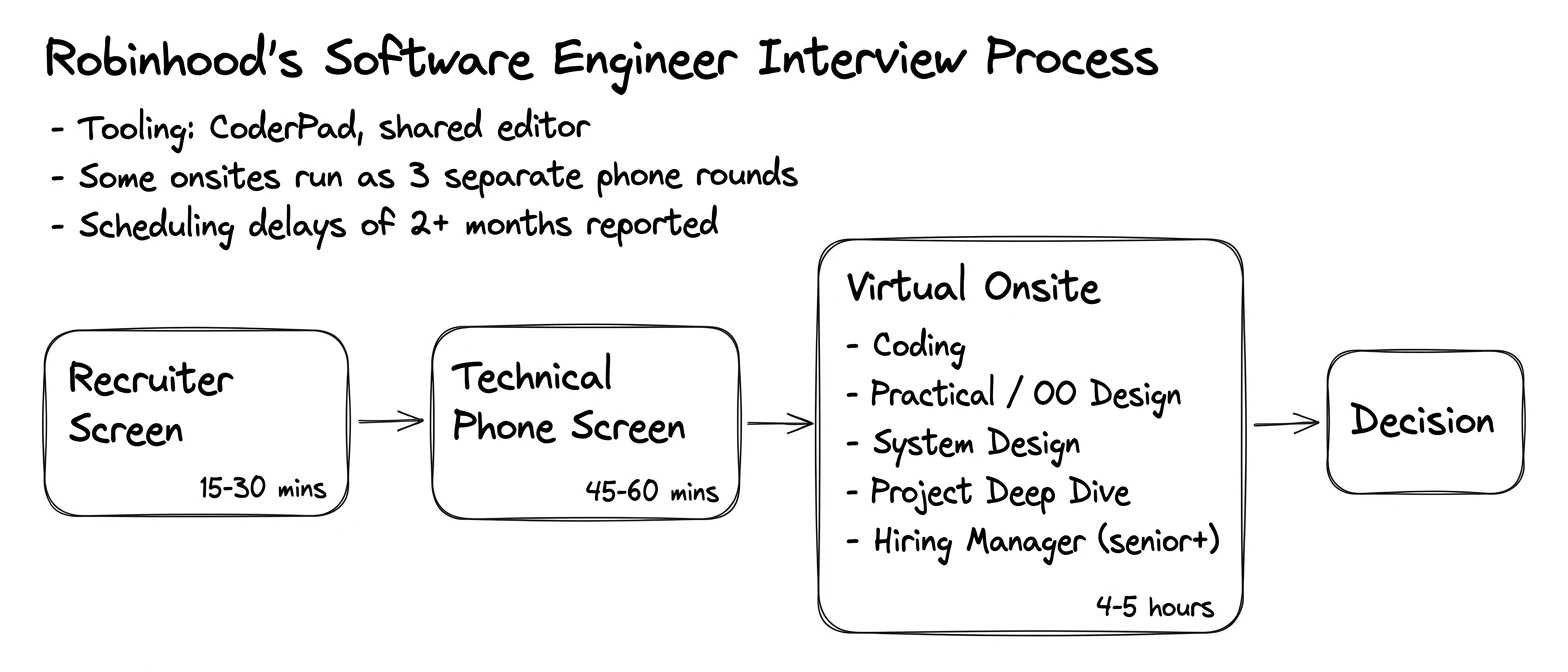
Robinhood interviews centrally: interviewers usually come from other teams, and the team is matched after the loop. The usual shape is a recruiter call, one technical phone screen and an onsite of three to four one-hour rounds; some candidates sat the same content as three separate phone rounds instead. Most processes take about four to six weeks, though rescheduling has pushed some past two months.
The shape shifts with level. Mid-level (IC4) loops pair one coding round with an object-oriented build, one system design and a project deep dive. Senior candidates often get system design as the phone screen, and one senior loop had two design rounds; a staff-level security loop ran five onsite sessions.
Here's what the interview process can look like:
- Online assessment (some cold applications): A timed coding test before any human contact; referred and recruiter-sourced candidates usually skip it.
- Recruiter screen: 15 to 30 minutes on motivation, your strongest project, offer priorities, compensation, other processes and work authorization.
- Technical phone screen: 45 to 60 minutes of live coding on a recurring graph or tree problem with layered follow-ups; system design instead for many senior candidates.
- Coding interview (onsite): One hour on a practical, domain-flavored problem such as fractional-share inventory or a capped leaderboard.
- Object-oriented design interview: One hour turning a sequence of text commands for a social payments app into running classes.
- System design interview (one or two): One hour on a job scheduler or a trading system, pushed hard on failure semantics.
- Project deep dive and behavioral interview: One hour on a single system you owned, sometimes from slides, plus experience questions.
Tip: Treat a correct first solution as the halfway mark. Interviewers keep adding variants (top three by count, an iterative rewrite, streaming inserts, a planted bug) until time runs out, and the score is written during those variants.
Online assessment
The assessment appears mainly in cold-application funnels. It is a proctored, timed test, usually about four tasks with separate time limits, and candidates call it fundamentals-first: data structures, string handling, boundary conditions and clean code rather than contest tricks. Passing it only earns the recruiter call; one cold applicant cleared it and was rejected the day after a 15-minute recruiter conversation.
Interviewers evaluate:
- Boundary handling: Empty inputs, duplicates and off-by-one limits that hidden tests check.
- Implementation stamina: Finishing a multi-step simulation task, not just the clever one.
- Code quality: Readable, defensive code, assessed alongside correctness at senior levels.
Practice timed string-processing and simulation problems at medium difficulty and finish each with your own edge-case tests.
Sample questions for the online assessment
Here are some questions reported by recent candidates:
-
Four tasks, each with its own time limit: a string-manipulation task, a multi-step implementation task and an algorithmic problem.
-
A medium-plus problem combining data-structure choice, string processing and boundary conditions, graded on code quality as well as correctness.
Recruiter screen
The recruiter call runs 15 to 30 minutes and is a real filter. A mid-level candidate covered a self-introduction, the most impactful project and their role in it, why Robinhood, the top three offer criteria, salary expectations, other processes and their stage, visa status, tech stack and relocation. Others were asked why they were leaving and how they handle pressure.
Recruiters often share the round lineup, leveling band and a compensation range, but treat verbal promises cautiously: one candidate's role moved from California to Toronto late in the process and earlier assurances fell through.
Interviewers evaluate:
- A specific reason for Robinhood: Fintech, the product you use, or the systems you want to build; a generic answer can end the process here.
- Ownership of your best project: Your individual role stated in one or two sentences.
- Logistics fit: Sponsorship, location and in-office expectations, which recruiters raise early.
Prepare a one-to-two-minute introduction, a concrete answer to "why Robinhood", and your offer criteria before the call.
Sample questions for the recruiter screen
Here are some questions reported by recent candidates:
-
Why Robinhood, and why are you leaving your current role?
-
Walk through your most impactful project and exactly what you owned.
-
What are the top three factors you will weigh when comparing offers?
Technical phone screen
The screen is 45 to 60 minutes with an engineer in a shared editor without a real debugger, after a brief introduction. The problem families repeat. The most common is a service dependency graph: compute each service's load factor, or the minimum time to finish all tasks given processing times and dependencies, a longest path through a DAG via Kahn's algorithm. Relatives count how often each node is triggered from an entry point, build a child-to-parent map, or count each user's direct and indirect referrals in a referral tree. Merge intervals also appears.
Follow-ups decide the round. On the referral tree, one candidate went from DFS with memoization to a size-three min-heap for the top three, an iterative DFS for deep trees, then streaming inserts that walk parent pointers to update ancestors. On the task-time problem, the interviewer flagged missed tasks with no dependencies, then hid a second bug to be found without print statements; tracing it used up the clock. Many senior candidates get a job scheduler design screen instead; one ran open-book, shifting the bar to justifying each decision.
Interviewers evaluate:
- Reasoning aloud: Brute force named first, then the improvement and why it is better; one rejected candidate cited not engaging the interviewer enough.
- Graph edge cases: Nodes absent from every dependency pair, several start nodes, and taking the maximum when several predecessors update one node.
- Debugging by tracing: Locating a bug by stepping through state on a small example, with print statements banned.
- Extending without restarting: Turning a batch answer into a top-k or incremental version in a few minutes.
Drill topological sort, subtree counting with memoization, and their top-k and streaming follow-ups until each base solution takes under 15 minutes.
Note: Seeing the problem before does not make the round easy. A referred candidate who had been shown the exact problem still spent the session debugging their own implementation, and another who reached a correct answer was rejected after the follow-ups.
Sample questions for the technical phone screen
Here are some questions reported by recent candidates:
-
Given tasks with processing times and dependency pairs, return the minimum total time to finish everything with unlimited parallelism.
-
Topologically sort a DAG, then compute how many times each node fires when execution starts from a given entry node.
-
For a referral tree, return each user's total direct and indirect referrals, then the top three, then keep counts current as users join.
-
Merge a list of overlapping intervals and discuss empty and single-interval inputs.
Coding interview
The onsite coding round is one hour, medium difficulty and practical. The most reported prompt is fractional-share inventory: process buy and sell orders, keep each ticker's fractional holdings in a hash map, never oversell, avoid floating-point drift and clear positions that reach zero. Others include a referral leaderboard capped at three entries with an O(N) requirement, and packing strings into fixed-width rows, then finding the emptiest row. In two reports, the interviewer replaced a problem the candidate had already solved with the fractional-share task mid-round.
Correctness outranks scalability. Expect 150 to 200 lines; code that does not run end to end, or defers an edge case to a "handle later" comment, counts as incomplete. Mobile-leaning loops may instead have you implement two methods inside a large existing stock trading app. Some recent loops split coding into an AI-assisted session (fix bugs in a small project, then accept or reject the assistant's suggestions aloud) and a second session with no assistance.
Interviewers evaluate:
- Running code: The full flow executes on the interviewer's example before time is up.
- Money invariants: No overselling, no negative balances, precise fractional quantities.
- Adaptability: Absorbing a swapped or extended problem without losing structure.
- Edge cases implemented, not listed: Unknown tickers, ties at the leaderboard cutoff, zero-quantity positions.
Practice ledger-style simulations in which you write the data model, the update path and the invariant checks in 40 minutes.
Sample questions for the coding interview
Here are some questions reported by recent candidates:
-
Process buy and sell orders for fractional shares, track inventory per symbol, and reject sells that exceed holdings.
-
Maintain a referral leaderboard that keeps only the top three users, computing counts in linear time.
-
Place strings into rows of a fixed width, then report which row has the most remaining space.
Object-oriented design interview
This hour turns a specification into runnable code. The recurring prompt is a social payments app driven by text commands: register a user, send a friend request, accept it by request ID, transfer money between friends with no overdraft, and print final balances. Candidates modeled a User with a balance and friends, a registry of pending requests, and a command processor; interviewers then push on duplicate requests, unknown users and invalid amounts.
Design choices are questioned directly: one interviewer asked whether a method that adds to a balance should be public at all and how the no-overdraft rule holds during a transfer; others raised concurrency and idempotency. A plain model that produces correct balances beats an elegant hierarchy that does not run.
Interviewers evaluate:
- Encapsulation: Balance changes only through methods that enforce invariants.
- Validation placement: Bad commands rejected at the boundary, not deep inside transfer logic.
- Duplicate and replay handling: The same friend request or transfer applied once.
- Verifiable end state: A final balance printout that proves money moved correctly.
Rehearse a command-parsing ledger from blank file to tested output in 45 minutes, then add one concurrency safeguard.
Sample questions for the object-oriented design interview
Here are some questions reported by recent candidates:
-
Parse commands to sign up users, send and accept friend requests, send money, and output final balances.
-
Model payments between friends with a strict no-overdraft rule and justify which methods are public.
System design interview
System design is the round rejected candidates most often name, and its bank is small. The job scheduler dominates: one-off and recurring jobs, SLAs, timeouts, retries with backoff, a job-status state machine, conditional writes so a job runs once, alerts when a job silently misses its schedule, jobs still running when the scheduler restarts, and queryable history and logs. The other pillar is trading: a stock order system calling an external exchange API, order routing from broker to exchange, and a real-time price system serving one-day to one-year charts.
Interviewers steer toward at-least-once versus exactly-once execution, durability so no order is lost, order and position consistency, and where price history lives. Other prompts include a secure trading platform on AWS and, in one loop, calendar and photo-management designs; a staff security loop used access-control and audit-pipeline designs.
Interviewers evaluate:
- Failure semantics you raise yourself: Worker death mid-job, retry storms, missed schedules and notification paths.
- Execution guarantees: Choosing at-least-once or at-most-once explicitly and enforcing it with idempotency keys or conditional writes.
- Order lifecycle modeling: Clear states and transitions for received, validated, submitted, filled and cancelled orders.
- Storage justification: A time-series store versus precomputed buckets for chart data, with granularity per time range.
- Pacing at senior levels: Leaving no long, empty deep-dive segment for the interviewer to fill with unfamiliar edge cases.
Prepare the job scheduler and one trading system to the point where you can defend every failure path and storage choice.
Note: Candidates rejected after the real-time price design traced the loss to one point: they could not argue concretely for a purpose-built time-series database over computed aggregations, or defend the data granularity for each chart range.
Sample questions for the system design interview
Here are some questions reported by recent candidates:
-
Design a job scheduler that meets SLAs, handles timeouts and transient failures, and alerts when a recurring job misses its run.
-
Design a trade management system that routes orders from broker to exchange through a durable state machine.
-
Design a real-time stock price service supporting one-day, one-week and one-year views with fault-tolerant feeds.
-
Design a secure trading app on AWS covering user profiles, authentication and real-time quotes.
Project deep dive and behavioral interview
This hour covers one system you owned and carries more weight than candidates expect. Some loops ask for slides; interviewers probe the architecture, rejected alternatives, timeline, team structure and what you would change. Several candidates were pressed on how they guaranteed idempotency in their own distributed system, and one loop asked for links to specific pull requests to examine real diffs and review discussion.
The behavioral half, or a separate behavioral round, covers a hard challenge, a team conflict, lessons from failure and what you would improve. In one loop the recruiter named the themes in advance (drive for results, influence for impact, bias for action, systems thinking), and they matched the sessions.
Interviewers evaluate:
- Reasoning over description: Why each decision was made, not just what was built.
- Separating your work from the team's: Specific changes and decisions you personally drove.
- Correctness thinking: Idempotency, failure handling and data consistency in your own architecture.
- Honest hindsight: What you would rebuild and why.
Choose one system you can defend down to the data model, and prepare two or three stories each for conflict, failure and pushing through a blocker.
Sample questions for the project deep dive and behavioral interview
Here are some questions reported by recent candidates:
-
Present a past project and explain how you ensured idempotency across its services.
-
What trade-offs did you make on this project, and what would you do differently now?
-
Describe a conflict within your team and how it was resolved.
-
Tell me about an unexpected challenge mid-project and the concrete steps you took.
-
Critique a Recent Engineering Project and Explain What You Would Redo
How Robinhood levels and evaluates Software Engineer candidates
Feedback is consolidated only after the whole loop, so warm signals in single rounds mean little. Recruiters often share the target band beforehand; senior loops lean harder on system design and the deep dive. Clearing the bar does not guarantee an offer: candidates rated strong in design and the deep dive were told no team was available, with their feedback valid for six months. Rejections can arrive the next day; positive outcomes have taken a week to a month, and rounds have been rescheduled on short notice.
Tip: Keep competing processes moving and tell the recruiter about deadlines early. One candidate accepted another offer before the Robinhood loop concluded.
How to prepare for the Robinhood Software Engineer interview
- Master the graph and tree family: Load factors, DAG longest paths, trigger counts and referral subtree counts, with top-k, iterative and streaming follow-ups.
- Practice debugging without print statements: Trace a planted bug on a three-node example by hand within five minutes.
- Build a payments ledger from text commands: Users, friend requests, no-overdraft transfers and final balances, running end to end in 45 minutes.
- Write fractional-share inventory cleanly: Exact quantities, oversell rejection and zeroed positions in a hash map.
- Own the job scheduler design: State machine, retries, idempotency, missed-run alerts, restart recovery and execution guarantees.
- Prepare one trading design: Order routing to an exchange or real-time price charts, including a time-series storage argument.
- Rehearse one deep-dive project: Slides, idempotency choices, your own pull requests and what you would redo.
- Have a sharp "why Robinhood": The recruiter call can end the process the next day.
About the Robinhood Software Engineer role
Robinhood Software Engineers build the services behind brokerage, crypto, retirement, cards, banking, futures and prediction markets, with work centered on correctness: orders and positions, clearing, money movement, market data and authentication, mostly in Go and Python behind REST APIs and messaging. Postings expect in-person attendance at least three days a week in Menlo Park, New York or Bellevue; Toronto also hires.
| Level | Primary focus | Impact scope |
|---|---|---|
| IC3 | Well-scoped features, with mentoring | Components within one team |
| IC4 | Independent ownership of services and features | A team's systems |
| IC5 (Senior) | Design leadership, cross-team trade-offs, mentoring | Several services and adjacent teams |
| IC6 (Staff) | Technical direction for large initiatives | An organization's architecture |
Robinhood hires Software Engineers across product and infrastructure. Teams include:
- Core Financial Products: Secure, scalable systems behind the main brokerage offerings.
- Clearing: Backend services and data for trade settlement, with strict correctness requirements.
- Credit Cards and Banking: Card, banking and money-movement services.
- Wallet and crypto: Crypto wallet and blockchain-facing services.
- Futures and Prediction Markets: New asset classes and their trading experience.
- Security: Access control, audit, service authentication and incident response.
Software Engineer experience and education requirements
Postings ask for production experience with distributed backend services in Go, Python or a similar language, plus API and data-modeling skills; staff roles ask for ten or more years, including several leading large initiatives. Internships require current degree enrollment. Mainstream languages are accepted in coding rounds, but mobile-leaning loops expect platform fluency.
FAQs about the Robinhood Software Engineer interview
How long does the Robinhood Software Engineer interview process take?
Usually four to six weeks from recruiter call to decision. Rescheduled rounds have stretched some processes past two months, while some rejections arrived the day after a round.
What is the hardest round of the Robinhood Software Engineer interview?
For senior candidates, system design, where questioning goes several layers into failure and storage choices. Below senior, the technical phone screen ends more processes through its follow-ups and debugging. The project deep dive is the most underestimated round.
How much does a Robinhood Software Engineer make?
Posted base pay for Software Engineer roles in the top pay zone (Menlo Park) has ranged from about $162K to $195K, with senior postings reaching about $230K. Robinhood uses three U.S. pay zones, and postings add bonus and equity eligibility on top of base.
What happens if there is no team match?
Interview feedback stays valid for about six months, so a candidate who cleared the bar can be matched later without repeating the whole loop.