Okta · Study
Okta Interview Process & Questions
TrueInterview
August 22, 2026 · 9 min read
Okta's loop leans on conversation: resume deep dives, a hiring-manager project chat and a discussion of how you use AI can each be a round, and one candidate was rejected after two rounds with no code. The coding that does happen is practical and often uses the identity domain: validating JWTs in a hands-on assessment, role permissions where a deny overrides an allow, a memory allocator, a rate limiter, and a thread-safe bank built on compare-and-swap.
This guide breaks down each stage of the Okta interview, what interviewers evaluate in each round, and how to prepare, with questions candidates were actually asked.
Verified: Based on 6 candidate-reported interview experiences, cross-checked against recent public accounts.
Okta interview process
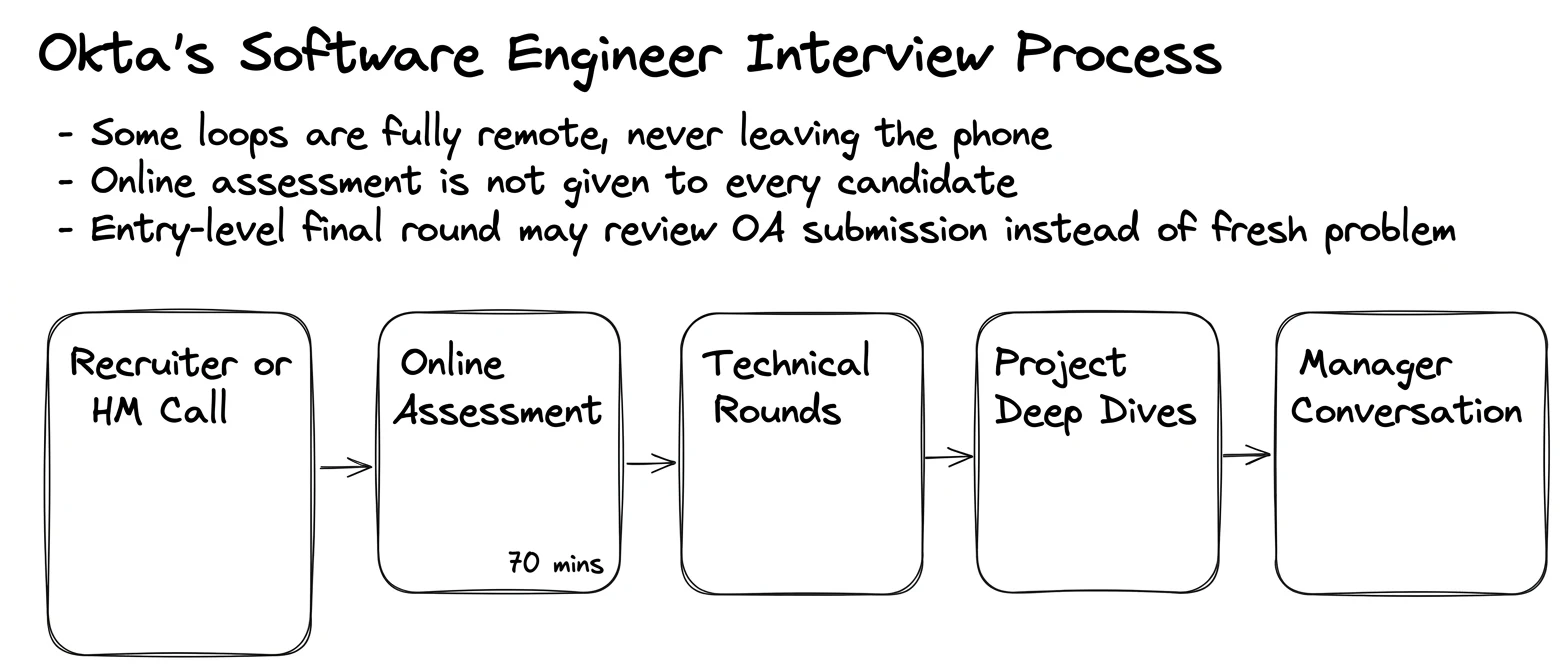
The shape varies by team, location and level. Reported loops ran two to four rounds, several entirely by phone (one candidate had four calls, two of them resume deep dives). Others end in an onsite of design and concurrency coding.
Entry-level candidates typically take an online assessment, a short behavioral call, and an hour-long review of their assessment answers. Mid-level and senior candidates get more project deep dives and one or two design rounds. Staff candidates have reported a take-home followed by a discussion of it with two engineers.
Here's what the interview process can look like:
- Recruiter and hiring manager screen: A resume-centered call, sometimes run by the hiring manager.
- Online assessment (entry level and some senior roles): Either about 70 minutes of four easy problems or a hands-on identity or security build.
- Technical phone screens: One or two practical coding problems per call, sometimes with Python and SQL questions.
- Project and AI conversations: Full rounds on one system you built, how you use AI tools, and on-call practice.
- Onsite coding: Concurrency and implementation problems, or a review of your assessment code.
- Design interviews (mid-level and above): Object design and system design driven by requirements and failure scenarios.
Tip: Treat every conversational round as scored. A candidate who had a warm project chat with the hiring manager was rejected after a follow-up call about AI's effect on engineering work.
Recruiter and hiring manager screen
The first call ranges from logistics to a full evaluation. One entry-level candidate had a brief call with no behavioral questions that only introduced the assessment. In other loops, the hiring manager took the first call and went through the resume in detail: technical decisions, challenges and cross-team work.
Interviewers evaluate:
- Team alignment: Whether your background (backend Java, infrastructure, identity protocols) fits the team.
- Decision reasoning: Why you chose an architecture, not just what it was.
- Collaboration: Specific examples of working across teams.
Prepare a five-minute walkthrough of your two strongest projects and their trade-offs.
Online assessment
Two formats are reported. The classic version is 70 minutes with four problems, two very easy and two easy. The hands-on version is an identity build. You register an application in the Okta developer portal, exchange client credentials for an access token, call a local API with it, and then build an Auth0-based MCP server. Its middleware validates the token's RS256 signature, audience, issuer, issued-at and expiry times, and an authorized-party or client-ID claim. A whoami tool requires the tool:whoami scope, with 401 returned for a bad token and 403 for a missing scope.
Interviewers evaluate:
- Protocol fluency: Credential to token to API call without stalling.
- Claim validation: Every required claim checked, and why each matters.
- Status-code precision: 401 for failed authentication, 403 for failed authorization.
Before the assessment, implement JWT validation and scope checks by hand once.
Note: For entry-level candidates, the final onsite was an hour of engineers going through the candidate's assessment answers instead of new problems. Write code you can defend line by line.
Sample questions for the online assessment
Here are some questions reported by recent candidates:
-
Build a token-protected MCP server whose middleware validates RS256, audience, issuer, timestamps and authorized party, with a scope-gated
whoamitool.
Technical phone screens
Phone coding is practical and medium at most. Reported prompts include cycle detection in a dependency graph, checking that every string in an array is a valid IPv4 address, and reversing substrings inside nested parentheses from the innermost pair outward. Access control also appears: deciding a user's access to a property across several roles, where any deny overrides any allow and no rule means deny. One final phone round combined a rate limiter with a memory allocator that returns the leftmost free block and frees by allocation ID.
Some screens are less algorithmic: one loop had a round on Python typing, debugging supplied code, complexity estimates and SQL joins.
Interviewers evaluate:
- Simplicity first: A rejected candidate's cycle-detection approach sprawled into edge cases and ran out of time.
- Contract clarity: Pinning down return values, such as -1 for a failed allocation or a double free, before coding.
- Validation edge cases: Leading zeros, empty segments and values over 255 in the IPv4 check.
Practice a correct baseline in 20 minutes, then extend it.
Tip: Confirm the exact spec and expected outputs at the start of the call. In one rejected loop, awkward problem sharing over the remote session cost real time.
Sample questions for the technical phone screens
Here are some questions reported by recent candidates:
-
Decide whether a resource dependency graph contains a cycle that would deadlock.
-
Implement an allocator over a 0/1 array with increasing IDs and leftmost fit that rejects invalid frees, then design a rate limiter.
-
Debug supplied Python, estimate its complexity, and write a SQL join.
Project and AI conversations
These are full rounds, and there can be more than one. One candidate had a second resume round on a single system, a distributed metric data backend: its architecture, data flow, scaling trade-offs and lessons. Another round skipped the resume and asked how the candidate uses AI tools, where they help most, and what cautions teams need. Topics also included on-call, incident response and sprint planning. Entry-level candidates get a 30-minute behavioral call instead.
Interviewers evaluate:
- Depth on one system: Architecture and scaling decisions that hold up under a second, deeper pass.
- A considered AI position: Where AI helps you, where you keep the final call, and which guardrails a team needs.
- Security ownership: Okta's values (love our customers, always secure and always on, build and own it, drive what's next) expect every engineer to own security.
Prepare one system in depth, a one-paragraph view on engineering with AI, and an incident story.
Sample questions for the project and AI conversations
Here are some questions reported by recent candidates:
-
Explain how you built a distributed metrics backend and which scaling trade-offs you made.
-
How do you use AI in daily engineering, and what cautions should teams adopt?
Onsite coding
Onsite coding takes a familiar problem and adds a production concern. One candidate built a bank with transfer, deposit and withdraw, then made it thread-safe; the interviewer steered toward a compare-and-swap loop using a map's conditional replace instead of locks. A senior round asked for linear-time, order-preserving deduplication, then an object-based rebuild, its memory risks on millions of entries, and how a code review would catch JavaScript memory leaks.
Interviewers evaluate:
- Race-condition reasoning: Why a naive read-modify-write loses updates and how CAS retries fix it.
- Memory awareness: The overhead of each data structure choice at scale.
Practice turning one locked data structure into a lock-free version with atomic compare-and-set.
Sample questions for the onsite coding
Here are some questions reported by recent candidates:
-
Make a multi-account bank thread-safe with compare-and-swap retries instead of locks.
-
Deduplicate a list in linear time, keeping first-appearance order, then discuss an alternative's memory risks.
Design interviews
In one four-round onsite, two rounds were design. The first was a CD rental system with search, rent and return, where the interviewer pressed on concrete data structures and on sorting by price and then shop ID. The second was a backup and recovery system taken in order: functional requirements, non-functional requirements, architecture, then scenarios such as partial backup failure, corruption during recovery and concurrent requests.
Interviewers evaluate:
- Requirements structure: Functional and non-functional requirements before any components.
- Concrete data structures: Hash maps and ordered sets named for each access pattern.
- Failure handling: Behavior under partial failure and concurrency.
Rehearse one design end to end, a third of it on failure scenarios.
Sample questions for the design interviews
Here are some questions reported by recent candidates:
-
Design a CD rental shop supporting search, rent and return, with results sorted by price and then shop ID.
-
Design a backup and recovery system, then handle partial failures, corruption on restore and concurrent requests.
How Okta makes hiring decisions
The hiring manager carries a lot of weight: managers often take the first call, and conversational rounds have decided outcomes alone. Feedback is typically combined after the final round, and level follows the scope of your past projects. The reports do not document cooldowns or decision timelines.
How to prepare for the Okta interview
- Learn the identity basics: The OAuth client-credentials flow, JWT claims, scopes, and 401 versus 403.
- Write simple baselines first: An overcomplicated first solution caused the reported phone-screen failure.
- Build an allocator and a rate limiter: They were asked together; clarify return codes first.
- Practice deny-overrides logic: Role and permission evaluation suits Okta's domain.
- Know one CAS pattern cold: Conditional replace in a retry loop, and when it beats a lock.
- Prepare an AI position: Specific gains, specific cautions, and where you keep human review.
- Deep-dive one system twice: Enough detail for two resume rounds without repeating yourself.
About working at Okta
Okta builds workforce and customer identity products: single sign-on, MFA, lifecycle management and governance on the Okta platform, and developer authentication through Auth0. Backend work is mostly Java with Spring Boot on AWS, plus some Kotlin and Go. Postings stress distributed systems, multi-tenancy and high availability.
| Level | Primary focus | Impact scope |
|---|---|---|
| Software Engineer 1–2 | Building features within established services | Tasks within one team |
| Senior Software Engineer | Owning complex production features | One team's services |
| Staff Software Engineer | Leading architecture and mentoring | Several teams |
| Principal Software Engineer | Large-scale distributed systems for enterprise customers | A product line |
Okta hires engineers across its identity products. Teams include:
- Okta Identity Governance: Access governance and audit, built as event-driven microservices.
- Authentication: Phishing-resistant sign-in such as passkeys and smart cards.
- Auth0 platform: Customer identity and developer authentication APIs.
Experience and education requirements
Postings ask for a computer science degree or equivalent experience. Senior roles typically require five or more years; staff and principal roles eight or more, including three in technical leadership. Java is the common language, and SAML, OAuth, FIDO and WebAuthn experience is often preferred.
FAQs about the Okta interview
How long does the Okta interview process take?
Typically a few weeks. Reported loops ranged from two calls to an assessment plus four interviews.
What is the hardest round of the Okta interview?
The rounds that look informal: project and AI conversations have rejected candidates without any code. Technically, the lock-free CAS round is the most demanding.
Is there an online assessment?
Usually for entry-level roles and sometimes for senior ones: four easy problems in about 70 minutes, or a hands-on identity build that a later round may review.