Netflix · Study
Netflix Software Engineer Interview Process
TrueInterview
July 24, 2026 · 14 min read
Netflix Software Engineer loops belong to one team's hiring manager, and in the advertising organization, the source of most recent loops, the question set is close to standardized: a cache or command-undo screen, an ads frequency cap design, and a standalone data modeling hour with no code. The decision weighs your background against what that manager needs, and several rejections named domain fit or a stronger candidate rather than a failed round. Working code is only the floor: candidates whose solutions passed their own tests were still rejected for loose code, unfinished follow-up chains, or not shaping requirements with the interviewer.
This guide breaks down each stage of the Netflix Software Engineer interview, what interviewers evaluate in each round, and how to prepare, with questions candidates were actually asked.
Verified: Based on 47 candidate-reported interview experiences, primarily from 2025 Q1 through 2026 Q3, cross-checked against recent public accounts.
Netflix Software Engineer interview process
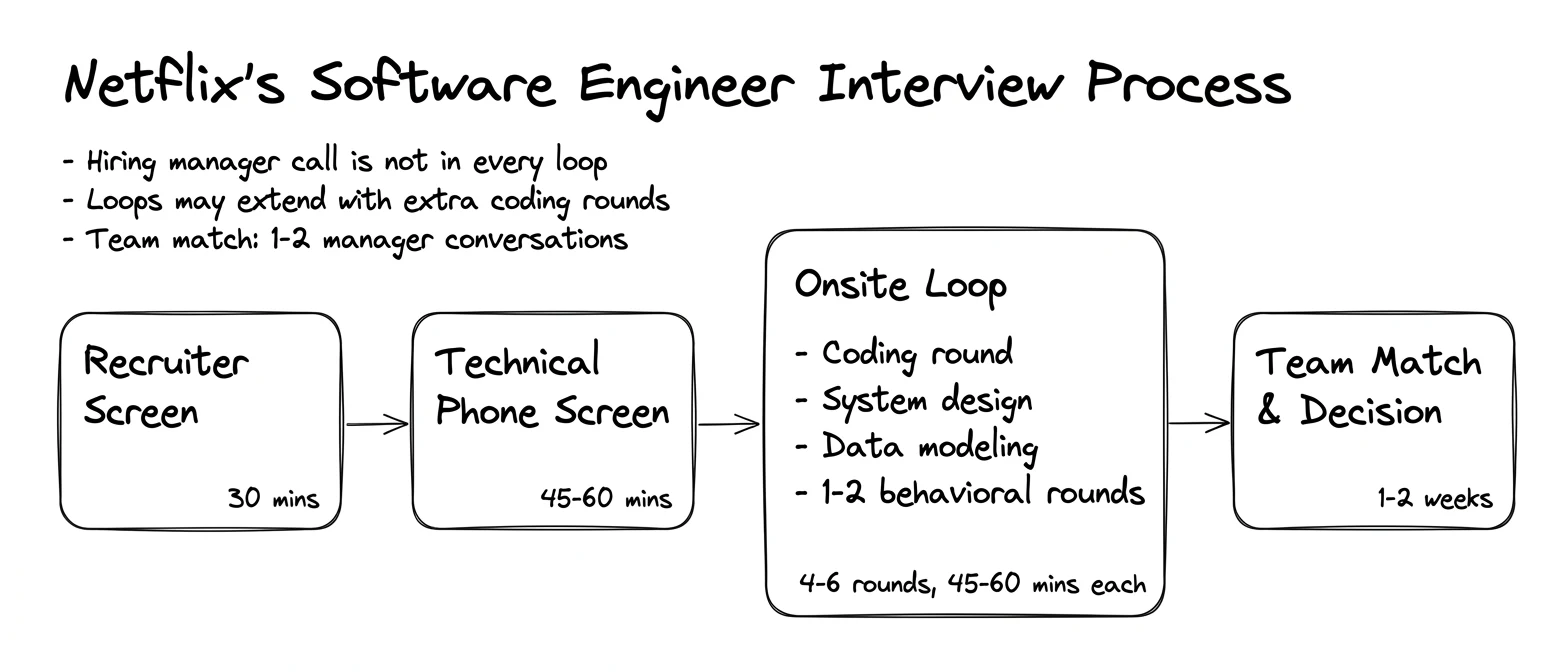
Netflix hires for a specific team, so the loop's content follows the team. Ads teams pair coding with system design and data modeling; Commerce and Games teams run a coding round plus a product-flavored problem-solving round; platform-leaning teams press on concurrency and durability. The skeleton is a 30-minute recruiter call, one or two technical screens of 45 to 60 minutes, a virtual onsite of four to six rounds of 45 to 60 minutes (sometimes over two days), and one or two team-match calls. Reported processes ran from about three weeks to two months.
Level changes the mix more than the format. L4 loops can be two back-to-back coding rounds with heavy testing; L5 loops add a design round and a data modeling round; one L6 loop had three design rounds (pacing, publisher configuration rules, inventory modeling). Netflix rarely hires below L4, and candidates holding staff titles elsewhere have been leveled as senior.
Here's what the interview process can look like:
- Recruiter screen (about 30 minutes): Background, motivation, culture-memo questions and logistics.
- Technical phone screen (one or two, 45 to 60 minutes): A practical component or a medium algorithm, coded and tested live.
- Coding interview (onsite, one or two): Command undo, tree traversal or dependency graphs, with self-written tests.
- Problem-solving interview (Commerce and Games, product teams): A homepage-deduplication scenario whose rules keep changing.
- System design interview (one to three): Usually an ads frequency cap or a variant of it.
- Data modeling interview (ads teams): Entities, relationships and query patterns for an ads domain, no code.
- Behavioral and culture interviews (one or two): Rapid-fire situational questions on feedback, conflict and ownership.
- Team matching (after the onsite): One or two hiring-manager calls about charter and mutual fit.
Tip: Ads loops reused the same prompts for months, but one mid-2026 loop swapped the expected order-tracking model for a parking lot with complex hourly rates, and the frequency cap for a competitor-exclusion rule. Prepare the known prompts plus one level of variation on each.
Recruiter screen
The recruiter call is about 30 minutes and broader than its length suggests: why Netflix, recent responsibilities, a significant challenge, and at least one direct culture prompt, such as which part of the culture memo resonates most, what selflessness means to you, or recent feedback given or received. It closes on work authorization, remote preference, salary expectations and recent languages. Cold applications and cold outreach both reached onsites, and a slow first response did not predict the outcome.
Interviewers evaluate:
- Motivation tied to the team: A reason for this team's charter, not admiration for the product.
- Culture literacy: A specific memo idea connected to something you did.
- Candor in practice: A feedback example with real friction and what changed afterward.
- Concise delivery: Short, structured answers; nerves were forgiven, padding is not.
Reread the culture memo and attach one short work story each to candor, selflessness, and context over control.
Sample questions for the recruiter screen
Here are some questions reported by recent candidates:
-
Why Netflix, and why this particular team?
-
Which part of the culture memo resonated with you most?
-
How do you interpret selflessness, and when have you acted on it?
Technical phone screen
Screens run 45 to 60 minutes in a shared editor, usually one problem, with the last five to ten minutes for your questions. About half are practical components: a cache with per-entry time to live, a weighted cache evicting the heaviest (or least frequently used) entry under a weight limit, a thread-safe p99 latency tracker, a printer that suppresses repeat events within 10 or 60 seconds, a versioned in-memory file system, or a playlist with shuffle. The rest are medium algorithms: topological sort, an itinerary rebuilt from tickets and then every valid itinerary, maximum overlap of closed intervals, or strict string-to-integer parsing that throws on extra leading zeros and overflow.
Follow-ups push toward production: clean expired keys off the hot path, extend to LRU, handle out-of-memory and out-of-order timestamps, or survive a server crash. Several screens required unit tests you write and run, including an item heavier than the whole cache. Advancing candidates heard back the next day.
Interviewers evaluate:
- Contract first: Inputs, outputs, miss values and tie rules fixed before coding; one candidate returned None on a miss because False could be a cached value.
- Data-structure pairing: A hash map with a tree map or heap for O(log n) eviction, with the reason for each.
- Self-testing: Your own cases for empty state, exact capacity and boundaries, actually run.
- Production follow-through: Lazy deletion versus a sweeper or queue, and persistence by write-through or snapshot.
- Tight code: A correct solution called insufficiently streamlined still failed.
Practice expiring, weighted and percentile caches from scratch in 30 minutes with tests, then rehearse their cleanup and durability follow-ups aloud.
Note: Passing your own tests does not mean passing the screen. Candidates who solved the weighted cache with passing tests, or answered every cache-design question in depth, were rejected within days; one interviewer cited more than 3,000 applicants for the posting.
Sample questions for the technical phone screen
Here are some questions reported by recent candidates:
-
Build a cache with per-entry time to live, extend it to LRU, and say what to evict when memory runs out.
-
Implement a thread-safe class that records latencies and returns the p99 over the last N milliseconds.
-
Print a cached value at most once per key in any 10-second window, then make the cache survive a server crash.
Coding interview
The onsite has one or two coding rounds of 45 to 60 minutes. The most repeated prompt is a command executor with execute and undo, where the history structure is the discussion and redo a verbal follow-up. Others: a tree traversal printing each node's level and whether its subtree is balanced, tree depth against provided tests, topological sort extended to every valid ordering, minimum completion time for tasks with durations and cycle detection, and fastest broadcast paths between cities when latencies keep changing. One L4 round inserted a row into the middle of a matrix and spent its second half on test cases. When coding signal was mixed, Netflix added an extra coding round after the onsite instead of closing the loop.
Interviewers evaluate:
- Bug-free first pass: Rejected candidates repeatedly suspected one bug, even fixed, cost them.
- Tests you design: Empty, single-element, skewed-tree and invalid-input cases, walked through aloud.
- Adapting to the twist: One ordering becomes all orderings; a shortest path must survive changing weights.
- Interface design: A clean command interface and history stack, not special cases per operation.
Drill topological sort, tree DFS with combined return values, and the undo pattern until each takes under 20 minutes with tests.
Sample questions for the coding interview
Here are some questions reported by recent candidates:
-
Implement a command executor supporting execute and undo for several commands, then describe redo.
-
Print every node's depth in a binary tree and whether each node is balanced, in one traversal.
-
Given tasks with durations and dependencies, return the minimum total time or report a cycle.
-
Minimum Time to Finish All Dependent Tasks with Durations (Detect Cycles)
Problem-solving interview
Commerce and Games and other product teams pair a coding round with a problem-solving round. The coding half is a three-step string-array progression: longest run of identical strings, longest window without a repeat, then all pairs sharing no characters, accepted at quadratic time by some interviewers while one required better and expected bitmasks. The problem-solving half is the homepage: rows of titles with no repeats, then a per-row threshold after which repeats are allowed, a dynamic threshold, deduplication only for the first N rows, and special rows that skip it. Other versions added a partial viewport per row or ended on a shared bloom filter at scale.
Interviewers evaluate:
- Requirement shaping: Concrete examples proposed and confirmed early; one rejection named too little iteration on examples.
- Timeboxing clarification: Coding by about minute 15; a candidate lost in nested-JSON edge cases sketched without code and failed.
- Extensible structure: New rules added without copying the core loop.
- Recognizing the index: Field-to-document lookups answered with an inverted index, not a scan.
Practice one evolving-rules problem end to end, refactoring after each new rule instead of patching.
Note: Candidates did not expect three follow-ups in one hour. One fixed a bug with logging just before time ran out and was still rejected; keep the first version small so later rules are cheap.
Sample questions for the problem-solving interview
Here are some questions reported by recent candidates:
-
Deduplicate titles on a homepage that scrolls horizontally and vertically, given a list of rows.
-
Allow repeats once a row reaches a threshold of unique titles, then make the threshold dynamic and limit it to the first N rows.
-
Return all nested JSON documents where a field equals a value, with defaults for absent fields.
System design interview
Mid-level loops have one design round and senior loops up to three. The ads frequency cap dominates: limit how often a user sees an ad in a rolling window, then go deep on distributed counters, atomic increments, fast store versus durable storage, read/write path separation and concurrent ad servers. Variants include audience targeting with very large segment uploads, budget pacing, supply-side publisher rules evaluated at decision time, inventory modeling, and a competitor-exclusion rule for the same user and title with sharding and check-to-impression lag. Outside ads: subscription billing, a crash-resilient file system, sentiment processing and movie recommendations.
Interviewers evaluate:
- Clarified constraints: Window size, per-ad versus per-campaign caps and rule semantics pinned down first.
- Consistency trade-offs: Where approximate counts are acceptable and how late events are reconciled.
- Depth on chosen components: Atomicity in the counter store, sharding keys, traffic estimates.
- Correctness where money moves: Idempotent charging, retries and an audit trail in billing.
- Failure modes you raise: Counter resets, delayed events, crash recovery.
Practice the frequency cap until you can defend every component, then pacing and targeting, which generic prep rarely covers.
Note: Design is the round most often blamed in L5 rejections. One candidate with strong screen and behavioral feedback named design as the weakest area; another failed a recommendation design by diving into details before structuring retrieval, filtering and scoring.
Sample questions for the system design interview
Here are some questions reported by recent candidates:
-
Limit impressions of an ad per user in a rolling 24-hour window across many ad servers.
-
Keep an advertiser's ad from appearing alongside a competitor's for the same user and title, and explain sharding and lag.
-
Design an ad pacing system that spends a campaign budget evenly from real-time spend signals.
Data modeling interview
Ads loops include a separate data modeling hour, and some screens do too. You list entities and relationships, justify normalization and indexing, and evolve the schema as requirements arrive. Reported prompts: demand-side tables for advertisers, campaigns, ad groups, ads, creatives, targeting and budgets; ads demand intake with bidding and targeting constraints; direct-sold order tracking on a demand-side platform; the data behind a frequency cap; and a parking lot with complex hourly rates.
Interviewers evaluate:
- Breadth of the flow: Every core entity of the ad-serving path, from account to impression.
- Domain depth: How bids are evaluated and targeting rules compose; one rejection cited this directly.
- Query-driven design: Indexes and partitions for "which ads are eligible" and "has this user hit the cap".
- Evolvability: Many-to-many targeting and new pricing rules added without breaking queries.
Model an ads demand platform end to end, stating the queries it must serve before drawing tables.
Tip: Learn the vocabulary first: frequency caps, pacing, direct-sold versus programmatic demand, ad groups, targeting taxonomies. A strong generalist was rejected for lacking ads domain expertise, and a demand-side engineer lost time to supply-side terminology.
Sample questions for the data modeling interview
Here are some questions reported by recent candidates:
-
Model demand-side tables for advertisers, campaigns, ad groups and ads, and the queries they serve.
-
Explain how a demand-side platform tracks a direct-sold order from booking to delivery.
-
Model a parking lot, then redesign the hourly-rate data when fee calculation becomes complex.
Behavioral and culture interviews
Most loops have two behavioral rounds, sometimes with two managers in one session. Rather than one deep project walk-through, several rounds fired six to eight situational questions back to back: feedback given and received, pivots, ownership, conflict, ambiguous requirements, success without clear metrics, your biggest mistake, and recent insights from using AI at work. Others map your history against the job description or add product thinking.
Interviewers evaluate:
- Specific, measured stories: Your actions and the result in numbers.
- Candor: Feedback that was hard to give, including across teams.
- Judgment without process: How you decided when nobody defined success.
- Fit to the posting: Heavy overlap with the job description; manager buy-in was often decisive.
- Calibrated depth: One rejection noted excessive detail in the culture round.
Prepare 8 to 10 stories on feedback, pivots, conflict, failure and ambiguity, each answerable in two minutes.
Tip: Have a cross-team feedback example ready; one interviewer explicitly ruled out examples from inside the candidate's own team.
Sample questions for the behavioral and culture interviews
Here are some questions reported by recent candidates:
-
Tell me about feedback you gave someone on another team and how it landed.
-
What is the biggest mistake of your career, and what did you change afterward?
-
How did you define success for a project whose metrics were unclear at the start?
How Netflix levels and evaluates Software Engineer candidates
The hiring manager owns the decision, informed by each interviewer's read. Evidence is not averaged: a strong-hire screen and favorable behavioral feedback did not offset a weak design round, and rejections cited background mismatch or a stronger candidate. Level is set by the hiring team and can land below expectations; one L5 candidate was told they might be considered at another level, and two weeks of silence ended in rejection.
Successful candidates usually have one or two team-match calls after the onsite, sometimes with competing managers. Ads feedback often arrived within one or two days; others waited a week or more, and one loop ended in a hiring freeze.
How to prepare for the Netflix Software Engineer interview
- Build the cache family from scratch: Time-to-live, weighted, LFU-with-recency and percentile caches, each with tests and a cleanup strategy.
- Run your own tests every time: Several rounds required runnable tests, and a late-fixed bug still counted against candidates.
- Rehearse follow-up chains: Take one problem through three rule changes without rewriting the core.
- Master the frequency cap and two neighbors: Counters, windows, atomicity and sharding, then pacing and audience targeting.
- Treat data modeling as its own exam: Model an ads demand platform and a direct-sold order flow from the queries they serve.
- Learn the team's domain vocabulary: Ads rejections cited missing domain depth more often than technical gaps.
- Settle level and team early: Ask the recruiter which team and level the loop targets, since prompts and leveling follow both.
About the Netflix Software Engineer role
Netflix engineers work on small, autonomous teams, own services from design through production, and decide with context rather than approval chains; managers apply the keeper test, asking whether they would fight to keep each person. Netflix long used a single senior engineer title and now posts openings by level, such as Software Engineer 4, 5 and 6.
| Level | Primary focus | Impact scope |
|---|---|---|
| L4 (Software Engineer 4) | Features and services within an established system | A team's components |
| L5 (Software Engineer 5, senior) | Systems owned end to end, through operations | A team's systems and partners |
| L6 (Software Engineer 6, staff) | Technical direction and cross-team architecture | Several teams or a domain |
Netflix hires Software Engineers across product and platform organizations. Teams include:
- Ads engineering: The in-house ad platform: ad serving, campaign management and media planning, supply and programmatic demand, audiences and measurement.
- Commerce and Games: Membership, sign-up, payments and the games experience.
- Consumer engineering: The member experience on TV, web and mobile, including the homepage and playback clients.
- Content and studio engineering: Tools for producing, acquiring and localizing titles.
- Personalization and member systems: Services behind recommendations and member-facing AI features.
Software Engineer experience and education requirements
L4 postings typically ask for two to four or more years of professional engineering, a computer science or related degree or equivalent experience, and strong skills in Java, Python, Scala or a similar language; client teams ask for TypeScript and Node.js. Senior postings expect ownership of distributed systems at scale. Interviews let you choose your language; candidates used Java, Python and C++.
FAQs about the Netflix Software Engineer interview
How long does the Netflix Software Engineer interview process take?
Usually three to eight weeks. One ads candidate got an onsite invitation the day after the screen and a decision four days after the onsite; others waited two weeks.
What is the hardest round of the Netflix Software Engineer interview?
System design and data modeling split it: design fails candidates who prepared only textbook systems, and data modeling fails those who treated it as drawing tables. In product-team loops, the multi-follow-up problem-solving round is the common stumble.
Is there an online assessment?
Rarely. One senior candidate reported a timed assessment with a versioned key-value store and an ads data-store problem; nearly every other loop began with a live screen.
How much does a Netflix Software Engineer make?
Approximate total annual compensation in the United States:
- L4: ~$330K
- L5: ~$505K
- L6: ~$720K
Pay is mostly base salary, and each employee chooses how much of it to take as stock options instead of cash.
What happens after a rejection?
Expect a short, generic email without detailed feedback. Offers to consider a candidate for another level or team rarely converted.