Netflix · Study
Netflix Interview Process & Questions
TrueInterview
July 24, 2026 · 11 min read
At Netflix the hiring team writes the loop. The advertising organization has used a nearly fixed set of prompts for more than a year: a timed cache or topological sort on the screen, then an onsite with undo, an ads frequency cap and a separate data modeling hour. Platform and data teams run quite different loops. Running, tested code is the minimum. Several candidates passed their own tests and were still rejected on code craft, requirement shaping, or fit with the hiring manager's needs.
This guide breaks down each stage of the Netflix interview, what interviewers evaluate in each round, and how to prepare, with questions candidates were actually asked.
Verified: Based on 55 candidate-reported interview experiences, cross-checked against recent public accounts.
Netflix interview process
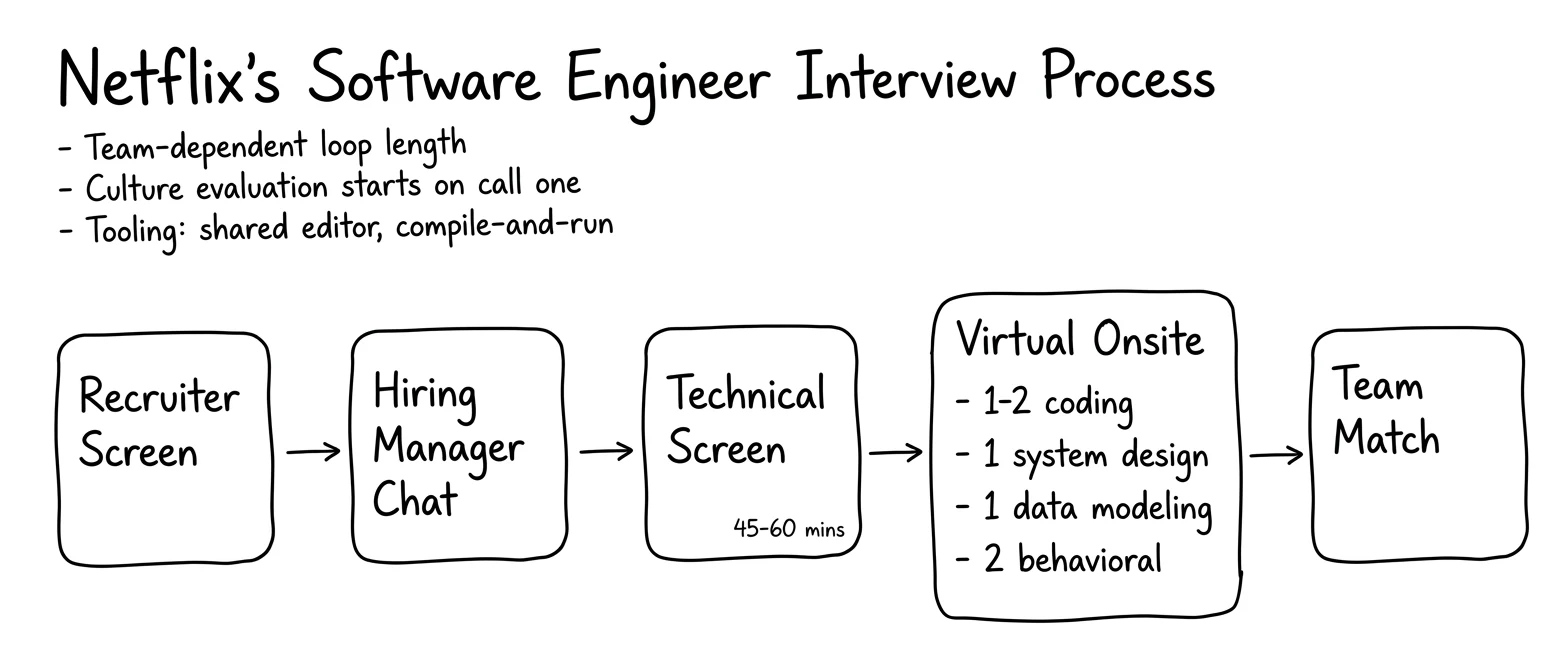
The loop varies more by team than by level. Most reported loops have a recruiter call, one or two technical screens of 45–60 minutes, and a virtual onsite of four to six independent rounds, followed by team-match calls with hiring managers. The shortest reported process was two phone screens. The longest was ten calls for a data role.
Netflix used a single senior title for most of its history. It formalized new-grad hiring in 2021 and now uses an explicit level ladder, but the loop is still built for experienced engineers. L4 loops focus on practical coding and testing. L5 and L6 loops add design, and one L6 candidate had three design rounds.
Here's what the interview process can look like:
- Recruiter screen (about 30 minutes): Background, motivation and logistics, plus direct questions about the culture memo.
- Technical phone screen (one or two): 45–60 minutes building a practical component in a shared editor, then running your own tests.
- Coding interviews: One or two onsite rounds of medium problems whose requirements change during the round.
- System design interview: An open-ended design in the hiring team's domain, most often an ads frequency cap.
- Data modeling interview: A round with no code, on the entities, relationships and access patterns of a business domain.
- Culture and behavioral interviews: One or two rounds based on the culture memo, often back to back.
Tip: Prepare every problem with its likely follow-ups. Nearly every coding report describes two to four changed constraints, and adapting quickly counted for more than the first solution.
Recruiter screen
Many candidates are contacted on LinkedIn, and some got a call the same day they applied. The call covers sponsorship, hybrid or remote preference, salary expectations and recent languages. It also includes culture questions, and recruiters expect you to have read the memo. Recruiters for data and platform roles went through resume projects in enough detail that the call worked as a first behavioral round.
Interviewers evaluate:
- Memo fluency: What selflessness or candor means in practice, with an example from work.
- Motivation: Specific reasons for Netflix, this team, and leaving your current role.
- Posting overlap: How closely your recent projects match the job description. This is checked again later.
- Concision: Brief, work-focused answers. Long personal stories hurt here and in later rounds.
Before this call, prepare a 60-second example for each of the memo's main values.
Sample questions for the recruiter screen
Here are some questions reported by recent candidates:
-
How do you interpret selflessness, and when did you act on it?
-
Which point in the culture memo resonated with you most?
-
What is a piece of candid feedback you recently gave or received?
Technical phone screen
Screens usually ask you to build a component. Caches dominate. One timed cache had to keep cleanup off the read path. One weighted cache evicts the heaviest entry with O(log n) operations, and another evicts by access frequency, breaking ties by recency. Other prompts include an event printer that suppresses repeats within a time window, a thread-safe P99 latency tracker, strict string-to-integer parsing, and itinerary reconstruction. Follow-ups ask about crash persistence, out-of-order timestamps, memory bounds, or listing every valid path.
Infrastructure Engineer screens are often design-first, such as a crash-resilient file system. Machine Learning Engineer screens pair loss-function and LoRA theory with a streaming word counter. Data engineering screens covered SQL and pipelines on a whiteboard, with no code run. Advancing candidates have been invited to the onsite the next day.
Interviewers evaluate:
- Tests you run: Interviewers asked for runnable unit tests, including a case where one item is bigger than the whole capacity.
- Pace: One candidate spent so long on nested-JSON rules that only a sketch was finished. Start coding by minute 15.
- Collaborative scoping: One rejection cited too little work on concrete examples before coding.
- Production instinct: Raising cleanup strategy, durability and lock granularity before being asked.
Build each cache and rate-limiter variant from scratch against a 45-minute timer.
Note: Clean screens still end in rejections. One weighted-cache solution passed every test, and the interviewer mentioned more than 3,000 applicants. Another candidate's correct code was judged not concise enough.
Sample questions for the technical phone screen
Here are some questions reported by recent candidates:
-
Build a cache that evicts the largest-weight entry once total weight would exceed the limit.
-
Track latencies under concurrent writes and return the P99 over the last N milliseconds.
-
Parse a string into a 32-bit integer without library calls, rejecting extra leading zeros.
Coding interviews
Onsite coding is medium difficulty, and the follow-ups carry most of the weight. Ads loops have asked for every valid topological ordering, a command executor with undo (redo was discussed but not coded), and a tree traversal that prints each node's level and whether its subtree is balanced. Another ads prompt removed duplicate movies from home-page rows. It changed three times, from a fixed per-row threshold to a dynamic one, then to the first N rows only, then to special rows being exempt. When coding results come back mixed, Netflix has added an extra coding round instead of rejecting.
Infrastructure loops test concurrency, with prompts such as a multithreaded map in C++, double-checked locking and an inverted index with phrase search. One full-stack ads loop replaced algorithms with a UI component built in plain HTML, CSS and JavaScript.
Interviewers evaluate:
- Correctness after each change: One candidate failed a round over a single wrong if-else branch.
- Restructuring: Moving to a new data structure when the problem changes shape, instead of adding branches.
- Self-testing: Edge-case tests you write and dry-run without being asked.
- Compile discipline: One C++ candidate lost so much time to missing headers that the tests never ran.
Practice adding three successive constraints to a solved problem in 45 minutes without rewriting it.
Sample questions for the coding interviews
Here are some questions reported by recent candidates:
-
Implement execute and undo for a command history, then explain how redo would work.
-
Print every valid topological ordering of a dependency graph.
-
Compute the fastest broadcast time from one city to all others, then handle latencies that keep changing.
System design interview
The ads frequency cap appears in at least ten reported loops. Interviewers press on read and write path separation, atomic counters in a Redis-like store, rolling windows, delayed events and reconciliation. An August 2026 variant blocked a competitor's ad for the same user and title, with follow-ups on sharding and the delay between the check and the impression. Other prompts include billing with idempotency, audience targeting with bulk uploads, and recommendations. One L6 loop covered pacing, publisher rules and inventory modeling.
Infrastructure Engineer prompts include global config rollout and ad click aggregation. Machine Learning Engineer prompts include CPU and GPU allocation across clusters and an ML platform portal. Prompts are left vague on purpose.
Interviewers evaluate:
- Structure from ambiguity: One rejection traced to a recommendation design that never separated retrieval, filtering and scoring.
- Specific choices: Why this store and this consistency model, with counter atomicity and traffic estimates.
- Failure handling: Retries, idempotency for payments, counter resets, and which component breaks first.
- Domain vocabulary: One L6 candidate with a demand-side background lost time on supply-side terms.
Practice frequency capping, pacing and billing until you can explain the trade-offs without notes.
Tip: Ads prompts repeated closely through mid-2026. An August loop then switched to a competitor-exclusion cap and a parking-lot data model. Learn the mechanics rather than memorizing past prompts.
Sample questions for the system design interview
Here are some questions reported by recent candidates:
-
Design an ads frequency cap over a rolling window, with separate read and write paths.
-
Design pacing that spends a campaign budget evenly from real-time spend signals.
-
Design subscription billing with retries, late payments and reconciliation.
Data modeling interview
Many loops have a separate data modeling round with its own interviewer and no code, usually on advertising. Prompts include demand-side tables (advertiser, campaign, ad group, ad), direct-sold order tracking, bidding and targeting rules, and frequency-cap tables. Interviewers ask about indexes, partitioning, and how the model changes when a new requirement arrives. Data engineering loops cover success metrics, SQL and data skew.
Interviewers evaluate:
- Domain depth: One rejection cited a weak grasp of bidding and targeting, despite positive general engineering feedback.
- Breadth: The candidate who got an offer covered every entity from the account through to ad serving.
- Access patterns: Normalization choices tied to the actual read and write queries.
Model one ads domain from advertiser to impression, and be ready to justify every index.
Sample questions for the data modeling interview
Here are some questions reported by recent candidates:
-
Model the demand side of an ads platform: advertisers, campaigns, ad groups and budgets.
-
Explain how a demand-side platform tracks a direct-sold order.
Culture and behavioral interviews
Expect one or two rounds. One pair covered product thinking in one round and feedback in the other. Several rounds asked many situational questions in a row instead of one deep dive into a project. Common themes are pivots, ownership, success criteria you had to set yourself, your biggest mistake, and conflict. An August 2026 loop asked about feedback given across teams and recent lessons from using AI at work. A machine-learning infrastructure loop added a partnership round built around a data scientist's problems.
Interviewers evaluate:
- Candor in both directions: Specific feedback you gave, and what you changed after feedback you received.
- Judgment with context: How you decided without being told what to do.
- Calibrated depth: One rejected L5 candidate was told the culture answers went into too much detail.
- Fit with the posting: One candidate who got an offer said their experience had to match the job description closely.
Prepare eight to ten stories of under two minutes each, mapped to the memo's values.
Note: Culture rounds alone can decide the outcome. One rejected candidate in a ten-call loop said their English held them back in these rounds.
Sample questions for the culture and behavioral interviews
Here are some questions reported by recent candidates:
-
Describe feedback you gave to someone on another team and how it was received.
-
How do you define success when no one gives you metrics?
How Netflix makes hiring decisions
Each interviewer writes feedback independently, and one clearly negative round can outweigh strong ones. The hiring manager compares the results with the team's needs, and several rejections cited background fit rather than a technical failure. Successful candidates then had one or two team-match calls. Levels can shift late in the process. A staff title elsewhere has mapped to senior at Netflix, and one candidate offered consideration at L5 was rejected two weeks later. One rejected candidate was told they could reapply after six months.
How to prepare for the Netflix interview
- Run your own tests: Practice where you compile and run code, because interviewers grade the tests.
- Practice changed constraints: Rework solved problems to return all answers, take a parameter, run concurrently, or bound memory.
- Master the cache family: TTL, weighted, LFU-style and LRU caches, including cleanup off the hot path and crash recovery.
- Timebox scoping: About five minutes of examples, then code.
- Learn the team's domain: For advertising, that means frequency caps, pacing, targeting and direct-sold orders.
- Settle level early: Agree on the target level with the recruiter before the onsite.
About working at Netflix
Netflix runs small teams of experienced engineers who get context instead of approval chains. The 2024 culture memo kept the keeper test. Each team hires for itself, and in recent loops the tested domain was mostly advertising and commerce, not streaming.
| Level | Primary focus | Impact scope |
|---|---|---|
| L3 (Software Engineer, new grad) | Well-scoped tasks with support | Part of a team |
| L4 (Software Engineer) | Owning features and components | One team's services |
| L5 (Senior Software Engineer) | Leading projects independently | A team and its partners |
| L6 (Staff Software Engineer) | Technical direction across systems | Several teams |
| L7 (Principal Software Engineer) | Architecture for a whole area | An organization |
Netflix hires engineers across product, platform and content organizations. Teams include:
- Ads Engineering: The in-house ad server and Ads Suite (rolled out across all ad markets in 2025), plus capping, pacing and measurement.
- Commerce and Games: Signup, billing, payments and the games platform.
- Content and Business Products: Studio production and distribution tooling.
- Data Platform: Pipelines and data products for growth, finance and content teams.
- ML and AI platform: Compute scheduling and model monitoring.
- Open Connect: Netflix's content delivery network and its control plane.
Experience and education requirements
L5 postings typically ask for five to eight or more years of experience in Java or Python, plus distributed systems and API design. New-grad roles exist but are few. Specialized teams prefer a computer science or electrical engineering degree.
FAQs about the Netflix interview
How long does the Netflix interview process take?
Typically three to six weeks. Feedback can come within one or two days, and team matching can add one to two weeks.
What is the hardest round of the Netflix interview?
For advertising roles, data modeling and system design, because both need domain knowledge. Elsewhere, coding rounds with several follow-ups, where one bug can end the loop.
How much does a Netflix software engineer make?
Approximate US total compensation:
- L4: ~$330K
- L5: ~$510K
- L6: ~$730K
Pay is mostly salary. Employees choose how much to take as stock options, and there are no performance bonuses.
Is there an online assessment?
Rarely. One L6 candidate reported a timed two-problem challenge. Most loops start with a live screen.