Study
Which ML Fundamentals Questions Do Candidates Report in 2026?
TrueInterview
November 2, 2026 · 13 min read
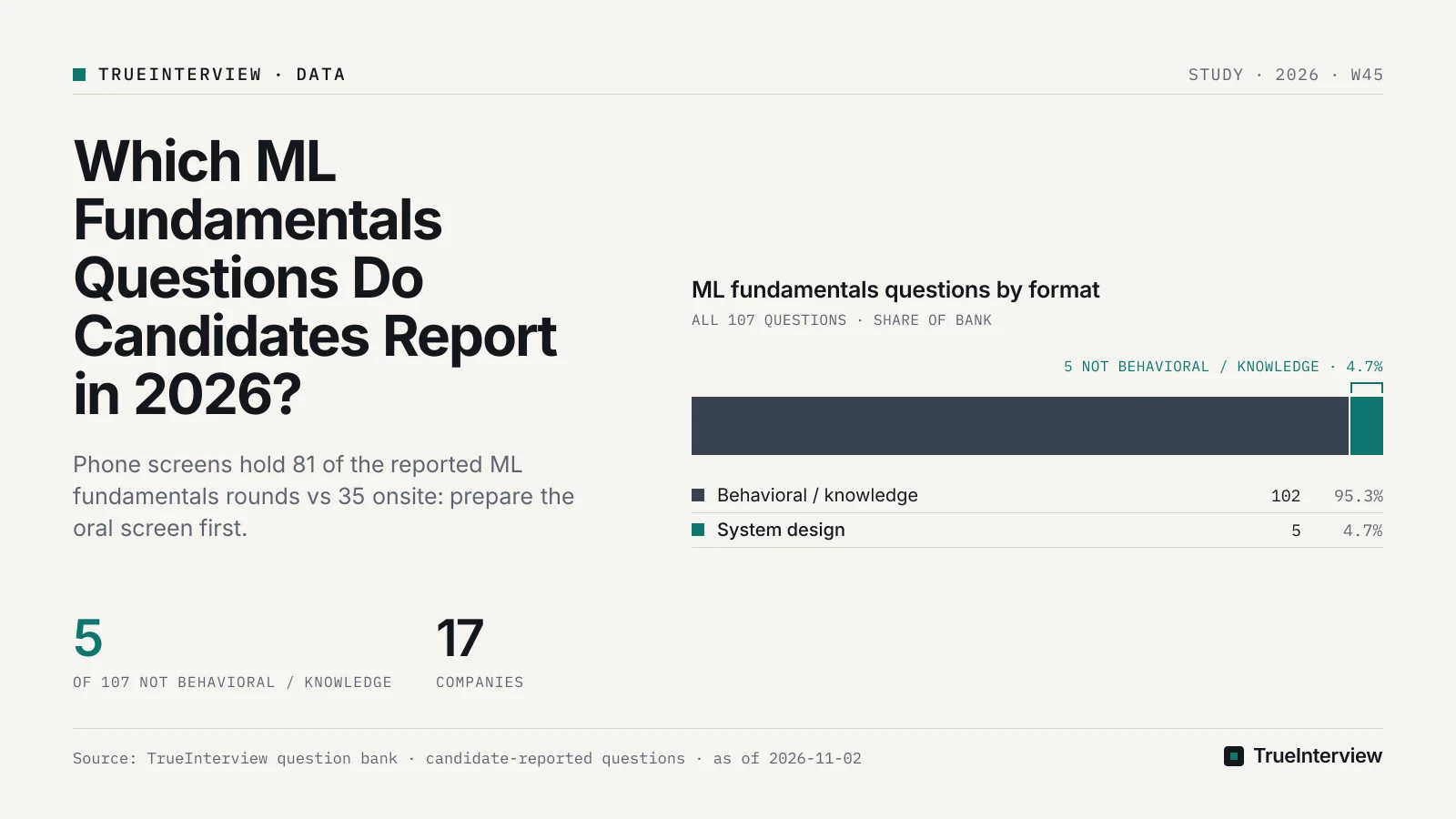
As of 2026-11-02, TrueInterview's bank holds 107 ML fundamentals questions reported at 17 big-tech companies, and 77 of them were last reported in the 12 months before that date. Of the 107, 102 are knowledge or discussion format and 5 are system design. For an engineer moving into machine learning, LeetCode stays in the loop and an oral knowledge round is added alongside it, most often reported in the phone screen. Before you add more algorithm problems, practise explaining dropout, normalization and loss functions aloud and walking through why a model overfits.
Disclosure: TrueInterview is an interview-preparation product and publishes this article. Facts about other products come from their public pages on the dates listed under Sources.
Where does the knowledge check land in the loop?
Mostly in the phone screen. Across the rounds candidates reported for these questions, 81 are phone screens, 35 are onsites and 2 are online assessments, and one question can appear in more than one round. Every knowledge-format question in the phone screen (77) and in the onsite (34) carries the ML fundamentals subtype.
The dated phone-screen examples are recent. Google's ML Fundamentals Deep Dive was last reported in 2026-09, ByteDance's Dropout, Overfitting, Normalization, Loss Functions in 2026-10, Amazon's Transformer / Attention Deep-Dive in 2026-09 and Netflix's ML Research Orals (Self-Attention / LoRA / Optimizers) in 2026-10.
Our take: prepare this round first, not last. The phone screen is the gate to the onsite, so a failed oral screen ends the loop before your ML system design or coding preparation is ever tested. Put machine learning knowledge drills in your first week of preparation and keep them running while you add onsite material.
Which fundamentals rounds do candidates write up most?
The most-linked rounds are general fundamentals rather than LLM topics: Google's ML Fundamentals Deep Dive, ByteDance's dropout and normalization round and Pinterest's ML Fundamentals Quick-Fire top the table below. Counts are what candidates reported in write-ups, not how often a company asks, and none of these titles is an official company list.
| Reported round | Company | Round, last reported | Write-up links | Practise |
|---|---|---|---|---|
| ML Fundamentals Deep Dive (AI/ML & MLE Roles) | Phone screen, 2026-09 | 10 | Deep Dive practice | |
| Dropout, Overfitting, Normalization, Loss Functions | ByteDance | Phone screen, 2026-10 | 8 | Dropout and normalization drill |
| ML Fundamentals Quick-Fire | Phone screen, 2026-06 | 8 | Quick-Fire practice | |
| ML Fundamentals, Transformer & Regularization | Snapchat | Phone screen, 2026-05 | 7 | Transformer and regularization drill |
| ML Fundamentals & Model Debugging Drill | Apple | Phone screen, 2026-06 | 6 | Model debugging drill |
| ML Knowledge / Discussion Round | DoorDash | Onsite, 2026-07 | 6 | Discussion round practice |
| ML Breadth Orals — Linear / Logistic / Random Forest / Optimizers | Amazon | — | 5 | Breadth orals practice |
| RLHF: PPO vs GRPO vs GSPO | Amazon | — | 5 | RLHF comparison practice |
How to prepare for the topics these titles name
The notes below are our preparation advice on the concepts each title names, not reports of what the rounds asked. Google's Deep Dive title promises depth over breadth, so prepare to follow one concept down through several "why" questions. A good test is regularization: explain why a ridge penalty shrinks every weight smoothly while a lasso penalty sets some weights to exactly zero, and what each does when features are correlated.
ByteDance's round names its own syllabus. Dropout zeroes random activations during training and rescales the survivors so the expected activation matches inference. Batch normalization normalizes across the batch while layer normalization normalizes across features, which is why transformers use the latter. For loss functions, be ready to say why cross-entropy trains a sigmoid or softmax classifier better than squared error: the gradient does not vanish when the model is confidently wrong.
The titles of Apple's debugging drill and Amazon's RLHF question point at reasoning rather than recall. For a model whose loss will not fall, a standard first move is to overfit a single small batch: if that fails, look for a bug in the model, the loss, the optimizer settings or the input pipeline; if it passes, move on to data quality and generalization. For RLHF, PPO trains a value model and clips the per-token policy ratio, GRPO drops the value model and scores each response against a group of samples for the same prompt, and GSPO moves the ratio and clipping to the sequence level.
By company, Amazon files the most ML fundamentals questions (30), then ByteDance (19), Snapchat (9), Google and Microsoft (8 each), Apple and Meta (6 each), Pinterest (4), and Netflix and NVIDIA (3 each). If Amazon or ByteDance is on your list, their reported rounds are your primary practice set. For the other companies the per-company sets are small, so the general fundamentals list above matters more than any single company's titles.
Are LLM topics replacing the classic fundamentals?
Not in these reports, which show a snapshot rather than a trend. The most-linked rounds are classic fundamentals, and LLM-era topics appear alongside them. Snapchat's round pairs transformers with regularization, Amazon's Transformer / Attention Deep-Dive and Netflix's ML Research Orals put self-attention and LoRA into phone screens, and LoRA and PEFT Variants is linked from 3 senior-or-above write-ups and 1 junior write-up.
Our take: master the classic layer first, because the most-linked rounds are built from it and the LLM questions assume it. Self-attention is a softmax over scaled dot products, so a candidate who cannot explain why the logits are scaled, or why layer normalization wraps each block, will stall in a transformer deep-dive. LoRA is the same story: it freezes the pretrained weights and trains a low-rank update, and the interesting follow-up is what that saves in optimizer memory, which is an optimizer question at heart. Add attention, LoRA and RLHF as a second layer once you can explain dropout, normalization, loss functions and optimizers without notes.
The classic layer is cheap to cover. Google's Machine Learning Crash Course page says the refreshed course "covers recent advances in AI, with an increased focus on interactive learning". Google's course page lists modules on linear models, loss and gradient descent, classification metrics such as precision, recall and AUC, neural networks, embeddings, and large language models "from tokens to Transformers".
Does coding go away when you move into machine learning?
No. The knowledge round is added next to coding rather than in place of it. Shivam Anand's interviewing.io guide lists the usual ML loop as "Coding (DSA/Implementation) - ML Knowledge/Case Study Rounds - ML System Design - Behavioral/Team Fit Interviews".
TrueInterview's problem list also files a Most Frequent Function Call Stack coding question under Roblox, in the phone screen and onsite, for a Machine Learning Engineer role. The same interviewing.io guide says research teams "might skip coding rounds and focus instead on whiteboard proofs, open-ended modeling problems, and research presentations".
Our take: because the loop above keeps a coding round and adds knowledge and design rounds, keep coding at a maintenance level, a few problems a week in your target companies' reported topics, and move the new hours to timed spoken explanations of models. For the coding side of that trade-off, see Is LeetCode still enough for big tech interviews in 2026?.
What do the role splits mean for a software engineer switching in?
Our reading: they say more about the title on the write-up than about switchers. By the role on the write-up, links come from Machine Learning Engineer candidates 103 times and from Software Engineer and Data Scientist candidates 6 times each. Google's ML Fundamentals Deep Dive is the exception, with 4 of its links from software-engineer candidates. The role is the one recorded on the write-up, which may be the title applied for rather than the candidate's background, so do not read these splits as how many switchers face each round.
The other top rounds, including ByteDance's dropout round, Pinterest's Quick-Fire, Amazon's breadth orals and Amazon's RLHF question, have no software-engineer links in the bank. Shivam Anand's interviewing.io guide separates generalist MLE roles, which expect "Good practical intuition across supervised, unsupervised, embeddings, metrics", from specialist roles, which expect the "Ability to implement and optimize SOTA models".
Our take: if you are applying under a software engineer title to an ML-heavy team, prepare to the depth of Google's Deep Dive and spend the rest on your normal loop. If you apply as an MLE, assume the full oral set and aim for the generalist profile, where your production engineering counts and breadth matters more than a record of implementing state-of-the-art models.
What changes at senior and staff level?
Senior candidates write up more of these questions, and their rounds are the open-ended ones. Write-ups link the questions 68 times from candidates who reported a senior, staff-plus or manager level and 53 times from candidates who reported a junior, new-grad or intern level. Levels are what each candidate reported on the write-up.
| Round | Senior-or-above links | Junior, new-grad or intern links |
|---|---|---|
| ML Fundamentals Deep Dive | 7 | 3 |
| ML Fundamentals & Model Debugging Drill | 5 | 1 |
| ML Knowledge / Discussion Round | 5 | 1 |
| RLHF: PPO vs GRPO vs GSPO | 4 | 1 |
| ML Fundamentals, Transformer & Regularization | 4 | 3 |
| LoRA and PEFT Variants | 3 | 1 |
| Deep Learning Fundamentals: Optimization, Drift, Calibration | 3 | — |
| ML Fundamentals Quick-Fire | 3 | 5 |
Staff-plus and manager write-ups link questions such as MLP Compute-vs-Memory Bound Analysis and Explain AI Safety and Weigh Advanced AI Benefits and Risks. Chip Huyen's ML interviews book says "interviews for more senior roles should expect harder questions". The Quick-Fire row is the only one in this table where junior links outnumber senior ones.
Our take: if you are senior, rehearse walk-throughs, not flashcards. For overfitting, start with the gap between training and validation curves, rule out leakage between splits, then reach for more data, weight decay, dropout or early stopping. For drift, compare feature and prediction distributions between training data and recent traffic before you decide whether to retrain. For calibration, draw a reliability diagram and fit temperature scaling on held-out data. For the staff-level compute question, explain why a small-batch MLP is memory-bound: every weight is read from memory for very little arithmetic.
Down-leveling note (our view): the rounds senior candidates link most are the open-ended ones, the deep dive, the debugging drill and the discussion round. We would expect trade-off depth in those rounds to matter more for a senior candidate than crisp definitions, so if you are worried about being leveled down, put your extra hours there rather than into the quick-fire material.
What do interviewers check in a knowledge round?
Concepts, common misconceptions and the signals behind your answers. Chip Huyen's ML interviews book says it holds over 200 knowledge questions, each marked with difficulty, that cover "important concepts and common misconceptions in machine learning", and that its first part explains the interviewers' mindset and the signals they look for.
For design discussions, Shivam Anand's interviewing.io guide lists what interviewers probe: tying the ML decision to the business problem, collecting training data while handling bias, cold start and privacy, keeping features consistent with the model choice, and testing offline and online before a launch with caching and rollback plans. The same guide says emphasis follows the team: infra-focused teams stress "MLOps and pipeline design", while applied teams stress the "End-to-end ML lifecycle: problem framing, feature engineering, modeling, evaluation".
Google's Rules of ML gives the frame these discussions reward: "Most of the problems you will face are, in fact, engineering problems," and most gains "come from great features, not great machine learning algorithms". Its fourth rule says to keep the first model simple and get the infrastructure right.
Our take: avoid three preparation mistakes. Do not treat ML preparation as more algorithm problems, do not study only LLM topics because they feel current, and do not stop at the definition when a round asks what you would check next. Huyen's book also says many companies are "still making it up as they go along", so ask your recruiter which of these rounds your loop contains before you plan.
Worked example: an Amazon loop
Amazon is the largest single practice set in the bank, and its reported rounds map onto both layers. All 27 of Amazon's knowledge-format questions carry the ML fundamentals subtype. Its breadth orals cover the classic layer, while the transformer deep-dive and the RLHF comparison cover the LLM layer, and 4 of the RLHF question's 5 links come from senior-or-above candidates.
A practical week looks like this. Spend the first two days explaining linear and logistic regression, random forests and optimizers aloud, about two minutes each. Spend the next two on self-attention and a full transformer block, then a day comparing PPO, GRPO and GSPO and when each fits. Use the last two days for mixed timed drills, with ByteDance's dropout round as a cross-check, since all 19 of ByteDance's knowledge-format questions are ML fundamentals as well.
How we counted
Counts come from TrueInterview's question bank as of 2026-11-02. TrueInterview says its questions are "Written up right after the interview and checked against other reports of the same round," and that questions are dated when the report gives a month. A write-up link means a candidate's write-up points to that question; link counts are not write-up counts, levels and roles are self-reported, and a question can sit in more than one round, so round totals exceed the question total. We show when questions were last reported rather than a quarter-by-quarter share, so read this as what candidates report now, not proof that companies ask more ML fundamentals than last year.
FAQ
Do machine learning interviews still include a coding round?
In most loops, yes. The interviewing.io guide quoted above puts coding next to ML knowledge, ML system design and behavioral rounds, and names research teams as the group that may skip it. For how to split your hours between coding and the knowledge round, see the coding section above and the practice plan below.
Is system design part of the fundamentals screen?
Rarely, in these reports: only 5 of the 107 ML fundamentals questions are system design format. Huyen's book says the open-ended questions some companies call ML systems design are "the questions that candidates often find to be the hardest" and that almost all companies the author talked to ask at least one. Plan for it as a separate onsite round. The fundamentals screen comes first, and the vocabulary you build for it, such as loss, metrics and calibration, is what you will reuse in the design round.
What does a quick-fire round look like?
Pinterest's ML Fundamentals Quick-Fire is the reported example, last seen in a phone screen in 2026-06. The title suggests a breadth format, so our expectation is that you need a correct one- or two-sentence answer on many topics, then the ability to go one level deeper when asked. It is the one round in the level table that junior candidates link more than senior ones, so treat it as the floor, and prepare a short definition plus one trade-off for each classic topic.
Which companies report the most fundamentals questions?
Amazon and ByteDance, by a wide margin; the company counts are in the table section above. If either company is on your list, its named rounds give you a concrete syllabus, from Amazon's breadth orals and RLHF comparison to ByteDance's dropout and normalization round. For companies with only a handful of reports, prepare the general fundamentals list rather than guessing at company-specific topics.
Should a senior engineer prepare with flashcards?
Only for the floor. The rounds that skew senior in the level table are the deep dive, the debugging drill and the discussion round, and Huyen's book says senior roles should expect harder questions. Flashcards get you through a quick-fire round; they do not get you through a question about what you would check first when a model drifts. Spend most of your time on spoken walk-throughs for overfitting, drift and calibration that end in a decision, such as retraining or recalibrating, and its cost.
Your practice plan
- In your first week, write a short spoken answer for dropout, overfitting, normalization, common loss functions and optimizers, then record and time yourself; practise them with the dropout and normalization drill and the ML breadth orals.
- Keep coding at maintenance level throughout, with a few problems a week from your target companies' reported topics.
- In your second week, add the LLM layer: walk through self-attention and a transformer block with the Transformer / Attention Deep-Dive and the ML Research Orals, then compare policy-optimization methods with RLHF: PPO vs GRPO vs GSPO.
- If you are senior or above, prepare one debugging walk-through each for overfitting, drift and calibration with the model debugging drill and Deep Learning Fundamentals: Optimization, Drift, Calibration.
- In your third week, run mixed timed drills from the ML Fundamentals Quick-Fire and the ML Fundamentals Deep Dive, answering each follow-up "why" until you reach the math.
- Before an onsite, book a mock with a human interviewer: TrueInterview says it does not sell mock interviews with human engineers and suggests booking one or two elsewhere.
Sources
- TrueInterview question bank — ML fundamentals at big-tech companies — counted 2026-11-02
- Machine Learning | Google for Developers — checked 2026-11-02
- Becoming an MLE at FAANG: What you need to know to know about MLE roles and interviews at Google, Meta, and other top companies — checked 2026-11-02
- Coding Interview Questions by Company · TrueInterview — checked 2026-11-02
- Introduction to Machine Learning Interviews Book · MLIB — checked 2026-11-02
- Rules of Machine Learning: | Google for Developers — checked 2026-11-02
- Real FAANG Interview Questions by Company · TrueInterview — checked 2026-11-02
- Interview prep compared: your application, end to end · TrueInterview — checked 2026-11-02
Last reviewed: 2026-11-02.