Meta · Study
Meta Software Engineer Interview Process
TrueInterview
July 24, 2026 · 15 min read
Meta's loop is changing under candidates' feet. Loops scheduled on or after April 16, 2026 replace some or all traditional coding with AI-enabled rounds: a multi-file project with an assistant, graded on hidden tests that only the optimal algorithm passes in time. Candidates rank it the hardest hour of the day, not the easiest. Traditional rounds still fit two problems into 45 minutes, and a single hint on a known edge case has ended a phone screen.
The interviews are only half the decision. A committee reviews the whole packet, can reject a loop rated "meets the bar" in every round, and moves the level in both directions; team matching follows, so an approved candidate can wait weeks for a team. This guide breaks down each stage of the Meta Software Engineer interview, what interviewers evaluate in each round, and how to prepare, with questions candidates were actually asked.
Verified: Based on 91 candidate-reported interview experiences, primarily from 2025 Q4 through 2026 Q3, cross-checked against recent public accounts.
Meta Software Engineer interview process
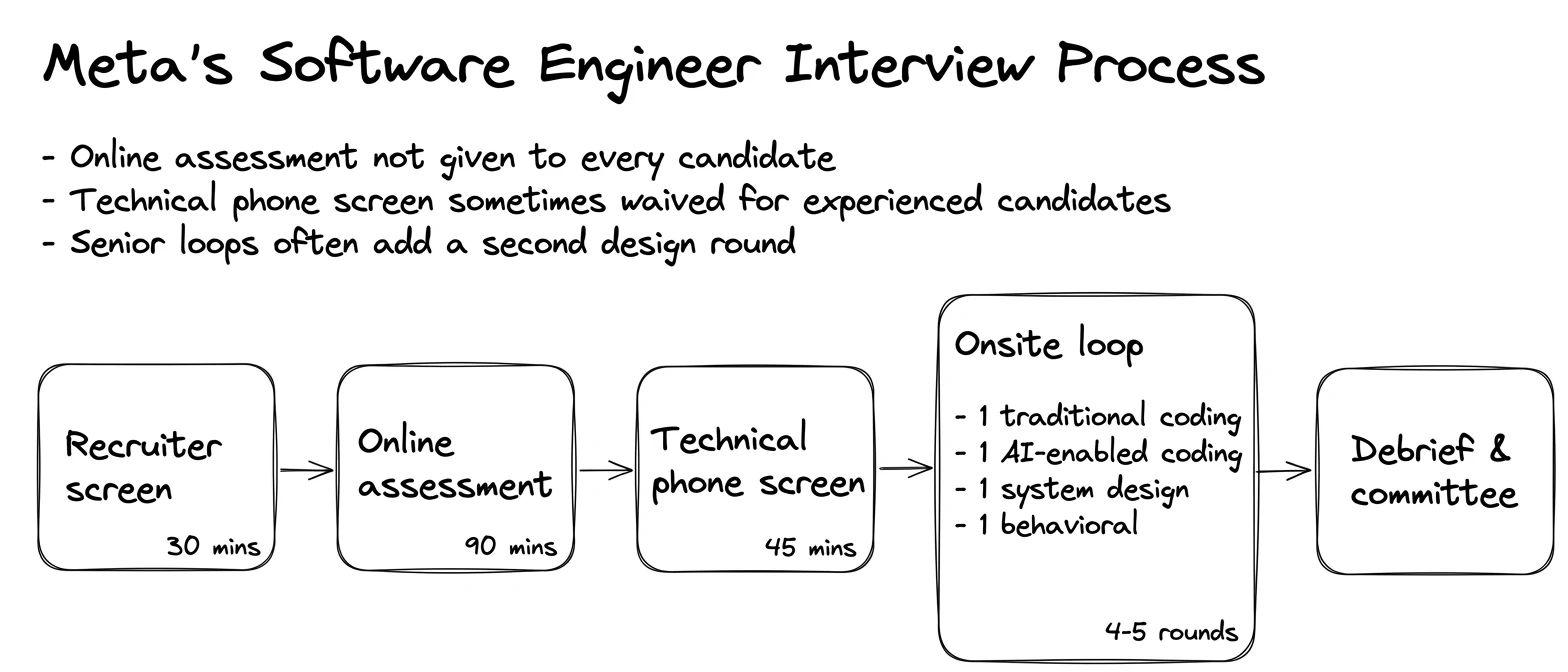
Meta hires software engineers into a general pool and matches them to a team after the hiring decision, so interviewers usually come from outside the eventual team and prompts lean on Meta's own products: feeds, comments, search, ads and friend graphs. A typical path is a recruiter call, an optional online assessment, one to three phone screens, and an onsite of four to six rounds of 45 to 60 minutes.
Level changes the mix more than the stages. New-grad loops can be three coding rounds and a behavioral round; E4 loops add one design round. E5 loops add a second design round or an AI-enabled design round, and recruiters have waived the phone screen for experienced candidates. E6 candidates have reported onsites made almost entirely of design rounds plus a behavioral round on scope and influence.
Here's what the interview process can look like:
- Recruiter screen: About 30 minutes on background, target level and logistics, sometimes with a short behavioral screen.
- Online assessment (some pipelines): A 90-minute proctored task, usually a progressive class design.
- Technical phone screen (one to three): 45 minutes and usually two problems in an editor that does not run code.
- Coding interviews (one or two): Two medium problems in 45 minutes, often with a hard follow-up you must code.
- AI-enabled coding interview (one or two): About 60 minutes on one themed codebase, from bug fixes to features to optimization, with an assistant available.
- System design interview (one or two): A 45-minute design of a Meta-style product; AI-native loops may swap one for an AI-enabled agent design.
- Behavioral interview: 35 to 45 minutes on ownership, conflict, feedback and ambiguity, now including how you use AI tools.
Tip: Ask your recruiter in writing which rounds you will get and whether each is traditional, AI-enabled or AI-native. One candidate in August was given two coding rounds with AI in both names that the recruiter could not tell apart.
Recruiter screen
The recruiter confirms level, location and team interests and walks through the loop. In some pipelines the call includes a 30-minute behavioral screen on ambiguity, a disagreement with a teammate, a proud project, a role model and something you are working to improve, each followed by probing questions. Others replace it with a project deep dive with an engineer. Experienced candidates have had the technical screen waived.
Interviewers evaluate:
- Level calibration: Your scope and years of experience set the target level, which decides how many design rounds you get.
- Personal ownership: What you did yourself on the proud project, not what the team shipped.
- Composure in conflict: Whether you addressed a disagreement directly or tried to win the argument.
- Self-awareness: A real growth area with evidence of practice, not a disguised strength.
Prepare a two-minute background summary aimed at a specific level, and confirm the exact loop format before the call ends.
Sample questions for the recruiter screen
Here are some questions reported by recent candidates:
- Tell me about moving a project forward without all the information you needed, and what happened when an assumption proved wrong.
- What are you actively improving about yourself, and how do you measure progress?
Online assessment
Some pipelines, most often new-grad and senior ones, send a proctored online assessment. The common version is a single 90-minute progressive class design: a banking system with transfers, scheduled payments and account merges; an in-memory key-value store with prefix scans, time-to-live and backup and restore; or a cloud file store with users, capacity and compression. Each level unlocks only after the previous one passes. Other pipelines get several auto-graded algorithm problems, each introduced by a short video that eats into coding time.
Descriptions are long, each level adds two to four functions, tests cannot be edited, and failures come without line numbers. Finishing is not required: one candidate stalled partway through level 3 and went straight to the full loop, skipping the expected phone screen. The recruiter said failing would have triggered a one-year freeze on reapplying.
Interviewers evaluate:
- Forward-compatible design: Level 1 structures must survive later levels; keep counters such as total spent separate from balances, and log events from the start.
- Time handling: Running lazy expiration first in every operation, and storing remaining time-to-live in backups rather than absolute expiry.
- Reading the tests: When the description is ambiguous, the tests define correct behavior.
- Pace: About 15 to 20 minutes per level, submitting each level once it passes.
Rehearse two or three progressive tasks against the clock, reading every level's requirements before writing level 1.
Note: A candidate rejected on a versioned database task, which added reading a field's value at a past timestamp, traced the failure to a first-level design that could not be extended; by level 4 a rewrite no longer fit.
Sample questions for the online assessment
Here are some questions reported by recent candidates:
-
Build a banking class with deposits, transfers, a top-spenders query, cancellable scheduled transfers and account merges.
-
Build an in-memory store with add, delete, lock and unlock, where writes to a locked key fail.
-
Extend a key-value store so a field's value can be read as of any past timestamp, alongside expiry.
Technical phone screen
The screen is 45 minutes with an engineer, occasionally 60: a few minutes of introductions, then two problems of about 20 minutes each in a shared editor. Problems are well-known mediums with a layered follow-up: minimum removals to make parentheses valid, then with three bracket types; kth largest, pushed to quickselect; weighted random pick, then constant time per pick; lowest common ancestor, then the search-tree, parent-pointer and low-memory versions; shortest path in a binary grid, then the path itself. A few pipelines ran an AI-enabled coding screen instead. E5 pipelines have run two coding screens plus a behavioral screen. Results usually came within days.
Interviewers evaluate:
- Unprompted edge cases: Empty input, one element, duplicates and invalid input handled before the interviewer asks.
- Independence: One alien-dictionary screen ended in rejection after a single hint on the invalid-prefix case.
- Complexity you can defend: Explaining why quickselect is linear on average, not just asserting it.
- Adapting to follow-ups: Extending the first solution to the new constraint without starting over.
Drill the common screen problems until each takes under 20 minutes, including a dry run on your own tests.
Sample questions for the technical phone screen
Here are some questions reported by recent candidates:
-
Remove the fewest parentheses to make a string valid, then support three bracket types with correct nesting.
-
Find the lowest common ancestor of two nodes, then redo it with parent pointers and constant extra memory.
-
Return the cells on a shortest 8-directional path through a binary grid, storing parent pointers rather than paths in the queue.
Coding interviews
Traditional onsite coding rounds keep the screen's format: 45 minutes, two problems, no introductions. One new graduate counted two mediums and a hard follow-up in about 35 minutes of coding. Reported problems include valid palindrome with one deletion extended to k deletions, vertical-order traversal, an iterative local minimum using as few comparisons as possible, insert and pop-random in constant time, a course-schedule variant summing hours for a target set across disconnected subgraphs, and an original problem counting the few distinct values in a huge sorted array by binary search on value boundaries. Follow-ups push on scale: many range queries on one tree, or a sparse vector against a dense one.
Interviewers evaluate:
- Optimal complexity: Stopping at a working but suboptimal second solution was the stated reason for a rejection.
- Self-testing: Writing and dry-running your own cases; typos are forgiven when you catch them.
- Time split: Polishing the first problem and rushing the second's complexity argument cost one candidate the round.
- Flexibility: Switching from binary search to an iterative-only approach when asked.
Practice pairs of medium problems in 40 minutes, each extended by a follow-up you code yourself.
Note: One soft round is not automatically fatal. An offer came through despite one round marked as a weak coding signal, but the rest of that packet was strong.
Sample questions for the coding interviews
Here are some questions reported by recent candidates:
-
Decide whether a string becomes a palindrome after deleting at most one character, then at most k, and code the follow-up.
-
Count the distinct values in a huge sorted array that holds only a handful of values, in better than linear time.
-
Given courses with prerequisites and hours, return the minimum hours to finish a target list, including disconnected graphs.
-
Analyze Minimum Completion Time for Target Courses in a Prerequisite DAG
AI-enabled coding interview
This round runs about 60 minutes in a multi-file environment with an assistant chat. You get one themed codebase and a sequence of stages: fix a failing test, add features, then optimize until hidden tests pass within a timeout. The maze is the most reported theme: keep the start marker intact, add the missing visited set behind an infinite loop, honor one-way cells, add keys and doors (state becomes position plus a key bitmask), and finally bombs that clear walls within a radius. Other themes are choosing words with no shared letters to cover the most characters (backtracking, pruning, then bitmask dynamic programming), a 36-card game scoring triples that sum to 15, a friend recommender with a broken validity check, and a compiler-optimization task.
Bugs can sit anywhere: in the print function, in a large object-oriented scaffold, or in the tests, where one candidate found a walled-in goal marked reachable. In the card game, greedy play reached a perfect 180 in about 20 of 100 simulated games and a dynamic-programming strategy in about 60. Some interviewers run the first stage without the assistant or ask you to explain its code.
Interviewers evaluate:
- Knowing the algorithm before prompting: The assistant implements what you specify; it will not find the bitmask state for you.
- Verifying generated code: Catching it passing an object where an ID was expected, or recommending existing friends.
- State modeling: Seeing that a visited set must include the keys held, not just position.
- Progress through stages: Completing every stage was called top-tier; four or five passing hidden tests did not pass the round.
Practice the maze and word-subset families twice, once without an assistant and once with it, in small prompts you verify one by one.
Note: Over-trusting the assistant is the most common failure. A candidate on the compiler task spent the hour undoing bad suggestions and was rejected three business days later; another hit the word-subset timeout because a map lookup silently inserted default values.
Sample questions for the AI-enabled coding interview
Here are some questions reported by recent candidates:
-
Fix a maze solver so the path never overwrites the start, then add one-way cells, keys and doors, and wall-clearing bombs.
-
Choose words with no letter in common to maximize distinct characters, fast enough for a large hidden test.
-
Fix a recommender that suggests users to themselves, then add random and mutual-friend recommendations and discuss metrics.
System design interview
Design rounds last 45 minutes: requirements, a high-level architecture and one or two deep dives. Prompts are Meta-shaped: Instagram with viral spikes, live comments on popular posts, a 1:1 chat app with WebSocket versus server-sent events, global and friends-only leaderboards, an online judge with sandboxed execution, an auction where a celebrity's listing creates contention, trending hashtags within a one-minute freshness target, status search with AND and OR queries, and an ad click counter at 100 million events per second. Product pipelines sometimes add a product-design round such as search over WhatsApp statuses.
AI-native loops add or substitute an AI-enabled design round. Reported prompts include a code-review agent (orchestrator, tools, memory, output verification and cost per model call) and a ticket-triage agent where the interviewer expected an explicit reason-and-act loop.
Interviewers evaluate:
- Scoping out loud: A broad, complete design was still marked down for not narrowing the problem.
- Adapting to new conditions: The celebrity scenario forced a switch from optimistic to pessimistic locking.
- Depth on the hard part: Index intersection with skip pointers, term versus document sharding, reconnect and catch-up for live comments.
- Security and execution details: Thin answers on presigned photo URLs or sandboxed execution were cited in rejections.
Practice Meta-product designs in strict 45-minute sessions, leaving 15 minutes for deep dives.
Tip: Budget the clock before you start. A candidate who lingered on non-functional requirements and the schema never reached the contest leaderboard, asked for extra time and was refused.
Sample questions for the system design interview
Here are some questions reported by recent candidates:
-
Design an Instagram auction showing the live highest bid, then handle a celebrity listing that thousands bid on at once.
-
Design search over plain-text status updates supporting AND and OR, including index updates and sharding.
-
Design an AI code-review agent and estimate its inference cost per review.
Behavioral interview
The behavioral round runs 35 to 45 minutes, sometimes with the hiring manager. Standard themes are your proudest recent project, starting with incomplete information, a project whose direction changed, critical feedback, a difficult coworker, conflict with a manager and a commitment that slipped. Newer rounds probe AI use: which tools, what changed in your workflow and how you verify output. Staff candidates report a round on technical direction, influence without authority and mentoring senior engineers.
Interviewers evaluate:
- What you personally drove: You wrote the design document and reset the timeline, not "we discussed and agreed."
- Evidence behind decisions: Whether data supported your actions and what you would change in hindsight.
- Measurable outcomes: Numbers for impact, expected even at E4.
- AI fluency: Specific examples of using and checking AI tools.
Prepare six to eight stories with numbers, each mapped to two or three themes, plus one AI-workflow story.
Sample questions for the behavioral interview
Here are some questions reported by recent candidates:
-
Describe a project that started with incomplete information and how you reduced the uncertainty.
-
Tell me about something you committed to that slipped, how you found out and how you recovered.
-
How do you use AI tools day to day, and how do you know their output is right?
How Meta levels and evaluates Software Engineer candidates
Interviewers submit independent feedback, and a hiring committee reviews the packet; candidates who felt every round went well have been rejected without feedback. An E5 candidate with 13 years of experience passed one design round, met the E5 bar in every other round, and received no offer. Some rejections arrive within three business days; offers take longer.
The committee also sets the level. An E6 target was offered E5, and an E5 target was considered for E4 after strong coding but design and behavioral signal below the E5 bar. After approval, candidates reported a further approval step, then team matching before the formal offer: one spoke with four teams over several weeks, and matching slowed during spring 2026 reorganizations. Recruiters described a one-year wait after a failed assessment or a rejected loop for the same role, while other roles stay open.
Tip: A clearly strong round protects your level. Packets rated "meets" everywhere were the ones declined or down-leveled, so aim to stand out in at least one coding and one design round.
How to prepare for the Meta Software Engineer interview
- Confirm your exact loop: Ask whether each round is traditional, AI-enabled or AI-native, since formats changed in April 2026.
- Make the common problems automatic: Parentheses removal, kth largest, weighted random, lowest common ancestor, tree side views, subarray sums and palindrome deletions, each in under 20 minutes.
- Generate test cases unprompted: Empty, single element, duplicates, all equal and invalid input, before the interviewer asks.
- Rehearse the AI-enabled themes with and without an assistant: Maze with keys and bombs, the word-subset bitmask, the card game and the friend recommender.
- Build assessment designs for later levels: Separate counters from state, expire lazily, log events and store remaining time-to-live in backups.
- Scope designs in the first ten minutes: Then prepare for contention, sharding, security and sandboxing follow-ups.
- Prepare one agent design: Orchestrator, tools, memory, a reason-and-act loop, output verification and cost per call.
- Write stories that show what you drove: Numbers, decisions and a hindsight change in each, plus one about checking AI output.
About the Meta Software Engineer role
Meta software engineers build and run the products and infrastructure behind Facebook, Instagram, WhatsApp, Messenger and Threads, and increasingly the AI systems inside them. Work happens in a large monorepo with fast release cycles and an emphasis on measurable impact, and engineers are expected to use AI tools daily.
| Level | Primary focus | Impact scope |
|---|---|---|
| E3 | Well-scoped features with defined requirements | Components within one team |
| E4 | End-to-end feature ownership and basic design decisions | A team's features |
| E5 (Senior) | Owning a problem space, creating scope for others, mentoring | A team's roadmap and quality bar |
| E6 (Staff) | Technical direction across multi-team systems | Several teams or a large technical area |
| E7 (Senior Staff) | Org-wide strategy and cross-product systems | An organization |
Meta hires Software Engineers across the company. Teams include:
- Facebook and Instagram: Feed, Reels, comments, search and creator tools.
- WhatsApp and Messenger: Messaging, calling, statuses and business messaging.
- Monetization: Ads delivery, measurement, auctions and advertiser tools.
- Infrastructure: Storage, networking, developer tools and the systems serving billions of users.
- Meta Superintelligence Labs: Model training, inference and the Meta AI assistant.
- Reality Labs: Quest headsets, smart glasses and their software platforms.
Software Engineer experience and education requirements
Postings ask for a bachelor's degree in computer science, computer engineering or a related field, or equivalent practical experience; university-grad hires must finish the degree before starting. Experience in a language such as Java, Python, C++ or JavaScript is required, and senior infrastructure postings ask for seven or more years building large-scale systems.
FAQs about the Meta Software Engineer interview
How long does the Meta Software Engineer interview process take?
Usually five weeks to three months. A new graduate went from assessment in late September to an offer in late October, an E5 candidate took about six weeks from the first call to an offer, and a candidate with four team-matching calls ran from March to June.
What is the hardest round of the Meta Software Engineer interview?
Most candidates name the AI-enabled coding round: an unfamiliar codebase, planted bugs, tight timeouts and an assistant that slows down anyone who trusts it. At E5 and above, system design is the most common cause of down-leveling.
Can you use AI tools during the interview?
Only in rounds labeled AI-enabled or AI-native, where an assistant is built into the environment.
How much does a Meta Software Engineer make?
Approximate total annual compensation in the United States:
- E4: ~$295K
- E5: ~$450K
- E6: ~$720K
Packages combine base salary, an annual bonus and stock granted over four years, which is most of the total from E5 upward; candidates report equity as the main lever in negotiation.
What happens after a rejection?
Rejections usually come without feedback. Candidates were told to wait a year before reapplying for the same role, though other roles stay open, and one rejected candidate was re-engaged within months for a different opening.