Study
Are Linked Lists Still Asked in Big Tech Interviews?
TrueInterview
October 19, 2026 · 17 min read
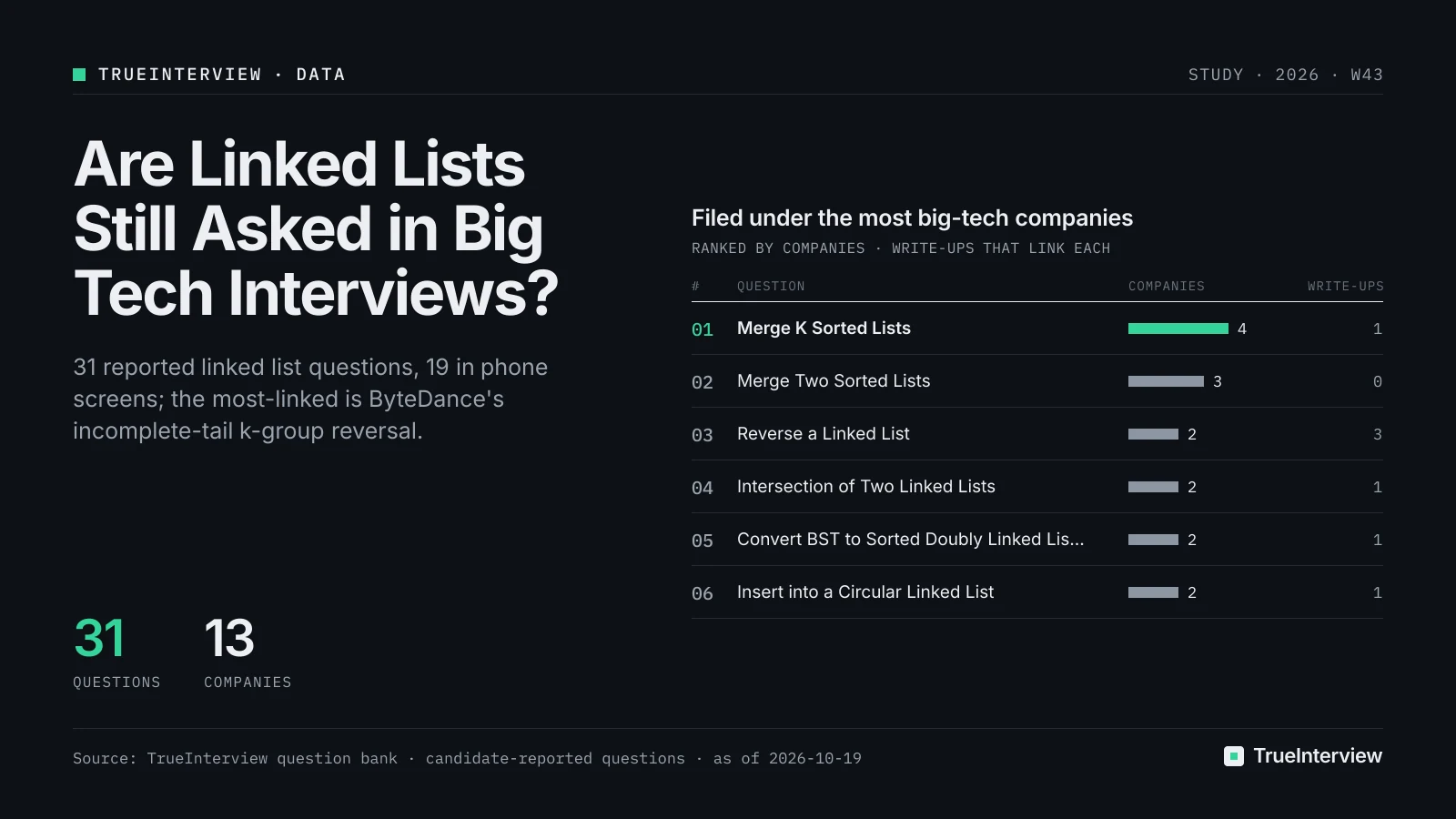
Yes, and mostly early in the loop. As of 2026-10-19, TrueInterview's bank holds 31 candidate-reported linked list questions at 13 big-tech companies, and 29 of them were last reported within the previous 12 months. Of those questions, 19 were reported in phone screens, 12 in onsites and 3 in online assessments. The most-linked question is a classic with one rule changed, ByteDance's incomplete-tail version of k-group reversal with 6 linked write-ups, and several other titles change a textbook assumption alongside plain basics in OAs, so drilling the textbook canon alone will leave gaps.
Disclosure: TrueInterview is an interview-preparation product and publishes this article. Facts about other products come from their public pages on the dates listed under Sources.
Which linked list questions do candidates report most?
The most-linked question is ByteDance's k-group reversal with an incomplete tail. Below it, the list splits into basics from online assessments (Salesforce, Pinterest) and cycle or stream variants from onsites (Airbnb, DoorDash). The ranking counts candidate write-ups that link to each question, which shows what candidates chose to write up, not how often a company asks it.
| Rank | Question | Company | Round, last reported | Write-up links | Senior-or-above links | Practise |
|---|---|---|---|---|---|---|
| 1 | Reverse Nodes in K-Group (incomplete tail variant) | ByteDance | Phone screen, 2026-08 | 6 | 2 | Incomplete-tail k-group reversal |
| 2 | Singly Linked List — Remove Duplicate Values | Salesforce | OA, 2026-01 | 3 | n/a | Remove duplicate values |
| 3 | Reverse a Linked List | ByteDance | n/a | 3 | 0 | Reverse a linked list |
| 4 | Delete Node in a Linked List | OA, 2025-12 | 2 | n/a | Delete a node | |
| 5 | Linked-List Intersection With Cycles | Airbnb | Onsite, 2026-05 | 2 | 2 | Intersection with cycles |
| 6 | Reverse Linked List in Groups of K Including the Last Partial Group | ByteDance | n/a | 2 | n/a | Last-partial-group reversal |
| 7 | First Unique Restaurant in a Stream | DoorDash | Onsite, 2026-08 | 2 | 2 | First unique in a stream |
In the table, n/a marks a figure our data summary does not break out for that entry. Read the top row with its level split: 4 of its 6 links come from junior, new-grad or intern candidates, so the most-linked variant is a question for every level, not a senior filter. The two ByteDance reversal entries are separate questions, and so are same-title entries at different companies. These are candidate-reported questions reconstructed for practice, not any company's official question list.
Which companies have candidates reported linked list questions at?
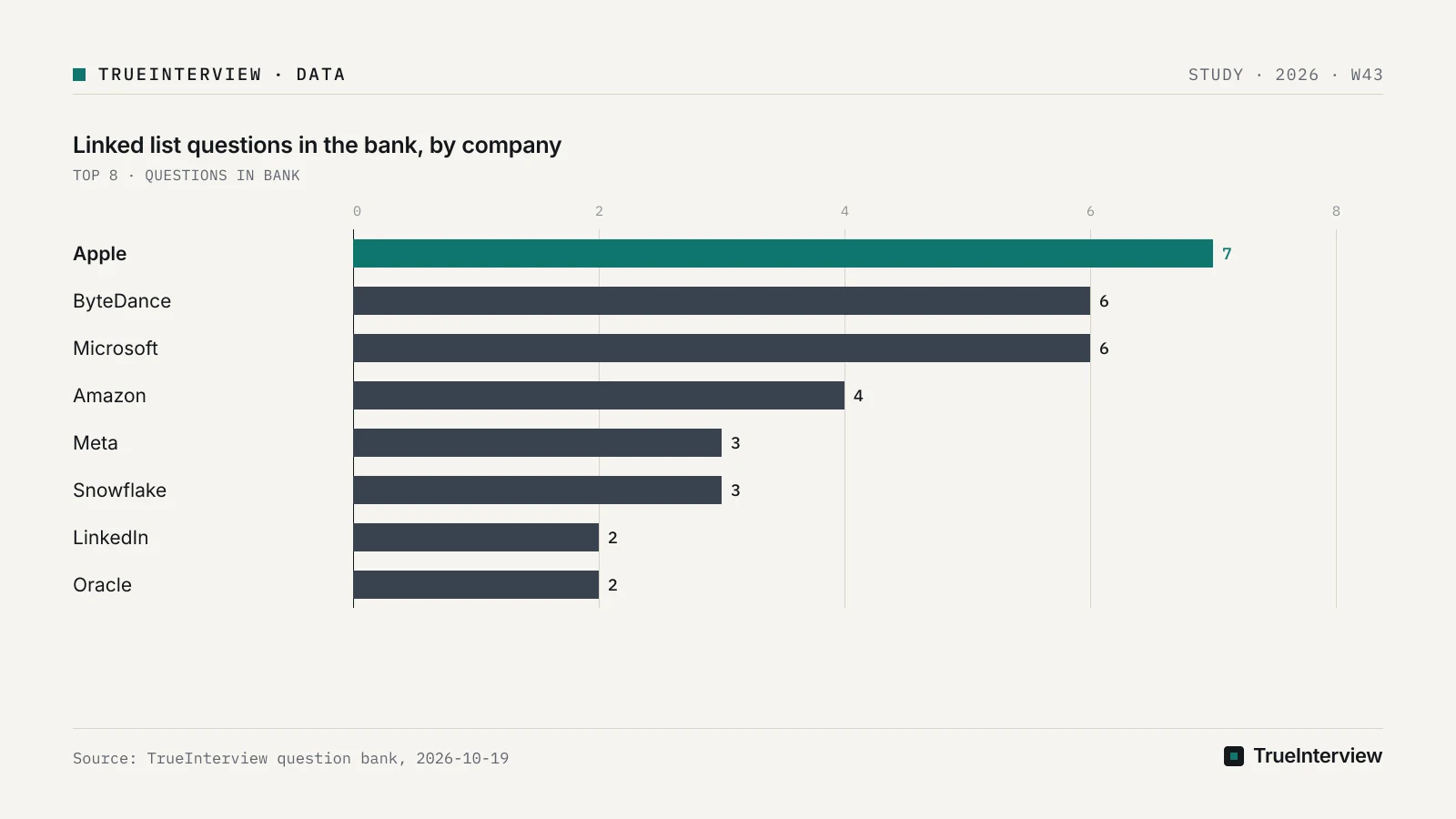
Ten companies have at least two linked list questions in the bank, led by Apple with 7 and ByteDance and Microsoft with 6 each. The company count matters less than what kind of question sits behind it: ByteDance, Oracle and Amazon have altered classics on file, while Pinterest and Salesforce show basics from online assessments.
| Company | Linked list questions | Other tags on them | Example reported question |
|---|---|---|---|
| Apple | 7 | Hashing 2, two-pointers 1, trees 1 | Merge K Sorted Lists and Merge Two Sorted Lists are both filed here |
| ByteDance | 6 | Two-pointers 1, trees 1, hashing 0 | Reverse Nodes in K-Group (incomplete tail variant), phone screen |
| Microsoft | 6 | Hashing 1, two-pointers 1 | Reverse a Linked List, OA, 2026-09 |
| Amazon | 4 | Two-pointers 2, hashing 0 | Detect and Break a Linked-List Cycle, onsite, 2026-06 |
| Meta | 3 | No tag beyond linked-list | Merge K Sorted Lists is filed here |
| Snowflake | 3 | Hashing 1 | Copy List with Random Pointer, phone screen, 2026-08 |
| Oracle | 2 | n/a | Replace a Range of Nodes in a Linked List, phone screen, 2026-09 |
| 2 | n/a | Delete Node in a Linked List, OA | |
| Salesforce | 2 | n/a | Remove Duplicate Values, OA |
| 2 | n/a | n/a |
The bank also holds examples from Airbnb, DoorDash and Anthropic, and they are the harder shapes: an intersection problem with cycles, a stream problem and an LRU cache. These per-company counts are small, so use them to choose which variants to rehearse for your target, not to predict what your interviewer will pick. If Apple is next, the merges and the hash map composites deserve the time; if ByteDance is next, reversal in every form does.
Phone screen, OA or onsite: where do linked lists show up?
Phone screens carry most of them, so treat linked lists as a gate to the onsite rather than its centrepiece. Of the 19 questions reported there, 4 add a hashing tag and 3 add two-pointers. A phone screen can bring a variant or a composite, not only a basic: the incomplete-tail k-group reversal, Oracle's range replacement, Snowflake's random-pointer copy and Anthropic's LRU cache all came from phone screens.
techinterview's 2026 canon article describes list reversal as "receding from primary onsite to phone-screen warmup". For reversal itself, our bank cannot confirm the shift: its one dated example is a Microsoft online assessment, and the ByteDance entry has no round in our data. The phone-screen share in the opening describes linked lists as a whole, and a single snapshot cannot show a trend over time.
The online-assessment examples are the basics, with Reverse a Linked List at Microsoft, Remove Duplicate Values at Salesforce and Delete Node in a Linked List at Pinterest. The onsite examples are the twisted ones: Detect and Break a Linked-List Cycle at Amazon and First Unique Restaurant in a Stream at DoorDash.
Our take: the common advice to skim linked lists because they are easy gets the risk backwards. A phone screen is where a slow reversal or a missed null check ends the loop before your design skills are seen. If your next round is an OA, drill the basics for speed. If it is a phone screen, rehearse one variant per classic under a timer. If it is an onsite, add the cycle and composite problems below.
Why train the changed rule instead of the classic?
Because the most-linked question and several onsite and phone-screen titles are classics with one rule altered, and noticing the altered rule is what those questions test. Four reported titles at ByteDance, Oracle, Airbnb and Amazon each change a different textbook assumption, from the partial last group to a cycle in the input. The plain basics in the table still matter, but they are the speed drill, not the depth.
| Classic you already know | What the reported title changes (our reading of the title) | Reported question | Practise |
|---|---|---|---|
| Reverse Nodes in K-Group | The last group of fewer than k nodes | ByteDance, two entries | Incomplete tail, last partial group |
| Intersection of Two Linked Lists | The lists may contain cycles | Airbnb, onsite | Intersection with cycles |
| Delete one node | A range of nodes instead of one node | Oracle, phone screen | Replace a range of nodes |
| Linked List Cycle | Break the cycle, not only detect it | Amazon, onsite | Detect and break a cycle |
The titles tell you which rule moved, not the exact rule. Open each practice page for the precise statement before you decide how your code changes.
K-group reversal with a partial tail
Techie Delight's interview guide rates reversing every group of k nodes as Medium. The standard solution uses a dummy node before the head, a pointer to the tail of the previous group, and a look-ahead that counts k nodes before it reverses anything. The textbook version leaves a short final group untouched, and both ByteDance titles point at that final group. Test lengths that divide evenly by k, lengths that do not, k equal to one and k equal to the list length.
Intersection when cycles are possible
The textbook intersection problem assumes neither list loops, and its pointer-switching trick depends on that, because a pointer inside a loop never reaches null. Techie Delight's guide rates the acyclic version, finding the intersection point of two lists, as Medium. The standard way to reason about the cyclic case is a split: detect a cycle in each list first; if only one list loops, they cannot share a node; if neither loops, use the textbook method; if both loop, check whether the two loops are the same one. At senior level, expect to be asked to say that case split before you write code.
Detecting and breaking a cycle
GeeksforGeeks says the slow and fast pointer approach can "locate the starting point of a loop efficiently in O(n) time with O(1) extra space". Once the pointers meet, reset one to the head and step both one node at a time until they meet at the cycle's start, then walk the loop to the node that points back to the start and set its next pointer to null. One Medium author's write-up describes a visited set as the naive approach; it works, but costs O(n) space, which is the first follow-up you should expect. Cover a cycle that starts at the head and a node that points to itself.
Replacing a range of nodes
We read Oracle's title as an edit to a run of nodes rather than to a single node; check the practice page for the exact rule. The habit that transfers is holding the node before the range and the node after it before you change any pointer. Tech Interview Handbook says a sentinel or dummy node at the head or tail helps "to handle many edge cases where operations have to be performed at the head or the tail", which covers a range that starts at the first node.
Turn this into a written list: next to Reverse Nodes in K-Group write partial last group, next to Intersection of Two Linked Lists write cycles allowed, next to Linked List Cycle write break, not only detect, and solve each changed version once.
Are the merge problems worth deep practice?
Keep them as warm-ups. Merge K Sorted Lists is filed under 4 big-tech companies (Apple, ByteDance, Meta and Snowflake) but linked from 1 write-up, and Merge Two Sorted Lists is filed under 3 companies with no linked write-ups. A wide filing tells you the prompt is known; it does not mean candidates found it worth describing in detail.
Generic lists rank these problems high. Tech Interview Handbook lists Merge K Sorted Lists as a recommended practice question, and Techie Delight's guide rates merging k sorted lists Hard and merging two sorted lists Medium.
Our take: solve each merge once under a timer and move on. Merge Two Sorted Lists with a dummy node should take a few minutes. For Merge K Sorted Lists, use a min-heap of the k current heads for O(N log k) time, and be ready to compare it with pairwise divide-and-conquer merging, which has the same bound. In Python, store an index in each heap tuple so equal values never force a comparison between nodes. Spend the hours you save on the variants above.
Where does a linked list hide inside a bigger problem?
Inside caches and streams, paired with a hash map. Hashing is the second most frequent tag on these questions, on 8 of the 31, ahead of two-pointers on 6. The reported composites include LRU Cache (Python) from an Anthropic phone screen in 2026-07, First Unique Restaurant in a Stream at DoorDash and Copy List with Random Pointer at Snowflake.
TrueInterview's October 2026 feed also lists an LRU Cache question at Apple, in the AI coding category and rated Medium. GeeksforGeeks lists the LRU cache as an application of doubly linked lists. techinterview goes further and calls LRU Cache design "universal at senior FAANG and tier-2 tech"; that is their view, and our bank cannot confirm it.
For each composite, know the decisions an interviewer will push on:
- LRU Cache. The map finds a node in O(1); the doubly linked list unlinks it and moves it to the front in O(1), because each node knows its predecessor. Expect to be asked why a singly linked list will not do, and to handle updating an existing key. Sentinel head and tail nodes remove the empty-list branches. If you use Python, be ready to build it by hand instead of reaching for OrderedDict.
- First unique in a stream. The usual design keeps a doubly linked list of values seen once, a map from value to node, and a set of values seen more than once. On a repeat, unlink the node in O(1). The follow-ups are the cost of each add and query, and memory growth on an unbounded stream.
- Copy List with Random Pointer. Techie Delight's guide rates cloning a list with a random pointer Hard. A map from old node to new node in two passes is the clear answer; interleaving copies between the originals gets O(1) extra space, and restoring the original list afterwards is the step candidates forget.
Our take: this is where an experienced hire's preparation time pays off. Build LRU Cache once from scratch, then explain aloud why each structure is there and what breaks if you remove it.
What changes at senior and staff level?
Senior candidates still get linked lists, and their links lean toward the composite and cycle variants. Write-ups link these questions 20 times from candidates who reported a senior, staff-plus or manager level and 16 times from junior, new-grad or intern candidates. Levels are what candidates reported on their own write-ups.
Hashing-tagged links split 5 senior-or-above to 1 junior-or-below, while two-pointers links are close to even at 6 to 5. The two onsite variants in the ranked table, intersection with cycles and the first-unique stream, are linked only by senior-or-above candidates. Single senior-or-above links also sit on Merge K Sorted Lists, Intersection of Two Linked Lists and Convert BST to Sorted Doubly Linked List (LC 426). Reverse a Linked List, by contrast, has none of its 3 links from senior-or-above candidates. Counts this small show a direction, so use them to order your practice rather than to predict your interview.
Our take: at senior level the list is rarely the whole question. Expect it inside a cache or stream design, or with an assumption removed, and expect to defend the O(1) operations, the edge cases and your tests without prompting. Producing working pointer code after two failed runs is a weaker signal than stating the invariant first.
Down-leveling note (our view): a linked list question seldom sets your level by itself; the system design round and the project deep dive, where you choose scope and defend trade-offs, carry more of that signal. A linked list question adds to it when it turns into a design, as LRU Cache does, so treat a clean, fast reversal as the entry ticket and your explanation of the map plus list as the part that counts.
Which routines cover the questions named here?
Five routines cover the reported questions named in this article: reversal, fast and slow pointers, dummy nodes, merging, and a hash map paired with a list. The tree-tagged titles, on 3 of the 31 questions, also need an in-order traversal. Tech Interview Handbook says many linked list questions use one or more common routines in their solution. Each row below pairs a routine with the reported questions it solves, so one session on fast and slow pointers prepares both the Amazon and the Airbnb cycle titles.
| Routine | Reported questions it serves | What to be able to say |
|---|---|---|
| Reversal | Both ByteDance k-group entries, Reverse a Linked List | The three-pointer loop and how group boundaries reconnect |
| Fast and slow pointers | Detect and Break a Linked-List Cycle, Linked-List Intersection With Cycles | Why the meeting point leads to the cycle's start |
| Dummy node | Replace a Range of Nodes, Remove Duplicate Values, both merges | Where the dummy goes and removing it before you return |
| Merge | Merge Two Sorted Lists, Merge K Sorted Lists | Heap versus pairwise merging and their costs |
| Hash map plus list | LRU Cache (Python), First Unique Restaurant in a Stream, Copy List with Random Pointer | Why each structure is needed for O(1) operations |
| In-order traversal (tree-tagged titles) | Convert BST to Sorted Doubly Linked List (LC 426) | Linking each visited node to the previous one, then closing the ends |
Tech Interview Handbook says the interviewer will usually request that you modify the list in place without additional storage, and it reminds you to remove dummy nodes at the end of the operation. One Medium author's write-up describes the recurring patterns as "fast and slow pointers, list reversal, segmentation, and controlled reconnection".
Tech Interview Handbook also says to ask whether the list can contain a cycle, adding: "Usually the answer is no and you don't have to handle it in the code". The Airbnb and Amazon titles are the cases where the answer is yes, so ask the question every time, and if the answer is yes, say how your code changes before you write it.
Worked example: a ByteDance phone screen, then an Amazon onsite
Take a senior engineer with a ByteDance phone screen and an Amazon onsite three weeks out. ByteDance has 6 linked list questions in the bank, and its most-linked one is the incomplete-tail k-group reversal from a 2026-08 phone screen. Amazon has 4, with two-pointers tagged on 2 of them. That points to four sessions.
- Session one. Standard k-group reversal, written cleanly with a dummy node and a look-ahead count.
- Session two. Reverse Linked List in Groups of K Including the Last Partial Group, changing only what happens to the final short group. Test k equal to one, k equal to the length, and a length that k does not divide.
- Session three. Detect and Break a Linked-List Cycle with fast and slow pointers: find the cycle's start, then cut the link into it.
- Session four. Merge Two Sorted Lists as a timed warm-up, since it is filed under Amazon. Neither company's linked list questions carry a hashing tag, so add LRU Cache (Python) only as a general senior hedge, not because these reports point to it.
How we counted
Counts come from TrueInterview's question bank as of 2026-10-19 and cover the questions tagged linked list. TrueInterview says each report is checked against other reports of the same round and stamped with the month it was asked wherever the report gave one. A question can be filed under several companies and reported in several rounds, so tallies overlap; round counts are question counts, not report counts. Write-up links count candidate write-ups that point to a question, split by each candidate's self-reported level, and they measure what candidates wrote up, not how often a company asks.
FAQ
Is Reverse a Linked List still asked, or only as a warm-up?
It is still reported, at the basic end of the range. ByteDance's entry is linked from 3 write-ups, and Microsoft's separate entry is the online-assessment example shown in the company table. Techie Delight's guide rates the iterative reversal Medium and the recursive one Hard. Write the iterative version from memory in a couple of minutes, then be ready to explain the recursive version and its O(n) call stack as a follow-up.
Which LeetCode linked list problems should I practise first?
Start with the classics that sit behind the reported variants: Reverse Nodes in K-Group, Intersection of Two Linked Lists, Linked List Cycle II, Copy List with Random Pointer and LRU Cache. Tech Interview Handbook lists Detect Cycle in a Linked List as an essential question. Then move straight to the reported versions in the ranked table, since the variants are what candidates write up. Leave Reorder List and palindrome checks for spare time unless your target company has them on file.
Do I need to handle a cycle if the prompt does not mention one?
Ask before you code, as the routines section explains. If the interviewer says the list is acyclic, say so in a comment and move on. If the answer is yes or unclear, add fast and slow pointer detection first, because a loop turns any traversal that waits for null into an infinite loop. That one question costs a few seconds and protects the cycle variants from a silent hang.
Which language should I use for linked list questions?
Use the language in which you can write a node class and a dummy-node loop fastest; in Python that is a small class with a value and a next field. GeeksforGeeks notes that in C and C++, improper memory deallocation can lead to memory leaks. If you use either, say who frees removed nodes in problems such as breaking a cycle, deleting a node or replacing a range. In Java or Python, garbage collection handles that, so spend the attention on null checks and pointer order.
Where can I practise these against tests?
TrueInterview says its questions are judged on hidden tests and come with solutions, and that the first few questions at every company are free, with no card needed. The practice question bank holds the reported questions linked throughout this article, filed by company and round, so you can rehearse the exact titles rather than generic versions.
Your practice plan
The target is small: the reported questions above rest mostly on five routines, plus one tree traversal. A three-week plan for someone working full time, about an hour on weekdays:
- Week one, speed. Solve Reverse a Linked List, Delete Node in a Linked List and Remove Duplicate Values. Time each until it takes a few minutes, and test empty and single-node lists.
- Week one, merges. Do Merge Two Sorted Lists with a dummy node and Merge K Sorted Lists with a heap, once each.
- Week two, changed rules. Solve Reverse Nodes in K-Group (incomplete tail variant) and Replace a Range of Nodes. Before coding, write the one rule that differs from the classic.
- Week two, cycles. Solve Detect and Break a Linked-List Cycle, then Linked-List Intersection With Cycles. Explain why the meeting point leads to the cycle's start.
- Week three, composites. Build LRU Cache (Python), First Unique Restaurant in a Stream and Copy List with Random Pointer. Say aloud why each structure is needed.
- Week three, rehearsal. Pick the variant that matches your next company and solve it as a timed phone screen, writing your test cases before the code.
Sources
- TrueInterview question bank — linked list at big-tech companies — counted 2026-10-19
- What’s Still Asked in 2026 — The Live Canon vs the Dead Canon – techinterview — checked 2026-10-19
- Linked List – Interview Questions and Practice Problems | Techie Delight — checked 2026-10-19
- Linked List Interview Questions - GeeksforGeeks — checked 2026-10-19
- Medium — checked 2026-10-19
- Linked list cheatsheet for coding interviews | Tech Interview Handbook — checked 2026-10-19
- Real FAANG Interview Questions by Company · TrueInterview — checked 2026-10-19
- Interview prep compared: your application, end to end · TrueInterview — checked 2026-10-19
Last reviewed: 2026-10-19.