Study
8 Interview Questions Filed at the Most Big Tech Companies (2026)
TrueInterview
October 11, 2026 · 14 min read
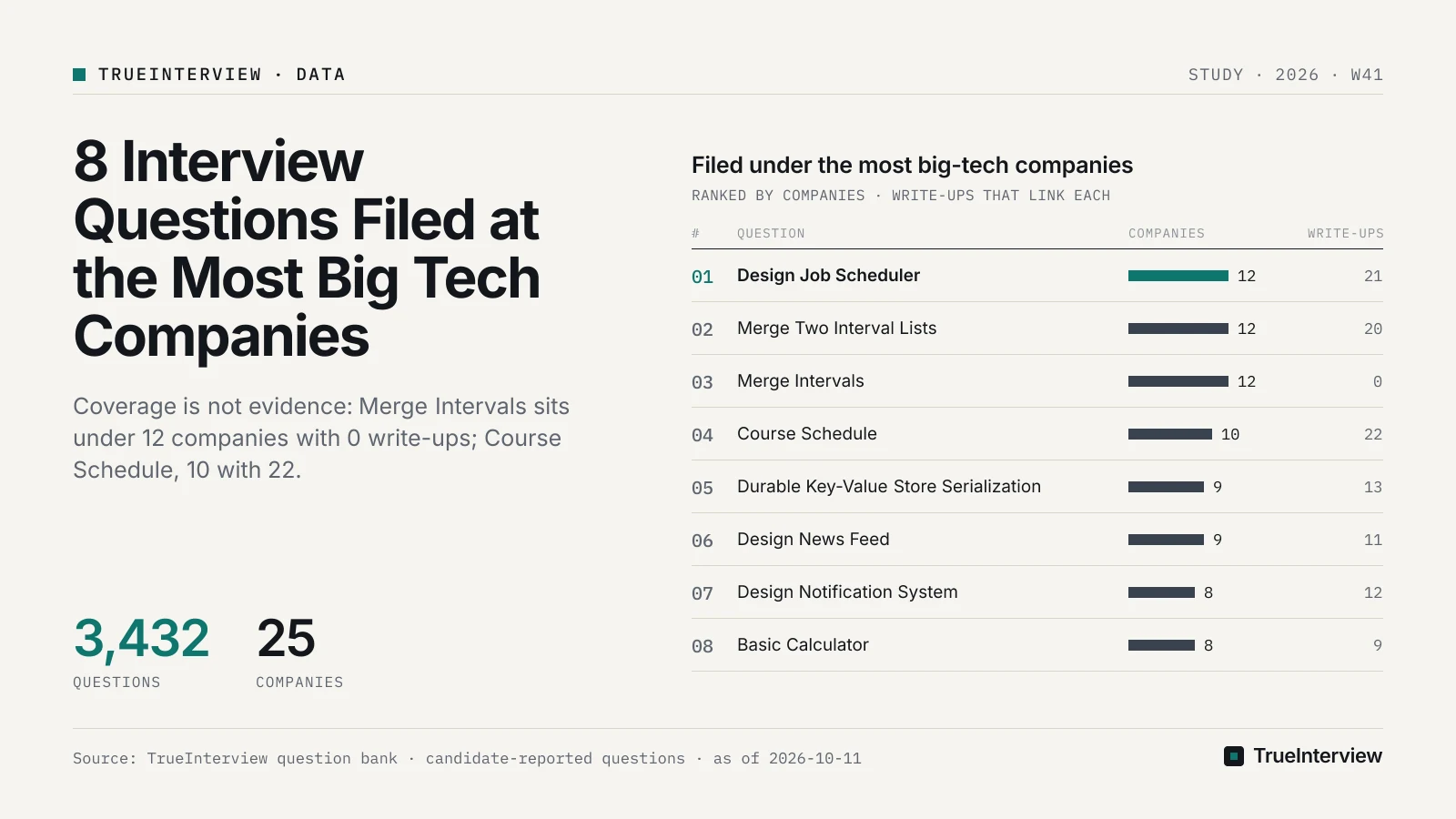
As of 2026-10-11, three questions sit under the most big-tech companies in TrueInterview's bank: Design Job Scheduler, Merge Two Interval Lists and Merge Intervals, each filed under 12 of the 25 big-tech companies it covers, with Course Schedule next at 10. Breadth alone is a weak signal, because Merge Intervals is linked from 0 candidate write-ups while Rate Limiter draws 25 write-ups from only 6 companies. Rank every question on two numbers, company coverage and write-up links, and practise first the ones that clear both.
Disclosure: TrueInterview is an interview-preparation product and publishes this article. Facts about other products come from their public pages on the dates listed under Sources.
Method. We ranked the bank's candidate-reported questions by how many big-tech companies each one is filed under, then added how many candidate write-ups link it and how many of those write-ups came from candidates who reported a senior, staff-plus or manager level. A company count is coverage in the bank: it records where candidates reported a question, and it says nothing about how often any company asks it.
Which questions are filed under the most big-tech companies?
The coverage ranking is led by four coding problems, three system design prompts and one object-oriented design exercise, each filed under at least eight big-tech companies. Only half of them also carry a solid write-up record, and those four rows are where a candidate interviewing at several companies should start.
| # | Question | Format | Big-tech companies filed under | Write-up links | Senior-or-above links | Practise |
|---|---|---|---|---|---|---|
| 1 | Design Job Scheduler | System design | 12 | 21 | 16 | Question bank |
| 2 | Merge Two Interval Lists | Coding | 12 | 20 | 10 | Question bank |
| 3 | Merge Intervals | Coding | 12 | 0 | 0 | Question bank |
| 4 | Course Schedule | Coding | 10 | 22 | 10 | Question bank |
| 5 | Durable Key-Value Store Serialization | Object-oriented design | 9 | 13 | 13 | Question bank |
| 6 | Design News Feed | System design | 9 | 11 | not broken out | Question bank |
| 7 | Design Notification System | System design | 8 | 12 | not broken out | Question bank |
| 8 | Basic Calculator | Coding | 8 | 9 | not broken out | Question bank |
Read the table from the right. The write-up column tells you which rows candidates actually wrote about, and the senior column tells you which rows carry weight in a senior loop. Design Job Scheduler and Durable Key-Value Store Serialization are the two rows where senior candidates supply most or all of the links.
Design Job Scheduler: the design rep that travels
Design Job Scheduler is filed under Robinhood, Airbnb, ByteDance, Databricks, DoorDash, Google, LinkedIn, Lyft, Meta, OpenAI, Pinterest and Snapchat, which makes it the most widely filed design prompt in the bank. A scheduler design turns on two decisions a senior interviewer will push on. The first is how a worker claims a due job: a lease with a heartbeat, so that a dead worker's job is dispatched again. The second follows from it: if a job can run twice, handlers must be idempotent under at-least-once delivery. Our take: for a multi-company loop this is the single best design rep on the list, because its links lean so heavily senior.
Merge Two Interval Lists and Merge Intervals: same coverage, opposite evidence
Both are filed under the same twelve companies: Apple, Amazon, ByteDance, Google, Lyft, Meta, Microsoft, Netflix, NVIDIA, OpenAI, Snowflake and Uber. Merge Intervals is the sort-then-sweep problem: sort by start time, then extend the current interval while the next one overlaps, in O(n log n). The two-list variant hands you two already-sorted lists, so the expected answer is a linear two-pointer merge that coalesces overlaps as it goes. If you prepare one interval question this month, prepare the variant: identical coverage, with 20 write-ups behind it instead of none.
Course Schedule: the most-linked row on the list
Course Schedule has 22 write-up links, the most of any question in the table, and 10 of them come from senior-or-above candidates. It asks whether a set of prerequisite pairs can all be completed, which is cycle detection on a directed graph. Kahn's algorithm, a topological sort driven by in-degree counts, answers it and also returns a valid order for the usual follow-up. It is the cheapest way into the bank's largest coding topic, graphs, which the next section covers.
Durable Key-Value Store Serialization: every link is senior
All 13 write-ups that link this question came from candidates who reported a senior-or-above level, and its 9 companies include OpenAI, Databricks, Google and Snowflake. Two design decisions carry the answer. The encoding should be length-prefixed, so arbitrary bytes in keys and values survive a round trip. Crash safety needs either a write to a temporary file followed by flush and atomic rename, or an append-only log that is replayed on start. For a senior loop, give this row more time than its company count suggests.
Rate Limiter: the strongest row that misses the cut
Rate Limiter is linked from 25 candidate write-ups from 6 big-tech companies (Snowflake, Pinterest, Google, Amazon, Snapchat and Microsoft), more links than any of the eight ranked questions. The bank's example is an object-oriented design question reported at Stripe in an onsite, last reported 2026-09. The core choice is the algorithm, a token bucket when bursts are allowed or a sliding-window counter when the window must be strict, followed by per-key state and thread safety. Practise it on the Rate Limiter practice page in your first week.
What three patterns sit behind the list?
Three patterns explain the ranking. Coverage and reported evidence can point at different questions, the shared coding core is graph-heavy rather than array-heavy, and the questions candidates write up most are single-company behavioral drills that never reach a coverage ranking. Each pattern changes what you should practise in your first week.
Pattern one: coverage is not evidence
Design News Feed is filed under 9 companies but linked from only 11 write-ups, fewer than Rate Limiter's 25. Merge Intervals, shown above, is the extreme case of the same gap. Our take: a large number on one bar and a small one on the other is coverage, not evidence. Spend week one only on the rows that clear both bars; the practice plan at the end lists them in order.
Pattern two: the shared coding core starts with graphs
Across the bank's 1,481 coding questions, the most frequent algorithm topics are graphs (227), hashing (203), strings (198) and arrays (185). The round split sharpens this: phone-screen coding questions lead with graphs (155) and hashing (119), onsite questions with graphs (97) and strings (73), while the online assessment leans on arrays (54). Company columns also differ: Google's top topics are graphs (41), arrays (27) and hashing (23); Amazon's are hashing (35), arrays (27) and graphs (26); Meta's are graphs (24), strings (22) and trees (20).
If your next round is a phone screen or onsite, start with graph traversal and topological order, which Course Schedule already exercises. Arrays lead only the OA split; in phone screens and onsites they rank fourth, so treat them as a secondary block rather than the place to start. For a single target company, take its top three topics from that list and cut the rest of your topic sheet.
Pattern three: the most-linked questions are single-company drills
None of the five most-linked questions in the bank appears on the coverage list. Project Deep Dive (Resume Drill) is linked from 47 write-ups, all from ByteDance; Culture & Behavioral Interview Questions from 43 (Anthropic and DoorDash); Onsite BQ + Hiring Manager + Project Deep-Dive from 32 (Uber); Leadership Principles Standard Set from 30 (Amazon). The one coding question among them, Infection Spread Simulation, has 34 links from OpenAI and Anthropic.
The Tech Interview Handbook (techinterviewhandbook.org) organises its advice under the heading "Most commonly asked behavioral questions across top tech companies". Our take: the bank does not support a cross-company behavioral list as the unit of preparation. Each company's most-linked behavioral item is its own format, from a resume drill to a combined hiring-manager onsite, so write one story pass per target company. The Engineering Leadership newsletter (eng-leadership.com), describing engineers who rehearse a list of top behavioral questions, calls that approach "logical but wrong". For per-company detail, see Big Tech Behavioral Questions by Company and Round.
What would we skip?
We would skip three things: Merge Intervals as a standalone drill, the news feed as your first design rep, and a long dynamic programming block if you are senior. Each one is either covered better by a sibling question or matched to a candidate group you are not in, and dropping them frees about a week.
Merge Intervals on its own. The two-list variant covers the same technique with the evidence behind it, so practise the variant and treat the original as a warm-up.
Design News Feed as the first design. Across the bank's 475 design questions, the most frequent families are ads, recommendation and ranking ML (59) and LLM, RAG and AI infrastructure (42); news feed is not among the ten largest. Named examples include Design an Ads Frequency Cap System (Netflix) and Design GPU Inference Serving System (Anthropic). For a frequency cap, expect pushback on counting impressions per user per window without double counting, and on where the counter state lives. For GPU inference serving, expect pushback on batching against latency and on the fallback when a replica fails. The family breakdown by company is in Big Tech System Design Questions by Company and Round.
A long dynamic programming block at senior level. Dynamic programming is the most junior-leaning algorithm topic in the bank, as the level table below shows. If you are interviewing at senior or staff level, a week of DP buys less than a week on the design rows.
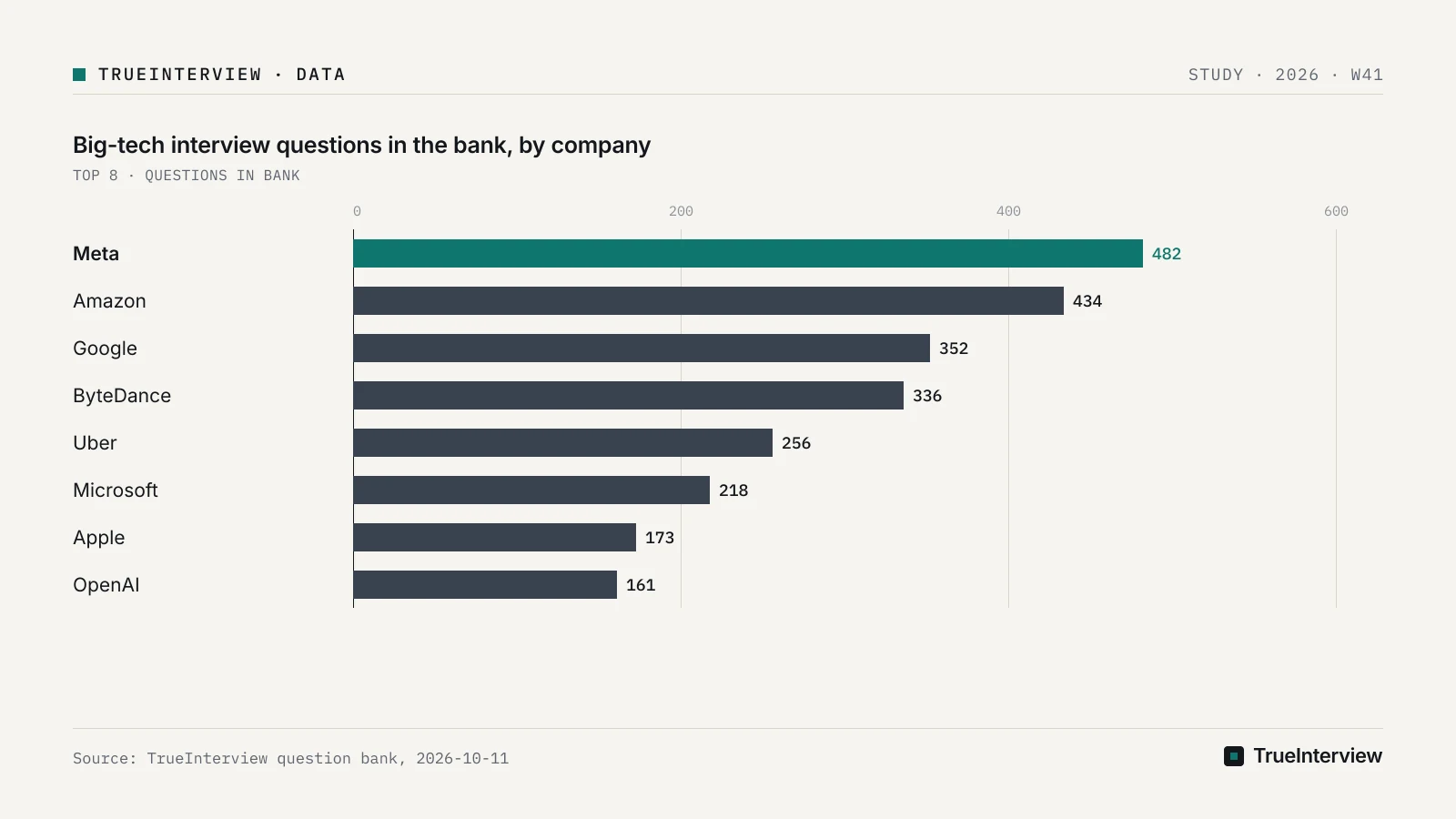
Company question counts as a difficulty signal. The bank holds 482 Meta questions, 434 Amazon and 352 Google, which reflects how many reports were collected, not how hard each loop is. interviewing.io's hiring-process guide says the claims that Amazon has the lowest bar and Google the highest are not true according to its data.
What changes at senior and staff level?
Senior candidates link coding questions at nearly the same rate as junior ones, 1,196 against 1,136, but they link system design questions about five times as often, 676 against 132. Levels are self-reported in the write-ups. The coding rows of the list are table stakes at every level, and the design rows carry the level signal.
| Write-up links by self-reported level | Senior-or-above | Junior-or-below | What it means for you |
|---|---|---|---|
| All formats | 3,291 | 2,163 | Senior reports dominate the bank, so the list reflects senior loops |
| Behavioral / knowledge | 798 | 477 | Behavioral weight grows with level |
| Object-oriented design | 477 | 307 | Durable Key-Value Store Serialization and Rate Limiter belong in a senior plan |
| Concurrency and motivation subtypes | 21 and 150 | 6 and 43 | Expect thread-safety and why-this-company probes |
| Dynamic programming | 59 | 91 | Lowest senior share of any algorithm topic, along with two-pointers |
| Intervals | 67 | 50 | The interval pair is worth senior time |
At staff level the sample is small but the direction is clear. Questions linked from staff-plus or manager write-ups include Behavioral / BQ Question Pack (10), Culture & Behavioral Interview Questions (4), Design GPU Inference Serving System (2) and Design Job Scheduler (2). Questions linked only from senior-or-above write-ups include Design GPU Inference Serving System (22), Describe your most impactful project (18) and Design an Ads Frequency Cap System (13). Our take: a staff candidate should treat the coding rows as a one-week refresher and spend the remaining time on Design Job Scheduler, one AI-infrastructure design and the behavioral rounds.
Down-leveling note
Our view: the rounds that set your level are design depth, the project deep dive and behavioral scope, and none of the coding rows on this list moves it. spacecomplexity.ai's article on hiring committees says "Down-leveling is more common than outright rejection for borderline candidates who show strong fundamentals at the wrong scope". The eng-leadership.com newsletter titles a section "Behavioral Interview is Where Your Level Gets Determined". A clean Course Schedule will not lift you a level; a Design Job Scheduler answer that never covers worker failure can lower one.
How should you use the list across several companies?
Use the coverage list only for questions filed under every company you are interviewing at, then fill the rest of week one from each company's own topic column and behavioral drill. If you are interviewing at one company, skip the coverage list entirely and start with that company's column and its most-linked drill.
Worked example: a Google and Meta loop. The interval pair, Design Job Scheduler and Course Schedule are all filed under both Google and Meta, so those four questions open week one. Rate Limiter's write-ups include Google, so add it if Google is the primary target. The two coding columns from pattern two overlap on graphs, so graph traversal is the only topic block you need for both. The other formats split: Meta's most frequent non-coding subtypes are SQL (62), statistics (58) and behavioral (39), while Google's are behavioral (39), object-oriented design (26) and statistics (24). For Google's behavioral side, the bank's example is Behavioral Round (Googliness Themes), reported in a phone screen and last reported 2026-08.
The result is a plan of four shared questions, one topic block and two company-specific blocks, which fits three weeks alongside a full-time job.
How we counted
The bank holds 3,432 big-tech interview questions reported at 25 big-tech companies as of 2026-10-11. TrueInterview says candidates write reports straight after the loop, and each report is dated where it gave a month and checked against other reports of the same round. A company count is the number of big-tech companies a question is filed under; a write-up count is the number of candidate write-ups that link it; level counts use the level each candidate reported. These are candidate-reported questions reconstructed for practice, not any company's official list.
FAQ
What are the most common big tech interview questions?
It depends on which number you rank by. By company coverage, the answer is the eight-row table above, led by Design Job Scheduler and the interval pair. By write-up volume, it is a set of company-specific behavioral drills, led by ByteDance's resume drill. The useful answer is the overlap: questions with broad coverage and a solid write-up record. With one week, work through the first two steps of the practice plan below, then your target company's behavioral drill.
Are the most common behavioral interview questions the same at every company?
Not in the bank's data. The most-linked behavioral items are each tied to one or two companies, from Amazon's Leadership Principles set to Uber's combined hiring-manager onsite. Amazon's SDE III preparation page says each interviewer will "typically ask two or three behavioral-based questions about successes or challenges and how you handled them using our Leadership Principles". That is a company-specific frame, so build your stories against each target company's own format rather than a generic list of questions.
What are the most common system design interview questions in 2026?
By family, ads and recommendation ranking and AI infrastructure lead the bank's design questions, as the skip section shows. By single title, Design Job Scheduler is filed under more big-tech companies than any other design prompt. Design News Feed is still filed widely, but its write-up record is thinner than its coverage. For a senior loop, prepare one job-scheduling design, one ads or recommendation design and one AI-infrastructure design before the classic feed and chat prompts.
Does filed under 12 companies mean 12 companies ask it?
No. It means candidates reported the question at those companies and the bank files it under each of them. It does not measure how often any company asks it, and none of these lists is official. Merge Intervals shows the gap clearly: twelve companies and no linked write-ups. Before you commit a week to any row, check its write-up column, and confirm the round format with your recruiter.
How current is this list?
2,729 of the bank's questions were last reported within the 12 months before 2026-10-11. The top drills are recent too: Project Deep Dive (Resume Drill) was last reported in a ByteDance phone screen in 2026-09, and Culture & Behavioral Interview Questions in an Anthropic onsite in 2026-09. Treat the ranking as a snapshot of current reports, and check a question's last-reported month on its practice page before you rely on it.
Your practice plan
A three-week plan for someone working full time, built from the rows that clear both bars.
- Week one, first half: solve Course Schedule and Merge Two Interval Lists from the question bank under a timer, then explain Kahn's algorithm and the two-pointer merge aloud in under two minutes each.
- Week one, second half: work through the Rate Limiter practice page, then sketch Design Job Scheduler on paper with a written paragraph on leases, heartbeats and idempotent handlers.
- Week two, first half: take the top three algorithm topics for each target company from pattern two and drill only those. Senior candidates add Durable Key-Value Store Serialization.
- Week two, second half: prepare one ads or recommendation design and one AI-infrastructure design, each with the two decisions you expect to defend.
- Week three, first half: run your primary company's drill: Project Deep Dive (Resume Drill) for ByteDance, Leadership Principles Standard Set for Amazon, Onsite BQ + Hiring Manager + Project Deep-Dive for Uber, or Culture & Behavioral Interview Questions for Anthropic and DoorDash.
- Week three, second half: OpenAI and Anthropic candidates practise Infection Spread Simulation; staff candidates add the Behavioral / BQ Question Pack. Before the loop, ask your recruiter which subjects and skills each round will cover, as Amazon's interview-prep page advises.
Sources
- TrueInterview question bank — big-tech interview at big-tech companies — counted 2026-10-11
- The 30 most common Software Engineer behavioral interview questions | Tech Interview Handbook — checked 2026-10-11
- How to Nail Big Tech Behavioral Interviews as a Senior Software Engineer — checked 2026-10-11
- A Senior Engineer’s Guide to FAANG Interviews — checked 2026-10-11
- The Interviewers Liked You. Now the Hiring Committee Decides. · SpaceComplexity — checked 2026-10-11
- Interview prep compared: your application, end to end · TrueInterview — checked 2026-10-11
- SDE III Interview Prep — checked 2026-10-11
- Amazon Software Development Interview Topics — checked 2026-10-11
Last reviewed: 2026-10-11.