Study
Big Tech Behavioral Questions by Company and Round
TrueInterview
October 11, 2026 · 11 min read
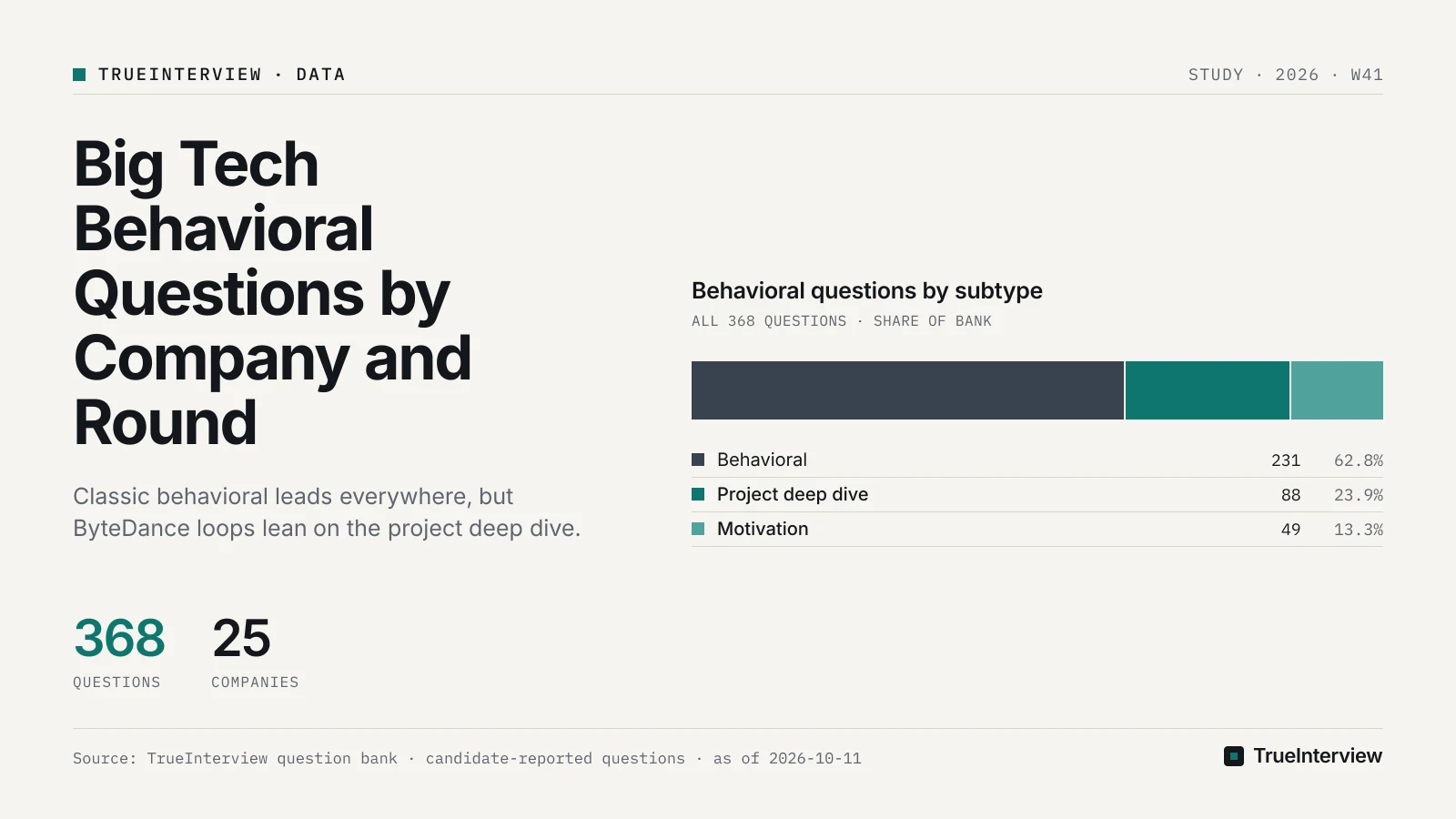
Big tech companies ask three kinds of behavioral question, and a generic list of prompts mostly prepares you for one of them. Of the 368 candidate-reported behavioral questions in TrueInterview's bank for 25 big-tech companies as of 2026-10-11, 231 are classic behavioral, 88 are project deep dives on your own resume, and 49 are motivation questions. The mix shifts between phone screen and onsite and flips at ByteDance and Anthropic, so find out which type your target loop weights before you memorize anything.
Disclosure: TrueInterview is an interview-preparation product and publishes this article. Facts about other products come from their public pages on the dates listed under Sources.
Big tech behavioral questions are three types, not one
Each type needs a different artifact, so prepare them separately. Classic behavioral is the tell-me-about-a-time prompt, answered with a story. Project deep dive means the interviewer drills the projects on your resume: the parts you personally built and the tradeoffs you chose. Motivation means why this company, why this team, why now, and it is answered with reasons rather than a story.
Published lists show what each type sounds like, even when they do not label it. Tech Interview Handbook's guide lists classic prompts such as "Tell me about a time when you had a conflict with a co-worker." and "What was the most difficult bug that you fixed in the past 6 months?". The same guide lists "Explain a project that you worked on recently." under Airbnb, which is a project deep dive whatever the list calls it, and "Why do you want to work for X company?" as a motivation prompt. Before you answer any practice prompt, tag it as classic, deep dive or motivation, whatever heading the list files it under.
Before writing a single STAR answer, open one document with three labelled sections: classic behavioral (six to eight stories), project deep dive (two or three, on projects that appear on the resume you submitted), and motivation (one or two). An empty section is your gap for this week.
What a project deep dive actually sounds like
A ByteDance phone-screen example in TrueInterview's bank is titled "Project Deep Dive (Resume Drill)," last reported 2026-09. The bank files the same shape at Microsoft as an onsite "Project Deep Dive" last reported 2026-09, and at Robinhood under the same title last reported 2026-05. SpaceComplexity's guide to Google's onsite reports that for 2026 Google is folding a technical design discussion into the Googleyness round, where you walk through architecture and trade-offs from a real project. So even at a company where the bank's deep dives are a small share, bring one project you can walk through in depth.
Ask these about each project before you write anything. What did you personally build, as distinct from what the team shipped? What broke, and what did you do when it broke? What tradeoff did you choose, and what did it cost? What would you do differently now? Write the answers as plain sentences first, then compress into STAR, and keep the numbers and names you are tempted to cut.
Vagueness is the failure this format exposes. Steve Huynh, who conducted nearly 1,000 interviews at Amazon, writes in Pragmatic Engineer's newsletter that the recurring debrief complaint was some version of "Every story was vague and unconvincing". If you have no resume project you can defend at that depth, use an internship, a course project or an open-source contribution, and prepare it to the same standard: the interviewer is testing whether you can explain your own decisions, not how large the project was.
The mix flips by company, so a flat FAANG list misallocates your prep
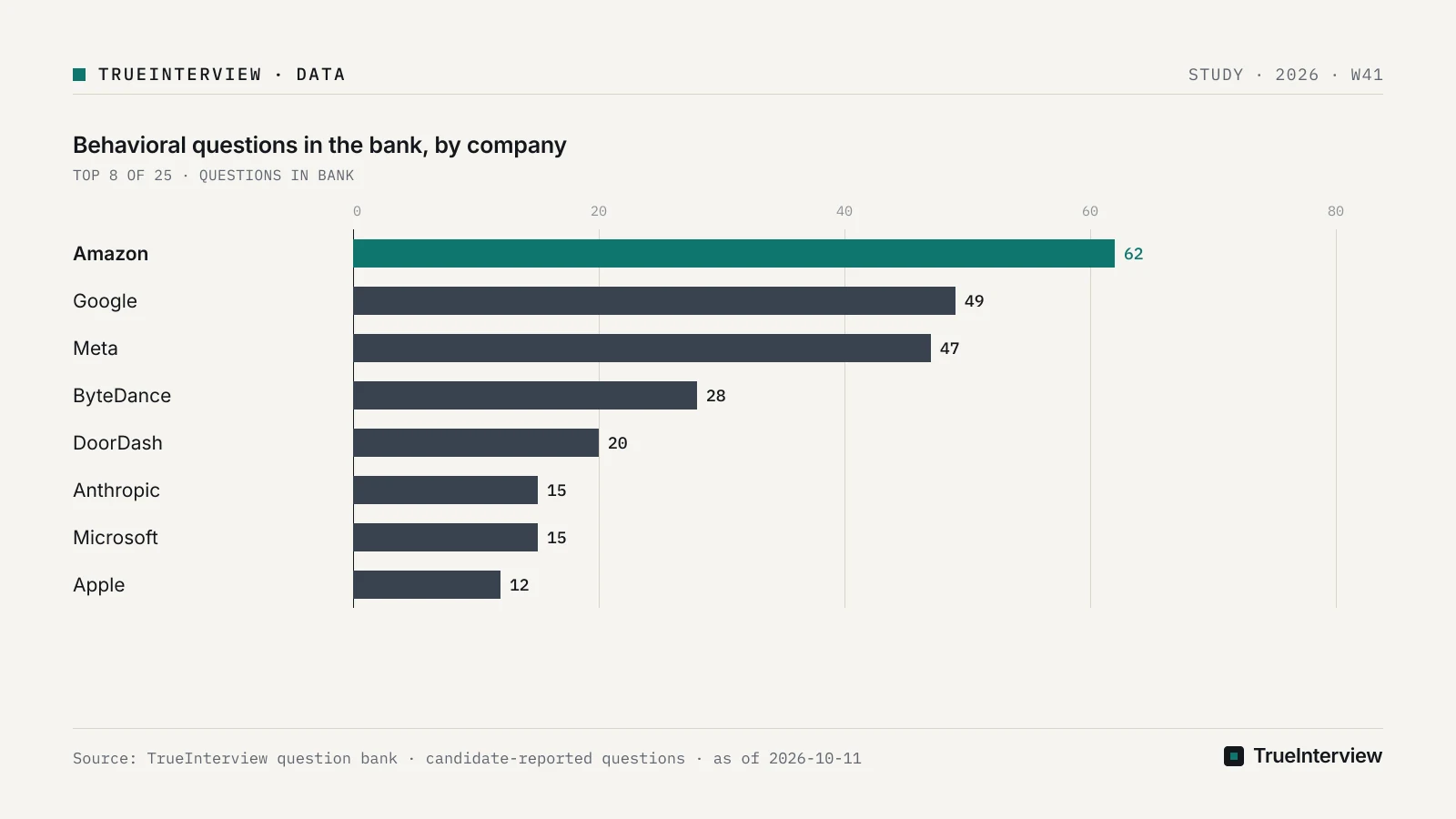
Classic behavioral leads at Amazon, Google, Meta and DoorDash in TrueInterview's bank, but two companies flip the mix. ByteDance files 17 of its 28 behavioral questions as project deep dives, and Anthropic files 7 of its 15 as motivation against 6 classic behavioral. The table shows the six companies where the bank reports a subtype split.
| Company | Classic behavioral | Project deep dive | Motivation | Filed questions | Prep first |
|---|---|---|---|---|---|
| Amazon | 53 | 6 | 3 | 62 | Six to eight classic stories mapped to Leadership Principles |
| 39 | 6 | 4 | 49 | Classic stories, plus one project walkthrough | |
| Meta | 39 | 6 | – | 47 | Classic stories, plus one AI-usage story |
| ByteDance | 7 | 17 | 4 | 28 | Two or three resume deep dives |
| DoorDash | 10 | 4 | 6 | 20 | Classic stories, then a researched motivation answer |
| Anthropic | 6 | – | 7 | 15 | Motivation and classic stories in equal weight |
Read the ratio, not the total. Google's bank looks like a heavier target than ByteDance's until you see that most of Google's questions are the classic type a general story bank already covers, while most of ByteDance's are about your own projects, which no borrowed list can supply. If your target and your backup are Meta and Google, one story bank serves both loops. Adding ByteDance means building a second artifact, the resume deep dive, not writing more stories. Motivation is where DoorDash and Anthropic differ from the rest: 6 of DoorDash's 20 filed questions are motivation, and at Anthropic it is the largest type, so a thin why-this-company answer costs the most at those two.
For a company without a split, use the loop title instead. If your loop names a project deep dive, as the bank's onsite titles do for Microsoft, Robinhood and OpenAI's slide-based technical deep dive, build two or three deep dives and ask your recruiter what format the walkthrough takes. If your company is not in the bank at all, start with the three-section document and weight it like Amazon's row, since classic behavioral is the largest type in the bank overall.
Do big tech companies ask behavioral questions in the phone screen?
Yes. In TrueInterview's bank, 184 of the 368 questions were reported in a phone screen and 190 in an onsite, and classic behavioral leads both: 105 of the phone-screen questions and 130 of the onsite ones. What shifts is the project deep dive, at 51 of 184 phone-screen questions against 41 of 190 onsite, or about 28% of phone-screen questions against about 22% of onsite ones. Build your resume stories before the screen, not in the final week before the onsite.
Amazon's SDE III prep page states that a technical phone screening comes before the interview loop and lasts 60 minutes, and that "half of the time will be spent on questions that focus on our Leadership Principles and the other half will be spent on coding problems and system design". With 30 minutes of behavioral time in Amazon's screen, lead with your strongest Leadership Principles story instead of saving it for the loop.
The same Amazon page says the loop is "five 55-minute interviews where you'll meet with members of our software development community," and that each interviewer "will typically ask two or three behavioral-based questions". Five interviewers at two or three questions each is 10 to 15 behavioral questions in one day, by the figures on Amazon's page, and your six to eight stories have to cover all of them. A post on blog.kindel.com says Amazon interviewers walk in with assigned leadership principles and two or three behavioral questions they intend to ask. Map each story to two or three principles rather than writing one story per principle, and keep a backup for the principles you expect to be asked twice.
Which named loops should you rehearse, and how?
Rehearse the named round your target reports when its title tells you the shape. Uber's "Onsite BQ + Hiring Manager + Project Deep-Dive" and ByteDance's resume drill name the subtypes outright, while Meta's "Traditional Behavioral" only tells you to bring classic stories. The write-up counts below are a confidence measure: they count candidate write-ups that link to the round, not how often a company runs it.
| Reported round | Company | Linked from N write-ups | Example in TrueInterview's bank: round, last reported |
|---|---|---|---|
| Project Deep Dive (Resume Drill) | ByteDance | 47 | Phone screen, 2026-09 |
| Culture & Behavioral Interview Questions | Anthropic, DoorDash | 43 | Anthropic onsite, 2026-09 |
| Onsite BQ + Hiring Manager + Project Deep-Dive | Uber | 32 | Onsite, 2026-08 |
| Leadership Principles Standard Set | Amazon | 30 | Phone screen, 2026-09 |
| GenAI Usage (How / Failure / Tradeoff) | Amazon | 29 | See the AI-usage section below |
| Hiring Manager Round: Behavioral & Collaboration | Anthropic | 24 | Tracked by link count only; the bank's Anthropic example is the culture set |
| Behavioral Round (Googliness Themes) | 23 | Phone screen, 2026-08 | |
| Traditional Behavioral | Meta | 23 | Onsite, 2026-06 |
| Behavioral / BQ Question Pack | – | Phone screen, 2026-09 |
A practical reading of the counts: 40 or more write-ups, as behind ByteDance's resume drill, means rehearse that shape as the company's default; low twenties, as behind Google's and Meta's rounds, means rehearse it but expect other behavioral formats too. A shape filed at two companies, like the culture set at Anthropic and DoorDash, is one you can practise once and reuse.
SpaceComplexity's guide says Googleyness interviewers "probe behavior observed in the room under pushback, not polished stories; the messy details and wrong turns are the credibility signal". The same guide says to expect four to six STAR questions with follow-ups that probe whether you actually did what you said you did. Rehearse with someone who interrupts: a story that only works as an uninterrupted monologue breaks at the first follow-up, and a story with a real wrong turn in it gives the interviewer the friction SpaceComplexity says they look for.
For Uber's combined onsite, rehearse the three parts as one sequence on the same day: classic stories for the BQ part, your reasons for the team in the hiring-manager part, and one project for the deep dive. Pick a deep-dive project you have not already used as a classic story that morning, so the panel hears two different pieces of work.
AI-usage behavioral questions: one story, not a fourth bucket
Prepare one AI-usage story, not a new section of your document. TrueInterview's bank files a "GenAI Usage (How / Failure / Tradeoff)" set at Amazon, linked from 29 candidate write-ups, and The Behavioral Substack reports that "Meta now directly assess AI impact in their behaviorals". Those are the two companies the evidence covers, so do not assume every loop asks it.
The Behavioral Substack reports that Meta replaced the Driving Results signal with AI-Driven Impact, and Growing Continuously with Continuous AI Learning. The Substack's list of common phrasings includes "How have you used AI to increase your impact?" and "How do you safely use AI in your day-to-day work?".
Build the story around decisions, not usage: what you handed to the tool and what tradeoff you accepted. The Behavioral Substack's reasoning is blunt: interviewers "will fill narrative gaps with the unfavorable assumption that you're now a prompt-typer with no underlying judgment". The Amazon set's title in TrueInterview's bank gives you an outline to follow, how you used it, where it failed and what you traded off, and the failure beat is what turns a demo into a judgment story.
How much time to give behavioral prep
Budget about ten hours of story work, spread over the weeks before your screen rather than the night before. Steve Huynh writes in Pragmatic Engineer's newsletter that "Ten hours of story prep can completely change the outcome of your behavioral rounds". Huynh says in the same newsletter piece that the average candidate probably spends 95% of prep time on technical preparation and 5% on everything else. A former Google engineer reports on dev.to that the number one reason for rejection across coding, system design and behavioral rounds was inability to communicate clearly under pressure.
Split the ten hours by your target's row in the company table. For Amazon, Google or Meta, spend most of it on six to eight classic stories. For ByteDance, spend most of it on two or three deep dives. For Anthropic or DoorDash, give the motivation answer a real share instead of the last half hour.
What these numbers are, and what they are not
These are candidate-reported questions reconstructed for practice, not any company's official question list. A company's count is how many questions candidates have reported there, not how often it asks a type, and a write-up count is how many candidate write-ups link to a round.
TrueInterview's bank shows 300 of the 368 questions were last reported in the 12 months before 2026-10-11. That leans current, but formats change: check a question's last-reported month before you drill it, and distrust any prep list that cannot show one.
How we counted
Every count of behavioral questions in this article comes from TrueInterview's own question bank on 2026-10-11, which files candidate-reported questions by company, round, subtype and last-reported month. Other figures are sourced to the company page or publication named in line. A question can be reported in more than one round, so the round totals exceed the question total. Company rows show the leading subtypes only; the balance is other or unspecified subtypes, so some rows, such as Meta's, do not sum to the filed total.
Your practice plan
- Today, open the three-section document and set its story counts from your target's row in the company table. Mark which section is empty.
- This week, before any phone screen, write two or three project deep dives with the four questions above, then test one against ByteDance's resume drill or Microsoft's project deep dive.
- Rehearse your target's named round as a sequence: Amazon's Leadership Principles standard set, Google's Googleyness round, Meta's traditional behavioral round or Uber's combined onsite.
- If DoorDash or Anthropic is on your list, write the motivation answer as its own piece and test it on the culture and behavioral set. A credible answer names a specific product or team decision you can discuss and ties it to work you have done.
- Ask a friend to interrupt every story at least twice with why? or what did you do, specifically? and rewrite any story that falls apart under the second interruption.
- If Amazon or Meta is in your loop, add the one AI-usage story described above and run it through the same interruption drill.
- If you are running two or three loops at once, keep one story bank and change only which section you rehearse first for each company. Book the ten hours in your calendar now.
Sources
- TrueInterview question bank — behavioral at big-tech companies — counted 2026-10-11
- The 30 most common Software Engineer behavioral interview questions | Tech Interview Handbook — checked 2026-10-11
- Google Software Engineer Onsite Interview: What Each Round Tests · SpaceComplexity — checked 2026-10-11
- Learnings from conducting ~1,000 interviews at Amazon — checked 2026-10-11
- SDE III Interview Prep — checked 2026-10-11
- Interviews are better with Behavioral Questions | tig.log — checked 2026-10-11
- How to talk about AI in your behavioral interviews — checked 2026-10-11
- I Interviewed 200+ Candidates at Google — Here's What Actually Matters - DEV Community — checked 2026-10-11
Last reviewed: 2026-10-11.