Instacart · Study
Instacart Interview Process & Questions
TrueInterview
July 24, 2026 · 10 min read
Instacart tests practical code that keeps growing, not classic puzzles. The online assessment is either a four-level system you extend under a timer or a full-stack exercise in which you direct Claude through requirements, features and fixes. A vendor-run live round puts you in an unfamiliar bus-simulation codebase with an AI assistant. In some loops the onsite is split in two, and candidates who miss the coding half never reach design. ML-leaning pipelines add a fundamentals screen that goes down to formulas.
This guide breaks down each stage of the Instacart interview, what interviewers evaluate in each round, and how to prepare, with questions candidates were actually asked.
Verified: Based on 16 candidate-reported interview experiences, cross-checked against recent public accounts.
Instacart interview process
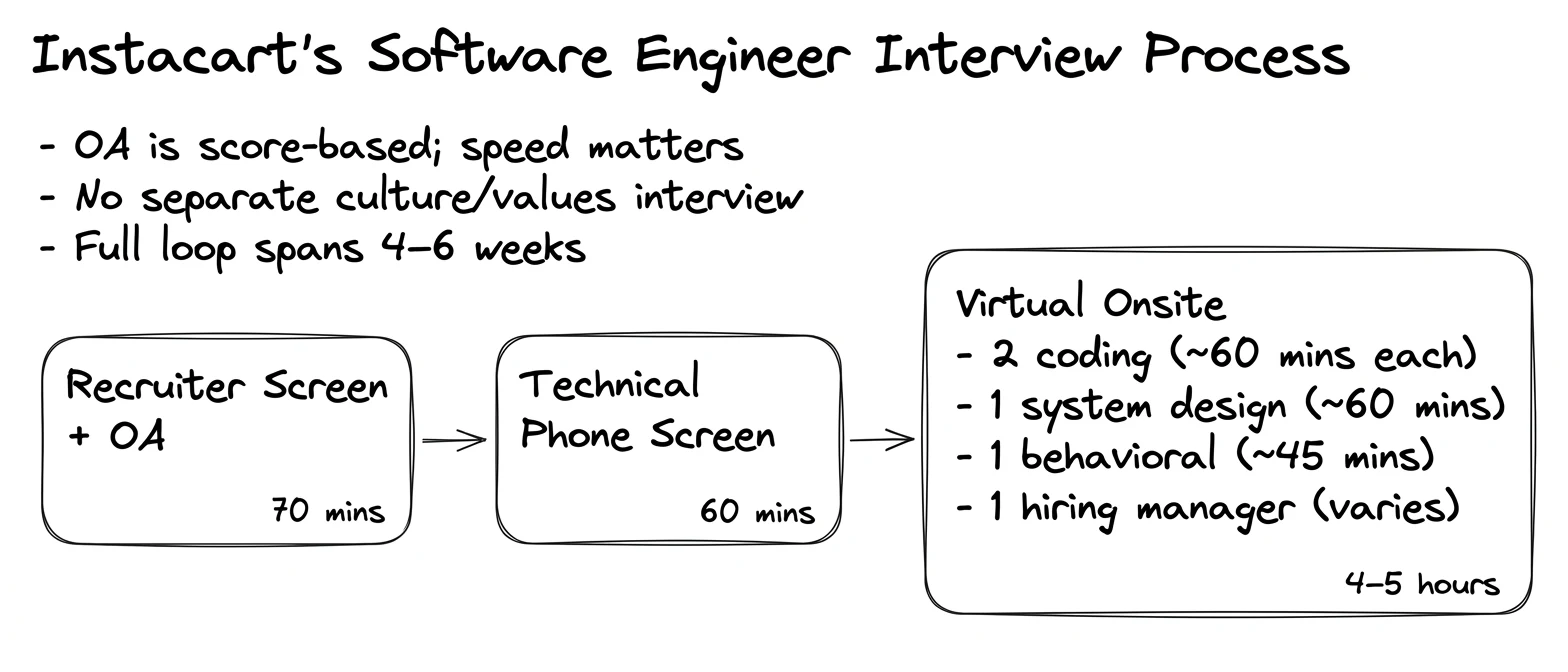
Most software pipelines open with a 90-minute online assessment. Others go straight to one or two phone screens, and some candidates sit both. The virtual onsite is typically three to five rounds: an AI-assisted round and two coding rounds, then system design and behavioral. End to end, the process typically takes three to six weeks.
New grad, L4 and senior candidates get the same medium-difficulty coding. At L5 and above, the design round and the project deep dive carry more weight. Backend candidates, senior ones included, still get the full-stack AI assessment.
Here's what the interview process can look like:
- Recruiter screen: A short call about role, level and timeline.
- Online assessment (most software pipelines): 90 minutes, either a four-level build-and-extend system or a five-part AI-assisted full-stack exercise.
- Technical phone screens (one or two): Hour-long practical coding, or ML fundamentals for ML-leaning roles.
- AI-assisted coding round: About 50 minutes in a large, unfamiliar codebase with an AI assistant.
- Coding interviews (two): Parsing and data-structure problems with multi-part follow-ups.
- System design interview: An Instacart-domain design, usually inventory, catalog or storage.
- Behavioral interview: A technical deep dive on your biggest project, plus a conflict scenario.
Tip: A few problems recur across phone screens and onsites: password decoding, expression evaluation with variables, and the bus simulation. Practice their full multi-part versions. Candidates who knew only part one ran out of time.
Online assessment
The classic version is one problem in four levels over 90 minutes. Each level adds timestamped methods to the system you already built. Reported scenarios: a task manager, a banking system, a worker payroll tracker, a key-value store with TTL and point-in-time reads, and an in-memory file store. In the task-manager version, scheduled deletions had to run before any other operation with the same timestamp. The last level asked for a user's task count at a past time. Scores are out of 600, and a candidate with 570 advanced.
The newer version, reported from mid-2026, has five timed parts on a small library app. You gather requirements from an AI product-manager agent, build search and notification features with Claude, and fix a JavaScript-and-Python bug without AI. One variant added a FastAPI dashboard bug and a FIFO hold queue with idempotent APIs, all with full test coverage.
Interviewers evaluate:
- Extensibility: Whether your level-one model survives levels three and four. A design that stores only current state fails the history queries.
- Ordering rules: Equal timestamps and queued actions, such as promotions applied only after a worker leaves the office.
- AI direction: Turning vague requirements into precise prompts and checking the output with tests.
- Test coverage: Unit and integration tests were required in the full-stack tasks.
Rehearse one timestamped four-level system and one AI-built mini app, each against a 90-minute timer.
Note: The tooling caused avoidable failures. The test file was read-only, so print debugging was impossible. Terminal errors could not be pasted into the assistant. Code from an earlier AI round did not carry over, and running two agents at once corrupted the project. The final task allowed 30 minutes, and C++ was missing even for a role that listed it.
Sample questions for the online assessment
Here are some questions reported by recent candidates:
-
Build a task manager with CRUD, then priorities, then users and delayed deletions, then historical task counts.
-
Track worker office time, rank the top N workers, queue promotions until a worker leaves, and compute pay over a period.
-
Gather requirements from an AI product manager, implement search with Claude, then fix a cross-stack bug without AI.
Technical phone screens
Screens run about an hour in a shared editor, usually with two problems. Common ones: decode a password in which a letter followed by a number of one or more digits repeats that many times, evaluate an expression string, and find the largest change in adjacent stock prices along with its dates. One screen was a key-field-value store with prefix scans, TTLs and restore to any past time. Another fit a storage design for text, images and video in alongside two coding problems.
Follow-ups shift to production concerns: malformed input, huge repeat counts, logging and tests. ML-leaning roles replace one screen with fundamentals: regression types, bias-variance, softmax with the max-subtraction trick, and gradient descent versus SGD under MSE. Feedback typically takes about a week.
Interviewers evaluate:
- Pace: Over-clarifying an easy problem uses up time the second problem needs.
- Running tests: Interviewers point you to their test cases and expect code that runs before time is up.
- Production thinking: Error handling, validation and memory limits once the solution works.
- ML depth: Answers you can defend at the level of the formulas.
Drill two medium parsing problems per hour, with tests.
Note: One rejected ML candidate said gradient descent and SGD converge to the same point under MSE, and the interviewer did not accept it. Another, who had prepared for system design, had to write out softmax term by term. Neither got feedback.
Sample questions for the technical phone screens
Here are some questions reported by recent candidates:
-
Find the fewest shoppers who can deliver every one-unit order between its ready time and its deadline, then handle uneven durations.
-
Build a key-field-value store with prefix scans, TTL expiry on read, and restore to a past timestamp.
-
Find the largest change between adjacent dates in stock records and return it with both dates.
AI-assisted coding round
This 50-minute round is run and recorded by a third-party vendor, and Instacart reviews the recording. You work in an editor with an AI assistant on a bus-route simulation you have never seen. The tasks build on each other: trace how the classes relate, reduce the simulated population, handle boarding under capacity, find a bug in the logs, and add priority-pass boarding and wheelchair support.
Interviewers evaluate:
- Orientation: How quickly you find the logic you need to change.
- Directed AI use: The assistant searches and drafts, and you verify.
- Testing unfamiliar code: Candidates found this the hardest part.
- Constraint handling: Priority and accessibility rules under a fixed capacity.
Practice adding features to an unfamiliar repository with an AI assistant, against a 50-minute timer.
Tip: Keep each step small and verified. One candidate reached only the fourth task. The candidate who got an offer kept answers short, which left time for every follow-up.
Sample questions for the AI-assisted coding round
Here are some questions reported by recent candidates:
-
Implement priority boarding in the bus simulator, then add wheelchair accommodation within capacity.
-
Find the class responsible for a behavior, change it, and propose an efficiency metric.
Coding interviews
The onsite usually has two live coding rounds of medium difficulty. Recurring prompts: an expression calculator that supports variable definitions and reassignment, a file of keyed matrices queried by matrix, row and column, and the password decoder. One loop paired expression evaluation with a depth-first search question. Another added a full-stack take-home AI test, even for a backend role. What decides the round is finishing every part with code that runs.
Interviewers evaluate:
- Parsing correctness: Multi-digit numbers, precedence and undefined variables.
- Data-structure fit: For example, a nested map from matrix key to row and column, rather than re-reading the file.
- Bug-free delivery: Candidates who left working but buggy code felt it cost them.
Write a calculator with variables and a keyed-matrix reader from scratch, each in under 40 minutes.
Sample questions for the coding interviews
Here are some questions reported by recent candidates:
-
Evaluate expressions in which later lines reuse and reassign variables defined earlier.
-
Load a file of named matrices and return the character at a given matrix, row and column.
System design interview
This hour-long round uses Instacart's domain. Reported prompts include inventory with real-time stock updates and reservations behind the shopper's picking flow, a product catalog, and asset storage. In the inventory prompt, overselling was ruled out from the start. The discussion covered the schema for counts, reservations and carts, transactional stock decrements, the shopper's scan API, and optimistic locking. It also covered caching product pages while writes go to the source of truth.
Interviewers evaluate:
- Consistency choices: Strong consistency for reservations and payments, and where staleness is acceptable.
- Schema depth: Reservations and their expiry, not just a stock counter.
- Concurrency control: Preventing two shoppers from claiming the last unit.
- Cache boundaries: The cache serves hot reads but never decides availability.
Build one inventory-reservation design from schema to locking, and defend each consistency choice.
Sample questions for the system design interview
Here are some questions reported by recent candidates:
-
Design inventory with reservations that never oversell, including the shopper's scan API.
-
Design a storage system for text, image and video assets, with its limitations.
Behavioral interview
The round pairs a technical deep dive on your biggest project with a conflict scenario. One candidate's story about a migration drew probing on broker choice, partial failures, and why payments stayed strongly consistent. The conflict question was about two senior engineers disagreeing on a schema.
Interviewers evaluate:
- Trade-off ownership: What you chose, what you rejected, and why.
- Depth under probing: Specific failures and how you handled them.
- Evidence-based resolution: Settling disagreements with use cases or quick benchmarks, not seniority.
- Motivation: Why Instacart, given the competition from larger retailers.
Prepare two project stories you can defend down to schemas, plus one disagreement you settled with evidence.
Sample questions for the behavioral interview
Here are some questions reported by recent candidates:
-
Walk through your biggest project and its consistency trade-offs.
-
Describe how you aligned two engineers who disagreed on a schema.
How Instacart makes hiring decisions
In split loops the first half acts as a gate. Feedback from all rounds feeds a single decision, which can arrive the day after the final round. Rejections rarely come with feedback. In ML-leaning loops, one weak fundamentals round sank candidates whose coding was solid. The level is set up front, and the design and project rounds are where L5 and L6 candidates show their scope.
How to prepare for the Instacart interview
- Master the recurring parsers: Password decoding with multi-digit counts, and expressions with variables.
- Design for history from level one: Store timestamped state so that later levels need no rewrite.
- Practice AI-directed development: Build and test features with an assistant in code you did not write.
- Know two scheduling patterns: An earliest-deadline heap and binary search on the answer.
- Harden code out loud: Validation, malformed input, memory limits and tests.
- Own the inventory design: Reservations, locking and cache boundaries.
- Derive ML basics for ML roles: Softmax stability, bias-variance and optimizer convergence.
About working at Instacart
Instacart runs a real-time grocery marketplace connecting customers, shoppers and retailers, alongside a retail media business and an enterprise platform for grocers. Product-aligned teams, often of eight to a dozen engineers, own their services. Under the company's Flex First policy, many roles are remote within the US or certain Canadian provinces.
| Level | Primary focus | Impact scope |
|---|---|---|
| L4 (Software Engineer) | Delivering features within an established design | One team |
| L5 (Senior Software Engineer) | Owning projects with moderate ambiguity | A team's systems |
| L6 (Senior Software Engineer II) | Leading larger, more ambiguous initiatives | Several teams |
Instacart hires engineers across its consumer, shopper and retailer businesses. Teams include:
- Order Experience: Checkout, order management and post-order quality.
- Fulfillment and Core Picking: The shopper app, picking and delivery logistics.
- Enterprise and Storefront Pro: Branded e-commerce sites for retail partners.
- Ads (Carrot Ads): Retail media, ranking and measurement.
- Connected Stores (Caper Carts): Smart carts and in-store technology.
Experience and education requirements
Postings ask for a computer science degree or equivalent experience, plus fluency in a general-purpose language such as Python, Ruby or Go. Senior roles ask for five or more years. Posted US base pay for one Senior Software Engineer II role ranged from about $187K to $250K depending on location, plus equity.
FAQs about the Instacart interview
How long does the Instacart interview process take?
Typically three to six weeks. Phone screen feedback takes about a week, and onsite decisions can arrive the next day.
What is the hardest round of the Instacart interview?
Candidates most often name the AI-assisted rounds, because of the time pressure and tooling friction. In ML-leaning loops, it is the fundamentals screen.
Is there an online assessment?
Yes, in most software pipelines. It runs 90 minutes, and candidates have advanced without a perfect score.
Can I use AI tools during the interview?
Only in the designated rounds. The full-stack assessment and the bus-simulation round require an assistant. The bug-fix task does not allow one.
Is the Instacart interview remote?
Yes. Every reported stage was held virtually.