Dropbox · Study
Dropbox Interview Process & Questions
TrueInterview
August 22, 2026 · 9 min read
Dropbox draws its rounds from a small, recurring pool of practical problems: a file crawler, a word-guessing game, a key-value store, a circuit breaker, an event logger. Each comes with a prepared chain of follow-ups toward scale, durability or an adaptive opponent, and the follow-up carries most of the signal. The gate before live rounds is strict: a 500 out of 600 assessment score was not enough to advance.
This guide breaks down each stage of the Dropbox interview, what interviewers evaluate in each round, and how to prepare, with questions candidates were actually asked.
Verified: Based on 9 candidate-reported interview experiences, cross-checked against recent public accounts.
Dropbox interview process
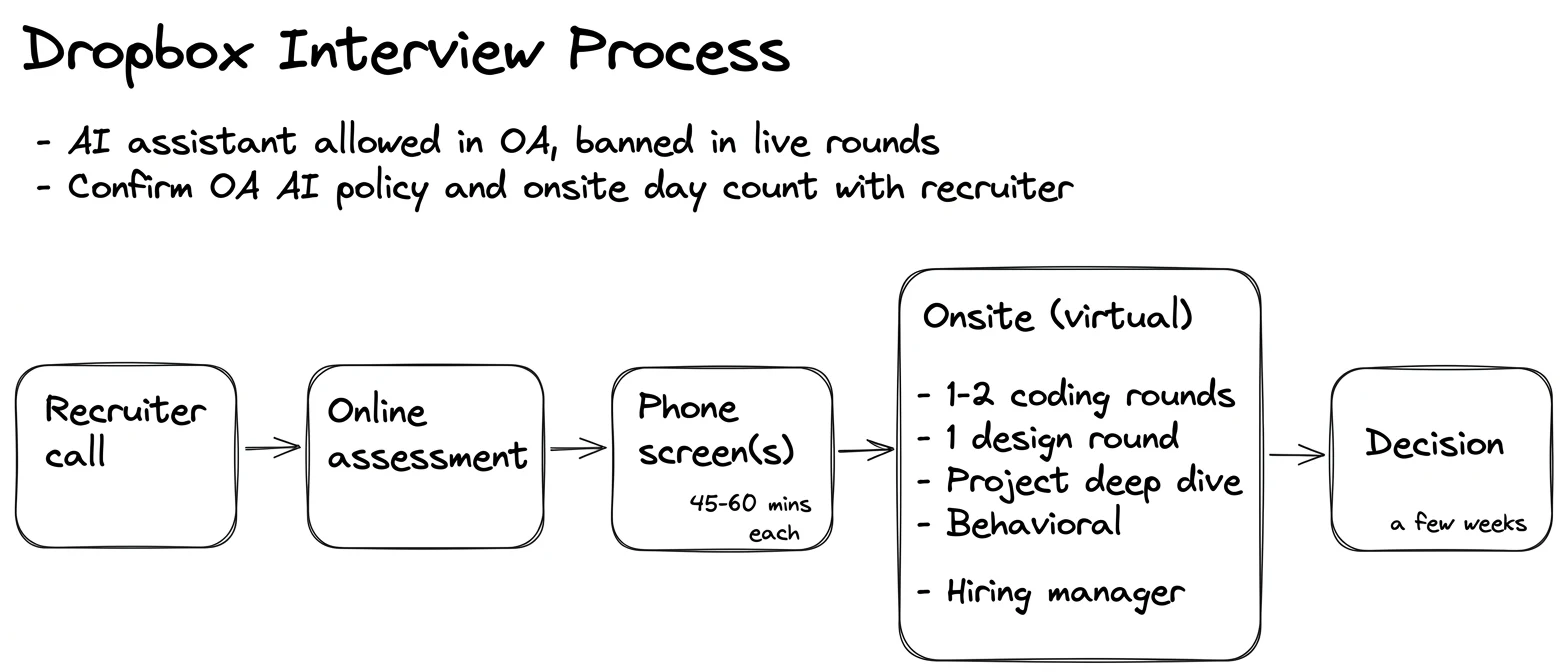
Dropbox is a Virtual First company, so every interview happens over video. After a recruiter call, candidates take a timed online assessment or one or two live technical screens, then a virtual onsite of three to five rounds. The loop that ended in an offer had two phone screens, then object-store design, a project deep dive and a behavioral round. The process typically takes three to five weeks.
Early-career candidates get more coding and an internship deep dive; system design is standard from IC3 (senior) upward.
Here's what the interview process can look like:
- Recruiter screen: A short call about background, motivation, level and logistics.
- Online assessment (many pipelines): A timed, auto-scored exercise that builds one small system in stages.
- Technical phone screens (one or two): Live sessions of typically 45–60 minutes, each a practical problem plus a scaling or adversarial follow-up.
- Coding interviews: One or two onsite rounds of simulations and games with exact state.
- Design interviews: API and low-level design with a coding core, plus storage-flavored system design for experienced candidates.
- Project deep dive and behavioral interview: One round on a single past project and one on career history and direction.
Tip: Get a small, clean, tested core running within the first third of every round. Candidates who treated the opening prompt as the whole exercise had no time left for the follow-up, where most of the grading happens.
Online assessment
The assessment is a proctored, hosted coding test, reportedly on CodeSignal, of roughly 90 minutes and typically about four connected levels that extend one system. Candidates describe a banking class that grows from deposits and withdrawals to transfers and balance queries, and a worker-registration task that then computes pay from the registered data.
Grading is automated and the cutoff is high: one candidate scored 500 out of 600 and was told it was below the threshold. Dropbox's stated policy bans AI tools in assessments unless the exercise says otherwise.
Interviewers evaluate:
- Completeness: Every level finished; unfinished later levels are what sink scores.
- Specification reading: Exact handling of rejected withdrawals, duplicate registrations and boundary values.
- Extensible structure: Classes that absorb the next level's requirement without a rewrite.
- Correctness at speed: Hidden tests passing at each level before you move on.
Practice a four-stage object-oriented build against a 90-minute timer.
Note: Treat the assessment as pass or fail on near-perfect completion. A strong but incomplete score ends the candidacy before any human interview.
Sample questions for the online assessment
Here are some questions reported by recent candidates:
-
Implement a banking class that supports deposits, withdrawals, transfers and balance queries.
-
Register workers with their details, then calculate each worker's pay from the records.
-
Design and Implement an In-Memory KV Store (API + Optional Extensions)
Technical phone screens
Expect one or two live sessions with an engineer, in an editor where code is expected to run. Every reported screen had a second act. A file-access question asked for a HasAccess check on a folder tree where a grant on any ancestor covers its descendants, then turned to its O(depth) cost and precomputing access for repeated queries. A file crawler built on a list-directory helper became a discussion of trees too large for memory, and then template code for a batched asynchronous job that keeps state between calls. Other screens covered a key-value store, a token-bucket rate limiter and a commute path with a cost per turn.
Interviewers evaluate:
- Working code first: A running, tested core before any optimization talk.
- Clarifying the model: Node structure, propagation rule and helper contract agreed before coding.
- Complexity reasoning: Per-query cost and how caching changes it for a static tree.
- Recursion to iteration: A traversal rewritten as a resumable process that yields batches.
Rehearse each known opener together with its scale-up follow-up, out loud, in 45 minutes.
Sample questions for the technical phone screens
Here are some questions reported by recent candidates:
-
Decide whether a node in a folder tree is accessible when explicit grants propagate downward.
-
Return every file under a path using a list-directory helper, then turn it into a paginated asynchronous job.
-
Find the best commute route on a grid, then add a cost for every turn.
Coding interviews
Onsite coding reuses the screen families with harder second halves. One round dropped block arrays into an environment array at horizontal offsets and asked for the settled board. Another applied CIDR firewall rules, then decided the outcome for a whole CIDR block. A word-guessing round scored guesses against a secret word, with duplicate letters as the trap.
The round candidates call unusual is adversarial hangman: the picker may switch to any word consistent with the letters revealed and missed so far, and you must find the minimum number of guesses that guarantees a win. One candidate answered in pseudocode, keeping the largest consistent set of candidate words; the worst-case argument mattered more than polished code.
Interviewers evaluate:
- Exact state handling: Duplicate letters, blocks at the board edge, overlapping address ranges.
- Clean decomposition: Small, separately testable functions that survive a changed rule.
- Worst-case reasoning: Guarantees against an adaptive opponent, not one simulated game.
Practice simulations end to end, then work minimax-style arguments on paper.
Tip: On the hangman follow-up, state the invariant first: the opponent keeps the largest group of candidate words that fits the current pattern. Code that update before trying to count guesses.
Sample questions for the coding interviews
Here are some questions reported by recent candidates:
-
Drop blocks into an environment at given offsets and print the board once everything settles.
-
Apply CIDR allow and block rules to an address, then to an entire CIDR block.
-
Compute the minimum guesses that guarantee a hangman win when the opponent can change the word.
Design interviews
API and low-level design rounds are coding rounds with a design spine. One asked for an endpoint that processes a batch of file identifiers, then a redesign once some files take very long: asynchronous processing, status polling or callbacks, timeouts, retries and idempotency. A double circuit breaker round centered on open, closed and half-open state, with a lambda standing in for a server call that drives retry versus fallback.
System design stays close to Dropbox's infrastructure: an event logger extended to batching, fsync durability and group commit; an S3-like object store; a service allocating virtual machines to free IPv4 addresses with APIs and schema. One loop grew a crawler into a distributed pipeline whose async jobs spawn new jobs as directories are discovered.
Interviewers evaluate:
- Guarantees per extension: What batching, fsync and group commit each buy, and their latency cost.
- State machines: Correct transitions and where state lives between calls.
- Long-running work: Idempotent submission, status tracking and retry semantics.
- Simplicity: A minimal correct design first, with complexity added only when a follow-up demands it.
Walk each known chain one step at a time and name the guarantee every addition provides.
Tip: Learn how databases batch fsync calls through group commit before the loop. The event logger chain ends there, and candidates who knew the mechanism found the last step far easier.
Sample questions for the design interviews
Here are some questions reported by recent candidates:
-
Design an event logger, then add batching, fsync durability and group commit.
-
Design a service that assigns virtual machines to free IPv4 addresses, including APIs and schema.
-
Evolve a synchronous file-processing API to handle files that take hours.
-
Event Logger with batching, fsync, and group commit follow-ups
-
Double Circuit Breaker for server calls (lambda returns success/failure)
Project deep dive and behavioral interview
One round examines a single past project: ownership, design decisions and alternatives, surprises, and how you drove it to delivery. New graduates get the same treatment on internship work, including the team's architecture. A separate behavioral round covers leadership, teamwork, career history and direction.
Interviewers look for:
- Personal ownership: What you decided and drove, distinct from the team.
- Trade-off rationale: Why this design, and which option you rejected.
- Direction: A coherent career story and the scope you want next.
Pick one project you can discuss for 45 minutes at architecture level, plus four or five shorter stories.
Sample questions for the project deep dive and behavioral interview
Here are some questions reported by recent candidates:
-
Walk through your most complex project and how you drove it to delivery.
-
What surprised you during that project, and what would you change?
-
Describe the architecture of the team you joined as an intern.
How Dropbox makes hiring decisions
The hiring team reviews interviewer feedback together and decides; level follows the scope you show in the deep dive and design rounds. In one reported loop, a three-round first onsite day had to go well before a second day was scheduled. Dropbox commits to an update within ten business days per stage, and feedback is shared only at the final stage on request.
How to prepare for the Dropbox interview
- Drill the known chains: Crawler to async batches to distributed pipeline; word game to adaptive opponent; event logger to group commit.
- Aim for a perfect assessment: Finish every level and test edge cases yourself.
- Practice resumable iteration: A recursive traversal rewritten as a job that yields batches and keeps state.
- Argue worst cases on paper: Hangman is graded on the guarantee, not the simulation.
- Review storage internals: Durability, write batching, idempotency and circuit-breaker states.
- Prepare one deep project: Ownership, rejected alternatives, surprises and team architecture.
- Front-load the onsite: Day one may decide whether day two happens.
About working at Dropbox
Engineers own their services end to end under the Virtual First model, and recent hiring leans toward Dash, the AI search product. Dropbox publishes its engineering career framework:
| Level | Primary focus | Impact scope |
|---|---|---|
| IC1 Software Engineer | Executing defined tasks with guidance | Tasks within one team |
| IC2 Software Engineer | Executing defined projects independently | Mostly one team |
| IC3 Software Engineer | Owning projects and open-ended problems | A product area or multi-component system |
| IC4 Software Engineer | Autonomous, ongoing business impact | A team, capability or technical system |
| IC5 Staff Software Engineer | Multi-year technical strategy | Several teams |
Dropbox hires software engineers across product and platform groups. Teams include:
- Core: File sync and sharing across desktop, mobile and web.
- Dash: AI search with connectors, data pipelines, a knowledge graph and retrieval.
- Infrastructure: Block storage, metadata and distributed systems.
- Dropbox Sign and DocSend: E-signature and secure document sharing.
Experience and education requirements
Early-career roles typically ask for a computer science degree or equivalent and fluency in one general-purpose language; Python, Go and Rust are prominent in the stack. Senior Dash and infrastructure postings ask for years of large-scale distributed-systems work, and principal roles list eight or more.
FAQs about the Dropbox interview
How long does the Dropbox interview process take?
Typically three to five weeks from recruiter call to decision; a gated two-day onsite can stretch it.
What is the hardest round of the Dropbox interview?
Candidates most often name adversarial hangman, which needs a worst-case argument. For senior candidates, the late design follow-ups such as group commit are hardest.
Can I use AI tools during the interview?
Not unless the exercise says so. Candidates are told in advance when an AI tool is part of an exercise.
How much does a Dropbox software engineer make?
Approximate US total compensation:
- IC1: ~$175K
- IC2: ~$255K
- IC3: ~$365K
- IC4: ~$450K
Packages combine base salary with stock vesting over four years, adjusted for location.