Datadog · Study
Datadog Interview Process & Questions
TrueInterview
August 22, 2026 · 11 min read
Datadog's technical rounds come straight from its own product: streams of logs and queries, buffered writers, file-system traversals and query clients. Candidates make them correct, then fast, then safe under deletion, memory pressure and concurrency. The follow-up chain decides the round more than the opening problem. System design ends more loops than coding, and recent loops have added AI-assisted coding and AI-agent design.
This guide breaks down each stage of the Datadog interview, what interviewers evaluate in each round, and how to prepare, with questions candidates were actually asked.
Verified: Based on 14 candidate-reported interview experiences, cross-checked against recent public accounts.
Datadog interview process
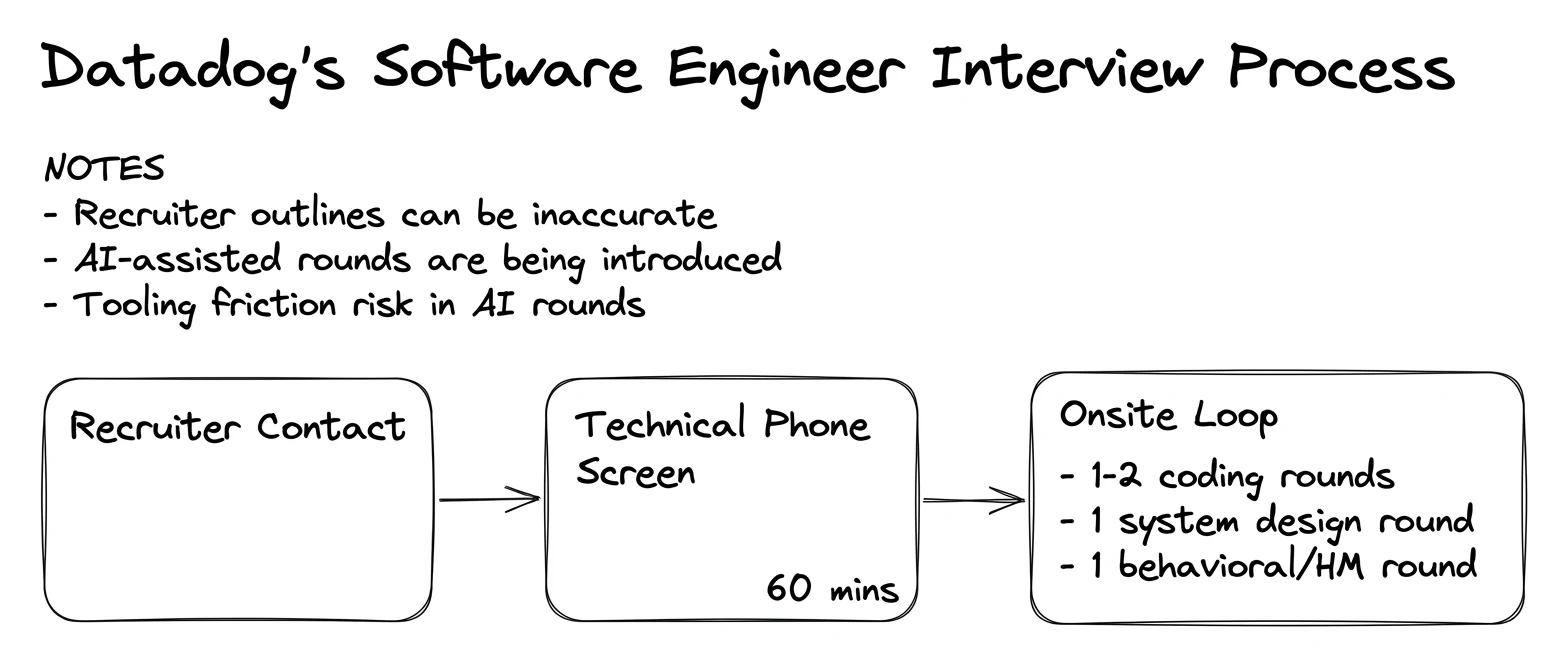
Hiring is centralized, with team matching after the loop, and problem families repeat across teams. The sequence is a recruiter call, a one-hour technical screen and a virtual onsite of three to five rounds, usually over three to six weeks.
The shape changes little by level. New-grad and junior loops also include system design. Senior and staff loops raise the bar in that round and in project depth. Data and ML candidates may get a conceptual modeling round instead of a second coding round.
Here's what the interview process can look like:
- Recruiter screen: A short call about background, level, interest in observability and the next round's format.
- Technical phone screen: A 60-minute live coding session on a practical problem with escalating follow-ups, sometimes plus a short classic question.
- Coding interviews (onsite): One or two pair-programming rounds on streaming, windowing, file-system or I/O problems.
- System design interview: A one-hour diagrammed design of a high-volume ingestion and query system.
- AI and ML rounds (some loops): AI-assisted coding, AI-agent design, or a conceptual ML deep dive for data and AI roles.
- Hiring manager interview: Behavioral questions, often merged with a resume or project deep dive.
Tip: Treat every coding question as step one of three: a correct brute force, an indexed version for higher volume, then deletion or concurrency. Candidates who jumped straight to an optimized design ran out of time.
Recruiter screen
The recruiter call is conversational and non-technical: background, why observability, level, location and the next round. Recruiters send preparation material. The outline is not always accurate. One candidate was told the screen would open with a project deep dive and got sixty minutes of pure coding.
Interviewers evaluate:
- Domain motivation: A specific reason to work on monitoring, logs or infrastructure data.
- Level fit: The scope of recent work, which sets the interview level.
- Logistics: Location, remote preference and competing timelines.
Ask which tool the screen uses and whether AI help is allowed, then prepare for both coding and project discussion anyway.
Sample questions for the recruiter screen
Here are some questions reported by recent candidates:
- Tell me about yourself and the system you are most proud of.
- Why Datadog, and which part of the product interests you?
Technical phone screen
The screen is one 60-minute live coding session in a shared editor, in any language. Most reports follow one pattern: a systems-flavored problem whose requirements change in the same code, sometimes followed by a shorter classic question. The most repeated problem is log-and-query matching. Queries and logs arrive on an unbounded stream. Each query gets an ID and an acknowledgment, and each log is emitted with the IDs of active queries sharing at least one word with it.
The expected path is explicit: scan active queries with word sets first, add an inverted index from words to query IDs when queries reach millions, then remove queries in constant time by holding each posting list as a hash map into a doubly linked list. A variant asks for keyword plus time-range lookup over stored logs, solved with an inverted index and binary search on timestamps.
Interviewers evaluate:
- Baseline first: A correct, simple solution before any optimization.
- Structure that survives change: Whether the first version absorbs deletion or a new constraint without a rewrite.
- Complexity per operation: Ingest, match and delete stated separately, with no hidden linear cost in delete.
- Memory and edge cases: Recursion near out-of-memory, buffer boundaries, an empty flush.
- Thinking aloud: Candidates who voiced confusion got useful hints.
Practice the log-and-query and buffered-writer families until all three follow-up stages fit in 45 minutes.
Note: On a path-simplification screen the algorithm was routine. The follow-ups asked how memory behaves under recursion versus iteration on a nearly out-of-memory machine, then for a constant-space rewrite parsing the string in place.
Sample questions for the technical phone screen
Here are some questions reported by recent candidates:
-
Tag each log in a live stream with every active query sharing a word, then scale it and support constant-time query removal.
-
Implement a buffered file writer with flush, then a test plan with error injection, then thread safety when the flush is slow.
-
Simplify a Unix absolute path, then discuss memory under recursion and redo it with constant extra space.
-
Count values of a sorted array into fixed-width buckets using integer division, with an overflow bucket.
Coding interviews
Onsite coding runs one or two hour-long pair-programming rounds drawn from the same pool, so log-and-query can reappear. Reported problems include sliding-window maximum (naive scan, then a deque of decreasing indices, plus k larger than the array and empty input), time-window statistics, a buffered reader over a fixed-size read primitive with a mutex, and DeleteTree built only from List, Delete and IsDirectory.
Pacing varies. Some rounds are one problem with no follow-up, where a complete first pass is the whole signal. Others become a production discussion: List loads a whole directory so memory scales with width, recursion overflows on deep trees, and absolute paths allow a delete-and-climb traversal in constant extra memory and linear time.
Interviewers evaluate:
- First-pass completeness: Edge cases handled unprompted, since there may be no second problem.
- Trade-offs before code: The brute force and its limits named before the optimization.
- Production instincts: Stack depth, fan-out memory and partial failure raised by the candidate.
- Concurrency literacy: The critical section named and lock granularity compared, not just "add a lock."
Time yourself on file-system and windowing problems and state each solution's memory profile aloud.
Sample questions for the coding interviews
Here are some questions reported by recent candidates:
-
Return the maximum of every window of size k, first naively and then in linear time.
-
Implement
DeleteTreewith only list, delete and is-directory calls, then handle very deep and very wide trees.
System design interview
A one-hour discussion, diagrammed in a whiteboard tool. Prompts stay close to streaming data: a Mint-style finance app with transactions and budgets, a bank transaction dashboard serving real-time totals, suspicious-transaction counts and balances, and, in two separate loops, matching photos from a firehose and notifying on a match. On the dashboard prompt, most of the hour went to exactly-once processing, late events, sliding-window anomaly detection and low read latency across time granularities.
Interviewers evaluate:
- Ingestion under volume: Partitioning, back-pressure and what is sampled or dropped.
- Windowed aggregation: Pre-aggregation by granularity and the cost of late data.
- Delivery semantics: Where duplicates appear and how idempotence is achieved.
- Read path: Serving recent and historical ranges without scanning raw events.
- Concrete components: A named queue, stream processor and time-series store, with failure modes, at senior level unprompted.
Prepare one streaming design you can draw from memory and defend against late data and duplicates.
Note: System design is the most commonly reported deciding round. One candidate who cleared coding and behavioral named the photo-matching design as the reason for rejection, and this round also drives level.
Sample questions for the system design interview
Here are some questions reported by recent candidates:
-
Design a real-time bank transaction dashboard with windowed aggregates, suspicious-transaction flags and balances.
-
Design a system that matches photos from a high-volume firehose and notifies subscribers.
-
Design a personal finance app covering transaction history and budgets.
AI and ML rounds
AI content appears in three forms. In an AI-assisted coding round, one candidate connected to Snowflake with a locally running model, and package conflicts consumed most of the hour. In an AI-agent design round, the prompt was an agent that detects infrastructure anomalies and proposes remediation, with pressure on guardrails against destructive actions and on logging the agent's reasoning for post-mortems. A 2026 interviewer said the company was moving further toward AI-driven formats, and published candidate guidelines warn that undisclosed AI use can disqualify. Data and AI candidates may instead get a no-code conceptual round: derive focal loss and place grouped query attention between multi-head and multi-query attention, with its savings and quality risks.
Interviewers evaluate:
- Directing the tool: Small, verified steps and critical reading of generated code.
- Environment fluency: Fixing dependency and connection problems fast enough to reach the task.
- Agent boundaries: Clear observation and action spaces, runbook-first planning and safety limits.
- Mathematical grounding (ML): The formulation written out and each term explained.
Rehearse a task against a real API in a fresh environment with an assistant enabled, and confirm the allowed tools with the recruiter.
Tip: In the AI-assisted round, set up and test the environment in the first five minutes. The reported failure was an hour lost to tooling with nothing to show.
Sample questions for the AI and ML rounds
Here are some questions reported by recent candidates:
-
Design an AI agent that monitors cloud infrastructure, detects anomalies and remediates safely.
-
Submit a SQL query to Snowflake, poll until done, then handle a result too large to load at once.
-
Explain focal loss and when to prefer it over weighted cross-entropy.
-
Derive the memory and speed savings of grouped query attention over multi-head attention.
-
Implement a Snowflake Query Client (Start Query & Get Query Status)
Hiring manager interview
About an hour, often doubling as a resume walkthrough. Reported questions cover pushing back on a product requirement for technical reasons, mentoring a junior engineer through hard debugging, conflict, and what makes a healthy engineering culture. One candidate found deep answers unnecessary; keep stories concise.
Interviewers evaluate:
- Ownership: Projects driven end to end, including incidents and what broke.
- Technical pushback: Disagreeing on feasibility with evidence, then committing.
- Mentorship: Concrete help given to others, expected from mid-level up.
- Defending past architecture: Why you made your choices and what you would change.
Prepare four or five short stories and two projects you can explain down to the data structures.
Sample questions for the hiring manager interview
Here are some questions reported by recent candidates:
- Tell me about a time you pushed back on a product requirement as technically infeasible.
- How did you help a junior engineer through a difficult debugging problem?
- What do you look for in an engineering culture?
How Datadog makes hiring decisions
Interviewers write independent feedback that a hiring committee reviews. Candidates then hold two-way team-matching conversations, and the offer follows a match. A match can fail after a strong loop: candidates were turned down after two teams passed, with feedback that they seemed unmotivated for those teams. System design and project depth set the level. Decisions usually arrive within one to two weeks, faster with a competing offer.
Tip: Name the product areas you want during team matching. Vague openness has been read as low motivation.
How to prepare for the Datadog interview
- Drill the log-and-query chain: Linear scan, inverted index with word counts, constant-time removal, then keyword plus time-range lookup.
- Write stateful I/O classes from a bare spec: Buffered writer and reader, each with boundary tests, error injection and a locking plan.
- Reason about memory aloud: Recursion versus an explicit stack, fan-out memory and constant-space rewrites.
- Own one streaming design: Ingest, windowed aggregation, time-series storage and a fast read path, with positions on late data and duplicates.
- Work against a real API: Submit a job, poll status, page a large result and keep credentials out of code.
- Rehearse AI-assisted work: Fresh environment, small verified steps, disclosed use.
- Prepare both formats for every call: The announced format does not always match the round.
About working at Datadog
Datadog runs an observability and security platform that ingests metrics, traces and logs at very high volume. Product-aligned teams own the path from agents and SDKs through ingestion, indexing and query, which is why interviews return to streams, indexes and buffers. Headquarters is in New York, with a large Paris engineering office.
| Level | Primary focus | Impact scope |
|---|---|---|
| Software Engineer I | Well-scoped features with guidance | Tasks within one team |
| Software Engineer II | Features and services end to end | One team's systems |
| Senior Software Engineer | Multi-quarter projects and mentoring | A team and its neighbors |
| Staff Software Engineer | Architecture and cross-team leadership | A product area |
Datadog hires engineers across its product lines. Teams include:
- Logs: Ingestion, indexing and search for one of the largest products.
- APM and tracing: Tracing SDKs and automatic instrumentation across many languages.
- Live Debugging: Investigating production issues without redeploying code.
- Database Monitoring: Query-level visibility into customer databases.
- Security: Cloud and application security products.
Experience and education requirements
Early-career roles expect a computer science or related degree and solid algorithms. Senior roles ask for several years on distributed or data-intensive systems. Candidates interview in the language of their choice, and high-throughput pipelines, time-series data or concurrency experience is a strong plus.
FAQs about the Datadog interview
How long does the Datadog interview process take?
Typically three to six weeks. One referral candidate reported about four weeks from application to an onsite decision; team matching can add time.
What is the hardest round of the Datadog interview?
System design, the most reported rejection point and the main input to level. In coding, the follow-up chain is harder than the base problem.
Is there an online assessment?
Not in the reported loops. The first technical step is a live 60-minute screen.
How much does a Datadog software engineer make?
Datadog's New York postings list base pay of about $187K–$240K for senior and $234K–$300K for staff roles, plus a four-year RSU grant; total compensation depends on level and team.
Is the Datadog interview remote?
Mostly virtual, and some teams offer remote or hybrid work.