Databricks · Study
Databricks Software Engineer Interview Process
TrueInterview
July 24, 2026 · 14 min read
Databricks grades running code, not approaches. Interviewers expect a complete, self-tested implementation inside the hour, then add a follow-up that changes the problem, and the most common rejection in the reports is a correct idea left unfinished. One onsite slot is a systems-programming round, where a thread-safe disk writer or blocking cache is judged on real concurrency correctness. That round sinks more otherwise strong candidates than the algorithms do.
The second difference comes after the interviews. References are collected before any decision and a hiring committee reviews the whole packet, so candidates with several strong-hire ratings have still been rejected. This guide breaks down each stage of the Databricks Software Engineer interview, what interviewers evaluate in each round, and how to prepare, with questions candidates were actually asked.
Verified: Based on 70 candidate-reported interview experiences, primarily from 2025 Q1 through 2026 Q3, cross-checked against recent public accounts.
Databricks Software Engineer interview process
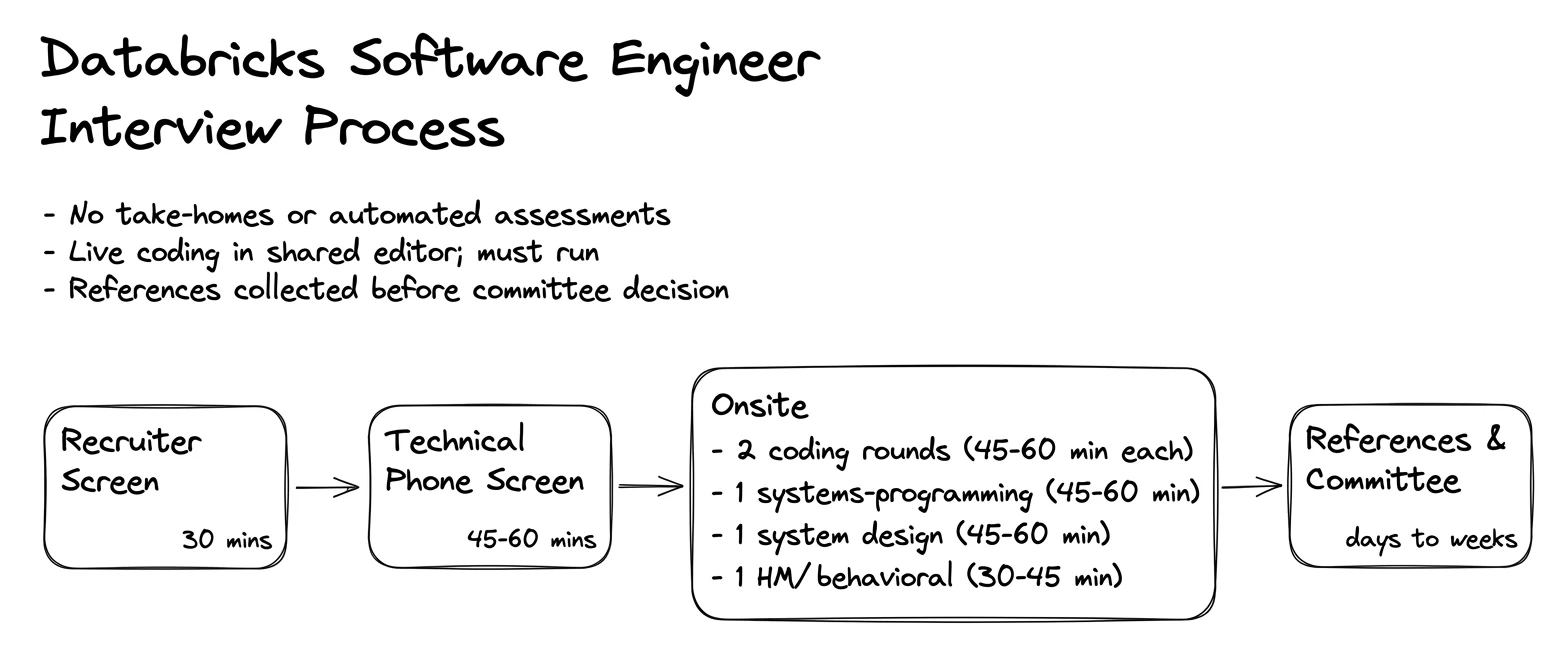
The skeleton is stable across teams: a recruiter call, one or two technical screens, and a virtual onsite of four to six rounds, followed by references and a hiring committee. Problems come from a small, recurring set of families, but each arrives with a twist, so recognizing a problem helps less than finishing it. The process usually takes four to eight weeks from the recruiter call.
Intern loops can be two video rounds, and new-grad loops still include an architecture round on APIs and schemas. Senior screens may mix coding with design; one staff candidate's only screen was a distributed file system design.
Here's what the interview process can look like:
- Recruiter screen: About 30 minutes on background, motivation, timeline and why you are leaving your current role.
- Technical phone screen (one or two): 45 to 60 minutes of live coding on one multi-part problem, with your own tests.
- Coding interviews (typically two): Hour-long rounds implementing a small class or API against a spec, then testing it.
- Systems-programming interview: A concurrent, durable component such as a log writer or blocking cache.
- System design interview: A product system such as a book marketplace or chat app, judged on APIs, schemas and failure handling.
- Hiring manager and behavioral interviews (one or two): A deep dive into a past project plus feedback, disagreement and cross-functional stories.
- References and hiring committee: References from a manager and senior colleagues, then a committee review of the full packet.
Tip: Plan each hour so part one is done, tested and running by the halfway mark. The interviewer has a follow-up planned, and candidates who spent 30 to 40 minutes on part one, even with a correct design, were rejected.
Recruiter screen
The recruiter call runs about 30 minutes and covers background, target level, location, competing processes and why Databricks. Recruiters sketch the upcoming rounds, but several candidates found the real rounds differed.
The screen is scored. One new graduate was rejected two days after this call, with the feedback naming the missing return offer from a prior internship. An experienced candidate was rejected for an unconvincing answer on why they were leaving their job.
Interviewers evaluate:
- Career narrative: A clear, professional reason for leaving, and for new graduates a credible account of internship outcomes.
- Motivation: Specific reasons for Databricks beyond its reputation.
- Logistics: Location, work authorization and timeline; one recruiter insisted on the exact city to validate the resume.
- Process fit: How you will choose between offers and whether your timeline matches theirs.
Prepare a two-sentence answer for why you are leaving and, if relevant, why an internship did not convert.
Sample questions for the recruiter screen
Here are some questions reported by recent candidates:
- Why are you leaving your current role?
- Why did your previous internship not end in a return offer?
- How well do you know Databricks, and why do you think you fit this role?
Technical phone screen
The screen is 45 to 60 minutes with an engineer, live in a shared editor that runs code. It is usually one problem in two or three escalating parts, and you write your own tests. Two screens before the onsite are common. The families repeat heavily:
- Optimal commute: Grid travel with up to four transport modes, each with its own time and cost, then mode switches with a penalty and a cap.
- IP firewall: First-match ALLOW/DENY rules in CIDR notation, escalating to whether an entire CIDR block is fully allowed.
- Fibonacci tree: Size, depth and paths between preorder-numbered nodes, computed from subtree sizes without building the tree.
- Key-value store with load metrics: Average gets and puts per minute over a rolling window.
- File encryption tree: Count encrypted files, then minimize total cost using per-file and per-folder encryption calls.
Results come quickly: rejections arrived within four hours to four days, and passes within one or two days.
Interviewers evaluate:
- Finishing the core: A working, tested part one with time left; pseudocode for the follow-up is accepted only when time is nearly out.
- Taking the simpler path: One candidate defended Dijkstra after a hint toward BFS, then ran out of time on duplicate-state handling.
- Optimal complexity: A correct but non-linear anagram-substring search was reported as enough for rejection.
- Edge-case tests: Empty inputs,
0.0.0.0/0, Unicode follow-ups, and what an API returns when nothing matches. - Precise reasoning: On the Fibonacci tree, interviewers asked why the path runs through the lowest common ancestor before any code was written.
Drill each family until part one takes under 20 minutes, with tests in the same file.
Note: A phone-screen rejection can carry a one-year cooldown. One candidate's rejection arrived four hours after the call with that wait attached.
Sample questions for the technical phone screen
Here are some questions reported by recent candidates:
-
Find the fastest route across a grid with walking, biking, driving and train modes, breaking time ties by cost, then allow capped mode switches with a penalty.
-
Given ordered ALLOW/DENY CIDR rules, decide whether an IP is allowed, then whether a whole CIDR block survives the rules.
-
Given two preorder labels in a Fibonacci tree of order n, return the path between them without building the tree.
-
Count encrypted files in a directory tree, then find the cheapest mix of per-file and per-folder calls when folder calls also re-encrypt encrypted files.
Coding interviews
The onsite usually has two hour-long coding rounds. They are implementation exercises: build a class from a list of requirements, run it, and test it in the same session. Recurring prompts:
- Lazy array: Copy-on-write copies, or
mapcalls deferred until an index is read. - Key-value store with traffic metrics: Per-minute rates over 5 minutes, then over an hour, a day and a week.
- Tic-tac-toe: An m-by-n board with a k-in-a-row win, then an opponent picking a uniformly random empty cell.
- Snapshot set:
getIterator()must be O(1) with no copying. - Others: Tetris drop distance, deleting and merging cipher-cover intervals, and a run-length encoder whose decoder is an iterator.
Full-stack loops swap in an autocomplete component with retries, debouncing and caching; one distributed-data-systems loop asked for predicate pushdown on a SQL query-plan tree.
Interviewers evaluate:
- Reading the spec exactly: One candidate built an order-preserving iterator the interviewer had said was unnecessary and lost the round on complexity.
- Test design: Tests that prove laziness is real, that a snapshot survives later mutation, and that stale time buckets drop out.
- Testing tools: One candidate attributed part of a rejection to fumbling the language's mocking library while faking the clock.
- Interface sense: Clean signatures, and an injectable timestamp so the class can be tested.
- Complexity under stated limits: Amortized O(1) add and remove, and O(N + M) space across M live iterators.
Practice each family as a class plus a test file, including a mocked clock, in under 45 minutes.
Tip: On rolling-rate problems, divide by the smaller of the window and actual uptime. A candidate who divided by a fixed 300 seconds was corrected on exactly this point and was rejected.
Sample questions for the coding interviews
Here are some questions reported by recent candidates:
-
Implement an array whose
mapcalls are evaluated only when an index is read, then write tests proving no function runs early. -
Build a set with an iterator that reflects the set at creation time, with O(1) iterator creation and no copying.
-
Build a key-value store reporting average gets and puts per minute over five minutes, then extend the window to a week.
Systems-programming interview
One onsite hour is a concurrent component with real I/O semantics. The most common prompt is a writer shared by many threads. In one version, thousands of threads call push(data) with byte arrays up to 1 KB that must be appended durably to a local file. Follow-ups add buffering, a background flush thread, fsync boundaries, shutdown and lock contention. Variants include a blocking cache, a circuit breaker with closed, open and half-open states, and routing across a primary and two replicas whose breakers open after two consecutive failures.
Some interviewers want running code with tests; others accept detailed pseudocode but probe every line for races. Several candidates who passed every other round named this one as the reason for rejection.
Interviewers evaluate:
- Concurrency correctness: No lost writes, no data races, no busy-waiting, and condition variables used correctly.
- Durability reasoning: What survives a crash, when data reaches disk, and what each fsync costs.
- Throughput trade-offs: Batching and group commit against latency, and cutting contention when producers spike.
- Primitive-level knowledge: The visibility and ordering guarantees your language actually provides.
Implement a buffered thread-safe file writer and a blocking bounded cache from scratch, with a shutdown path and a stress test.
Note: Explaining a fix is not the same as having one. One candidate described using
signalAllto avoid busy-waiting in a blocking cache, but the feedback said busy-waiting was still unresolved, and that round alone produced the rejection.
Sample questions for the systems-programming interview
Here are some questions reported by recent candidates:
-
Implement a
DataWritershared by thousands of threads that appends each pushed byte array to one file safely and durably. -
Build a thread-safe log writer that buffers messages and flushes them from a background thread, then reduce lock contention.
-
Route database requests across a primary and two replicas with per-node circuit breakers, driven by a caller-supplied lambda.
System design interview
The design hour, sometimes labeled architecture, focuses on APIs, data model and failure handling; several candidates typed designs in Markdown instead of drawing. New-grad loops include it too.
The book marketplace is the most frequent prompt. It has about 30 vendors and hundreds of requests per second, or 50 to 200 sellers with a 10 to 20 second latency target, and must order automatically when a price falls in range without overselling. Other prompts include a stock-order service over a third-party broker API that cancels unfilled orders at their deadline, Slack-like chat with deletion for everyone, a game shop with credits and refunds, a write-ahead-logged key-value cache, a dependency-graph job scheduler and a collaborative playlist. Interviewers push on every failure: partial results from a slow vendor, cache stampedes on a hot ISBN, retried charges, and compensation when a charge succeeds but the order fails.
Interviewers look for:
- Raising failure modes unprompted: Candidates were expected to identify idempotency and scaling concerns themselves.
- Lean APIs: Only necessary fields, such as quantity rather than total value, and a pending status for asynchronous work.
- Data-model trade-offs: For a shared playlist, one interviewer pushed from a single blob toward per-song rows linked like a list.
- Consistency story: Ordering of order and charge, transactions around crashes, and idempotency keys on retries.
- Storage depth at senior levels: Write-ahead logs, LRU eviction, sharded locks and crash recovery.
Rehearse the book marketplace and stock-order prompts end to end, naming every failure point and its mitigation before you are asked.
Sample questions for the system design interview
Here are some questions reported by recent candidates:
-
Design a book service that queries dozens of sellers and buys automatically if the lowest price is under the user's maximum, without overselling or double charging.
-
Design a trading service over a broker API with create, status and cancel calls, cancelling orders not filled by their deadline.
-
Design a group chat where deleting a conversation removes it for every participant.
Hiring manager and behavioral interviews
Most loops have one behavioral round with the hiring manager, ending with about 15 minutes for your questions. Some loops split it: one had a cross-functional round on collaboration and on-call surprises plus a tech-fit round presenting projects to an organization's tech lead. Common topics are why Databricks, your proudest project, feedback you disagreed with, a technical disagreement, your biggest mistake and breaking down a large task. Some interviewers interrupt or apply deliberate pressure; tone did not predict the outcome.
Interviewers evaluate:
- Project depth: Defending design choices and rejected alternatives at a level that shows you did the work.
- Response to feedback: A specific disagreement, what you did, and what changed.
- Cross-functional collaboration: Weighted heavily in one senior offer's manager round.
- Composure: Staying structured when interrupted or challenged.
Prepare five or six stories with concrete technical detail and rehearse them aloud under interruption.
Note: The manager's read is not averaged away. One candidate with strong-hire ratings from three technical rounds was rejected because the hiring manager rated the behavioral round very negatively, which blocked team matching.
Sample questions for the hiring manager and behavioral interviews
Here are some questions reported by recent candidates:
-
Tell me about feedback you disagreed with and how you handled it.
-
Describe a technical disagreement with a coworker and how it was resolved.
-
Tell me about an on-call surprise and how you worked across teams to resolve it.
-
Impactful Project Experience: Goals, Role, Challenges, Outcomes
How Databricks levels and evaluates Software Engineer candidates
After the onsite the recruiter requests references, usually within a week: a manager and two senior colleagues, or a previous manager and tech lead. A hiring committee of managers and directors from outside the team then reviews interview feedback, background and references together, and decisions arrived one to two weeks later. Passing every interview is not enough. One candidate was rejected for being unable to supply a current-manager reference, one with strong-hire feedback across five rounds was rejected by the committee without a reason, and one lost an offer to a headcount freeze. Candidates also suspected informal back-channel checks.
The target level is set before the loop; L4 and senior reports describe the same round types, with deeper design follow-ups at senior. Team matching can sit before the onsite or after the committee. Feedback is rarely given, and a one-year cooldown has followed even a phone-screen rejection.
Tip: Line up references before the onsite, including a current or recent manager, and brief them on the role. The request often comes within days of the final round and cannot be fixed afterward.
How to prepare for the Databricks Software Engineer interview
- Master the recurring families: Optimal commute, CIDR firewall, Fibonacci-tree paths, the encryption-cost tree and rolling-rate key-value stores.
- Finish part one in 20 minutes: The follow-up is the real evaluation, and an unfinished function is the most common rejection.
- Test inside the solution: Write unit tests as you go, including a mocked clock.
- Build concurrency from scratch: A durable multi-threaded writer and a blocking cache with condition variables, without busy-waiting.
- Confirm the spec before coding: Ordering, window length, time source and uptime; do not import constraints from a version you practiced.
- Design around failure: Cover timeouts, caching, idempotency, compensation and pending states before being asked.
- Treat every conversation as scored: A clean career narrative for the recruiter, deep project stories for the manager.
- Prepare references early: A current or recent manager and senior colleagues, ready before the onsite.
About the Databricks Software Engineer role
Databricks Software Engineers build the lakehouse platform, which runs on AWS, Azure and Google Cloud. They own features from design through production, including on-call, and the interview problems are simplified versions of this storage and platform work.
| Level | Primary focus | Impact scope |
|---|---|---|
| L3 (Software Engineer, entry level) | Well-scoped features with guidance | A component within one team |
| L4 (Software Engineer) | Independent ownership of features and services | A team's systems |
| L5 (Senior Software Engineer) | Design of larger systems, technical leadership, mentoring | Several systems or a product area |
| L6 (Staff Software Engineer) | Technical direction across teams | An organization's architecture |
Databricks hires Software Engineers in hubs including San Francisco, Mountain View, Seattle, Amsterdam and Bengaluru. Teams include:
- Runtime and query engines: Spark, the Photon vectorized engine and query optimization, largely in Scala and C++.
- Storage: Delta Lake transactions, time travel and compaction.
- Platform and control plane: Cluster management, serverless compute and cloud infrastructure.
- Governance: Unity Catalog permissions, lineage and data access.
- AI and model serving: Mosaic AI training, fine-tuning and inference.
- Product and full stack: Notebooks, SQL experiences and customer-facing web applications.
Software Engineer experience and education requirements
New-grad postings ask for a degree in computer science, engineering or a related field, fluency in a language such as Python, Java or C++, and knowledge of algorithms, data structures and object-oriented design. Experienced hires are expected to show distributed-systems or storage depth. Any mainstream language works, but a Java candidate lost minutes explaining collection calls to a Python-only interviewer.
FAQs about the Databricks Software Engineer interview
How long does the Databricks Software Engineer interview process take?
Usually four to eight weeks from recruiter screen to decision, with the reference and committee stage adding one to three weeks. One Amsterdam new graduate went from recruiter screen to offer in under six weeks.
What is the hardest round of the Databricks Software Engineer interview?
The systems-programming round is most often named as the reason for rejection, because concurrency bugs and busy-waiting are judged strictly. The least predictable stage is the committee review, which has overturned strong technical feedback.
Is there an online assessment?
Generally no; nearly every report describes live screens with an engineer. One candidate described an open-book assessment covering CIDR matching, run-length encoding and a log writer.
How much does a Databricks Software Engineer make?
Approximate total annual compensation in the United States:
- L3: ~$250K
- L4: ~$410K
- L5: ~$630K
- L6: ~$1,000K
Packages combine base salary, a small bonus and restricted stock units vesting over four years, with stock making up most of the total from L5 upward.