Databricks · Study
Databricks Infrastructure Engineer Interview Process
TrueInterview
July 24, 2026 · 14 min read
The Databricks Infrastructure Engineer loop is decided less by distributed-systems vocabulary than by single-machine implementation. Its signature hour asks you to write bytes to one disk correctly while thousands of threads call in, then defend batching, fsync, crash recovery and lock contention, and candidates with strong feedback elsewhere named it as the round that sank them. The phone screen opens with matching an IP against ordered CIDR rules, then asks whether a whole CIDR block survives overlapping allow and deny rules.
Passing every interview does not end it: references follow the onsite, a committee weighs the packet, and one negative hiring-manager read has outweighed three strong-hire ratings. This guide breaks down each stage of the Databricks Infrastructure Engineer interview, what interviewers evaluate in each round, and how to prepare, with questions candidates were actually asked.
Verified: Based on 70 candidate-reported interview experiences, primarily from 2025 Q1 through 2026 Q3, cross-checked against recent public accounts.
Databricks Infrastructure Engineer interview process
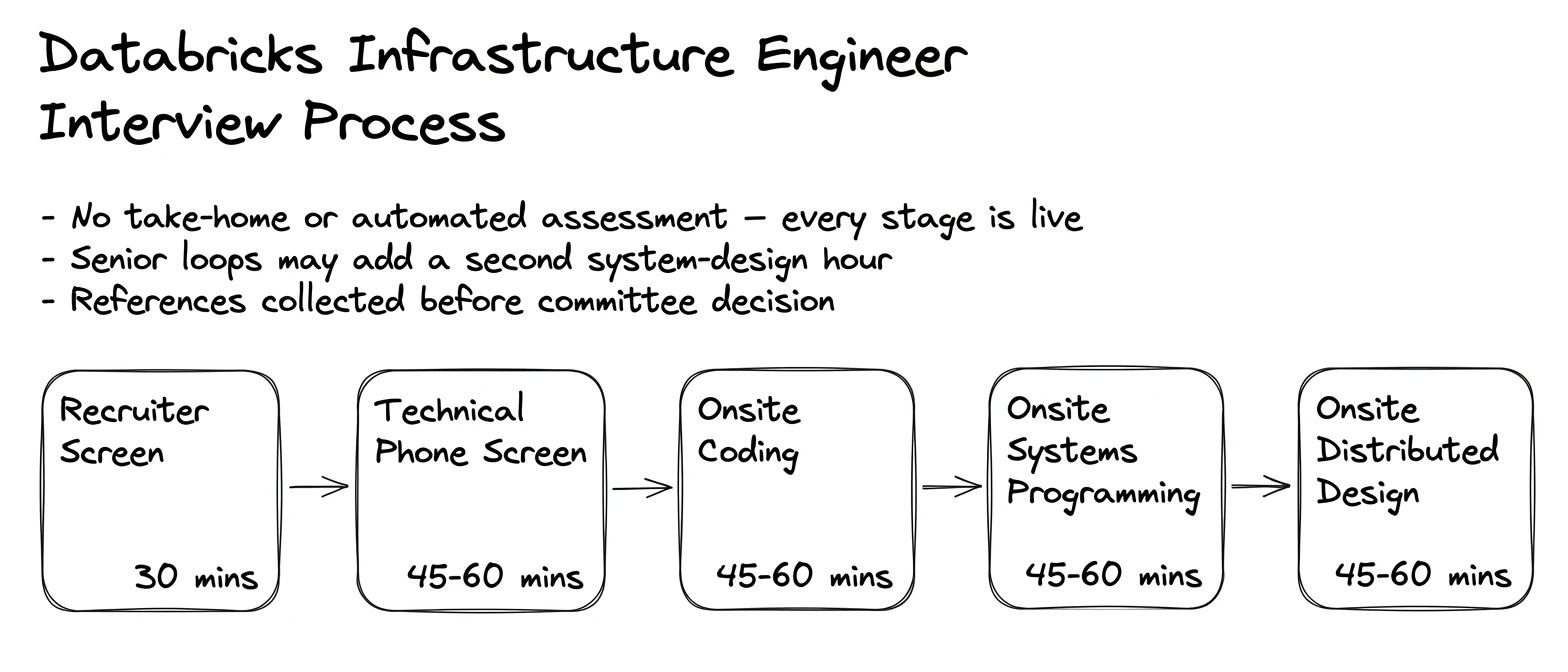
Infrastructure candidates sit on the general software engineering ladder, but the loop is assembled around the platform team, so prompts skew toward networking, durability and concurrency. The skeleton is a recruiter call, one or two technical screens, and a virtual onsite of four to six rounds of 45 to 60 minutes, then references and a committee decision. It typically runs four to eight weeks.
New-grad loops weight coding and the systems-programming hour, and design can be a schema-and-API conversation. Senior loops add a full distributed design round, sometimes two; one staff screen was an hour of distributed file system design with no coding.
Here's what the interview process can look like:
- Recruiter screen: About 30 minutes on background, level, location and, pointedly, why you are leaving your current role.
- Technical phone screen (one or two): 45 to 60 minutes of live coding on a problem that escalates mid-hour, usually networking or windowed metrics.
- Coding interviews (one or two): Hour-long implementation rounds on systems-flavored APIs, with tests you write and run.
- Systems-programming interview: A thread-safe, durable writer, cache or log, implemented and probed on concurrency and crash recovery.
- System design interview (one, sometimes two at senior levels): Infrastructure surfaces such as file systems, schedulers and rate limiters, driven by you.
- Hiring manager and behavioral interview: STAR questions plus a granular audit of one past project, often with an operational slant.
Tip: Budget each technical hour as two problems. The base case is a 15-minute warm-up, and the follow-up that changes the answer's shape arrives with about 20 minutes left; candidates who spent half the hour polishing part one were rejected even when it was clean.
Recruiter screen
The 30-minute call covers background, target level, location, visa and competing processes. Many infrastructure candidates are sourced through recruiter or hiring-manager outreach, and the call shapes which platform team the loop is built around; some waited on team matching before the onsite.
It carries real weight on employment history. One candidate was rejected two days later with a missing internship return offer named as the reason; another blamed an unconvincing answer about leaving a current job. Candidates also found the actual prompts diverged from the recruiter's outline.
Interviewers evaluate:
- A clean career narrative: A specific, non-defensive reason for leaving and for any gap or missing return offer.
- Motivation for Databricks infrastructure: Why multi-cloud compute or storage work, not generic interest in data and AI.
- Level fit: Scope of systems you have owned, which sets the bar for the design rounds.
Prepare a factual two-sentence account of every job transition.
Sample questions for the recruiter screen
Here are some questions reported by recent candidates:
- Why are you leaving your current role, and why now?
- Why did your last internship not end in a return offer?
- Why Databricks, and how well do you know the platform?
Technical phone screen
The screen is 45 to 60 minutes of live coding in a shared editor, with tests you write yourself. The infrastructure signature is network access rules as code: convert a dotted-decimal IPv4 address to a 32-bit integer, build masks from prefix lengths, and return the action of the first matching rule in an ordered allow and deny list, checking 0.0.0.0/0, /32 and reordering.
Escalation decides the round. Follow-ups make the query itself a CIDR block, or carve allowed overlaps out of a target block, fail on any denied overlap, and return true only if nothing remains. Scaling to millions of rules brings in tries and segment trees. Other screens use windowed metrics, such as a key-value store reporting put and get rates over five minutes at hundreds of thousands of queries per second; Fibonacci-tree index arithmetic and multi-mode grid paths also recur. A few screens are deliberately broad: subnet arithmetic, a messaging sketch, a multi-threaded event logger and a hit counter in one hour. Results usually arrive within two days; one rejection came four hours after the call.
Interviewers evaluate:
- Bit-level fluency: Network address, broadcast address and usable hosts computed without slowly counting bits.
- Reaching the follow-up: Block containment or overlap removal implemented, not just described, before time runs out.
- The intended scaling structure: A prefix trie or interval structure for rule elimination. One candidate who proposed sorting rules by prefix length was rejected after completing every stated task.
- Test discipline: Self-written boundary cases, plus a clear convention for errors and no-match results.
Drill IPv4 and CIDR bit manipulation until the base case takes under 15 minutes, then practice range subtraction over overlapping blocks.
Note: On the five-minute rate problem, one candidate's working ring buffer divided by 300 seconds even when the server had run for only a few. The interviewer flagged it, and the candidate believed that edge case caused the rejection four days later. Follow-ups then stretched the window to 300 days or made traffic bursty and sparse.
Sample questions for the technical phone screen
Here are some questions reported by recent candidates:
-
Given ordered allow and deny rules in CIDR notation, return whether an IP is allowed under first-match semantics, then accept a CIDR block as the query.
-
Given a target block and an ordered rule list, remove allowed overlaps, fail on any denied overlap, and report whether the target was fully covered.
-
Size memory for 1,000 timestamped writes per second over five minutes and then 24 hours, and redesign when it no longer fits.
Coding interviews
Onsite coding rounds run 45 to 60 minutes and are implementation exercises, often extending a provided skeleton. Infrastructure prompts lean toward data-system internals: a query-plan optimizer applying predicate pushdown and a second rewrite with runnable tests; a hybrid run-length and bit-packing encoder with an iterator decoder; a directory tree where each folder chooses per-file encryption or one fixed-cost folder-wide call. Lazy arrays, snapshot sets and key-value stores with hit counters fill the rest.
Grading favors complete, running code. Interviewers add their own tests, such as negative values and integer limits; one candidate rewrote a decoder after missing the iterator requirement, and another was pressed on a mocking library. A candidate on a distributed data systems team found that loop noticeably harder than general ones.
Interviewers evaluate:
- Reading the specification: Iterator versus batch output, and whether order must be preserved. One candidate built an ordered structure the problem never required and was rejected.
- Data-system correctness: Predicates pushed only where semantics allow, and encodings that round-trip at integer limits.
- Optimal structure on request: O(1) snapshot creation without copying, and O(log n) ordered updates instead of sorted-array inserts.
- Testing as part of the answer: Tests that prove laziness or confirm a plan rewrite preserves results, written and run in the editor.
Practice extending an unfamiliar skeleton in 45 minutes, finishing with your own tests at integer and empty-input boundaries.
Sample questions for the coding interviews
Here are some questions reported by recent candidates:
-
Rewrite a logical query plan by pushing filters below projections and joins, then prove the rewrite with runnable tests.
-
Encode a stream of integers by choosing run-length or bit-packing per run for the shortest output, and decode it lazily as an iterator.
-
Count encrypted files in a directory tree, then minimize total cost when a folder-wide call re-encrypts everything below it at a fixed price.
-
Build a set whose iterators see the contents at creation time, with O(1) iterator creation and space linear in elements plus live iterators.
Systems-programming interview
This hour decides the track most often. A typical prompt: thousands of threads share one writer object, each calling push with up to 1 KB of bytes that must be appended durably to a local file. Variants include a buffered log writer with a background flush thread, a log writer whose every write is synchronous, a master thread coordinating disk writes, a write-ahead-logged cache with sharded locks and LRU eviction, and a cache with blocking reads. Circuit breakers land here too: a primary and two replicas, each opening after two consecutive failures, driven by an injected function simulating the backend.
Follow-ups go below the API: when data is durable relative to fsync, what group commit buys, when the log can be truncated, how replay works, and where the lock is contended at peak. Some interviewers accepted a walk-through; others ran tests, and one candidate whose durable writer still had bugs believed it decided the rejection.
Interviewers evaluate:
- Separation of layers: A plain append API kept apart from buffering, flushing and durability, with the guarantee of each layer stated.
- Correct synchronization: Condition waits that do not spin. One candidate's use of a broadcast wake-up was judged to leave busy-waiting unresolved, which failed the round.
- Defensible concurrency claims: Naming the memory-visibility guarantee you rely on. A correct mutex design outscores a hand-waved lock-free one.
- Crash semantics: What is lost on a crash before flush, how recovery replays the log, and what shutdown must drain.
Implement a write-ahead-logged store and a batched multi-threaded file writer end to end before the loop, including a crash-and-replay test.
Note: Candidates who could describe write-ahead logging but had never implemented one stalled here. One candidate passed every other round and was rejected on a blocking cache; another named a multi-threaded disk-write design as the round that sank them.
Sample questions for the systems-programming interview
Here are some questions reported by recent candidates:
-
Implement a thread-safe, durable writer that thousands of threads call with byte arrays up to 1 KB, appending to one local file under high load.
-
Design a single-machine key-value cache with write-ahead logging, sharded fine-grained locks, LRU eviction and deadlock avoidance.
-
Route database requests across a primary and two replicas, each with a circuit breaker that opens after two consecutive failures.
System design interview
The design round is 45 to 60 minutes of discussion, sometimes in typed notes rather than diagrams. Infrastructure prompts include a distributed file system, a scheduler over an arbitrary job dependency graph, a CRUD service extended into an asynchronous job pipeline, a host bandwidth limiter guaranteeing each virtual machine a minimum, and a write-ahead-logged key-value cache. Product prompts appear too: chat with message deletion, a book-seller platform fanning out to dozens of vendors, a stock-order service cancelling at deadlines.
Depth scales with level. Mid-level sessions can stay at APIs, schema and flow; one interviewer waived scaling. One staff-level file system round spent the whole hour in the metadata layer: namespace sharding, the metadata bottleneck, replication, consistency and crash recovery. Candidates are expected to raise idempotency, timeouts and duplicate requests themselves.
Interviewers evaluate:
- Driving the session: Requirements, API and data model stated before components, then depth where the interviewer steers.
- Metadata and state ownership: Where state lives, how it is sharded, and how it recovers after a crash.
- Failure handling you raise yourself: Retries with idempotency keys, compensation when a later step fails, and circuit breaking toward slow dependencies.
- Numbers at senior levels: A component list with a happy path is the common failure mode for staff candidates.
Prepare a distributed file system and a dependency-graph scheduler to the depth of their metadata and recovery paths.
Tip: For file-system prompts, candidates recommend studying how GFS and HDFS separate metadata from data. Questioning stays on metadata and recovery rather than moving to new components.
Sample questions for the system design interview
Here are some questions reported by recent candidates:
-
Design a distributed file system with uploads, reads and directory operations, keeping the namespace consistent and recoverable.
-
Design a scheduler that runs jobs with arbitrary dependencies, detects cycles and handles failed jobs.
-
Design a rate limiter so the virtual machines on one host never exceed its total bandwidth while each keeps a guaranteed minimum.
Hiring manager and behavioral interview
Expect 30 to 60 minutes with a hiring manager or senior engineer: questions on disagreement, feedback, ambiguity and cross-team work around a granular audit of one project. Some loops split it into a cross-functional conversation about on-call surprises and a tech-fit session presenting projects to an organization's technical lead. Some interviewers press deliberately, cutting answers off or questioning harshly. The round carries outsized weight: one very negative hiring-manager read overrode three strong-hire ratings.
Interviewers evaluate:
- Depth on one system: The schema, the alternatives you discarded and why, defended down to specifics.
- Operational judgment: An incident with its signals, the trade-off you took and what changed afterward.
- Handling disagreement: Feedback you disagreed with, what you did next, and what you would do differently.
- Cross-functional range: Work that required coordinating with other teams, a theme senior candidates found emphasized.
Prepare one infrastructure project you can defend for 30 minutes and one incident story with concrete metrics.
Sample questions for the hiring manager and behavioral interview
Here are some questions reported by recent candidates:
-
Describe the hardest technical challenge you have faced and your biggest mistake.
-
Tell me about feedback you disagreed with and how you handled it.
-
How do you respond to an on-call surprise in a system you do not own?
-
Impactful Project Experience: Goals, Role, Challenges, Outcomes
How Databricks levels and evaluates Infrastructure Engineer candidates
A hiring committee reviews the full packet: interview scores, references and team fit. References are requested within days of a passed onsite, typically three including a manager and a senior colleague or technical lead. One candidate was rejected for lacking a current-manager reference; others with strong technical feedback were rejected at committee without a technical reason, one citing headcount. Candidates are compared against one another, so a pass is relative.
The target level is set before the loop, and design and systems-programming depth carry most of the level signal; an extra coding screen has occasionally been added after the onsite. Decisions typically arrive within one to two weeks of references, and feedback is rarely given.
Tip: Line up a current manager as a reference before the onsite; the request arrives within days, and a missing one has ended an otherwise passing loop.
How to prepare for the Databricks Infrastructure Engineer interview
- Implement durability, do not just describe it: Build a write-ahead-logged key-value store and a batched multi-threaded file writer with a crash-and-replay test before the onsite.
- Master IPv4 and CIDR arithmetic: Practice first-match rule evaluation, block containment and overlap subtraction, and know when a prefix trie beats a linear scan.
- Plan every hour for the follow-up: Finish the base case in 15 minutes so that range queries, configurable windows or cost optimizations get the remaining time.
- Get synchronization exactly right: Use condition waits without spinning, state the visibility guarantee you rely on, and prefer a correct lock over an unproven lock-free design.
- Write tests as part of every answer: Cover integer limits, empty inputs, short uptime and ordering assumptions, and know your language's mocking and clock-injection tools.
- Prepare two infrastructure designs to metadata depth: A distributed file system and a dependency-graph scheduler, each with sharding, consistency and recovery choices justified.
- Rehearse the narrative rounds and references: Script each job change, prepare one project and one incident to defend under interruption, and have a current manager ready as a reference.
About the Databricks Infrastructure Engineer role
Infrastructure engineers build the multi-cloud platform under Databricks' products: compute launching very large numbers of virtual machines daily across AWS, Azure and GCP, systems managing thousands of Kubernetes clusters, and deployment tooling. Teams own services end to end, including on-call, and the published principles (customer obsessed, raise the bar, truth seeking, first principles, bias for action, company first) shape behavioral discussions.
| Level | Primary focus | Impact scope |
|---|---|---|
| L3 (Software Engineer) | Well-scoped features and services with guidance | A component within one team |
| L4 (Software Engineer) | Owning services through design, delivery and operations | A team's systems |
| L5 (Senior Software Engineer) | Leading designs, reliability and cost trade-offs, mentoring | Several services and neighboring teams |
| L6 (Staff Software Engineer) | Technical direction for a platform area | An organization's architecture |
Databricks hires Infrastructure Engineers across its platform organization. Teams include:
- Serverless Compute Platform: The compute layer behind the serverless product lines, including efficiency and margin work.
- Compute Fabric (Clusters): The serverful cluster platform, aimed at reliable, cost-competitive compute.
- Infrastructure and Tools: Multi-cloud systems and services that run Kubernetes clusters at scale, plus build and deployment tooling.
- Execution Sandbox: Isolated execution for user code, including GPU onboarding and managed REPL environments.
Infrastructure Engineer experience and education requirements
Postings ask for a bachelor's degree or higher in computer science or a related field: two or more years of backend work at mid level, five or more at senior, and about ten of large-scale distributed systems at staff. Java, Scala, Go and C++ are common, and Kubernetes experience is preferred for compute roles. Interviews accept any mainstream language.
FAQs about the Databricks Infrastructure Engineer interview
How long does the Databricks Infrastructure Engineer interview process take?
Usually four to eight weeks. Reported spans run from about two weeks for a fast senior loop to about twelve for a new graduate, with team matching and references causing most waits.
What is the hardest round of the Databricks Infrastructure Engineer interview?
The systems-programming hour; even candidates strong in distributed systems rated it their weakest. The escalating CIDR screen is second because it can end the process before an onsite.
Can you write pseudocode in the systems-programming round?
Databricks' own preparation material allows it, but some interviewers ran tests against the code, so plan for working code and use pseudocode only when told.
How much does a Databricks Infrastructure Engineer make?
Approximate total annual compensation in the United States:
- L3 (Software Engineer): ~$250K
- L4 (Software Engineer): ~$410K
- L5 (Senior Software Engineer): ~$630K
Packages combine base salary with restricted stock units that vest over four years, a quarter after the first year and the rest in equal installments. Stock makes up most of the package at senior levels.
What happens after a rejection?
Feedback is rarely shared, and candidates rejected after the screen reported a one-year cooldown before reapplying.