Capital One · Study
Capital One Data Scientist Interview Process
TrueInterview
July 31, 2026 · 7 min read
Data Scientist candidates here are routinely handed two full business cases in one day, and neither is likely to be about banking: reported prompts include calculating the profitability of an amusement park and quantifying the financial impact of decisions in a wheat harvest. The modeling questions people spend weeks preparing occupy a fraction of the loop; the cases, the mental arithmetic performed out loud, and a role-play where you explain a degraded production model to a product manager without jargon occupy most of it. Candidates who can build the model but cannot narrate a P&L breakdown are the ones who fall out late.
Interview Process
-
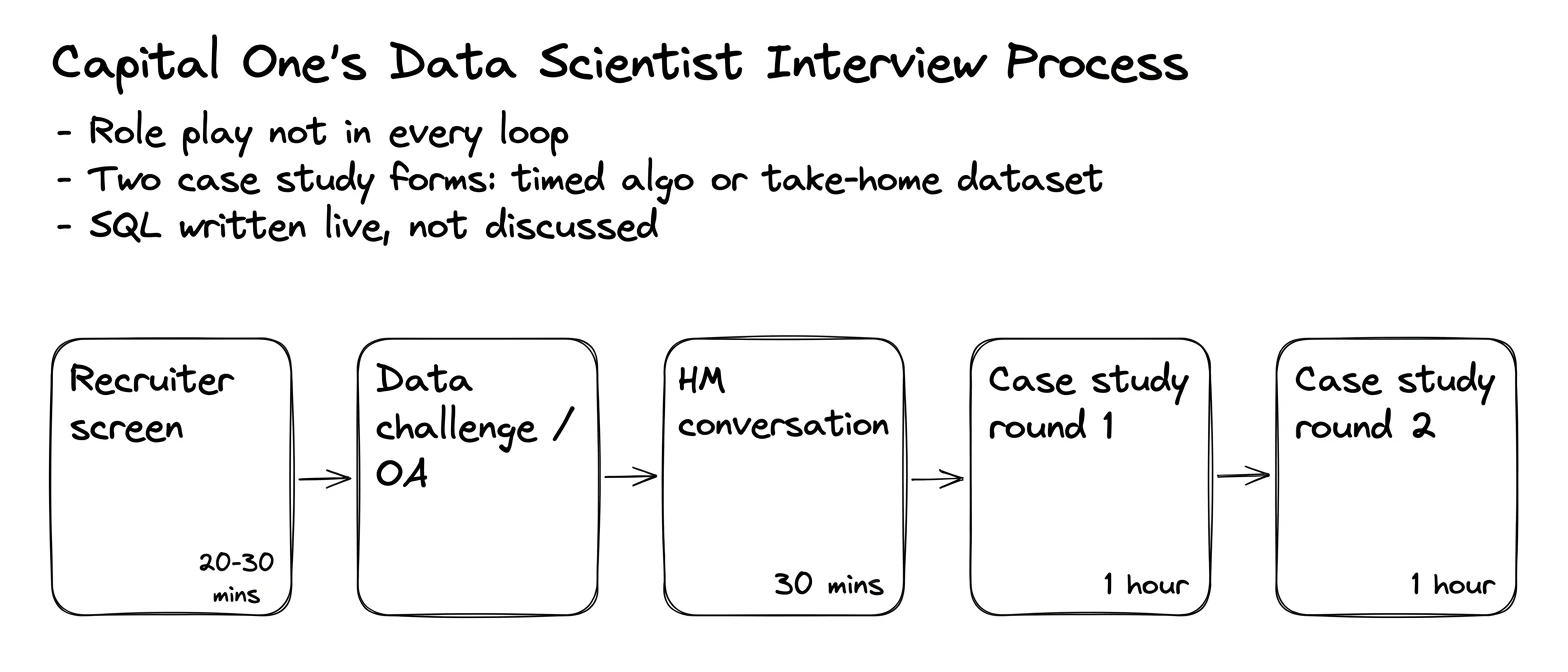
Recruiter screen (20–30 minutes). Background, the analytics or modeling problems you have owned end to end, level, location and timeline, plus a walkthrough of the stages. Recruiters on this track ask which parts of the pipeline you personally handled — data pull, analysis, model, stakeholder recommendation — because the loop grades the last of those as heavily as the first three. Expect the assessment or data challenge invitation within about a week.
-
Data challenge or online assessment. Two forms are reported. The timed coding assessment is externally hosted and proctored — four problems, webcam on, no copy-paste, scored out of 600 — and its content is general algorithms rather than statistics: prefix sums over visit counts, exact-specification array simulation, grid and shape-placement puzzles, round-robin allocation across warehouses with capacity and closure events, and pair counting to a target. The alternative is a dataset-and-prompt challenge you complete on your own time, submitted as exploratory analysis, a modeling or analytical approach with stated reasoning, and a written narrative a non-technical reader could act on. Review of a submitted challenge typically takes one to two weeks.
-
Hiring manager conversation (about 30 minutes). Team fit, the kinds of decisions the team informs, and a quick pass over your background. Reported versions are conversational rather than adversarial: why you work in Python and which packages you reach for, what you would conclude from a staffing dataset, and what you found most interesting in your own challenge submission. Answering the tooling question with reasons rather than a package list is what registers.
-
Interview day, case study round one (about 1 hour). A structured business case, frequently outside financial services. Reported prompts: an amusement park profitability calculation, and a credit business scenario where you build a basic P&L framework, name the formula components, and estimate break-even points and margin impacts with mental math. Some sittings blend this with a data challenge presentation, where you talk through your insights and then write code to answer business-sense follow-ups.
-
Interview day, case study round two (about 1 hour). A second case on an unrelated domain — the reported one centers on a wheat harvest, where you identify the drivers of yield, name the risks, and propose how you would quantify the financial impact of different decisions. This round is testing repeatability: whether your structure holds up on a topic you know nothing about, and whether you balance quantitative estimates against qualitative factors instead of guessing a number.
-
Interview day, technical deep dive (about 1 hour). Statistics and modeling plus hands-on work in one session: tree-based models and XGBoost specifically, treatment of missing values, detecting and mitigating overfitting, then live SQL with window functions and several join types, and a Python task that cleans and reshapes a messy dataset. The SQL is written live, not discussed.
-
Interview day, role play (about 1 hour, not in every loop). A model in production has started performing worse and you must explain it to a non-technical product manager: translate precision, recall and drift into business consequences, lay out an investigation plan in plain language, and propose immediate mitigations. Undefined jargon is the scored failure.
-
Interview day, behavioral round (about 1 hour). STAR format. Reported prompts cover interpersonal conflict, a significant technical challenge, projects with ambiguous or shifting requirements, and — distinctively — feedback you have received from others and what you changed as a result.
-
Debrief and decision. Every interviewer submits a rating and the hiring discussion consolidates them. End to end the process commonly runs several weeks; when the outcome is positive the recruiter typically calls within a few days of the interview day.
What They Actually Evaluate
Domain Deep Dive
The largest block of the day and the one that decides most outcomes. You are graded on stating a framework before touching numbers, decomposing a profit or loss into its drivers, doing arithmetic aloud without a calculator, and closing with a recommendation you can defend. Interviewers deliberately choose unfamiliar industries, so domain knowledge is not the point — the reusable structure is. The two most common failures: computing silently and announcing only the answer, and producing a framework so generic it never touches the specifics of the scenario.
Coding and Algorithm
Two very different tests. The timed assessment is conventional algorithm work — simulation, careful state tracking, grid manipulation — where following the written specification exactly matters more than complexity, and brute force passed inside the stated constraints in several reports. The live technical hour is applied data work instead: window functions and multi-table joins typed out under observation, plus a Python wrangling task on a deliberately messy dataset. Candidates who only practise notebook-style analysis stumble on the SQL.
- Dynamic Two-Array Pair Sum Queries
- Warehouse Round-Robin Allocation with Closures
- Even Digit Count
- Repeated Leading-Nonzero Subtraction
ML Theory
Breadth over depth, and biased toward tabular practice: tree ensembles, missing-value strategies, overfitting detection and mitigation, and how you would know a deployed model has degraded. The bar is a crisp definition that survives one follow-up and one example from your own work. Where the role play appears, the same knowledge is retested through communication — you must convert a metric movement into a business consequence and a plan.
Behavioral and Leadership
A graded hour with prompts that resist rehearsed answers, notably the feedback question: what someone told you, how you reacted, and what specifically changed afterwards. Conflict and ambiguity stories are expected to end with a measurable result. Interviewers probe your individual actions, so stories told entirely in the first person plural score poorly.
What They Don't Test
- Deep learning and model architecture. Nothing in the reports goes past tree-based tabular modeling. Preparing neural network internals buys nothing; a clean XGBoost narrative does.
- Advanced algorithms in the assessment. The problems are simulation and bookkeeping, and quadratic solutions passed. Finishing all four correctly beats optimizing two.
- Statistical theory for its own sake. No report describes derivations or proof-style probability questions. Estimation, metric selection and business framing appear instead.
- Finance domain knowledge. Cases are chosen from unrelated industries on purpose, so memorizing credit terminology is largely wasted next to practising structured decomposition.
- Silent analysis. Two rounds are graded almost entirely on your commentary. An answer produced without narration reads as unverifiable, however correct.
The Real Filter
The primary rejection path is a candidate who is strong technically and unstructured commercially. Two of the interview-day hours are business cases in industries you do not know, graded on framework, arithmetic aloud and a defended recommendation — and a third, the role play, is graded purely on explaining a technical problem without technical language. Analytics skill does not carry these rounds. Preparation that actually moves the needle: decompose three unfamiliar businesses into revenue and cost drivers, do the estimates verbally, and force yourself to state a recommendation with its risk.
The second pattern is the assessment at the front of the process. Candidates report rejection within about three days after solving every problem, with scores in the 500s out of 600, and the same is described at the top of the scale. Above the pass line the score decides little; resume fit, the requisition and the batch you are in decide the rest, so a referral is worth more than another practice problem.
The third is live SQL. The technical hour asks for window functions and multiple join types typed in front of an interviewer, and candidates whose day-to-day is notebook analysis on already-clean data lose the round there rather than on modeling.
Data Source
Based on 9 candidate-reported interview experiences, primarily from 2026 Q1 through 2026 Q2.
FAQ
What is the work actually like on this track?
Our reports document hiring rather than daily work, so treat this as context: data science here sits close to credit, fraud and marketing decisions in a fully cloud-based environment, and the deliverable is usually a recommendation a business owner acts on rather than a paper or a dashboard. Python is the working language and production-quality code is expected of models that ship. Our reports document no compensation figures.
What is the engineering culture like?
Consensus-driven and heavily governed: model risk review is a genuine gate before anything touches customers, and documentation and explainability requirements are heavier than outside financial services — which is exactly why the loop tests plain-language explanation twice. Candidates should also know that performance management is widely described as stack-ranked with semi-annual reviews and formal improvement plans; one candidate raised precisely that during their process.
How hard is it to get in?
The technical bar in the live rounds is moderate, but the process is long and it is unusual in shape. The difficulty concentrates in the assessment filter at the front — where strong scores are rejected — and in the case rounds at the end, which reward a consulting-style skill most data science preparation ignores.
Which round is hardest?
The case rounds, and specifically the second one, because it lands on an unfamiliar industry after you have already spent an hour improvising structure. Candidates who prepared only statistics and modeling name these as the rounds that ended their process.