Study
How Is the Array Interview Question Mix Shifting in 2026?
TrueInterview
October 19, 2026 · 16 min read
As of 2026-10-19, TrueInterview's bank holds 206 candidate-reported array coding questions from 24 big-tech companies, and 178 of them were last reported in the 12 months before that date. The most-linked questions now mix classics with company-titled problems: In-Flight Movie Pair (Two Sum Variant) at Amazon and Meta and Drone Delivery on a Hub Ring at Amazon sit beside Trapping Rain Water. The trend data is quarterly, not monthly: two-pointer questions lost share of write-up links on small counts, while greedy held steady. Prepare by round and company, and practise naming the classic pattern inside a company-specific prompt instead of working through a generic list of famous array problems.
Disclosure: TrueInterview is an interview-preparation product and publishes this article. Facts about other products come from their public pages on the dates listed under Sources.
Which array questions are candidates reporting most?
Eight questions lead the write-up links, and five of them carry a company-specific title rather than a LeetCode name. The table ranks them by the number of candidate write-ups that link to each one. That count measures what candidates reported, not how often a company asks a question, and none of this is any company's official list.
| Question | Companies in the write-ups | Write-up links | A reported round | Practise |
|---|---|---|---|---|
| In-Flight Movie Pair (Two Sum Variant) | Amazon, Meta | 8 | Amazon onsite, 2026-08 | In-Flight Movie Pair |
| Request Routing System | Stripe | 8 | Stripe OA, 2026-09 | Request Routing System |
| Trapping Rain Water | Amazon, Meta | 7 | Trapping Rain Water | |
| Subarray Sum Equals K | ByteDance, Apple, Meta | 7 | Apple phone screen, 2026-08 | Subarray Sum Equals K |
| Drone Delivery on a Hub Ring (Minimum Travel) | Amazon | 7 | Drone Delivery on a Hub Ring | |
| Monster Duel | OpenAI | 6 | OpenAI phone screen, 2026-09 | Monster Duel |
| Contains Duplicate III | Netflix | 6 | Netflix phone screen, 2026-05 | Contains Duplicate III |
| Find Robots Position | Uber | 6 | Uber phone screen, 2026-08 | Find Robots Position |
Our take: the title you memorised may not be the title you are given, since five of the eight carry a company-specific name. In-Flight Movie Pair is the only company-titled entry whose name tells you the classic underneath, and even there the work is spotting that a pair-sum lookup with a hash table removes the rescan. For the others, read the prompt and write one line naming the pattern before you write code. Educative's array course frames the same skill: "The most valuable skill in an array interview is recognizing which one to reach for within the first minute of reading the problem."
The three classics on the list each teach one move worth owning. Trapping Rain Water rewards the two-ends walk that keeps the tallest bar seen on each side. Subarray Sum Equals K rewards a running prefix sum with a hash map of earlier prefixes. Contains Duplicate III rewards a bounded window with an ordered or bucketed lookup. For recent examples, TrueInterview lists Longest Non-Decreasing Subarray with One Replacement at Google, rated Medium and reported in October 2026, and Count Non-Decreasing Arrays with Target Digit Sums at Microsoft, rated Hard, from the same month.
How has the array topic mix shifted through 2026?
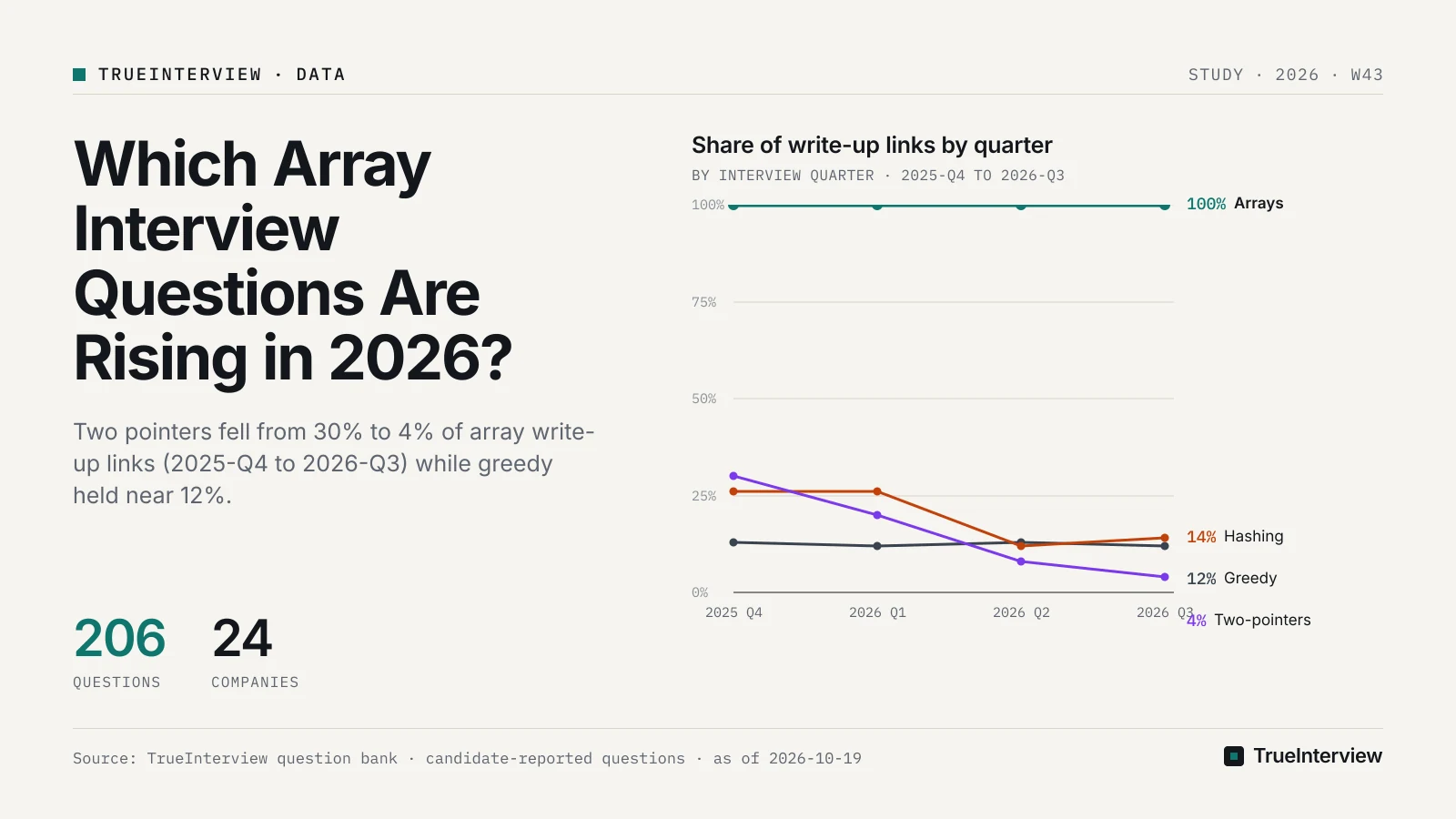
Measured as a share of write-up links per interview quarter, two pointers fell hardest, hashing dropped and then held, and greedy barely moved. The data is grouped by quarter, not by month, and the dated examples elsewhere on this page are single reports, not a monthly trend. Link totals grew from quarter to quarter mainly because more write-ups were collected, so compare the shares, not the totals.
| Topic tag, share of the quarter's links | 2025-Q4 | 2026-Q1 | 2026-Q2 | 2026-Q3 |
|---|---|---|---|---|
| Two pointers | 30% (7 links) | 20% (13) | 8% (6) | 4% (3) |
| Hashing | 26% (6) | 26% (17) | 12% (9) | 14% (12) |
| Greedy | 13% (3) | 12% (8) | 13% (10) | 12% (10) |
| All array links in the quarter | 23 | 66 | 76 | 85 |
Read the two-pointer line as direction, not as a collapse: the last two quarters rest on a handful of links, and a falling share of write-up links does not show that companies ask the topic less. The steadier signal is greedy, which kept roughly an eighth of the links in every quarter. Hashing also roughly halved its share, so in our view its place in your plan comes from the round data below, where it leads phone screens, rather than from this table.
Our take: on small counts, the shift argues for rebalancing rather than dropping anything. Greedy deserves a fixed slot every week, and two pointers should stay in rotation at its place in the round tables, not above it. Educative's course still lists "two pointers, sliding window, and prefix sums" as the common array patterns, and the technique remains worth owning. Keep it as a tool you can defend: the interview-prep-hub guide says of the two-pointer elimination argument, "Being able to state that is worth more than the code." The quarterly data covers tags only, so it cannot show whether company-titled problems are gaining ground; what it does show is that the most-linked list today mixes them with classics, which is why the first section matters as much as this table.
Which companies report the most array questions, and what does each lean on?
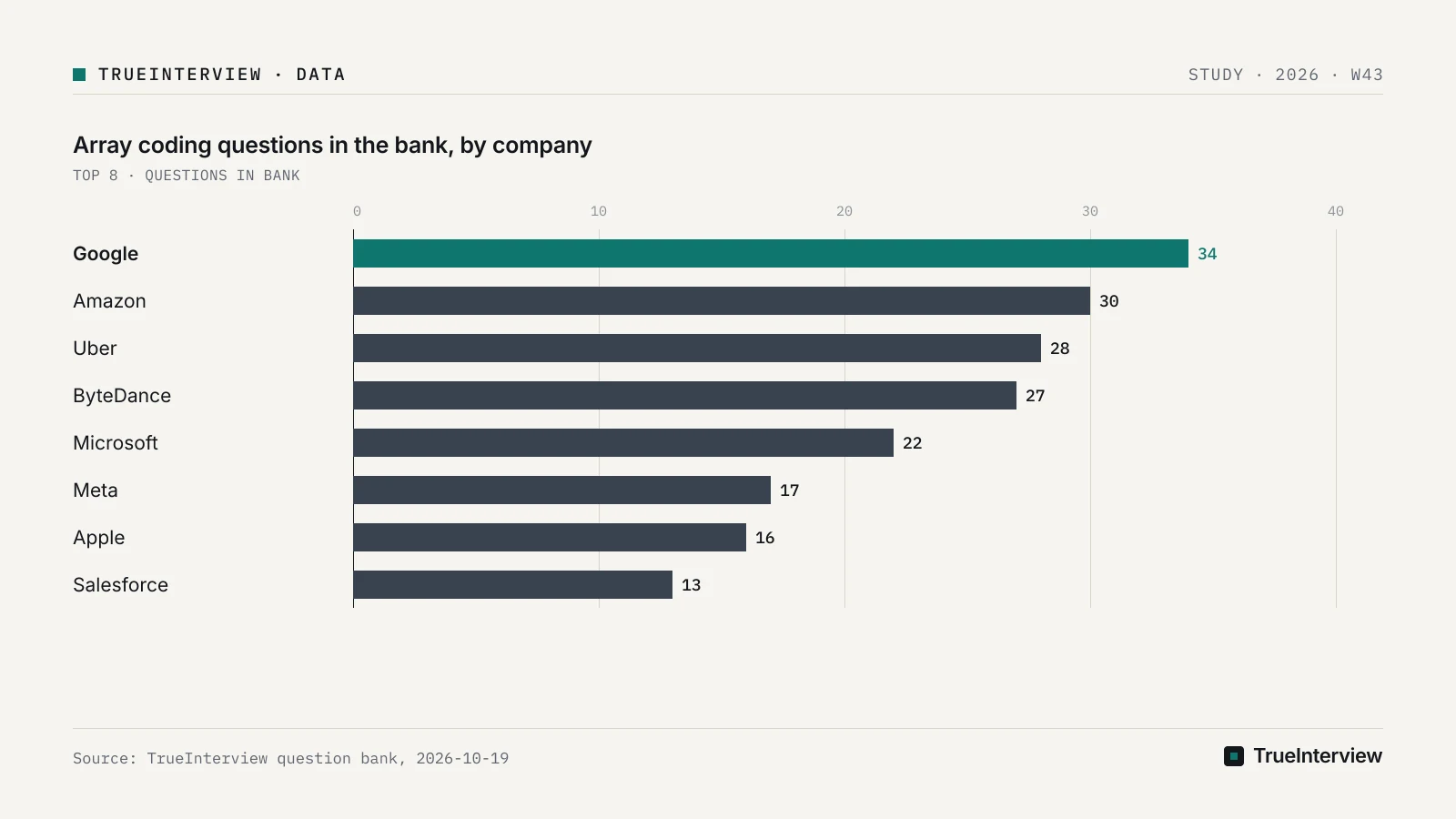
Google leads the bank with 34 array questions, followed by Amazon (30), Uber (28), ByteDance (27), Microsoft (22), Meta (17), Apple (16), Salesforce (13), Snowflake (9) and DoorDash (7). The second tag on each company's questions is the more useful number, because it tells you which pattern to drill after the array basics.
| Company | Most frequent tags after arrays | What to drill first (our view) |
|---|---|---|
| greedy (5), dynamic programming (4) | Greedy proofs, then one-dimensional DP over arrays | |
| Amazon | greedy (7), sorting (4) | Sort-then-greedy problems |
| Uber | two pointers (6), sorting (3) | Two pointers, despite the bank-wide decline |
| ByteDance | hashing (5), math (4) | Hash-map counting and prefix arithmetic |
| Microsoft | greedy (5), two pointers (3) | Greedy, with pointer problems second |
| Meta | hashing (4) | Hash lookups, including the In-Flight Movie Pair variant |
For the first week, drill only the top tag listed for your company. Uber is the exception to the two-pointer advice above: its own filings put two pointers first, so an Uber candidate should keep that drill high on the list. For Amazon and Google, greedy is the shared lean, which makes it the best single topic for anyone interviewing at both.
Which pattern should you drill for the OA, phone screen and onsite?
The round should set your first pattern, because the reported tags differ by stage. These questions were reported in phone screens 97 times, onsites 65 times and online assessments 61 times, and a question can appear in more than one round. Phone screens carry the most array questions, so they deserve the earliest practice.
| Round | Most frequent tags after arrays | A reported example |
|---|---|---|
| Online assessment | greedy (8), math (7), hashing (5) | Laser Grid Robot Max Safe Run, Databricks, 2026-09 |
| Phone screen | hashing (17), two pointers (13), greedy (11) | Random Pick with Weight, Meta, 2026-08; Split Stay Booking, Airbnb, 2026-02 |
| Onsite | binary search (11), two pointers (9), dynamic programming (7) | Median of Two Sorted Arrays, ByteDance, 2026-10 |
The decision rule follows directly. If your next round is an OA, weight extra time toward greedy and math. If it is a phone screen, weight it toward hashing and two pointers. If it is an onsite, add binary search and dynamic programming on top. These are the leading secondary tags, not the majority of each round's questions, so spend roughly half of each session on the round's leading tag and the rest on the most-linked questions for your company.
Worked example: an Amazon onsite in three weeks
Start from the Amazon filings: greedy (7) and sorting (4) lead Amazon's array questions, while onsite-round questions most frequently carry binary search (11), two pointers (9) and dynamic programming (7). In week one, take the three questions in the top list that are filed with Amazon and carry the most linked write-ups. In-Flight Movie Pair (Two Sum Variant) is linked from 8 write-ups at Amazon and Meta, and one report places it in an Amazon onsite in 2026-08. Trapping Rain Water and Drone Delivery on a Hub Ring are each linked from 7 write-ups, at Amazon and Meta and at Amazon alone.
For In-Flight Movie Pair, name the pattern before coding: the title says Two Sum variant, so the plan is a hash lookup of the complement, and you should be ready to explain why the table removes the nested scan. In week two, apply the Amazon lean and the onsite tags: a single-pass greedy classic such as Best Time to Buy and Sell Stock II, which the bank files under Amazon and six other companies, then Median of Two Sorted Arrays as a general binary-search drill; the bank files it under ByteDance, Google and Uber, not Amazon. In week three, rerun all five under a timer and state each invariant aloud before coding.
Is a question filed under many companies a good bet?
It is a useful signal, but a different one from linked write-ups. Filings measure how many companies a question has been reported at; linked write-ups measure how many detailed candidate write-ups point to it. Merge Intervals is filed under 12 big-tech companies in the bank, yet it is linked from 0 candidate write-ups. In our view, rank by linked write-ups first and use filings to break ties.
| Question | Companies it is filed under | Linked write-ups |
|---|---|---|
| Merge Intervals | 12 | 0 |
| Best Time to Buy and Sell Stock II | 7 | 4 |
| Trapping Rain Water | 4 | 7 |
| Sliding Window Maximum | 3 | 5 |
| Median of Two Sorted Arrays | 3 | 3 |
| Product of Array Except Self | 3 | 3 |
Our take: keep Merge Intervals in your review, since its breadth shows it has been reported widely, but give the full sessions to questions with linked write-ups. Trapping Rain Water is filed under a third as many companies and has the write-ups Merge Intervals lacks, so the write-ups tell you more about how candidates saw it asked. The absence of links may only reflect which write-ups are in the linked set.
Why do prefix sums with a hash map deserve their own session?
Because one of the two most-linked classics in the bank depends on them, and they are where a silent sliding-window error happens. Subarray Sum Equals K is filed under Apple, ByteDance and Meta. The trap is reaching for a sliding window when the input can hold negative numbers. The interview-prep-hub guide says that without monotonic validity "a sliding window is silently wrong."
PracHub's prefix-sum guide gives the reason in one line: "removing the left value can increase or decrease the sum" when negatives are allowed. The same PracHub guide advises you to "State the sign constraint before choosing." That sentence is the habit to build: before you pick a window or a prefix map, say out loud whether the values can be negative.
The prefix-hash version keeps a running sum and a map from each earlier prefix value to how many times it appeared, seeded with the empty prefix. At each position you look up the running sum minus the target, add that count to the answer, and only then record the current prefix. PracHub's guide says inserting after querying keeps an empty range from being counted by accident, and notes that storing only one index per prefix would undercount. For the longest subarray with sum k, PracHub's guide says to keep the earliest index for each prefix and never overwrite it. PracHub also advises deciding overflow behaviour up front, since a 32-bit input array can need 64-bit sums.
Our take: this one problem teaches three follow-ups an interviewer can ask: count, longest and overflow. Solve it with negative inputs, then solve the longest-subarray variant without looking at your first answer.
What do interviewers push on in an array question?
Prep guides point to three things to rehearse: the complexity upgrade, the correctness argument and the follow-up variant. The interview-prep-hub guide calls the hash lookup "the single most common improvement in interviews: trade memory for the rescan", and says each linear-scan pattern removes a specific redundancy from a nested loop. Before coding Subarray Sum Equals K or In-Flight Movie Pair, say which repeated scan your hash map removes.
One candidate's write-up on Medium reports that the interviewer wanted to know why a hash table reduces time complexity on Two Sum, asked what each variable represented as the loop progressed, and cared more about the thought process than a flawless solution. That is one person's report and not evidence about big tech, but it matches what the guides above tell you to rehearse.
Our take: at senior level the follow-up is where the round is decided. Expect the classic with a twist (a replacement allowed, a weight added, a bound on the difference) and state the invariant that still holds before you change the code. Edge cases belong in that statement: empty input, a single element, negative values and sums that outgrow the input type.
What changes at senior and staff level?
Senior candidates report array questions too, and their links lean toward sliding window and binary search. Write-ups link these questions 129 times from candidates who reported a senior, staff-plus or manager level and 148 times from junior, new-grad or intern candidates. Levels are what candidates reported on their own write-ups.
Sliding-window links split 16 senior-or-above to 9 junior-or-below, binary-search links 14 to 12 and math links 9 to 7, while strings (3 to 7) and backtracking (2 to 6) lean junior. Greedy leans junior as well, at 11 senior-or-above links to 23. If you are senior, add sliding-window and binary-search problems on top of the round-based plan.
| Question | Senior-or-above links | Junior-or-below links |
|---|---|---|
| Monster Duel | 4 | 2 |
| Contains Duplicate III | 4 | 2 |
| Longest Subarray with Bounded Diff | 4 | 1 |
| Random Pick with Weight | 4 | 1 |
| Trapping Rain Water | 3, one staff-plus or manager | 4 |
Some questions appear only in senior-or-above write-ups: Token Usage Calculation (3), Weighted Sampling from Unnormalized Probabilities (3, one staff-plus or manager) and Tree-Encoded Subtree Deletion and Stable Compaction (3). Staff-plus or manager write-ups link Trapping Rain Water, Weighted Sampling from Unnormalized Probabilities and Maximum Subarray Sum After K Concatenations.
Our take: the senior version of an array question is the classic with weighting, bounds or a repeat added, and you are judged on the invariant you state. In our read, weighted sampling is the idea behind Random Pick with Weight with the normalisation left to you; the bounded-diff window is a sliding window whose validity you must prove is monotonic.
Down-leveling note (our view): within the array evidence on this page, the level-leaning signals are the sliding-window and binary-search splits and the questions linked only from senior-or-above write-ups. If your loop's coding rounds are where level is judged, practise those variants until you can state the invariant and the trade-off against the simpler approach without prompting, such as why a prefix map beats a window when values can be negative.
Do ML and research candidates see different array questions?
Slightly, but the sample is small. Software engineers account for 240 of the write-up links and Machine Learning Engineers for 22. Comparing ML, AI, research and data-science candidates with software engineers, binary search takes 13% of links against 9%, and sorting 4% against 10%, on 24 and 248 links.
Random Pick with Weight and Monster Duel are each linked from 2 ML-side write-ups. With only 24 ML-side links, treat this as tentative: binary search shows the widest gap in the ML side's favour, so if you interview for an ML engineer role, an extra binary-search session is a cheap hedge.
How we counted
Counts come from TrueInterview's question bank as of 2026-10-19 and cover the array-tagged coding questions described above. A question can be filed under several companies and reported in several rounds, so tallies overlap. Write-up links count candidate write-ups that point to a question, split by the interview quarter, level and role each candidate reported; quarterly figures are shares of that quarter's links because totals track collection volume.
FAQ
Which array questions are big tech companies asking in 2026?
Candidates report a mix of classics and company-titled problems, led by the eight questions in the first table. Start with whichever of those your target company appears against, then add the next most-linked questions filed under that company. Treat every list, including this one, as candidate-reported practice material rather than an official company list, and re-check the dates, since the bank lists recent and often-reported questions first, according to TrueInterview's site.
Are classic LeetCode array problems still asked?
Yes, but they share the top of the list with company-titled problems. Trapping Rain Water and Subarray Sum Equals K are among the most-linked questions in the bank, and In-Flight Movie Pair says in its own title that it is a Two Sum variant. In our view, the other company-titled problems are best approached the same way: identify the pattern before coding. The practical answer is to learn each classic for the move it teaches, then practise reported variants so the move transfers when the title and story change. Once you can name the pattern, spend the next hour on a reported variant rather than another classic title.
Which array patterns matter most for coding interviews?
Hashing, greedy, two pointers and binary search are the tags that lead the round tables above, and prefix sums sit underneath Subarray Sum Equals K. The order depends on your stage: greedy for OAs, hashing for phone screens, binary search for onsites. Educative's course describes the two-pointer pattern as placing a pointer at each end and moving them toward each other based on a condition. That layout is worth knowing; in the round tables it ranks behind hashing in phone screens and behind binary search in onsites, so give it a share in line with those tables.
Do senior candidates get harder array questions than new grads?
They get different emphasis rather than a separate question set. Senior-or-above write-ups lean toward sliding window and binary search, and a few questions appear only in senior write-ups, as the senior section shows. In our view the bigger difference is the bar: a senior candidate is expected to state why the approach is correct, handle the twist without prompting and discuss trade-offs, not only reach a passing answer.
Are binary search questions worth separate practice?
Yes, if you have an onsite coming. Binary search is the most frequent second tag on onsite array questions and leans toward senior-or-above write-ups, so it carries more weight later in the loop and higher up the ladder. Practise it on arrays first, with Median of Two Sorted Arrays, reported in a ByteDance onsite, as a worked example, and say what the search space is and why the condition is monotonic before you write the loop.
How should I prioritise array practice for a specific company?
Open your target company's array questions and sort them by linked write-ups, not by how many companies share them. Practise the top three first, starting with any reported in recent months, then fill in the company's leading tag from the company table. On TrueInterview, coding questions are judged on hidden tests that show the case you failed, and every question has a reference solution, according to its comparison page.
Your practice plan
A three-week plan for someone working full time, about an hour on weekdays:
- Week one. Solve In-Flight Movie Pair (Two Sum Variant) and Trapping Rain Water. Before coding each one, write a line naming the classic pattern and a line stating why the approach is correct.
- Week one. Solve Subarray Sum Equals K with negative values in the input. Say out loud why a sliding window fails, then check that you query the map before inserting the current prefix.
- Week two. Pick the company-titled question that matches your target, such as Drone Delivery on a Hub Ring for Amazon, Find Robots Position for Uber or Monster Duel for OpenAI, and solve it as a timed phone screen.
- Week two. Drill the tag your next round leans on: greedy for an OA, hashing for a phone screen, or Median of Two Sorted Arrays for binary search before an onsite.
- Week three. If you are senior or above, add Contains Duplicate III, Random Pick with Weight and Weighted Sampling from Unnormalized Probabilities, stating the invariant before each change.
- Week three. Review a broadly filed classic such as Best Time to Buy and Sell Stock II or Sliding Window Maximum, then rerun any earlier problem where you could not explain correctness before writing code.
Sources
- TrueInterview question bank — array coding at big-tech companies — counted 2026-10-19
- Common Array Techniques for Coding Interviews — checked 2026-10-19
- Real FAANG Interview Questions by Company · TrueInterview — checked 2026-10-19
- The Core Interview Patterns | Algorithms | Algorithms — checked 2026-10-19
- Prefix Sum Interview Questions: Negative Numbers, Hash Maps, and Range Queries | PracHub Knowledge Hub — checked 2026-10-19
- Medium — checked 2026-10-19
- Interview prep compared: your application, end to end · TrueInterview — checked 2026-10-19
Last reviewed: 2026-10-19.