Arista · Study
Arista Networks Interview Process & Questions
TrueInterview
September 4, 2026 · 8 min read
Arista Networks keeps the algorithm problems easy to medium and spends the rest of each round on C and C++ fundamentals: pointers, object lifetime, memory layout and debugging. Once your code runs, the follow-up questions about it are the real test. Speed in the coding environment is graded too. One candidate solved both problems optimally and was still rejected for slow error reading and debugging under time pressure.
This guide breaks down each stage of the Arista Networks interview, what interviewers evaluate in each round, and how to prepare, with questions candidates were actually asked.
Verified: Based on 3 candidate-reported interview experiences, cross-checked against recent public accounts.
Arista Networks interview process
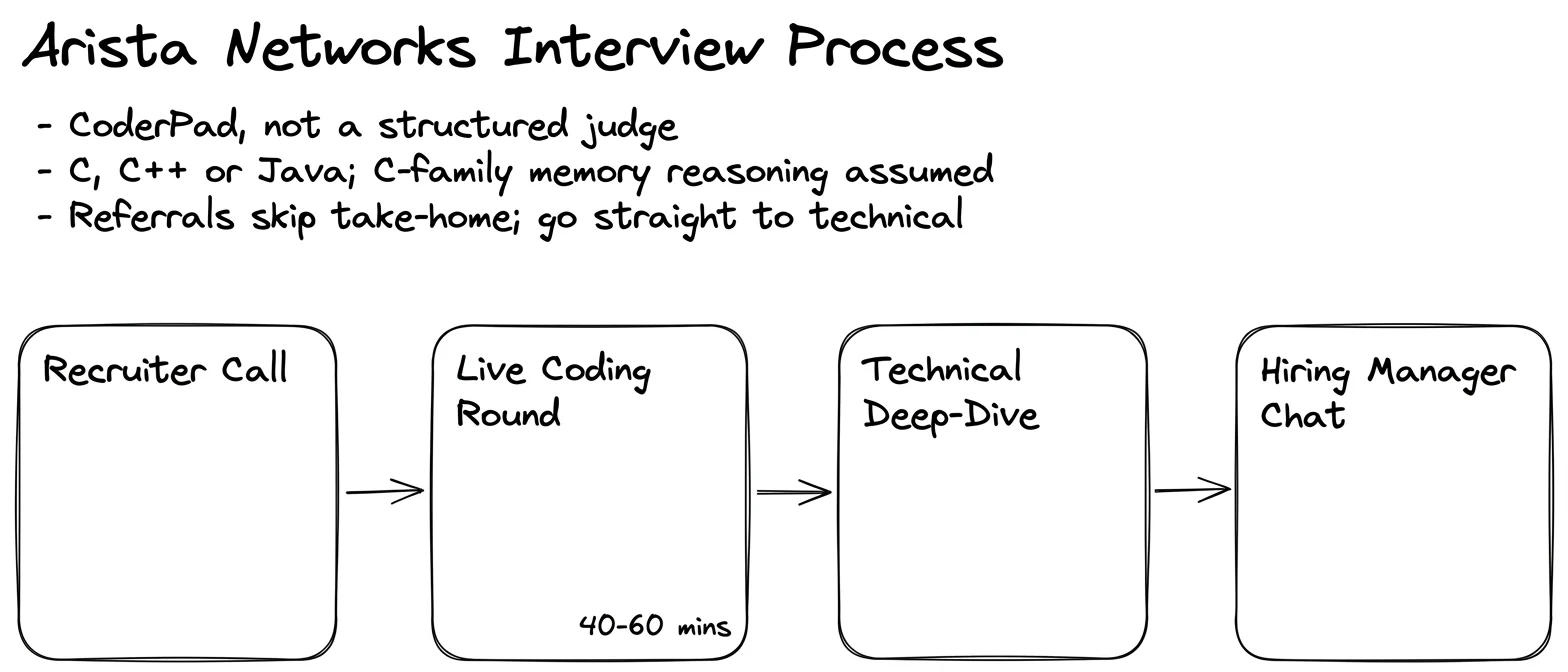
The hiring team sets the content, but every reported loop tested systems-level C++. Referrals are a common way in, and referred candidates went from the recruiter call straight to a live technical round, with no online assessment.
Reported loops ranged from one technical round ending in rejection to two rounds still in progress. Public accounts describe three to five rounds in total, with later rounds typically covering concurrency, operating-system and networking fundamentals, and a hiring-manager conversation. The language bar does not drop for junior candidates; senior candidates should expect more design and debugging discussion, not harder algorithms.
Here's what the interview process can look like:
- Recruiter screen: A short, non-technical call about background, team, location and timeline.
- Technical screen: A 40–60 minute live CoderPad session with one or two easy-to-medium problems, often mixed with rapid C or C++ fundamentals.
- Technical deep-dive: An implementation round, such as a generic container in C++, followed by detailed questions on every design and language choice.
- Later rounds and hiring manager (typically): Further coding and systems rounds, then a conversation about past work and team fit.
Tip: Practice where you write your own
main, compile, and read raw compiler and runtime errors. Candidates lost minutes to unfamiliar CoderPad output, and the delay counted against them.
Recruiter screen
Candidates describe a non-technical conversation about the role, team, location and timing, sometimes with visa status and an outline of the rounds. One applicant for a network-systems role in Vancouver went from this call directly to a single technical interview. Candidates consistently call the process professional and quick.
Interviewers look for:
- Systems background: Recent C, C++ or Linux work that matches the posting.
- Domain interest: Networking or embedded software rather than general application work.
- Logistics: Location, start date and work authorization.
Ask which language the technical rounds expect and whether the next call includes fundamentals questions.
Sample questions for the recruiter screen
Here are some questions reported by recent candidates:
- Walk through your background and how your current work maps to this role.
- Why Arista, and why networking software?
Technical screen
The screen is a live CoderPad session, typically 40–60 minutes. One report described two problems in 40 minutes with no introduction or resume talk; another opened with a five-minute introduction. You write the whole program, including the driver, and run it yourself, so failures show up as raw compiler or runtime output. C, C++ and Java are usually allowed, but follow-ups assume C-family memory reasoning.
The problems are approachable: palindrome validation that must handle both empty and null input, and a missing-number variant on a sorted array that starts at an arbitrary value, may have nothing missing, and must run in logarithmic time. Another screen paired C++ trivia with a depth-first search problem. A third asked what several printf calls print for a const char* holding a digit string (%s, %d, %c, with and without dereferencing), how to trace them in GDB, and then malloc versus new and the heap, stack, data and text segments. Complexity is asked after every solution.
Interviewers evaluate:
- Edge cases: A missed null check was treated as a defect, even with the empty-string case handled.
- Pacing: Two problems in about 40 minutes was not enough. A secondhand account describes a rejection after finishing in 30 minutes when about 20 was expected.
- Debugging fluency: Reading unfamiliar errors quickly and fixing them without a hint.
- Unprompted optimization: Moving from the summation solution to binary search and stating complexity without being asked.
- Memory model: What a format specifier does with a pointer versus a character, and where each kind of data lives.
Solve easy and medium problems in plain C++ in under 15 minutes each, guarding null and empty input first.
Note: Interviewers are patient and hint early, but rounds that needed hints still ended in rejection. Hint-free execution is the expectation.
Sample questions for the technical screen
Here are some questions reported by recent candidates:
-
Check whether a string is a palindrome, handling both an empty string and a null input.
-
Find the missing number in a sorted array with an arbitrary start and possibly none missing, in O(log n).
-
Explain the output of several
printfcalls on aconst char*, then show how to inspect them in GDB.
Technical deep-dive
This round sets Arista apart. In one report the task was a generic stack in C++, and the interview began once it worked: new versus malloc, the new operator versus placement new, and whether top() should return T&, const T&, T or T&&. A lifetime follow-up asked what printing a reference from top() does after pop(). The answer is a dangling reference and undefined behavior, because pop() destroys the element. The round closed on calling conventions: where arguments and return values live during a call.
Earlier accounts show the same style with other material, including a snippet whose out-of-bounds write looped forever instead of crashing, and linked-list and matrix-construction warm-ups. The questions get harder with each answer rather than moving on.
Interviewers evaluate:
- API justification: Returning
T&orconst T&as standard containers do, and why the alternatives are worse. - Object lifetime: What
pop()destroys, when references dangle, and raw allocation versus construction. - Low-level mechanics: Stack frames, argument passing and return-value placement.
- Undefined behavior: Why a memory bug can silently corrupt nearby state instead of faulting.
Rebuild a small container from scratch and defend every signature out loud.
Tip: After each practice implementation, ask who owns each piece of memory and what happens if a caller keeps a reference too long. That is where this round's follow-ups go.
Sample questions for the technical deep-dive
Here are some questions reported by recent candidates:
-
Implement a generic stack in C++, then justify the return type of
top()and the allocation strategy. -
After taking a reference from
top()and callingpop(), explain what printing the reference does. -
Explain why an out-of-bounds write in a short snippet causes an infinite loop rather than a segmentation fault.
Later rounds and hiring manager
None of the reported candidates reached this stage. Public accounts describe three or four virtual rounds that typically cover coding with concurrency (threads, deadlocks, sometimes a smart pointer), operating-system and networking fundamentals, and low-level design, ending with a hiring manager who covers past projects and fit. Some describe the expected C style as closer to C98 than modern C++: raw pointers, bitwise operations, packing bytes into wider integers.
Interviewers look for:
- Concurrency basics: Locks, deadlock conditions and safe shared state.
- Systems fundamentals: Processes, memory, and the Linux tools you would debug with.
- Networking awareness: Layer 2 and Layer 3 concepts, a plus rather than a requirement.
- Ownership: Projects you designed, tested and debugged end to end.
Review threading primitives, bit manipulation and Linux debugging alongside your project stories.
How Arista Networks makes hiring decisions
Any round can end the process. Two of three reported candidates were rejected after their first technical round, by email within a few days. Feedback given on request was specific: more fluency reading errors and debugging under time pressure. A correct answer that came slowly or needed hints is not enough. The hiring manager and team typically decide, and level follows experience.
How to prepare for the Arista Networks interview
- Code in a bare environment: Write
main, compile and run in CoderPad or a terminal until raw errors cost seconds. - Aim to finish early: Target 15–20 minutes per easy or medium problem and leave the rest for follow-ups.
- Guard null and empty first: Say and write the edge-case checks before the main logic.
- Offer the better complexity: Ship the simple solution, state its cost, then propose the logarithmic version.
- Know C++ object lifetime cold: Placement
new, destructor timing, dangling references, accessor return types. - Refresh memory layout: Process segments,
mallocversusnew, format specifiers and pointer arithmetic. - Debug out loud: Explain what GDB or a trace print would show, because debugging is graded on its own.
About working at Arista Networks
Arista builds data-center, campus and AI-cluster networking around EOS, a single Linux-based operating system image that runs across its switches and routers. Engineers own features from specification and test plans through automated tests and customer-issue debugging. The company describes its management as flat and engineer-led.
Arista Networks hires software engineers across its systems and product lines. Teams include:
- Network Systems (EOS): Routing and switching features and protocols, mostly in C and C++.
- Platform: Hardware bring-up and drivers for new switch platforms.
- Diagnostics: Software that validates and troubleshoots hardware.
- Campus wired and wireless: Campus switching and Wi-Fi access points.
- SD-WAN: The VeloCloud portfolio acquired in 2025.
Experience and education requirements
Postings ask for a degree in computer science, electrical engineering or computer engineering. Mid-level roles typically want two to three or more years of post-graduate experience; some Vancouver roles target one to three. Required skills are C, C++ and/or Python with UNIX or Linux; routing protocols (OSPF, BGP, IS-IS) and Layer 2 features are preferred.
FAQs about the Arista Networks interview
How long does the Arista Networks interview process take?
Typically a few weeks. Rejections arrived within a few days of a technical round.
What is the hardest round of the Arista Networks interview?
The technical deep-dive. The implementation is familiar, but each answer on lifetime, allocation and calling conventions leads to a harder question.
Is there an online assessment?
None was reported. Referred candidates went straight from the recruiter call to a live CoderPad round.
Which language should I use?
C or C++. Java is sometimes allowed, but the fundamentals questions assume C-family memory knowledge.
How much does an Arista Networks software engineer make?
Recent Santa Clara postings list new-hire base pay of about $119K–$148K for a hardware-tools software engineer, $128K–$200K for diagnostics software, and $140K–$210K for senior and lead network-systems roles. Some roles add a discretionary bonus and equity.