Airbnb · Study
Airbnb Software Engineer Interview Process
TrueInterview
July 24, 2026 · 14 min read
Airbnb grades coding on whether the program runs. Screens and onsite coding rounds expect a complete solution that executes against the stated cases, plus test cases you write yourself and a complexity analysis; candidates with the right idea but unfinished or untested code were rejected. The onsite also has two rounds most companies skip: a code review of one to four pull requests, and one or two non-technical core values interviews weighed in the same decision as coding.
The decision often turns after the technical rounds: several candidates cleared every coding round and lost on how their past work matched the team, judged in the project deep dive and the hiring manager conversation. This guide breaks down each stage of the Airbnb Software Engineer interview, what interviewers evaluate in each round, and how to prepare, with questions candidates were actually asked.
Verified: Based on 41 candidate-reported interview experiences, primarily from 2025 Q4 through 2026 Q2, cross-checked against recent public accounts.
Airbnb Software Engineer interview process
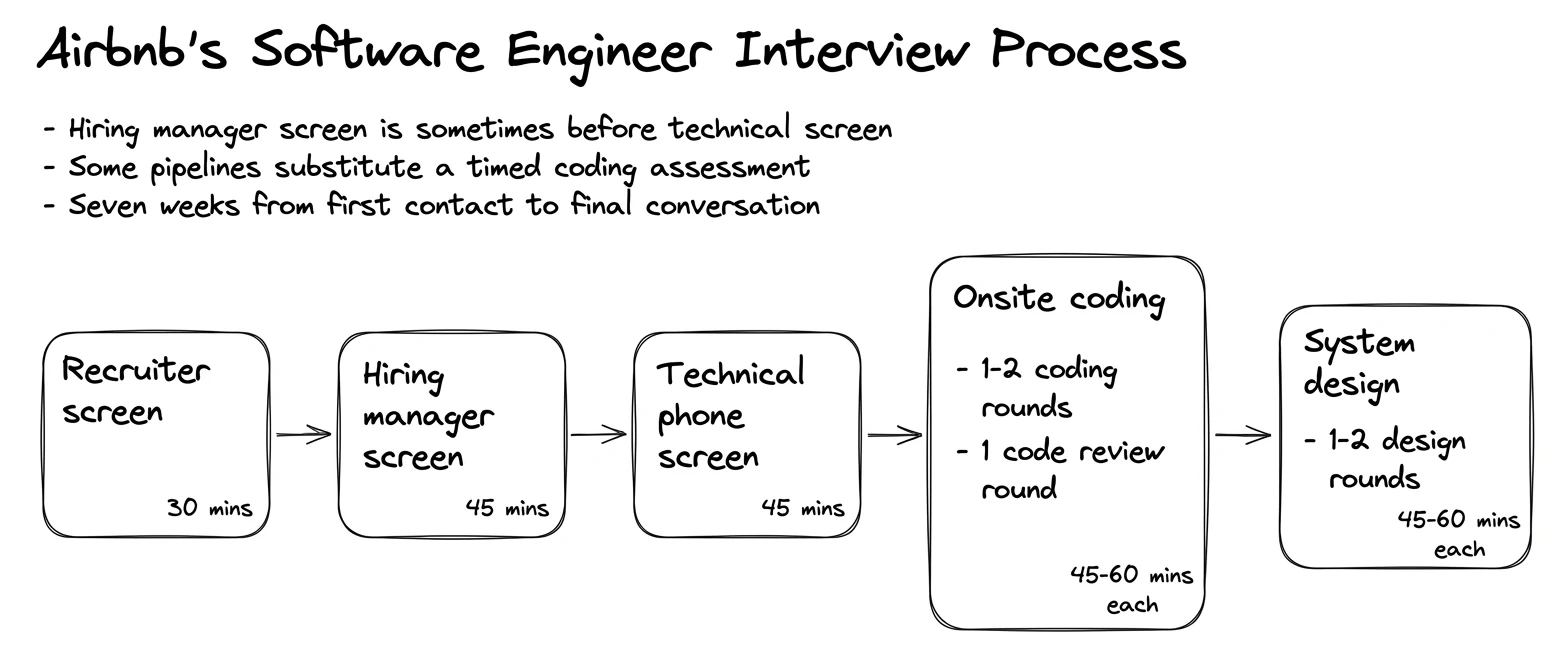
Airbnb hires Software Engineers into specific teams, and the hiring manager's view of your background carries real weight. The common shape is a recruiter call, one to three phone rounds and a virtual onsite of four to six sessions; with prep calls and team match, senior candidates counted eight to ten conversations over about seven weeks.
Nearly every report is from a mid-level or senior candidate. Senior loops move system design into the phone stage, add a second design round and expect depth one candidate called staff level. Some pipelines open with a timed online assessment instead of a live screen.
Here's what the interview process can look like:
- Recruiter phone screen: About 30 minutes on background, team, level and the pipeline.
- Hiring manager screen (some teams): Past projects and how they map to the team, sometimes before any coding.
- Technical phone screen (one to three rounds): 45 to 60 minutes on one practical problem in a shared editor, run and tested live.
- Coding interviews (one or two): Hour-long onsite rounds on scenario or class-design problems that must execute.
- Code review interview: One to four pull requests in Python or Java, graded on which defects you find and how you rank them.
- System design interview (one or two): Marketplace prompts such as booking, chat, notifications and waitlists.
- Past experience deep dive: One project from your resume examined in detail.
- Core values interview (one or two): Personal questions about hosting, belonging and why Airbnb.
- Hiring manager and team match: Behavioral questions and a two-way conversation about the team.
Tip: Plan each coding hour as core logic first, tests second, polish last. Two candidates lost their screens by polishing a trivial helper early and then rushing the main function and its tests.
Recruiter phone screen
A short call covers your background, what you want next, the level band (reports name G9 and senior targets) and the rounds ahead. Recruiters often return between stages with screen feedback, and some hold a prep call before the final rounds that explains what the hiring manager and values interviewers look for, with sample questions.
Interviewers evaluate:
- Specific motivation: A reason for Airbnb and this team, not a generic interest in travel.
- Level fit: Years and scope of past ownership consistent with the band discussed.
- Timeline transparency: One recruiter sped up the process for a candidate who raised a competing offer.
- Headcount status: Which team owns the role and whether it is still open.
Ask early which team owns the role and whether the headcount is still open.
Note: Two candidates in one office passed every round and were not hired because the position had been filled; both were placed in a talent pool for a year. Elsewhere a team match call was added late after headcount shifted.
Sample questions for the recruiter phone screen
Here are some questions reported by recent candidates:
- Walk me through your background and what you are looking for next.
- Why Airbnb, and why this team?
Technical phone screen
The screen is 45 to 60 minutes in a shared editor that runs code. One problem fills the block: clarify, explain, implement, run, write a small test suite in the editor, and analyze complexity. Some candidates had two or three phone rounds, one of them a background conversation with the hiring manager. One senior candidate who got a complexity bound wrong was given an extra round to make up for it.
Problems are practical and many recur: merging accounts that share an email or phone, parsing a query string with repeated keys and a provided percent-decoding function, splitting a stay across two listings, the smallest digit permutation at or above a bound, scoring connected regions of a board game grid, printing sentences in a bordered fixed-width table and the fewest items that exactly spend a gift card, returning the items. Some screens are class design: a retry mechanism with pluggable backoff, or a banking class with transaction history.
Pipelines with an online assessment send several timed problems at once: refund allocation by recency, a maximum-score path in a directed graph, cheapest menu combos covering a wish list, maximum-profit job scheduling and a terrain water-flow simulation. Live-screen results took more than a week for some.
Interviewers evaluate:
- Bug-free, running code: One candidate failed a split-stay screen with partial logic that missed given cases.
- Your own tests: Empty input, impossible targets and ties between equally good answers, written in the editor.
- Clean decomposition: A candidate who got an offer felt modular code offset minor runtime errors.
Practice the recurring parsing, interval and knapsack problems until each runs with tests in 35 minutes.
Sample questions for the technical phone screen
Here are some questions reported by recent candidates:
-
Parse a query string so repeated keys collect a list and valueless keys map to an empty string, then add percent-decoding so encoded separators stay literal.
-
Given accounts as lists of phones and emails, return the indices of all accounts linked through any shared value.
-
Given digits and a lower bound, return the smallest permutation at least the bound, or empty if none exists.
Coding interviews
The onsite has one or two hour-long coding rounds under the same rule. Problems fall into marketplace scenarios (split stays, menus, layovers, cascading bookings), classics with a twist (search in a rotated sorted array, intersection of two linked lists that may each contain a cycle, pouring water on terrain, removing digits for the smallest number), and class design with an algorithm attached (a round-robin iterator over stream types built with inheritance, nested boxes with keys and candies, a configurable Connect Four board, a cell store where cells hold sums of others).
Follow-ups change the problem rather than replace it: account deduplication from two attributes to any number, diagonal spread in a grid infection simulation, multiple skiers on a best-ski-run search, and a cell store optimized for frequent writes by marking dependents dirty and computing lazily.
Interviewers evaluate:
- The optimal method when it matters: A greedy answer to maximum-profit scheduling fell short; dynamic programming was expected.
- Committing to an approach: A candidate who switched from depth-first to breadth-first search mid-implementation ran out of time for tests and named that as the reason for rejection.
- Class structure before algorithm: Members, interfaces and edge rules settled first on design-flavored prompts.
- Systematic cases: The linked-list problem has four structural cases, each needing linear time and constant space.
Practice union-find, topological sort, grid search, interval coverage and unbounded knapsack inside scenario wrappers, each finished with tests in 40 minutes.
Note: Passing every test is not enough on design-flavored problems. A candidate whose box-and-candy solution passed all tests was rejected because the class model did not match what the interviewer intended; asking about nesting, key rules and signatures first would have surfaced it.
Sample questions for the coding interviews
Here are some questions reported by recent candidates:
-
Determine whether two singly linked lists intersect when either may contain a cycle, in linear time and constant space.
-
Implement a store where a cell holds a value or the sum of other cells, keep dependents correct, and optimize for frequent writes.
-
Decide whether repeatable activities of given durations can exactly fill a layover, then return the fewest that do.
Code review interview
You read prepared code as a pull request and leave comments; nothing is written from scratch. Candidates choose Python or Java, and several picked Python because more preparation material describes it. Material ranges from one feature block to three or four diffs; one candidate reviewing four Java pull requests completed three, with comment quantity and quality both watched. It is usually onsite, occasionally a phone round.
Planted defects lean toward production reliability: wrong results without a crash, exceptions swallowed without logging, null returns the caller never checks, race conditions on shared mutable state, no error handling around an external API call, and a quadratic loop hidden in a list comprehension.
Interviewers evaluate:
- Severity ordering: Correctness first, then design, then style; nits before the race condition read poorly.
- Explaining impact: Why each defect matters in production and what input triggers it.
- Concrete fixes: A suggested change, not just a flag.
Rehearse reviewing production-style Python or Java under a timer, with one-line comments naming defect, impact and fix.
Tip: Candidates who ran mock reviews with a colleague called this their strongest round. Go through each diff once for correctness and concurrency before writing any style comment.
Sample questions for the code review interview
Here are some questions reported by recent candidates:
-
Review three pull requests and find the silent failures, swallowed exceptions, unchecked nulls and unsafe shared state.
System design interview
Mid-level loops typically have one design round and senior loops two, each an hour of discussion without code; a distributed key-value store has also appeared as a senior phone screen, pushed toward CAP trade-offs, consistent hashing and vector clocks. Prompts stay close to the business: booking with availability search, double-booking prevention, pagination and indexing; group chat with presence, read receipts and a top-N most active chats view; a unified notification platform; a waitlist; a host dashboard serving 100+ listings; the homepage backend with ranking signals; and a job scheduler for about ten million users.
The notification prompt is specific: one pipeline for event-triggered messages (a booking confirmation, a lock code by SMS on check-in morning) and batch campaigns to prospective hosts, for guests, hosts and employees, over SMS, push, email and social posts. A design round is sometimes added after the onsite; one candidate's extra round on a support ticketing system, with agent claim rules by language and location and first-response metrics, decided the outcome.
Interviewers evaluate:
- Scoping early: A candidate asked for an in-memory SQL database tried to cover everything and ran out of time.
- Collaborative pacing: One senior candidate chased perfection on the chat schema instead of aligning on trade-offs, and was rejected.
- Domain correctness: Double-booking under contention, idempotent refunds, delivery guarantees.
- Data modeling: Schemas and indexes that make the stated queries cheap, including top-N and time-and-location filters.
Practice the marketplace prompts above, opening each with a two-minute requirements agreement.
Sample questions for the system design interview
Here are some questions reported by recent candidates:
-
Design one notification platform for instant event-triggered messages and scheduled bulk campaigns across four channels.
-
Design group chat, then serve the top N most active group chats over a configurable window.
-
Design a waitlist with APIs to join, check position and leave, notifying people when spots open under high contention.
Past experience deep dive
One interviewer, often a senior engineer, takes one or two resume projects apart: motivation, how you persuaded cross-functional stakeholders, success metrics, a specific conflict, rejected alternatives and what you would change. One interviewer focused on product thinking and user impact over implementation.
Interviewers evaluate:
- Scope of ownership: What was yours versus the team's, and whom you influenced outside your group.
- Concise framing: One senior candidate spent over 20 minutes on background and lost the follow-up time.
- Measured impact: Numbers behind the outcome.
- Fit with the team's problems: Several rejected candidates believed this round surfaced a background mismatch.
Prepare a ten-minute version of your widest cross-team project and let the interviewer steer.
Sample questions for the past experience deep dive
Here are some questions reported by recent candidates:
-
Why did the project start, and how did you get stakeholders to commit?
-
Describe a conflict during the project, and which alternatives you would choose now.
Core values interview
One or two values conversations with no technical content. Questions are personal: why Airbnb, travel, experiences as a guest or host, a time you hosted something, hard feedback, a calculated risk, mentoring, working across time zones, and the biggest challenge Airbnb faces today. Candidates mapped answers to values such as being a host, embracing the adventure and championing the mission. The tone is relaxed; the evaluation is real.
Interviewers look for:
- Authenticity: Specific, honest stories; recited value names read poorly.
- Hospitality instincts: Making others feel welcome, at work or outside it.
- Mission connection: A personal reason the product matters to you.
- Growth from feedback: What you changed after hearing something difficult.
Prepare five or six short stories, at least one from outside work, each mapped to a value.
Sample questions for the core values interview
Here are some questions reported by recent candidates:
-
Tell me about a time you were a host, at work or outside it.
-
What do you think is the biggest challenge Airbnb faces today?
Hiring manager interview and team match
The hiring manager screens early or appears in the onsite, mixing resume review with behavioral questions on cross-team collaboration, an incident's root cause and scoping a project to a deadline. Some candidates were matched to a team before the onsite; others had a match call added after headcount moved. Candidates asked about org structure, the senior-to-staff ratio and the path to staff.
Interviewers evaluate:
- Background match: Whether your recent work maps onto the team's problems; several rejections cited this alone.
- Ownership under ambiguity: How you re-planned when requirements moved.
- Root-cause rigor: A real incident traced to cause and fix.
Bring team-specific questions and two stories on collaboration and incidents.
How Airbnb levels and evaluates Software Engineer candidates
Feedback from every round, values included, is pooled into one hiring decision, and strong design performance is repeatedly named as what carries a packet. The level is set before the onsite and design depth rises with it. Clearing the coding rounds is necessary but not sufficient: candidates who solved every problem were rejected on background match or project scope, and others lost a borderline packet in an added design round. Candidates who did not advance were told to wait a year before reapplying.
How to prepare for the Airbnb Software Engineer interview
- Make every solution run: Practice in an editor that executes code, core logic before helpers, with ten minutes left for your own tests.
- Drill the recurring families: Query-string parsing, account merging, split stays, bounded digit permutations, board scoring, text tables and knapsack variants that return the chosen items.
- Treat class-design prompts as design first: Settle classes, signatures and edge rules aloud before the algorithm.
- Rehearse the code review: Timed Python or Java diffs, ranking correctness and concurrency above style.
- Practice marketplace designs: Booking, group chat, unified notifications, waitlists and read-heavy listing pages, scoped in five minutes.
- Compress your best project to ten minutes: Motivation, stakeholders, metrics, a conflict and rejected alternatives, from your widest-scope work.
- Write honest values stories: Hosting, hard feedback, a calculated risk and why Airbnb, one from outside work.
- Confirm headcount early: Ask which team owns the role and whether it is still open.
About the Airbnb Software Engineer role
Airbnb Software Engineers build the marketplace for stays, experiences and services on a service-oriented backend, in small product teams with design, product and data science. Teams own their areas end to end, and engineers review each other's code in the way the code review interview mirrors. Under the Live and Work Anywhere policy most employees can work remotely, with offices used for in-person collaboration.
| Level | Primary focus | Impact scope |
|---|---|---|
| G7 (Software Engineer) | Well-scoped features with guidance | Components within one team |
| G8 (Software Engineer) | Moderately complex features delivered independently | A team's services |
| G9 (Senior Software Engineer) | Leading meaningful projects and mentoring | A team and its partners |
| G10 (Staff Software Engineer) | Technical direction across several teams | An organization's systems |
| G11 (Senior Staff Software Engineer) | Architecture across organizations | Multiple organizations |
Airbnb hires Software Engineers across the product and platform. Teams include:
- Search: Ranking, the search feed and the homepage.
- Pricing and Availability: Calendars, availability and pricing tools for hosts.
- Payments: Pay-ins, payouts and refunds.
- Community Support: Ticketing, routing and AI-assisted customer support.
- Communication and Connectivity: Messaging and notification systems connecting guests, hosts and Airbnb.
- BizTech and internal platforms: Business systems and engineering automation.
Software Engineer experience and education requirements
Postings ask for strong fundamentals in data structures, algorithms and design patterns, listing languages such as Java, Scala, Ruby, C++, JavaScript and SQL. New-graduate roles target recent degree holders; senior roles expect several years building production backend or full-stack systems. You choose the interview language.
FAQs about the Airbnb Software Engineer interview
How long does the Airbnb Software Engineer interview process take?
Usually four to eight weeks; one senior candidate measured about seven. Screen feedback alone took over a week for some, and a competing offer shortened the process for another.
What is the hardest round of the Airbnb Software Engineer interview?
System design and the past experience deep dive decide the most outcomes: design punishes poor scoping and unfamiliar domains, and the deep dive is where scope and fit are judged. Coding is hard to pass with untested code but rarely sinks an offer alone.
Is there an online assessment?
Not for most candidates, who start with a live screen. Some pipelines first send a timed set of scenario-based algorithm problems.
How much does an Airbnb Software Engineer make?
Recent United States postings for Senior Software Engineer list base salaries of roughly $185K to $223K, and a mid-level remote platform posting listed $165K to $180K. Packages add equity, and may add a bonus and travel credits.
What language should I use?
Any mainstream language. Candidates favored Python and Java for concise syntax under a 45-minute clock, and the code review offers Python or Java.