Airbnb · Study
Airbnb Machine Learning Engineer Interview Process
TrueInterview
July 31, 2026 · 11 min read
Airbnb's Machine Learning Engineer loop is decided in the ML system design rounds, not the coding rounds. A candidate whose coding went well was still rejected on design depth, and a borderline design signal earns another design round rather than a pass. Prompts come from the marketplace itself: search ranking, listing lifetime value, relisting, cover photos. Every report also includes a core values conversation that turns personal and counts in the decision.
This guide breaks down each stage of the Airbnb Machine Learning Engineer interview, what interviewers evaluate in each round, and how to prepare, with questions candidates were actually asked.
Verified: Based on 3 candidate-reported interview experiences, primarily from 2026 Q1 through 2026 Q2, cross-checked against recent public accounts.
Airbnb Machine Learning Engineer interview process
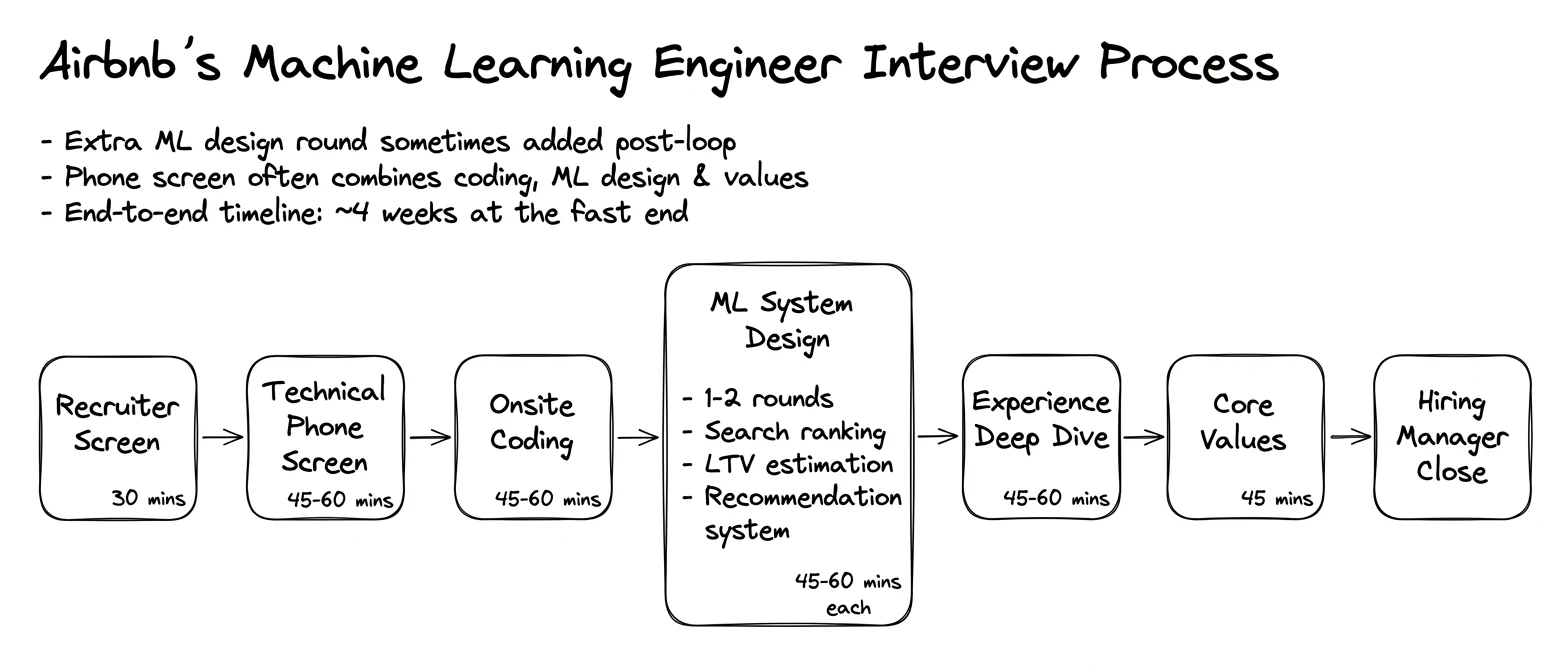
The loop is run by the hiring team and its shape depends on team and level. A full loop is a phone screen and a virtual onsite of five or six rounds: one coding round, one or two ML system design rounds, an experience deep dive, core values, and a hiring manager conversation. A referred candidate went from application to decision in about four weeks, including a design round added after the screen.
The phone screen varies most: a single coding problem for some, coding plus two ML design prompts and values questions for others. At Senior (G9) and above, design carries more weight, and recent senior loops added ranking and retrieval prompts around generative-AI support tools.
Here's what the interview process can look like:
- Recruiter screen: Background, target level, team area and timeline.
- Technical phone screen: Live coding with your own tests, sometimes followed by ML design and values questions.
- Coding interview (onsite): One practical problem as complete running code.
- ML system design interviews (one or two, sometimes more): Open-ended marketplace prediction problems designed end to end.
- Experience deep dive: One past ML project examined for decisions, trade-offs and scope.
- Core values interview: A non-technical conversation about Airbnb's values and what you care about.
- Hiring manager conversation: The team's problems and how your background fits them.
Tip: Rehearse one ML design skeleton until it is automatic: decision supported, label, data, features, model, offline and online metrics, serving, experiment. A rejected candidate traced the outcome to jumping straight into model ideas.
Technical phone screen
The screen is a live session with an engineer in a shared editor. The coding is practical: fixed-width string formatting that extends to a multi-column layout, a key-value store whose follow-up was writing the test cases, and filling a layover with the fewest repeatable activities. A candidate who used depth-first search with memoization and early pruning was credited for explaining the pruning before coding.
For this track the screen can continue past the coding. One referred candidate moved straight into two ML design prompts (a listing's cover photo to lift bookings, and finding high-quality listings) and then personal values questions in the same call.
Interviewers evaluate:
- Running code: A complete program that executes, not pseudocode with gaps.
- Stated strategy: Memoization, pruning or data layout explained before typing.
- Test design: Your own boundary cases, especially when the follow-up is about tests.
- Adaptability: Extending a single-column formatter to multiple columns without a rewrite.
- Fast design framing: If design is added, a target variable and cold-start plan within minutes.
Practice formatting, exact-fill and small-store problems as full programs with a test list, and keep a two-minute design opener ready.
Sample questions for the technical phone screen
Here are some questions reported by recent candidates:
-
Format text into lines of a fixed width, then lay the same content out across several columns.
-
Given activity durations that may repeat, find the fewest activities that exactly fill a layover window.
-
Implement a key-value store, then specify the test cases you would write against it.
Coding interview
The onsite has one coding round with the same bar as the rest of Airbnb engineering: code that runs, your own tests, complexity at the end. Problems are domain-flavored: the cheapest way to buy a wanted item set from priced menu bundles (a bitmask over items, dynamic programming over bundles), the phone-screen key-value store with added constraints, and a document-redaction exercise in recent senior loops.
Interviewers evaluate:
- Problem modeling: Recognizing that a small item set calls for a bitmask state before writing any loops.
- Correctness first: A working baseline before optimizing; unfinished main logic is a failing result.
- Extensibility: Adding the second set of constraints to a store without a rewrite.
- Verification: Running the code against cases you wrote yourself, including empty and impossible inputs.
Drill subset dynamic programming and small in-memory stores until each takes about 30 minutes including tests.
Sample questions for the coding interview
Here are some questions reported by recent candidates:
-
Given menu bundles with prices and the items each contains, find the cheapest way to get every item on a wanted list.
-
Extend the phone-screen key-value store with additional constraints and show how the tests change.
ML system design interviews
Full loops have had two ML design rounds, and one candidate got an extra one after a combined screen. Prompts are broad and come from Airbnb's product: search ranking end to end, a property's lifetime value, a recommendation system, relisting detection tied to online metrics, and ranking home search results with no text query. The rounds are conversations without code, and the first minutes of scoping are graded.
Interviewers steer firmly. One lifetime-value round defined the label first, then moved from regression to bucketized classification; a relisting round went into geohashing; search ranking rounds pushed on latency, freshness and experimentation. Treat a redirection as a hint about the expected answer and restate the narrower scope before going on.
Interviewers evaluate:
- Problem framing: The business decision the model supports and the success metric, before any model is mentioned.
- Label definition: What lifetime value or listing quality means and over what time window.
- Data and features: Concrete marketplace signals such as reviews, host responsiveness, booking completion, photos and location encodings.
- Offline-to-online link: How an offline metric predicts the online result, and how an A/B test would confirm it.
- Production behavior: Candidate generation, latency, freshness, cold start for new listings, and monitoring.
Practice six Airbnb-shaped prompts out loud with the same skeleton every time, ending each with an experiment plan.
Note: A strong coding performance does not offset a weak design. A candidate who felt the coding went well was rejected after the added design round, and the feedback named design depth specifically.
Sample questions for the ML system design interviews
Here are some questions reported by recent candidates:
-
Design Airbnb search ranking, from candidate generation through offline and online evaluation and deployment.
-
Estimate the lifetime value of a property, after first agreeing on what lifetime value means here.
-
Design a relisting system, including how its outputs show up in online metrics and how geohashing helps.
-
Pick a listing's cover photo to raise its booking rate, including cold start for new listings.
-
Generate Customer-Support Instructions from Company Policies
Experience deep dive
One round takes a single past project apart: architecture, your decisions, rejected alternatives, measured impact, and what you would change. The tone is conversational but thorough, and scope is scored separately from modeling difficulty. Recent senior loops also asked about milestones and conflicts.
Interviewers evaluate:
- Ownership: The decisions you made personally, as distinct from the team's.
- Scope: Who used the system, which metric moved, and which teams you had to align with.
- Trade-off reasoning: Why you chose this model, feature set or serving path over the alternatives.
- Reflection: What failed, and what you would do differently with what you know now.
Choose a project with clear business reach and open with problem size and outcome.
Tip: A technically deep project that affected only a narrow area reads weaker than a simpler one with impact across teams. Open with the surface the project touched and the metric it moved.
Sample questions for the experience deep dive
Here are some questions reported by recent candidates:
-
Walk through one ML project end to end, covering the decisions that were yours and the impact you measured.
-
Describe the project's milestones, a conflict over scope, and how it was resolved.
Core values interview
The values round is non-technical, often run by an employee from outside the hiring team, and built around Airbnb's four values: Champion the Mission, Be a Host, Embrace the Adventure, and Be a Cereal Entrepreneur. Questions in this track are unusually personal: why Airbnb, the biggest problem facing the world, and a cause you support and what you do for it. Candidates found it relaxed and sincere, but it counts in the decision.
Interviewers look for:
- Authentic motivation: A real reason to work on travel and belonging, not a recited mission.
- Hosting behavior: Times you made someone feel included, gave hard feedback with care, or helped another team.
- Follow-through on what you care about: Specific actions behind a cause, not only an opinion.
- Rapport: One rejected candidate felt missing rapport weakened the overall signal.
Prepare three or four true stories, some from outside work, and map each one to a value.
Sample questions for the core values interview
Here are some questions reported by recent candidates:
-
What drew you to Airbnb rather than another company?
-
What do you think is the biggest problem facing the world today?
-
Tell me about a cause you support and how you contribute to it.
Hiring manager conversation
The final round is a relaxed two-way conversation about the team's current problems, your career direction and where your background fits, while the manager also judges scope and roadmap fit.
Interviewers evaluate:
- Fit with the team's problems: Linking your past work to the ranking, trust or support problems the team owns.
- Career direction: A clear view of the ML work you want next.
- Quality of your questions: Questions about the team's metrics, data and roadmap.
- Collaboration: How you worked with product, data science and infrastructure partners.
Read up on the team's area and bring three questions about its current problems.
Sample questions for the hiring manager conversation
Here are some questions reported by recent candidates:
-
What kind of ML problems do you want to own over the next few years?
-
How would your background help with the problems this team is working on now?
How Airbnb levels and evaluates Machine Learning Engineer candidates
Feedback is combined in a committee-style review, and the target level, such as G9 for Senior, is set before the loop. Design depth and past scope weigh most. On a mixed signal the team adds a round rather than deciding: one candidate was asked for another ML design round days after the screen. Team fit matters too; in a recent senior loop the original team declined, but the candidate was matched to another team. Rejection feedback in the reports pointed to design depth or overall match, never coding.
Tip: An added design round is a second look at your weakest signal, not a formality. Rework your design structure before it instead of repeating the same answers.
How to prepare for the Airbnb Machine Learning Engineer interview
- Drill one design skeleton: Decision, label, data, features, model, offline and online metrics, serving, experiment, used on every practice prompt; when an interviewer steers, restate the narrower scope and follow it.
- Practice Airbnb's own ML problems: Search ranking, ranking without a query, listing lifetime value, listing quality, relisting detection, cover-photo selection and recommendations.
- Know spatial and marketplace features: Geohashing, location buckets, review and host-responsiveness signals, and cold start for new listings.
- Connect offline to online: For every model, name the offline metric, the online metric it should predict, and the A/B test that confirms it.
- Write running code with tests: Practice subset dynamic programming, exact-fill search with memoization, text formatting and small key-value stores as complete programs.
- Lead the deep dive with scope: Open with who used the system and what moved, then go into model detail.
- Prepare personal values stories: A cause you support, a time you acted as a host, and a specific reason for choosing Airbnb.
About the Airbnb Machine Learning Engineer role
Airbnb ML engineers own models end to end, from features and training through deployment and online experiments, for batch and real-time systems. Postings stress training-serving skew, A/B testing, and feature and model selection. Shared infrastructure includes an internal ML platform and Chronon, Airbnb's open-sourced feature platform for consistent online and offline features.
| Level | Primary focus | Impact scope |
|---|---|---|
| G7–G8 (Machine Learning Engineer) | Well-scoped models and pipelines with guidance | Features and models within one team |
| G9 (Senior Machine Learning Engineer) | Owning a modeling area from framing to launch and experiments | A team's ranking, trust or support systems |
| G10 (Staff Machine Learning Engineer) | Technical direction across related ML systems | Several teams and shared platforms |
Airbnb hires Machine Learning Engineers across several orgs. Teams include:
- Relevance and Personalization: Search ranking, recommendations and query understanding across the platform.
- Trust and Safety: Fraud defense, reservation screening, party-risk prediction and property-damage risk.
- Community Support AI: LLM fine-tuning, retrieval, evaluation and guardrails for customer-support assistants.
- Pricing: Models behind pricing and host pricing tools.
- ML infrastructure: The ML platform and feature platform that other ML teams build on.
Machine Learning Engineer experience and education requirements
Mid-level postings accept a new ML or AI PhD, or two or more years of applied ML with a master's or bachelor's. Staff postings ask for about nine or more years, often with a master's or PhD. All ask for strong Python, Scala, Java or C++, data engineering skills, and neural network and optimization experience.
FAQs about the Airbnb Machine Learning Engineer interview
How long does the Airbnb Machine Learning Engineer interview process take?
The one reported end-to-end timeline was about four weeks from application to decision, with a few days between stages. It runs longer when a design round is added or another team match is needed.
What is the hardest round of the Airbnb Machine Learning Engineer interview?
The ML system design rounds: rejections in the reports were attributed to them explicitly, there can be two, and another can be added. The experience deep dive comes second, because the scope of past work cannot be improved during the interview.
How much does an Airbnb Machine Learning Engineer make?
Total compensation figures were not consistent enough to report by level. Airbnb's own postings list base pay of about $191K to $235K for Senior Machine Learning Engineers and about $252K to $315K for Senior Staff. Packages add bonus eligibility, equity and employee travel credits.
Is the interview remote?
Yes. Every reported onsite was held over video, and some roles are posted as remote under Airbnb's work-from-anywhere policy.