xAI · Study
SpaceXAI (formerly xAI) Software Engineer Interview Process
TrueInterview
July 24, 2026 · 14 min read
SpaceXAI, formerly xAI, judges Software Engineer candidates on what they build and on one project they can defend in depth. Many candidates get a four-hour build with AI assistants allowed, plus a recorded demo, in place of an algorithm test. Live rounds use applied problems, often taken from the interviewer's own recent work: parallel sorting, streaming windows, rate limiters, in-memory stores. Rounds can be booked a day apart. Passing every technical round is not enough: several candidates who solved everything were rejected without a reason.
This guide breaks down each stage of the SpaceXAI Software Engineer interview, what interviewers evaluate in each round, and how to prepare, with questions candidates were actually asked.
Verified: Based on 22 candidate-reported interview experiences, primarily from 2025 Q4 through 2026 Q2, cross-checked against recent public accounts.
SpaceXAI (formerly xAI) Software Engineer interview process
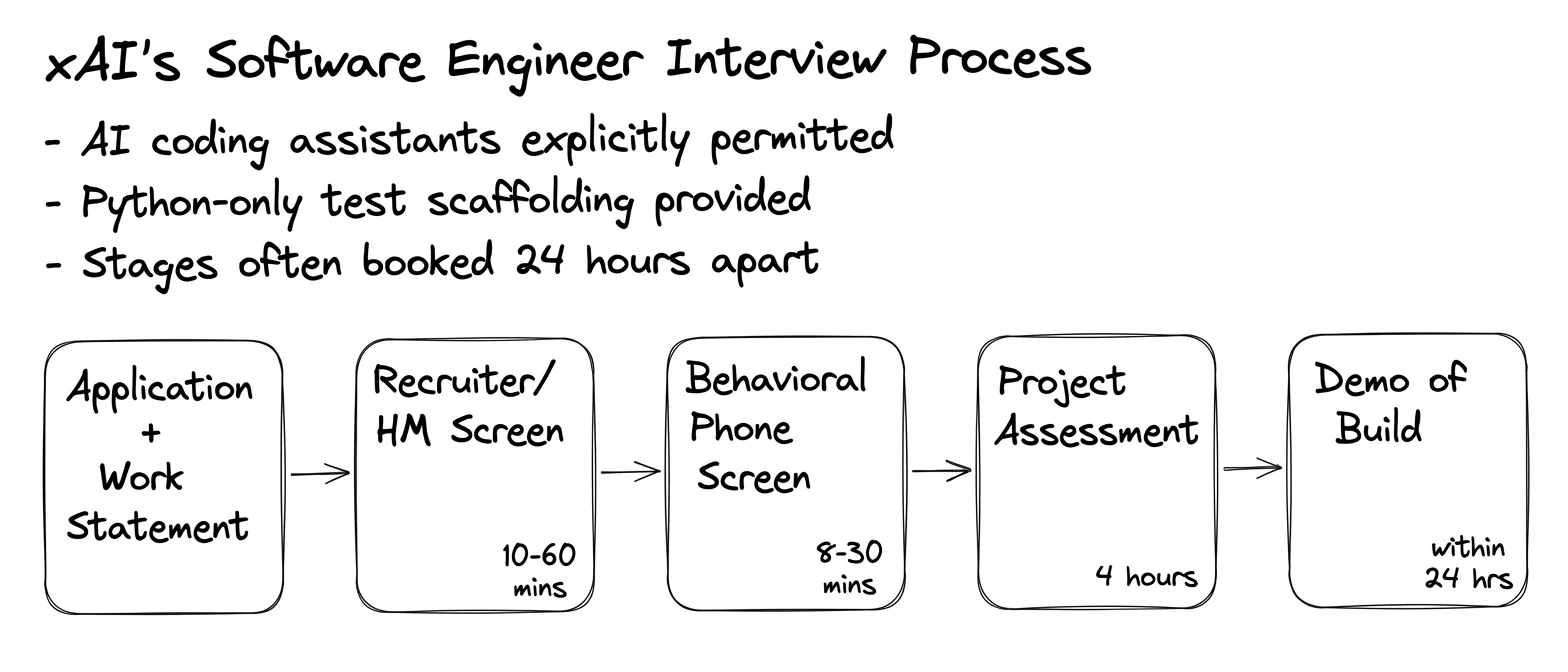
The format depends on the team and on how you applied. Engineers read every application, which pairs a CV with a short statement of exceptional work. Some candidates had one conversational screen and an offer. Others went through a recruiter call, a timed build, a live coding screen, a hiring-manager deep dive and a closing call. Job postings say the main stage should finish within about a week. Rounds were often booked within 24 hours of each other, though a week of silence after a submission was also common.
Cold and early-career applicants usually get the four-hour project assessment and then one or two live coding rounds. Referred and experienced candidates more often skip the build and do coding and system design rounds by phone. Senior candidates spend more time defending past architecture. Since SpaceX acquired xAI in February 2026, the company has operated as SpaceX's AI division.
Here's what the interview process can look like:
- Application review: Engineers read your CV and a short statement of your most exceptional work.
- Recruiter or hiring-manager screen: From ten minutes to over an hour, covering fit, pipeline and logistics.
- Engineer phone screen: An 8- to 30-minute call about your hardest project and motivation, sometimes with a fundamentals question or a short debugging task.
- Project assessment (most cold and early-career applicants): A four-hour build chosen from a set of briefs, with AI tools allowed, and a demo video due within 24 hours.
- Coding interviews (one or two): 45 to 60 minutes of applied problems involving concurrency, streaming or state, by phone or onsite.
- System design interview (usually one): A distributed-systems or backend design that often ends in code.
- Hiring manager deep dive and close: A full session on your strongest project, then a call about vision and the offer.
Tip: Choose the one project you will defend before the first call. The work statement, the phone screen, the coding rounds' opening minutes and the hiring manager all come back to it. Describing what the team shipped, without the trade-offs you chose yourself, falls short.
Recruiter and hiring-manager screens
Most candidates arrive through recruiter outreach, a cold application or a referral. Recruiter calls are short, often about ten minutes. They walk through the job description and check that your background fits an open pipeline. Recruiters often cannot follow technical detail, so explain your work plainly. Manager-run screens can be longer: one was booked for 30 minutes and ran past an hour.
Since the acquisition, calls have also covered SpaceX. One candidate was asked why SpaceX specifically and had no answer ready. Interviewers described a flat organization with about four layers between any engineer and Elon Musk. Government-facing backend roles have hard requirements, checked on this call: US citizenship, willingness to start a security clearance on day one, and regular travel between California and Washington, DC.
Interviewers evaluate:
- Pipeline fit: Whether your recent stack matches an open team. Some candidates were redirected to another team here.
- Motivation: A specific reason to work on Grok, its infrastructure or the SpaceX mission.
- Eligibility: Citizenship, clearance and travel for government roles.
- Plain explanation: Whether a non-engineer can follow what you built and why it was hard.
Prepare a two-minute background summary and a concrete answer to why you want to join both the AI division and SpaceX.
Sample questions for the recruiter and hiring-manager screens
Here are some questions reported by recent candidates:
- Walk me through your projects from the last two years and the technologies you used.
- Why do you want to work here, and why SpaceX in particular?
- Are you willing to apply for a security clearance on day one and travel regularly to Washington, DC?
Engineer phone screen
An engineer runs this screen, and it can be very short: reported calls lasted 8, 15 and about 30 minutes. The most common version is purely conversational. You introduce yourself, walk through your most challenging project with follow-ups on its technical decisions, and explain why you are changing jobs and what you want to work on here. Some screens add an operating-systems question: processes versus threads, how threads share memory, and what can go wrong. Others ask for real examples of using multithreading.
An infrastructure-leaning version adds code. In one 30-minute call, the candidate spent about 15 minutes on a Python snippet of concurrent bank-account deposits, finding the race condition and fixing it with a lock, while the interviewer stayed silent. Results come fast: two candidates heard within an hour, one with a move-forward and one with an offer.
Interviewers evaluate:
- Project depth: The problem, why it was hard and what you decided, in a few minutes.
- Concurrency fundamentals: Processes, threads, shared memory, races and locks, each with an example from your own work.
- Concision: Interviewers often let you talk uninterrupted, so you have to set your own pace.
- Specific intent: A concrete answer to what you want to build here.
Rehearse a three-minute version of your hardest project and the classic thread-safety questions.
Note: A very short call is not a good sign. One candidate answered every question correctly, including the process-versus-thread and shared-memory questions, yet the screen ended after about eight minutes with a rejection. Treat every call as the whole evaluation.
Sample questions for the engineer phone screen
Here are some questions reported by recent candidates:
-
Describe your most challenging project, then go deeper on its technical choices and obstacles.
-
What is the difference between a process and a thread, how do threads share memory, and what are the risks?
-
Find and fix the race condition in a multithreaded bank-account deposit function.
Project assessment
Many candidates get a timed build on a hosted assessment platform instead of an algorithm test. You choose one of about seven briefs spanning frontend, backend and ML: an Android app, a Grok-powered search experience, a full-stack sales tool, a retrieval-augmented generation system, two backend services, or a pipeline that loads public tweet data into a local database and scores each tweet through the Grok API. The clock runs for four hours once you start, and a demo video is due within 24 hours. Candidates put the total effort at about eight hours.
The most-reported backend brief is a tweet insight platform with two independently enforced rate limits: a global API cap of 100 requests per second and a per-consumer cap of 10. The service must be packaged with Docker. Another brief is a layered in-memory database:
- Level 1: Set, get and delete on fields under a key.
- Level 2: A sorted prefix scan.
- Level 3: Per-field TTLs, with a sentinel for fields that never expire.
- Level 4: Backup and restore. Expirations are stored as absolute times and recalculated at restore, and fields that have already expired are dropped.
AI coding assistants are explicitly encouraged. One candidate who received an offer had the assistant generate the scaffolding and spent the time on the core logic.
Interviewers evaluate:
- Scope discipline: A working core in four hours, not a broad, half-finished product.
- Reading the whole spec: Auxiliary requirements such as inbound and outbound limiters matter, and job postings never mention them.
- State semantics: TTL reset on overwrite, lazy versus eager expiry, and timestamps on restore.
- Owning generated code: You must explain every line in the demo, and candidates suspect that heavy, unexplained AI output counted against them.
Rehearse a rate-limited service or a TTL store against a four-hour clock, including Docker and a five-minute demo.
Note: The brief has shipped in two near-identical versions, one for machine learning and one for backend, and candidates confused their requirements. One candidate who received an offer was allowed to finish the containerization after the timer, so confirm that rule instead of cutting core logic to make time for Docker. Also ask what graders weigh: rejections at this stage came back with no feedback.
Sample questions for the project assessment
Here are some questions reported by recent candidates:
-
Build a tweet insight backend that enforces a 100-requests-per-second global limit and a 10-per-second per-consumer limit, packaged with Docker.
-
Implement an in-memory store with field-level operations and prefix scan, then TTLs, then a backup and restore that recomputes expirations.
-
Load public tweet data into a local database and write a worker that calls a model API to score and classify each tweet.
Coding interviews
Loops include one or two coding rounds of 45 to 60 minutes. They run by phone in a shared editor or onsite in Palo Alto or San Francisco, and phone rounds often open with a short resume deep dive. Problems are medium to hard and applied, and interviewers said they picked them from recent work. The most frequent is a multithreaded integer sort, reported in three separate loops. Others include:
- Streaming k-th smallest: The k-th smallest value in a sliding window under a memory limit, solved with a queue and bucketed counts.
- Space activity: Active time per virtual space from enter and exit records, with a live top-k.
- Distinct values: Maximizing distinct values when elements can be adjusted by k.
- Nested structures: Flattening and rebuilding nested lists, dicts and tuples.
- Component builds: A token limiter, an LRU cache variant and a resumable iterator.
Follow-ups tighten the constraints instead of changing the problem. One candidate got four follow-ups per question. Test scaffolding has been provided only in Python, so candidates using other languages wrote their own harness.
Interviewers evaluate:
- Optimal complexity: An O(N·K) answer to the distinct-values problem was called unnecessary; a sort plus a greedy pass was expected.
- Precise problem definition: Feedback on one rejection asked for exact statements of the problem and its constraints.
- Concurrency correctness: Partitioning, joins and a correct merge in the parallel sort.
- Incremental state: Updating a window or a top-k in place rather than recomputing it.
- Finishing: Running code when time is called.
Drill these families until each takes under 25 minutes in plain Python with your own tests.
Note: Unfinished code earns little or no credit. One candidate who ran out of time on an LRU cache variant said that was the direct reason for the rejection. Settle the data structures aloud early, then write continuously.
Sample questions for the coding interviews
Here are some questions reported by recent candidates:
-
Sort a large integer array using multiple threads, and explain how you split the work and merge safely.
-
For each window over a stream, return the k-th smallest value without sorting each window, under a memory limit.
-
Track users entering and leaving spaces, report total active hours per space, and answer top-k spaces by current users in real time.
System design interview
Most loops beyond the shortest include one design round, sometimes by phone. Reported prompts are a rate limiter, a distributed key-value store and a checkers backend:
- Key-value store: Consistent hashing, replication, strong versus eventual consistency, quorums and node failure.
- Checkers backend: Board setup, legal moves including jumps and kinging, and detecting a win.
The round rarely stays on the whiteboard. The checkers round moved into code optimization: a compact board representation and faster move validation. Time ran out there, but the interviewer was satisfied because the core worked and the next steps were clear.
Interviewers evaluate:
- A working core first: A design you can partly implement, before any optimization.
- Precise trade-offs: When to choose quorum reads or strong consistency, and what each costs.
- Failure handling: Node loss, replica divergence and durability, raised without prompting.
- Code-level judgment: Data representation and hot-path cost.
Practice each design end to end, finishing with core code and a failure-mode pass.
Sample questions for the system design interview
Here are some questions reported by recent candidates:
-
Design a distributed key-value store, covering partitioning, replication, consistency, quorums and recovery from node failure.
-
Build a checkers backend that validates moves including jumps and kinging, detects a win, and then optimizes the board representation.
-
Design a rate limiter for a public API.
Hiring manager deep dive
The hiring manager asks you to present the strongest project from your past work and then drills into it for the whole call: architecture, rejected alternatives, bottlenecks, testing strategy and what you would change. The pace is fast and stays technical throughout. The candidate who received an offer said breadth across many projects did not help, but deep expertise in one did. A closing call follows, combining the company's direction with offer details. Classic behavioral content is scarce, but one referred candidate faced questions on collaboration and handling disagreement.
Interviewers evaluate:
- Personal ownership: Which decisions were yours, backed by numbers and rejected alternatives.
- Depth under drilling: The fourth follow-up still gets a specific answer.
- Speed of judgment: Sound calls made quickly with incomplete information.
- Intent: What you would build here and why it needs this scale of compute.
Rehearse defending one project for 45 minutes at code level.
Tip: Be ready to schedule quickly. One candidate who received an offer had each round booked within 24 hours of the last, including off-hours slots, so have your project outline ready before the coding rounds end.
Sample questions for the hiring manager deep dive
Here are some questions reported by recent candidates:
-
Present your strongest project, then defend its architecture, bottlenecks and testing approach.
-
What would you do differently if you rebuilt it today?
-
Tell me about a disagreement on a team project and what you learned.
How SpaceXAI (formerly xAI) levels and evaluates Software Engineer candidates
Members of the technical team review applications, and job postings call the statement of exceptional work a key deciding factor. Each stage is a gate, not evidence pooled for a single debrief. Decisions came anywhere from under an hour after a screen to about a week after a submission. The bar is comparative: candidates who passed every test and every follow-up were still rejected without a reason, and one candidate's rejection followed a hiring pause. There is no public level ladder. Member of Technical Staff and Exceptional Software Engineer each cover a wide range, so ask the recruiter how the role maps to scope. Feedback is rarely given, and no fixed reapplication cooldown has been reported.
How to prepare for the SpaceXAI (formerly xAI) Software Engineer interview
- Write the work statement deliberately: Name one project with concrete scale and results. It becomes the deep-dive topic.
- Make that project defensible at code level: Prepare its architecture, alternatives, bottlenecks, tests and regrets.
- Master practical concurrency: Parallel sort with a correct merge, races and locks, and processes versus threads.
- Rehearse the four-hour build: Ship a rate-limited service or a TTL store with Docker and a demo, using AI only for code you can explain.
- Finish streaming and stateful problems: Window order statistics, live top-k and LRU variants, done with tests in 25 minutes.
- State the problem exactly before coding: Imprecise framing was cited in a rejection.
- End every design with code and failure modes: Cover node loss, consistency and durability without being prompted.
- Prepare a SpaceX-aware motivation: For government roles, also confirm clearance eligibility early.
About the SpaceXAI (formerly xAI) Software Engineer role
Software Engineers at SpaceXAI build the products, APIs and systems around the Grok models and the GPU superclusters that train and serve them. Teams are small and flat. Engineers work closely with researchers and own systems from design to production. Interviewers described long hours as normal, and one infrastructure candidate was told 60 to 80 hours a week. The upside they mentioned most often was the compute available. Since February 2026 the company has operated as SpaceX's AI division, and leadership has changed repeatedly.
SpaceXAI hires Software Engineers across product, platform and infrastructure. Teams include:
- Grok chat and apps: The consumer Grok experience across web and mobile.
- API and enterprise: The developer platform for external customers.
- Search and retrieval: Real-time retrieval systems that feed the models.
- Coding agents: Agentic coding products and tooling.
- Supercomputing: Software for training clusters, scheduling and reliability.
- Government: Cleared roles that apply AI to government systems.
Software Engineer experience and education requirements
Postings put demonstrated exceptional work ahead of credentials, alongside strong engineering fundamentals. New-grad roles exist, including on the government team, which requires US citizenship and clearance eligibility. Python is the common interview language. Stack discussions have covered Go, Rust and Kerberos. In May 2026, leadership publicly invited strong engineers without AI experience to apply.
FAQs about the SpaceXAI (formerly xAI) Software Engineer interview
How long does the SpaceXAI (formerly xAI) Software Engineer interview process take?
The process often takes one to three weeks. Rounds were frequently booked a day apart, and one candidate had an offer within an hour of a single screen. Waits of a week or more after the project submission were also common, and holidays slowed decisions.
What is the hardest round of the SpaceXAI (formerly xAI) Software Engineer interview?
The project deep dive is the hardest. It has no visible rubric, it recurs across rounds, and it is where the exceptional-work judgment is made. The four-hour build comes second, because scoping under a running clock is a different skill from solving a defined problem.
Is there an online assessment, and can you use AI tools?
Many cold and early-career applicants get the four-hour build, where AI assistants are encouraged but every line must be explained in the demo. Live coding rounds expect you to write the code yourself. Test scaffolding has been provided only in Python, so Python is the safest choice.
How much does a SpaceXAI (formerly xAI) Software Engineer make?
Posted base salaries for Member of Technical Staff and Software Engineer roles have ranged from about $180K to $440K a year. A government new-grad posting listed about $165K to $200K. Packages add equity, now tied to SpaceX stock, plus benefits.
What happens after a rejection?
Rejections usually come without feedback, even after strong rounds, and no fixed cooldown has been reported. Hiring follows each team's pipeline and has paused at times, so applying later to a different team is a reasonable path.