xAI · Study
SpaceXAI (formerly xAI) Machine Learning Engineer Interview Process
TrueInterview
July 31, 2026 · 10 min read
This loop is built around your own research, not a question bank. Nearly every round asks you to defend one past project, and one candidate sat three screens that each repeated the most-challenging-project question and how to choose a reinforcement learning environment. The coding is the team's live work: batching requests for a model server, sharding a matrix multiply, finding bad nodes in a cluster. Passing every technical round is not the last gate; one candidate cleared the screen, two coding problems and a research talk and was still rejected.
This guide breaks down each stage of the SpaceXAI (formerly xAI) Machine Learning Engineer interview, what interviewers evaluate in each round, and how to prepare, with questions candidates were actually asked.
Verified: Based on 6 candidate-reported interview experiences, primarily from 2025 Q4 through 2026 Q2, cross-checked against recent public accounts.
SpaceXAI (formerly xAI) Machine Learning Engineer interview process
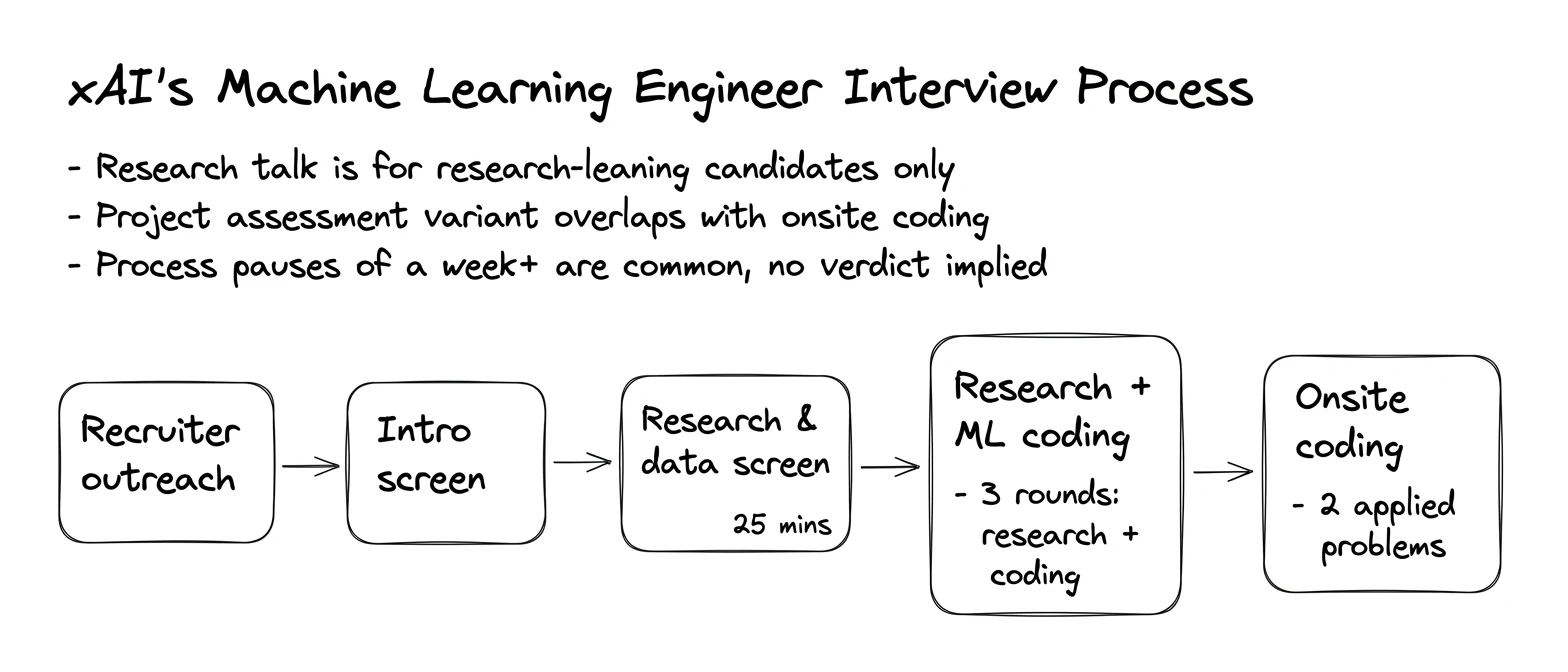
Engineers and researchers all carry the title Member of Technical Staff, so the loop is shaped by the team rather than by a level. Earlier postings described a CV plus a short statement of exceptional work, a 15-minute call, then four video interviews the company aimed to finish within a week. For research teams, two of the four were open-ended LLM problem sessions and the last was a presentation of past work. Current postings no longer describe the process, and SpaceX's February 2026 acquisition was followed by a restructuring.
Candidates report one screen to five rounds; doctoral candidates add a research talk, and infrastructure engineers get more implementation work.
Here's what the interview process can look like:
- Recruiter or introductory screen: A short, mostly non-technical call on background, motivation and eligibility.
- Take-home project assessment (some candidates): A four-hour timed build from a menu of briefs, then a recorded demo.
- Research and project screens (one to three): Deep dives into one past project, often with a short machine learning coding task.
- ML coding interviews (one or two): Applied training and inference problems with complexity analysis and an optimization pass.
- ML system design interview: A design around a model workload, such as long-form generation.
- Research presentation: About 20 minutes on your past work, then group questions.
Tip: Rehearse one project narrative at three lengths: two minutes, ten minutes and a full hour. Interviewers do not share notes, so each round needs the complete version.
Recruiter screen
The application asks for a statement of your most exceptional work, capped at 100 words in one posting, and later interviewers draw follow-ups from it. The first call is a short chat about past projects and the stack. Government-facing roles add a hard gate: mandatory U.S. citizenship, a security clearance started on day one, and regular travel between California and Washington, D.C.
Interviewers evaluate:
- Eligibility: Citizenship, clearance and travel for government work; relocation for Palo Alto teams.
- A project explained plainly: What you built and why it mattered, in terms a recruiter can repeat.
- Motivation: Why this company now, given its pace and the SpaceX integration.
- Team fit: Whether your background matches the specific posting.
Prepare a plain-language version of your strongest project and confirm the posting's eligibility rules before the call.
Sample questions for the recruiter screen
Here are some questions reported by recent candidates:
-
Walk through your recent projects and the stack behind them.
-
Will you apply for a security clearance from day one, and are you a U.S. citizen?
-
Why do you want to work here, and why are you looking to move?
Take-home project assessment
Some engineering candidates get a timed four-hour project offering about seven briefs across frontend, backend and machine learning. The machine learning brief: download a public dataset of social-media posts, define a typed schema, load it into a local database, write an inference worker that calls the Grok API to score and classify each record, validate the results, and record a demo. Its backend twin differs subtly and adds inbound and outbound rate limiters and Docker packaging. AI coding assistants are explicitly encouraged. The demo video is due within 24 hours, so candidates budget about eight hours in total.
Interviewers evaluate:
- Scoping: A working, validated pipeline in four hours rather than a half-built feature list.
- Reading the right brief: Every requirement of your variant, including auxiliary ones.
- Validating model output: Checking returned scores and labels before storing them.
- The demo: Clear trade-offs and what you would do with more time.
Rehearse an ingest, model-call and validation pipeline with a container inside four hours, plus a five-minute walkthrough.
Note: Rejections arrive with little feedback, and one candidate suspected the demo was barely reviewed. Ask the recruiter whether speed, correctness or production readiness matters most before starting.
Sample questions for the take-home project assessment
Here are some questions reported by recent candidates:
-
Ingest social-media posts into a local database, score and classify them through a model API in a worker, validate, and demo.
-
Build the same platform's backend with inbound and outbound rate limiters, packaged in Docker.
Research and project screens
These screens are the core of the track. In a 25-minute screen for a research role, the whole call covered how the candidate collected and processed data, how data quality and quantity affected downstream performance, and how impact was measured. Another candidate had three identically structured screens: the most challenging project, how to select a reinforcement learning environment, and overlapping technical questions. A third had three screens each pairing research discussion with machine learning coding, where small mistakes were not penalized.
Interviewers evaluate:
- Decision rationale: Why this data or architecture, and which alternative you rejected.
- Measurement: The metric that showed a change helped, and by how much.
- Reinforcement learning judgment: How you choose an environment and what makes its reward trustworthy.
- Consistency under repetition: Full depth for every new interviewer.
- Core logic in coding: Correct reasoning outweighs syntax.
Prepare one project down to individual decisions and their measured effects, plus a reasoned view on environment selection.
Note: Repeated questions do not make a round a formality. Each interviewer scores independently, sometimes visibly tired; the candidate with three identical screens was rejected, so bring the full story and your own energy each time.
Sample questions for the research and project screens
Here are some questions reported by recent candidates:
-
How did you collect and preprocess your data, and how did quality compared with quantity affect the model?
-
How would you choose a reinforcement learning environment for a given problem?
-
How Would You Prevent Hallucinations in an LLM-Based System?
ML coding interviews
Problems come from training and inference infrastructure, written live or as pseudocode. A research candidate's onsite, two days after the screen, had two. The first was dynamic batching: map a stream of variable-length requests to inference slots to maximize throughput under a latency threshold, minimize padding, and compare greedy with lookahead scheduling. The second was group testing to find faulty nodes in a large cluster with limited parallel tests and a cap on nodes per test. An infrastructure-leaning candidate was asked for a data-parallel matrix multiply across devices, covering sharding, communication and fully sharded data parallelism, then a custom tensor operation with forward and backward passes; that candidate was rejected.
Interviewers evaluate:
- A cost model: Complexity for every answer and, for distributed work, bytes communicated per step.
- The optimization pass: A better answer after the first works, such as lookahead batching or fewer test rounds.
- Mechanism, not vocabulary: What fully sharded data parallelism shards, gathers and frees.
- Gradient correctness: A backward pass that matches the forward pass in shapes and reductions.
- System constraints: Latency budgets, memory ceilings and padding waste as part of the problem.
Practice batching schedulers, group-testing searches and a sharded matrix multiply from scratch, stating the cost model first.
Tip: State the throughput, latency and memory trade-off before writing code. Interviewers pushed for optimization after every initial solution, and a stated cost model gives you a baseline to improve.
Sample questions for the ML coding interviews
Here are some questions reported by recent candidates:
-
Batch variable-length inference requests to maximize throughput while keeping latency under a fixed threshold.
-
Find all faulty nodes in a large cluster in as few rounds of parallel group tests as possible.
-
Multiply two large matrices across devices, then explain how fully sharded data parallelism changes memory use.
ML system design interview
Design prompts start from a model workload. One round opened with machine learning fundamentals, then asked for an agentic workflow that generates a one-hour movie, focusing on consistency across a very long output, narrative pacing, decomposition into stages and the mechanisms that enforce coherence. Research postings describe these as sessions on formulating and solving a concrete LLM problem, leaning research or engineering by background.
Interviewers evaluate:
- Decomposition: Hierarchical planning from outline to scenes to shots, with clean interfaces.
- State across long outputs: What memory each stage keeps and how later output is checked against earlier.
- Evaluation loops: Detecting drift or bad pacing and repairing it without restarting.
- Trade-offs: Cost, latency and quality per stage, with a reason for each model choice.
Practice two or three generative-system designs, opening each with the quality bar and how to measure it.
Sample questions for the ML system design interview
Here are some questions reported by recent candidates:
-
Design an agentic system that generates a one-hour movie with consistent characters and plot.
-
How would you enforce pacing over a long generated output, and what signal would flag a problem?
Research presentation
Research candidates present about 20 minutes of past work to a small group of researchers and engineers, then take questions on depth and on how the work connects to the company's mission and their vision for it. It is not a formality: a candidate who passed both coding problems was rejected after it.
Interviewers evaluate:
- Depth under group questioning: Answers that hold when several specialists push at once.
- Ownership: Which decisions were yours and what you would change.
- Relevance: A credible line from your work to training, reasoning or inference problems here.
- Vision: What you would work on first and why.
Build the talk around two or three defensible decisions and close with a concrete first project.
How SpaceXAI (formerly xAI) levels and evaluates Machine Learning Engineer candidates
There is no public ladder: everyone shares one title in a flat structure. Model-team postings promise clarity on your first project before an offer, so placement is settled during the process. The team decides and recruiting controls timing: one candidate was put on hold while others were evaluated, and another was rejected after clearing every technical stage.
Tip: Ask which posting and team the loop belongs to. Content shifts sharply between research, RL infrastructure and applied teams, and the posting's responsibilities predict the prompts.
How to prepare for the SpaceXAI (formerly xAI) Machine Learning Engineer interview
- Write the exceptional-work statement as an abstract: Every later round takes follow-ups from it.
- Defend one project at decision level: Know the rejected alternative and the confirming metric for each data, architecture and evaluation choice.
- Form a view on reinforcement learning environments: It was asked in every screen of one loop.
- Drill infrastructure-flavored coding: Dynamic batching, group testing and a sharded matrix multiply, each with a cost model.
- Know distributed training mechanics: Explain what fully sharded data parallelism stores and communicates per step.
- Rehearse a generative-system design: Stages, memory, evaluation loops and repair.
- Confirm format and eligibility early: Ask whether a take-home, talk or clearance is involved.
About the SpaceXAI (formerly xAI) Machine Learning Engineer role
Machine learning engineers work across the stack behind Grok, from data and pretraining through post-training, inference and applied ranking, on the Colossus supercomputers in Memphis. Teams are small and hands-on, mostly in Palo Alto and typically in the office five days a week. Since February 2026 the company operates as SpaceX's AI division.
SpaceXAI (formerly xAI) hires Machine Learning Engineers across model and product teams. Teams include:
- Model training and post-training: Pretraining, reward modeling, preference optimization and reinforcement learning.
- Mid-training: Trillion-token synthetic data, distillation into smaller models and long-context recipes.
- RL infrastructure: Inference for reinforcement learning, low-precision training and evaluation at scale.
- Multimodal: Image, video and audio models, including Imagine and Voice.
- Recommendations and ads: Ranking for the X platform's roughly 600 million monthly users and Grok in the ads stack.
- Government: Applied AI for government systems, requiring citizenship and clearance.
Machine Learning Engineer experience and education requirements
Postings ask for expert Python and PyTorch, JAX or XLA; infrastructure roles add C++ or Rust and CUDA, and inference roles value quantization and engines such as vLLM. Applied roles ask for about three years of industry experience; a PhD marks an exceptional candidate on research infrastructure, while model-training postings say modeling experience is not required. Posted base salaries run $180,000 to $440,000 for most roles and up to $600,000 for model training and post-training, plus equity.
FAQs about the SpaceXAI (formerly xAI) Machine Learning Engineer interview
How long does the SpaceXAI (formerly xAI) Machine Learning Engineer interview process take?
The company aims to finish the technical loop within a week, and candidates report onsites two days after a screen. Recruiting holds can stretch the total to several weeks.
What is the hardest round of the SpaceXAI (formerly xAI) Machine Learning Engineer interview?
The research deep dives: they repeat, have no visible rubric and decide fit. The coding problems are demanding but have a clear optimum to work toward.
Is there an online assessment?
None of the machine learning loops reported one, but some engineering candidates get a four-hour take-home with a machine learning brief and AI assistants allowed.
Is the process remote?
Postings say interviews run over video, and candidates describe remote coding rounds. One candidate was told the stage after the take-home is an in-person onsite in San Francisco.