xAI · Study
SpaceXAI (formerly xAI) Interview Process & Questions
TrueInterview
July 24, 2026 · 11 min read
SpaceXAI, the Grok lab SpaceX acquired in February 2026, swaps the usual algorithm test for a four-hour build you then explain on video, and weighs one project you can defend down to the code above a run of solved problems. Screens last eight minutes to an hour, and decisions can arrive within the hour. The most common complaint is a rejection without feedback after every test passed.
This guide breaks down each stage of the SpaceXAI interview, what interviewers evaluate in each round, and how to prepare, with questions candidates were actually asked.
Verified: Based on 29 candidate-reported interview experiences, cross-checked against recent public accounts.
SpaceXAI (formerly xAI) interview process
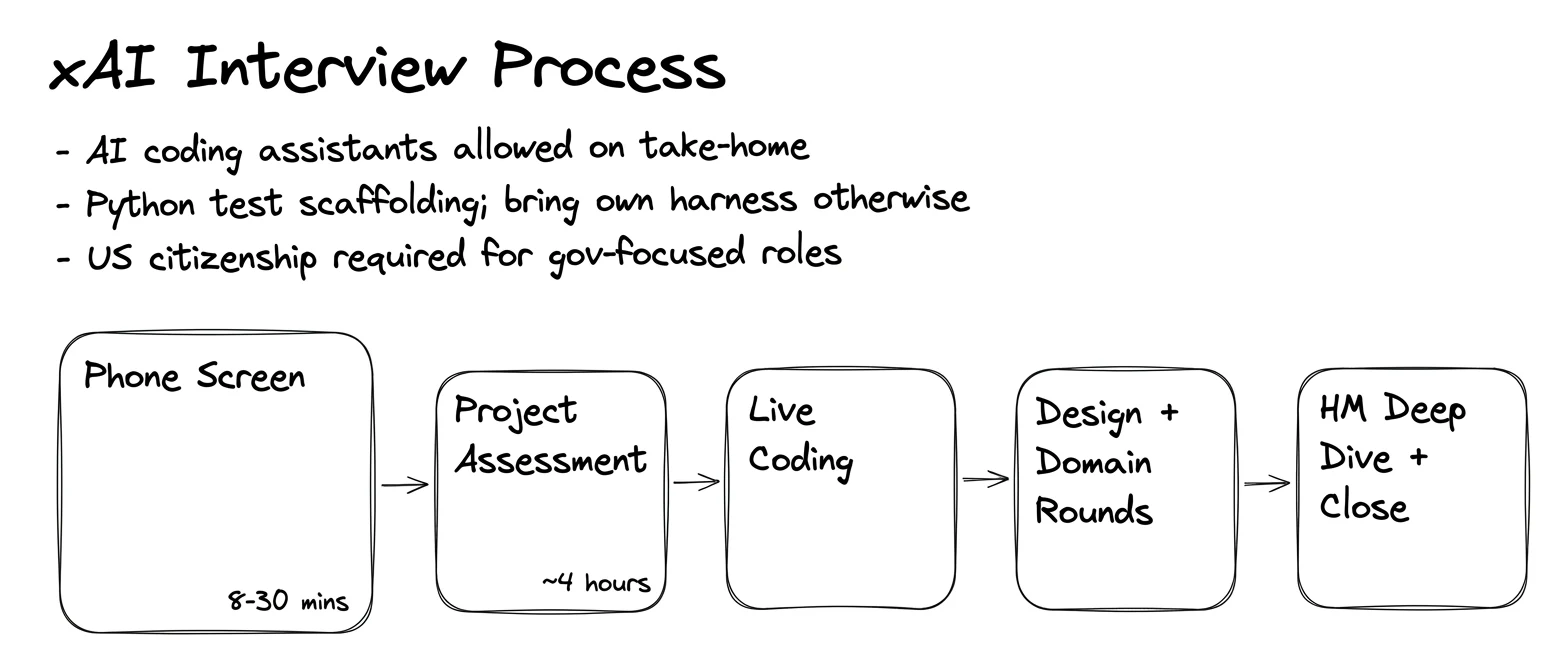
Hiring teams run their own loops, and reported loops ran from one round (a conversational screen ending in an offer) to five (recruiter call, timed project, live coding, hiring-manager deep dive and a closing call). A moving pipeline books each round within 24 hours of the last; a stalled one sits through holiday delays, holds or a hiring pause.
Everyone is hired as a Member of Technical Staff, so the loop shifts by track rather than level. Software Engineer candidates are the most likely to get the project assessment; Infrastructure Engineer candidates get concurrency and cluster problems; Machine Learning Engineer candidates get distributed-training questions, research discussion and sometimes a talk. Senior candidates are judged mostly on how far one project holds up.
Here's what the interview process can look like:
- Application and recruiter screen: A written exceptional-work statement, then a short call on background and eligibility.
- Initial phone screen: An 8–30 minute engineer call on your hardest project and motivation, sometimes with a fundamentals or debugging task.
- Project assessment (many Software Engineer candidates): A four-hour build from about seven briefs, AI allowed, demo video within 24 hours.
- Technical phone screens: 45–60 minute live rounds: a resume deep dive, then one practical coding problem with tightening follow-ups.
- Final technical rounds: Coding and design in Palo Alto, San Francisco or remotely, plus domain rounds for machine learning candidates.
- Hiring manager deep dive and close: A full call on your strongest project, then a vision and offer conversation.
Tip: Prepare one project at three depths (a two-minute summary, a ten-minute architecture walkthrough, a code-level account of the hardest bug). The same project is examined in the statement, the first screen and the hiring-manager round.
Recruiter and initial phone screens
Most candidates arrive through recruiter outreach or cold contact. The application asks for a written statement of exceptional work, which later interviewers mine for questions. Recruiter calls run about ten minutes and check fit with an open pipeline; one manager screen booked for 30 minutes ran past an hour. Government-facing roles gate here on US citizenship, starting a security clearance on day one, and regular California to Washington, DC travel.
Engineer-run screens last 8–30 minutes and are often purely behavioral: background, most challenging project, why you are leaving, why this company. Some add fundamentals (process versus thread, shared-memory risks, multiprocessing versus multithreading with your own examples). Infrastructure Engineer screens may include a 15-minute race-condition fix; Machine Learning Engineer screens may spend 25 minutes on how one project's data quality and quantity drove model performance. Since the merger, some screens ask why SpaceX.
Interviewers evaluate:
- Project ownership: Which decisions were yours and why they were hard, not a tour of what the team shipped.
- Concise delivery: Pacing yourself in a 15-minute call where the interviewer never interrupts.
- Motivation: A specific reason for this mission and pace, including the SpaceX side.
- Stack and eligibility: Whether your stack fits (Go, Rust and Kerberos have come up), plus clearance terms for government work.
Rehearse the project story and the motivation answer out loud with a timer.
Note: A short call can still be the whole evaluation. One candidate answered everything correctly in an eight-minute screen and was rejected. Another got an offer within an hour of a relaxed project conversation.
Sample questions for the recruiter and initial phone screens
Here are some questions reported by recent candidates:
-
Walk through the most challenging project you have worked on, then the technical choices and obstacles in detail.
-
Explain the difference between a process and a thread, how threads share memory, and what can go wrong.
-
Are you willing to apply for a security clearance on your first day and travel regularly to Washington, DC?
Project assessment
Many Software Engineer candidates get a hosted four-hour build instead of an algorithm test, choosing from about seven briefs: two backend services, an Android app, a Grok-powered search experience, a full-stack sales tool, a retrieval-augmented generation system, and a data pipeline that scores tweets with the Grok API. Once started, the clock runs continuously, and a demo video is due within 24 hours; candidates put the total at about eight hours.
The most-reported brief is a social insight backend with two independent rate limits (100 requests per second API-wide, 10 per consumer), packaged with Docker; one candidate was allowed to finish the Docker step after the timer. Its backend and machine learning versions differ subtly and are easy to confuse. Another variant is a levelled in-memory database: set, get and delete, a sorted prefix scan, TTL expiry, then backup and restore that recalculates TTLs against the restore time.
Interviewers evaluate:
- Scope discipline: A working core with both limits enforced matters more than extra features.
- Spec reading: The rate limiters and restore-time TTL rules are buried in the brief and are where submissions fail.
- Use of AI tools: Assistants are encouraged for scaffolding, but you must explain every line in the demo.
- Demo clarity: Your trade-offs and what you would harden next, in a few minutes.
Practice a timed build of a rate-limited service and a TTL store, then record a five-minute walkthrough.
Note: Grading weights are unpublished and feedback rarely comes back. Ask the recruiter before starting whether graders favor speed, correctness, production readiness or creativity.
Sample questions for the project assessment
Here are some questions reported by recent candidates:
-
Build a backend for a social insight platform with inbound and outbound rate limiters, containerized with Docker.
-
Implement an in-memory store with field-level TTLs, then back it up and restore it at a later timestamp, recalculating expirations and dropping expired fields.
-
Load a tweet dataset into a local database through a typed model, then score each tweet with a worker calling the Grok API.
Technical phone screens
Live rounds last 45–60 minutes: about 15 on your resume, the rest on one problem in a shared editor, sometimes with the interviewer's camera off. Problems are practical and often drawn from the interviewer's own work: parallel sorting, an LRU cache variant, a sliding-window token limiter, flattening and rebuilding nested containers, or maximizing distinct array values. Each answer draws follow-ups that tighten the constraints.
Infrastructure Engineer screens lean on threads and locks. Machine Learning Engineer candidates have sat three near-identical screens (hardest project, choosing a reinforcement-learning environment) and coded a distributed matrix multiply or a custom tensor operation with its backward pass.
Interviewers evaluate:
- Finishing: An unfinished LRU cache variant was the stated reason for one rejection.
- Optimal complexity: One O(N·K) first answer was dismissed as unnecessary, and the interviewer expected a greedy pass.
- Precise problem statements: Feedback on one rejection asked for more exact definitions of the problem and its constraints.
- Independence: Needing a hint on one of four follow-ups was enough to be noted.
Solve practical medium problems in 30 minutes in a plain editor.
Tip: Bring your own quick test harness. Scaffolding has been provided only in Python, so candidates using other languages lost minutes building one during the round.
Sample questions for the technical phone screens
Here are some questions reported by recent candidates:
-
Sort a large integer array with multiple threads, then merge the partitions correctly.
-
Implement a sliding-window token limiter that rejects requests over a threshold, then discuss high concurrency.
-
Given an array and an integer k, apply increments to maximize the number of distinct values, in better than O(N·K).
Final technical rounds
Finals run in person in Palo Alto or San Francisco with travel covered, or remotely. Candidates describe heavy entrance security and a deadline-room atmosphere. Formats vary: two interviewers each presenting a large problem in one session, a single streaming round, or two coding rounds plus design. Interviewers push for optimizations after the first working answer.
Software Engineer design mixes architecture with code: a distributed key-value store with quorums and node failure, a rate limiter, or a checkers backend with jumps, kinging and win detection. Infrastructure and Machine Learning Engineer finals have included dynamic batching for language-model inference and group testing to find faulty GPU nodes. Research-leaning candidates give a 20-minute talk, and agentic design has appeared (a one-hour film with consistent pacing).
Interviewers evaluate:
- Incremental updates: Maintaining a window or count without recomputing, including duplicates and windows longer than the stream.
- Core before polish: A checkers interviewer was satisfied when time ran out with the core working.
- Distributed trade-offs: Consistency models, consistent hashing, quorums and failure handling, defended under pushback.
- Cluster-scale reasoning: Throughput against latency in batching, and test count against parallelism in node diagnosis.
Practice design problems where you implement the core path in code after the whiteboard sketch.
Sample questions for the final technical rounds
Here are some questions reported by recent candidates:
-
Track users entering and leaving spaces, total each space's active hours, and answer live top-k occupancy queries.
-
Find the k-th smallest value in each sliding window of a stream under a memory limit.
-
Batch variable-length inference requests to maximize throughput while keeping latency under a threshold.
Hiring manager deep dive
The hiring manager has you present your strongest project and drills into it for the whole call: architecture, trade-offs, bottlenecks, testing strategy and what you would change. Behavioral questions are otherwise rare; one referral loop added a screen on teamwork and disagreements. Offers close with a call on the company vision and the package.
Interviewers evaluate:
- Depth on one project: Explaining any part of it down to the code.
- Judgment: The alternatives you rejected and how you measured the result.
- Pace and autonomy: Whether you make decisions quickly and own their consequences.
- Composure: Staying steady with interviewers who range from warm to distracted or openly challenging.
Choose one project and prepare to defend every decision in it at whiteboard level.
Sample questions for the hiring manager deep dive
Here are some questions reported by recent candidates:
-
Present the single strongest project from your career, then explain its bottlenecks, testing strategy and what you would do differently.
-
Describe a time you disagreed with a teammate and what you learned.
How SpaceXAI (formerly xAI) makes hiring decisions
Hiring teams decide quickly and compare you against candidates in parallel. Several candidates passed every round and were still rejected without feedback, and one Machine Learning Engineer application was put on hold after three screens because others looked stronger. Some 2026 accounts describe senior-leadership sign-off on offers, which can add days, and one loop ended shortly before a hiring pause. With a single title there is no public down-leveling step.
Tip: Keep other processes running and ask after every stage what remains; fast scheduling does not mean a fast decision.
How to prepare for the SpaceXAI (formerly xAI) interview
- Write the exceptional-work statement as a technical document: One project with metrics, your own decisions and the hardest failure; later rounds draw on it.
- Rehearse the 15-minute screen: Hardest project, why you are leaving and why this company (including SpaceX), each concise.
- Run a timed four-hour build: A rate-limited service with two independent caps, packaged with Docker, followed by a recorded walkthrough within a day.
- Implement lifecycle components from scratch: An LRU variant, a sliding-window limiter, a TTL store with backup and restore, and a resumable iterator, each with your own harness.
- Drill concurrency: Parallel sort and merge, race conditions fixed with locks, and processes versus threads explained with your own examples.
- Practice escalation and track depth: Take each solved problem to a stream, a memory limit and multiple threads; add distributed key-value design, cluster diagnosis or FSDP for your track.
About working at SpaceXAI (formerly xAI)
The company builds the Grok models and the Colossus GPU supercluster that trains them, and since February 2026 operates as SpaceX's AI division. It is unusually flat: one interviewer described about four layers between any engineer and the top. Infrastructure candidates were told to expect 60–80 hour weeks in an intense in-office culture, and one interviewer named the available compute as the job's best part. All technical staff share one title, with no public level ladder.
SpaceXAI hires engineers across model, infrastructure and product work. Teams include:
- Pre-training and post-training: Scaling, data, evaluation and reinforcement learning.
- Inference: Serving, batching and caching for the Grok API and apps.
- Infrastructure: Colossus clusters, networking and GPU fleet health.
- Grok product: The consumer apps and Grok features inside X.
- Government: Grok for Government, staffed by cleared engineers.
Experience and education requirements
The application centers on evidence of exceptional work; some postings also list a bachelor's degree in computer science or a related field, and government-facing postings ask for four or more years of experience. Python dominates the interviews, and Go, Rust, Kubernetes and TypeScript appear in postings. Machine learning roles favor hands-on training or inference experience.
FAQs about the SpaceXAI (formerly xAI) interview
How long does the SpaceXAI (formerly xAI) interview process take?
From one day to several weeks. The fastest offer came within an hour of a single screen, and one five-round loop booked each round within 24 hours of the last. Holidays, holds and hiring pauses stretched others.
What is the hardest round of the SpaceXAI (formerly xAI) interview?
The project deep dive, which has no visible rubric and is where unexplained rejections cluster. The four-hour build is second, mostly for its scope pressure.
Is there an online assessment?
Many Software Engineer candidates get the four-hour project assessment. Some Infrastructure and Machine Learning Engineer loops skip it for live screens.
Can I use AI tools?
On the project assessment, yes; they are explicitly encouraged. The demo then checks that you understand everything you submitted.
How much does a SpaceXAI (formerly xAI) engineer make?
Recent postings for technical staff list base salaries of roughly $180K to $440K, plus equity. Per-level totals are not public because there is a single title.