xAI · Study
SpaceXAI (formerly xAI) Infrastructure Engineer Interview Process
TrueInterview
July 31, 2026 · 15 min read
SpaceXAI screens Infrastructure Engineers faster and more abruptly than most employers. The first technical call can last eight minutes, or give you fifteen silent minutes to fix a race condition, and candidates who answered everything correctly were still rejected without feedback. Later rounds test concurrency you write yourself, such as sorting with threads or locking a shared account, more than puzzle algorithms. The loop ends with one project you must defend in full, and government-adjacent roles check eligibility before anyone looks closely at your engineering.
This guide breaks down each stage of the SpaceXAI (formerly xAI) Infrastructure Engineer interview, what interviewers evaluate in each round, and how to prepare, with questions candidates were actually asked.
Verified: Based on 22 candidate-reported interview experiences, primarily from 2025 Q4 through 2026 Q2, cross-checked against recent public accounts.
SpaceXAI (formerly xAI) Infrastructure Engineer interview process
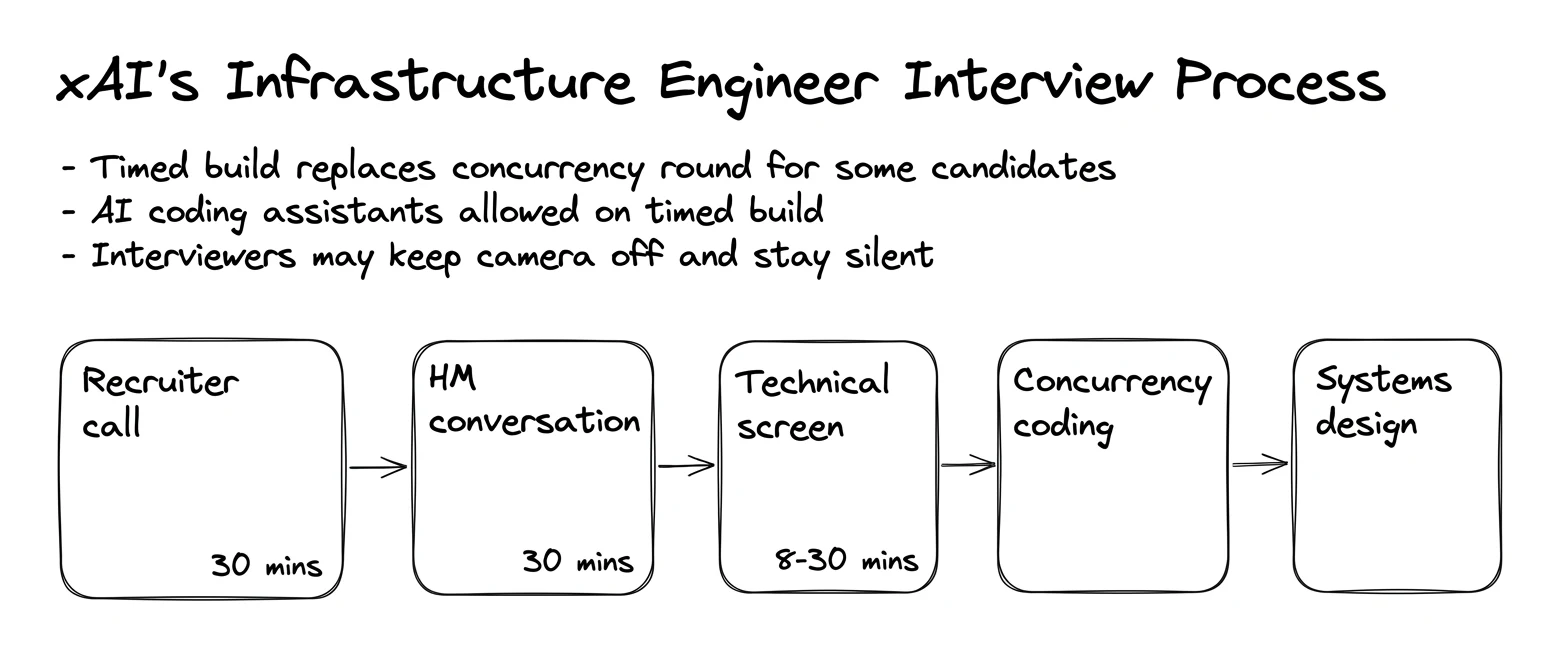
The loop depends on the team, and each posting describes its own steps. A supercomputing role lists a 45-minute screen, two coding assessments in Rust, C++ or Go, a live systems session and a project presentation. A reliability role has a site-reliability session and a manager interview instead. Government infrastructure roles add a statement of exceptional work and a hands-on troubleshooting challenge. Candidates report one to five rounds, and several loops ended after one phone call.
Postings aim to finish the main process in about a week, and in one loop that ended in an offer, each round was booked within 24 hours of the last. The company has been reorganizing since the 2026 merger, and one candidate's loop stalled when hiring paused soon after. Everyone holds the title Member of Technical Staff, so there is no separate senior loop. Experienced candidates get the same rounds with deeper questions on their project and in design.
Here's what the interview process can look like:
- Recruiter or hiring-team screen (15 to 45 minutes): Background, motivation, stack fit and, for government-adjacent roles, citizenship and clearance.
- Online assessment (many, not all, candidates): A four-hour build, such as a rate-limited backend or a layered in-memory database, followed by a recorded demo.
- Technical phone screen (8 to 60 minutes): Quick operating-systems questions, a concurrency debugging task, or one live coding problem after a resume review.
- Coding interviews (one or two): Concurrency and memory-limited problems, such as parallel sorting, a streaming k-th element, or a key-value store.
- System design interview (usually one): Storage and traffic-control systems, with follow-ups on node failure.
- Hiring manager and project deep dive: A full call on your strongest project, sometimes presented to a small group, and in some loops a final call on vision and the offer.
Tip: The first technical call is the most important round, not a warm-up. Prepare a 90-second version of your hardest systems project that starts with the hard part, and answer each fundamentals question in one sentence plus one example from your own work.
Recruiter screen
Most infrastructure candidates were contacted directly by a recruiter or an engineer. Postings say a technical team member reviews every application and ask for a written statement of your most exceptional work, which later interviewers use for questions. The first call usually runs 15 to 30 minutes. It covers your background, your most challenging project, why you are changing jobs, and what you want to work on.
For government-adjacent infrastructure, this call checks eligibility. Candidates were told that US citizenship is mandatory, that they must be willing to start a security clearance on day one, and that the job includes regular travel between California and Washington, DC. The clearance was described as a ten-year background check followed by an informal verification interview. Once they pass your resume to the engineering team, scheduling can move very quickly.
Interviewers evaluate:
- Concision: One 15-minute screen let the candidate talk without interruption, so time spent rambling could not be recovered.
- A specific reason to join: The mission and the compute, not general interest in AI. Candidates without a prepared answer noticed the gap during the call.
- Stack alignment: Whether the languages and systems on your resume, such as Go, Rust or Kerberos, match what the team runs.
- Eligibility and logistics: Citizenship, clearance, travel and on-site work in Palo Alto. Any one of these can redirect or end an application.
Before the call, prepare a short project story, a specific reason for joining, and your eligibility answers.
Note: If a posting mentions government systems or clearance, ask on the first call which requirements are binding. One experienced candidate's application was redirected over clearance eligibility, which could have been checked on day one.
Sample questions for the recruiter screen
Here are some questions reported by recent candidates:
-
Walk through your background and describe the most technically challenging project you have worked on.
-
Why are you changing jobs, and what would you want to work on here?
-
Are you a US citizen, and will you start a clearance on day one and travel regularly to Washington, DC?
Online assessment
Many candidates complete a timed build, either before or after the first call. An assessment platform offers seven briefs across frontend, backend and machine learning. You pick one, and the four-hour clock starts when you begin. A demo video is due within 24 hours, so candidates put the total at about eight hours. AI coding assistants are explicitly allowed. One candidate who got an offer used one for scaffolding and spent the four hours on the core logic.
Infrastructure candidates most often report the backend brief, a tweet insight platform. It needs two separate rate limits: a global API cap of 100 requests per second and a per-consumer cap of 10 requests per second. The service must be packaged in Docker, and the Docker step could be finished after the timer ran out. Another variant is an in-memory key-value store built in four levels: set, get and delete, then a sorted prefix scan, then per-field TTLs with a value for no expiry, then backup and restore that recalculates each remaining TTL.
Interviewers evaluate:
- Reading the full spec: The rate limits were not in any job description, and the ML and backend versions of the brief are easy to confuse.
- A working core over breadth: Both limits enforced correctly and a container that runs are worth more than many half-working features.
- Expiry and restore logic: Converting stored absolute expiry times back to remaining TTLs at restore, and silently dropping fields that have already expired.
- Demo clarity: The recording is often the only explanation graders see.
Practice building a rate-limited service and a TTL store in Docker in four hours, and record one practice demo.
Note: The build is graded without you there, and candidates say the criteria are unclear. One was rejected with almost no feedback. Before you start, ask the recruiter whether graders care most about speed, correctness or production readiness.
Sample questions for the online assessment
Here are some questions reported by recent candidates:
-
Build a tweet insight backend with a 100-requests-per-second global limit and a 10-requests-per-second per-consumer limit, packaged in Docker.
-
Implement a key-value store with fields under each key, a sorted prefix scan, per-field TTLs, and backup and restore that recalculates remaining lifetimes.
Technical phone screen
This is the shortest round and often the one that decides the outcome. It comes in three formats. The first is a quick verbal check of operating-systems basics: process versus thread, how processes share memory, and what can go wrong. One candidate answered all three correctly in an eight-minute call and was rejected. The second is a 30-minute call with about fifteen minutes to find and fix a race condition in a Python snippet that simulates concurrent bank deposits, while the interviewer says nothing.
The third is an hour with an engineer. The first half is a detailed review of your resume and decisions. The second half is one live coding problem. In one case the task was to maximize distinct values when any element can be increased by k, where a linear greedy solution was expected rather than O(n·k). Other screens used an LRU cache variant or a sliding-window token limiter, and one candidate was rejected solely for not finishing the LRU. Interviewers may keep their cameras off and rarely say how you did.
Interviewers evaluate:
- Fast, precise answers: A clear definition first, then a concrete detail. Slow answers were the most common reason for failing.
- Real concurrency experience: Threads, processes and locks from systems you built. A correct textbook answer without your own example was not enough.
- Correct synchronization: Finding the read-modify-write race, locking the right section, and explaining why.
- Finishing: An unfinished implementation counts as a failure even when the approach is right.
Practice answering operating-systems questions aloud in under a minute each, and be able to write an LRU cache and a sliding-window limiter from scratch in under twenty minutes.
Sample questions for the technical phone screen
Here are some questions reported by recent candidates:
-
Explain process versus thread, how processes share memory, and what risks shared memory creates.
-
Find and fix the race condition in a Python class that simulates concurrent deposits into a bank account.
-
Given an array and an integer k, where any element may be increased by k any number of times, maximize the number of distinct values.
Coding interviews
Later coding rounds take place in a shared editor or in person. Candidates who went onsite describe heavy entrance security and a deadline-like atmosphere. The most common problem on this track is sorting an integer array with multiple threads. You split the array, sort each chunk on its own thread, wait for all of them, and merge. Follow-ups cover thread count, uneven splits, empty input, races, and how merge cost and thread overhead limit the speedup, which matter more than the sorting algorithm.
Other problems involve streams and memory limits. One interviewer used a problem from their own recent work: find the k-th smallest element in each sliding window of a stream when memory is too tight to keep the window sorted. The expected approach is a queue plus a bucketed count of values. One onsite had two interviewers back to back. The first asked for a tracker of users entering and leaving spaces, with active time per space and live top-k occupancy. The second asked for a checkers engine with legal moves, kinging and win detection. A cluster-focused loop asked how to find faulty compute nodes using a limited number of parallel tests.
Interviewers evaluate:
- Concurrency correctness: Correct joins and synchronization, with no unprotected shared state.
- Cost reasoning: How thread count, chunk size and merge cost determine the real speedup, or why bucket counts fit the memory limit.
- Incremental updates: Updating as the window slides instead of recomputing, and handling duplicates and windows larger than the stream.
- Core before polish: Two-part problems usually run out of time, so build a working core before optimizing.
Practice writing parallel merge sort with a thread pool in your strongest language, and explaining its speedup and failure modes aloud.
Tip: If the room allows it, use a laptop and write test cases as you go. Interviewers ask about duplicates, empty input and window edges, and an answer you have already tested holds up better than one argued on a whiteboard.
Sample questions for the coding interviews
Here are some questions reported by recent candidates:
-
Sort a large integer array using multiple threads, then justify the pool size, the handling of uneven chunks, and the merge cost.
-
Return the k-th smallest element of every sliding window over a stream when memory does not allow keeping each window sorted.
-
Track users entering and leaving spaces, report active time per space, and answer live top-k queries by current occupancy.
System design interview
Design prompts here are about storage and traffic control, not product features. The main one is a distributed key-value store: partitioning with consistent hashing, replication, read and write quorums, strong versus eventual consistency, durability, and node failure. Interviewers spend the most time on what happens during and after a failure. The other common prompt is a rate limiter. It starts with a single-node token bucket and moves to a counter shared across hosts, where the question is how the limiter behaves when that counter is out of date.
Interviewers evaluate:
- Failure handling: Which writes survive a crash, how a replica catches up, and what clients see during a partition.
- Justified consistency choices: Quorum sizes or eventual consistency picked for the workload, not a recitation of the CAP theorem.
- Numbers and hardware sense: Throughput, storage and replication estimates. These teams run their own clusters, so generic managed-cloud answers land poorly.
Practice a replicated key-value store and a distributed rate limiter, with each failure case worked through step by step.
Sample questions for the system design interview
Here are some questions reported by recent candidates:
-
Design a distributed key-value store covering partitioning, replication, quorums, consistency and recovery after node failure.
-
Design an API rate limiter, starting with one token bucket and extending it to a distributed counter.
Hiring manager and project deep dive
The hiring manager round centers on one project. In one loop that ended in an offer, the manager asked for the candidate's strongest project and spent the whole call on it: architecture, tradeoffs, bottlenecks, testing, and what they would change. Some postings run this as a presentation to a small group about a large problem you owned from start to finish. Another manager call was booked for 30 minutes and lasted over an hour, covering two years of projects and named technologies such as Go, Rust and Kerberos to check the experience was real.
Candidates also learn how the company is run on this call. They were told that about four layers separate any engineer from the top, and that infrastructure teams commonly work 60 to 80 hours a week on site. Loops that end in an offer can finish with a call about company vision and the offer itself.
Interviewers evaluate:
- Depth on one project: Explaining every decision in detail. Covering many projects shallowly did not help.
- Personal contribution: What you built, kept clearly separate from what the team did.
- Precision: Clear problem statements and constraints. One candidate was told directly to define problems more precisely.
- Fit with the pace: A realistic view of the hours and on-site work. This conversation goes both ways, so decide how you feel about the hours beforehand.
Choose one infrastructure project whose hardest part you solved yourself, and rehearse it until you can answer any follow-up.
Sample questions for the hiring manager and project deep dive
Here are some questions reported by recent candidates:
-
Present your strongest project, then walk through its architecture, bottlenecks, testing and what you would change.
-
Which recent projects used Go, Rust or Kerberos, and what exactly did you build with them?
-
Why this company's infrastructure specifically, now that it sits inside a larger space and energy group?
How SpaceXAI (formerly xAI) levels and evaluates Infrastructure Engineer candidates
There is no public level ladder. Engineers and researchers all hold the title Member of Technical Staff, and postings describe a flat structure where leadership goes to people who take initiative. The hiring manager and team decide, with scope shaped mainly by how deep your project discussion goes, so there is no separate down-leveling step. Decisions can arrive within an hour of the last call. Rejections usually come without a reason, even after every task was completed, and one loop ended in a hold notice instead of a decision.
Tip: Ask the recruiter early what a successful profile looks like beyond the technical bar.
How to prepare for the SpaceXAI (formerly xAI) Infrastructure Engineer interview
- Make the first call count: Prepare a 90-second project summary that starts with the hard part, and one-sentence answers on processes, threads, shared memory and locks.
- Settle eligibility first: For any government-adjacent role, confirm citizenship, clearance, travel and on-site expectations on the first call.
- Write concurrency code, not just explanations: Practice parallel sorting, a race-condition fix and a thread-safe cache until each takes under twenty minutes.
- Rehearse the four-hour build: Build a Docker service with two independent rate limits and a TTL store with backup and restore, with an AI assistant writing the scaffolding.
- Practice memory-limited streaming problems: Solve the sliding-window k-th element with bucket counts, updating incrementally instead of recomputing.
- Prepare two failure-focused designs: A replicated key-value store and a distributed rate limiter, each with what happens when a node dies.
- Pick one project to defend fully: Know its architecture, bottlenecks and tests, and be exact about what you did yourself.
About the SpaceXAI (formerly xAI) Infrastructure Engineer role
Infrastructure engineers build and run the systems behind the Grok models. That includes the Colossus GPU supercomputer in Memphis, the networking and storage around it, and the platform that schedules training and serving jobs on it. Postings list Linux, Kubernetes, InfiniBand and RDMA, MPI and NCCL, along with performance work down to the kernel level. Teams are small and hands-on, engineers are expected to work across areas, and most roles are based in Palo Alto. Posted base salaries typically range from $180,000 to $440,000, with equity on top.
SpaceXAI hires Infrastructure Engineers across several teams. Teams include:
- Compute infrastructure and supercomputing: Building and running very large GPU clusters for training and serving.
- Networking and storage systems: High-performance interconnects, low-latency communication libraries, and cluster storage.
- Infrastructure reliability: Site-reliability work on production systems, including incidents and automation.
- Government infrastructure: Infrastructure across on-premise, virtual-machine and classified environments, with clearance and on-site requirements.
- Observability and developer experience: Monitoring, tooling and internal platforms for the rest of engineering.
Infrastructure Engineer experience and education requirements
Applications are judged on a written statement of exceptional work and on systems you have shipped, more than on credentials. Supercomputing assessments accept Rust, C++ or Go, while phone-screen debugging has used Python. Strong candidates have production experience with Linux internals, concurrency, distributed storage or networking. Government roles require US citizenship and prefer security certifications.
FAQs about the SpaceXAI (formerly xAI) Infrastructure Engineer interview
How long does the SpaceXAI (formerly xAI) Infrastructure Engineer interview process take?
The target is about a week. Fast loops booked each round within 24 hours of the last and made decisions within hours, but pauses of a week or more happen, especially around holidays and reorganizations.
What is the hardest round of the SpaceXAI (formerly xAI) Infrastructure Engineer interview?
The first technical screen, because it is so short. Eight minutes of verbal questions, or fifteen minutes to fix a race condition with a silent interviewer, leaves no time to recover from a slow start. The distributed key-value store design is harder to think through, but you have more time for it.
Is there an online assessment?
Often, but not always. Many candidates do a four-hour build from one of seven briefs, followed by a demo video within 24 hours, and AI assistants are allowed. Others go straight from a phone screen to live coding.
Is the interview remote?
Screens and early rounds are by phone or video, and some postings say every interview is a video call. Other candidates were invited to in-person onsites in the Bay Area. The job itself is on site.