Study
Will I Be Down-Leveled in a Big Tech Interview?
TrueInterview
October 11, 2026 · 15 min read
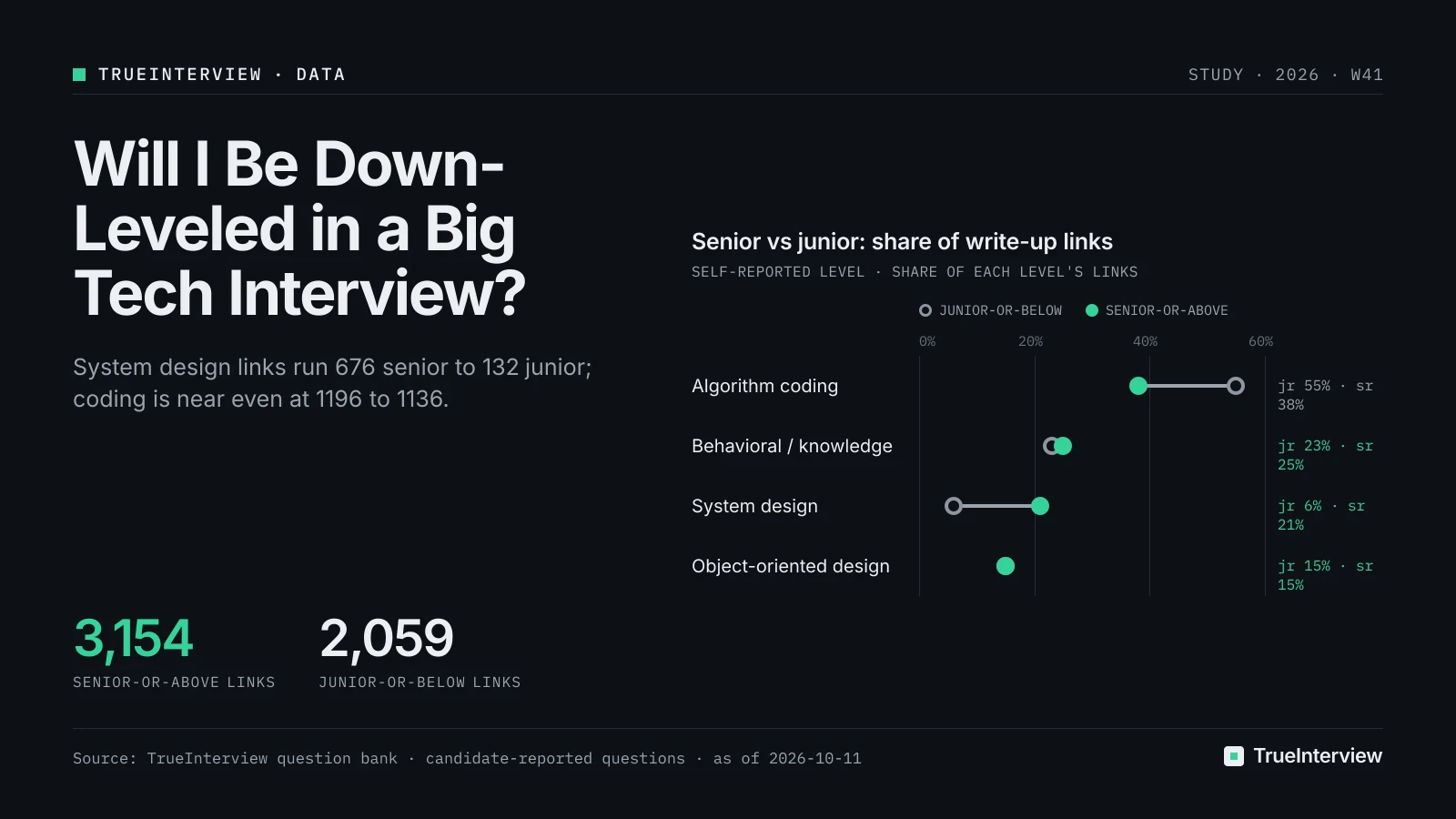
You might be, but rarely because you cannot code. As of 2026-10-11, candidate write-ups in TrueInterview's bank link system design questions 676 times from senior-or-above candidates and 132 times from junior-or-below, and behavioral and knowledge questions 798 to 477, while coding sits near even at 1196 to 1136. Read that as a map of where the level band lives: the rounds that show scope. Settle the target level with your recruiter before the loop, then put your remaining hours into design depth and scope stories rather than another month of hard algorithm problems.
Disclosure: TrueInterview is an interview-preparation product and publishes this article. Facts about other products come from their public pages on the dates listed under Sources.
What does down-leveling mean, and why does it happen?
Down-leveling is when a company still wants to hire you, but not for the role you interviewed for, so it extends a lower-level offer instead; Business Insider's report on the practice describes it that way. It is a leveling outcome rather than a rejection, decided from the written record of your loop, which SpaceComplexity's guide says is what the hiring committee reads.
The same Business Insider report says that, with more candidates than ever, companies are less willing to take a chance on someone who almost meets their requirements. SpaceComplexity's guide to hiring committees says down-leveling is more common than outright rejection for borderline candidates who show strong fundamentals at the wrong scope. The same guide says feedback documents typically carry a leveling signal stating whether performance was above, at or below the target band.
DataVidhya's lesson on down-leveling describes the common route: a split loop with strong coding and SQL but weaker design or behavioral rounds, which committees resolve by offering the lower level. The Big Tech Careers newsletter says down-leveling is less about being underqualified than about failing to communicate your qualifications in the interviewer's language.
Our take: that makes down-leveling a signal problem you can rehearse, not a verdict on your ability. Before each round, write one sentence naming the evidence of scope you want to appear in the interviewer's notes, because those notes are all the committee will see.
Which rounds carry the level signal?
System design carries the sharpest level tilt in the reports, behavioral is the only other format clearly above the baseline, and coding, despite the most senior links of any format, carries almost no tilt. Across the bank, senior-or-above candidates account for 3291 write-up links and junior-or-below candidates for 2163, so a format only signals seniority when its ratio beats that baseline of about 1.5.
| Format | Senior-or-above links | Junior-or-below links | Senior links per junior link | What it means for your prep |
|---|---|---|---|---|
| System design | 676 | 132 | 5.1 | The sharpest separator; depth here is level evidence |
| Behavioral / knowledge | 798 | 477 | 1.7 | Above the baseline, with more senior links than design; scope stories are tested here |
| Object-oriented design | 477 | 307 | 1.6 | At the baseline; keep it sound, it rarely lifts you |
| Coding (algorithm) | 1196 | 1136 | 1.05 | Below the baseline; it is the entry ticket |
| SQL | 7 | 7 | 1.0 | Too few links to read |
Our take: DataVidhya's lesson says the demotion is usually decided in the system design round. The counts agree that design shows the sharpest tilt, but they do not support a design-only theory: behavioral rounds carry more senior links than design rounds do, and coding sits below the bank's own baseline.
The loop is also shifting toward the round that separates levels least. System design's share of write-up links fell from 16% in 2025-Q4 to 11% in 2026-Q3, while coding rose from 40% to 52%. Prepare coding to pass cleanly, then move the spare hours to system design and behavioral, the two formats clearly above the baseline.
These counts show which questions candidates at each self-reported level said they were asked. They do not show why any candidate received a level, and nothing here measures how often down-leveling happens.
Where does the senior tilt show up inside each round?
Inside each round, the tilt concentrates in a few design families and one behavioral subtype, while in coding the clearer signal is which topics tilt junior. The most useful of them is ads, recommendation and ranking ML: it is the largest design family in the bank, at 59 of 475 design questions, and one of the most senior-tilted.
| Category | Kind | Senior-or-above links | Junior-or-below links | Read |
|---|---|---|---|---|
| Collaboration and productivity apps | Design family | 23 | 1 | Strong tilt on a small sample |
| Video, media and uploads | Design family | 11 | 1 | Strong tilt on a small sample |
| Ads, recommendation and ranking ML | Design family | 106 | 10 | Strong tilt on a large sample: drill this first |
| Maps, ride-hailing and delivery | Design family | 26 | 14 | Least senior-tilted family, still above baseline |
| Motivation | Behavioral subtype | 150 | 43 | The behavioral subtype to over-prepare |
| Concurrency | Subtype | 21 | 6 | Worth one rep if your target asks for it |
| Math | Algorithm topic | 69 | 43 | Just above the bank baseline; the most senior-tilted coding topic |
| Intervals | Algorithm topic | 67 | 50 | Near the baseline, slightly below it |
| Binary search | Algorithm topic | 65 | 48 | Near the baseline, slightly below it |
| Two pointers | Algorithm topic | 65 | 79 | Junior-tilted: more junior links than senior |
| Dynamic programming | Algorithm topic | 59 | 91 | The most junior-tilted coding topic |
Pick two design families from the top of the table and drill named prompts from the bank. In ads and ranking, the bank files Design an Ads Frequency Cap System and Design the Data Model for an Ads Demand Platform at Netflix, and Reels / Short Video Recommendation at Meta. For a frequency cap, expect the push on where the counter lives and how exact the cap must be when one user hits several regions at once. For a recommender, expect the push on the split between candidate generation and ranking, and on which metric proves a model change helped.
In LLM and AI infrastructure, the bank files Design GPU Inference Serving System at Anthropic and Design GPU Scheduling Platform at Databricks and Anthropic. There the deciding questions are usually batching against latency, and what the system does when GPU capacity runs out.
DataVidhya's lesson draws the line inside the design round: a working, sensible design is the mid bar, and volunteering volume math, failure modes, cost or trade-offs is the senior bar. The same lesson says "answering probes is reactive, and reactive is mid-level by definition at most rubrics". Rehearse saying the failure modes and the cost before the interviewer asks for them.
For coding, the useful reading is at the junior end: no algorithm topic tilts senior the way design families do, but dynamic programming and two pointers tilt clearly junior. Dynamic programming is not rare in the bank, at 110 of 1481 coding questions, yet it is the topic junior candidates report most relative to senior ones. So do not add a dynamic programming block to fix a level worry; keep coding at maintenance and spend the freed hours on design and stories.
What do candidates and interviewers report about down-leveling?
The named reports share one pattern: candidates are pulled down a level for thin scope or depth, and InterviewLegend's Apple guide says years of experience do not protect you. Each source below is one person's account or one site's guide, so treat them as patterns to rehearse against, not as rates.
- Thin depth. InterviewLegend's Apple guide describes a candidate who comes across as broad but thin, and says that profile turns an ICT5 target into an ICT4 offer. The same guide says verbal-offer downgrades are reported, so the level can move after a recruiter has floated a number.
- Coding can still cost a level. One candidate's post on Taro reports 4.5 years of full-time experience, an accepted Google L3 offer, and coding rounds, specifically algorithm optimization, as the reason given for the lower level. A tech lead commenting in the same thread says Google is notorious for down-leveling and describes receiving an L3 offer with 3 years at similar companies.
- The first interview sets the level at Amazon. A former Amazon recruiter writing on Levels.fyi says level is set by years of experience and interview performance, and that a candidate between the L4 and L5 requirements is usually submitted at L5 but likely down-leveled to L4 after a weak first interview.
- Behavioral sets the level, not only the offer. A former Amazon Principal Engineer and Bar Raiser, writing in The Pragmatic Engineer, says the behavioral interview carries huge weight in whether you get an offer and at what level. The same author says ten hours of story prep can change behavioral outcomes, while the 80th hour of LeetCode adds almost nothing over the 60th.
- Scope gets lost in translation. The Big Tech Careers newsletter says candidates sound junior when they describe scope in their old company's metrics while the interviewer judges it against their own company's scale. One author's Medium post on FAANG feedback reports scorecard categories for scope of impact, from team to org to company, and for ownership, driving work versus being involved.
Our take: the Taro account is the useful counterweight to our counts. Coding rarely separates levels in the reports, yet a weak coding round can still pull you down, so treat coding as a floor to clear cleanly and spend the margin on scope.
What changes at senior and staff level?
At senior and staff level the reported artifacts narrow to rounds that defend a decision or a story. The slide-based Technical Deep Dive is linked from 21 senior-or-above write-ups against 1 junior-or-below, and the Hiring Manager Round (Behavioral & Collaboration) from 22 against 2.
Some questions appear only in senior-or-above write-ups: Design GPU Inference Serving System (22 links, 2 of them staff-plus or manager), the hiring-manager question on why OpenAI, AI safety and AGI (20), Describe your most impactful project (18), Durable Key-Value Store Serialization (13) and Design an Ads Frequency Cap System (13). Write-ups from staff-plus or manager candidates link mostly behavioral artifacts: Behavioral / BQ Question Pack (10), Culture & Behavioral Interview Questions (4) and Traditional Behavioral (3), with Design Job Scheduler at 2.
Third-party guides set the bar higher still. SpaceComplexity's guide says Meta cannot hire at E6 and above without passes in both system design rounds, and ResumeGeni's Google guide says external hires usually land at L3 to L5, with L6 and above rare.
Our take: at staff level the loop stops testing breadth and starts testing whether you can defend one or two decisions and the scope behind them. If you are targeting staff, assume the design rounds and one deep dive will set the level, and decide before the loop what you would do with an offer one rung lower.
Where should your remaining prep hours go?
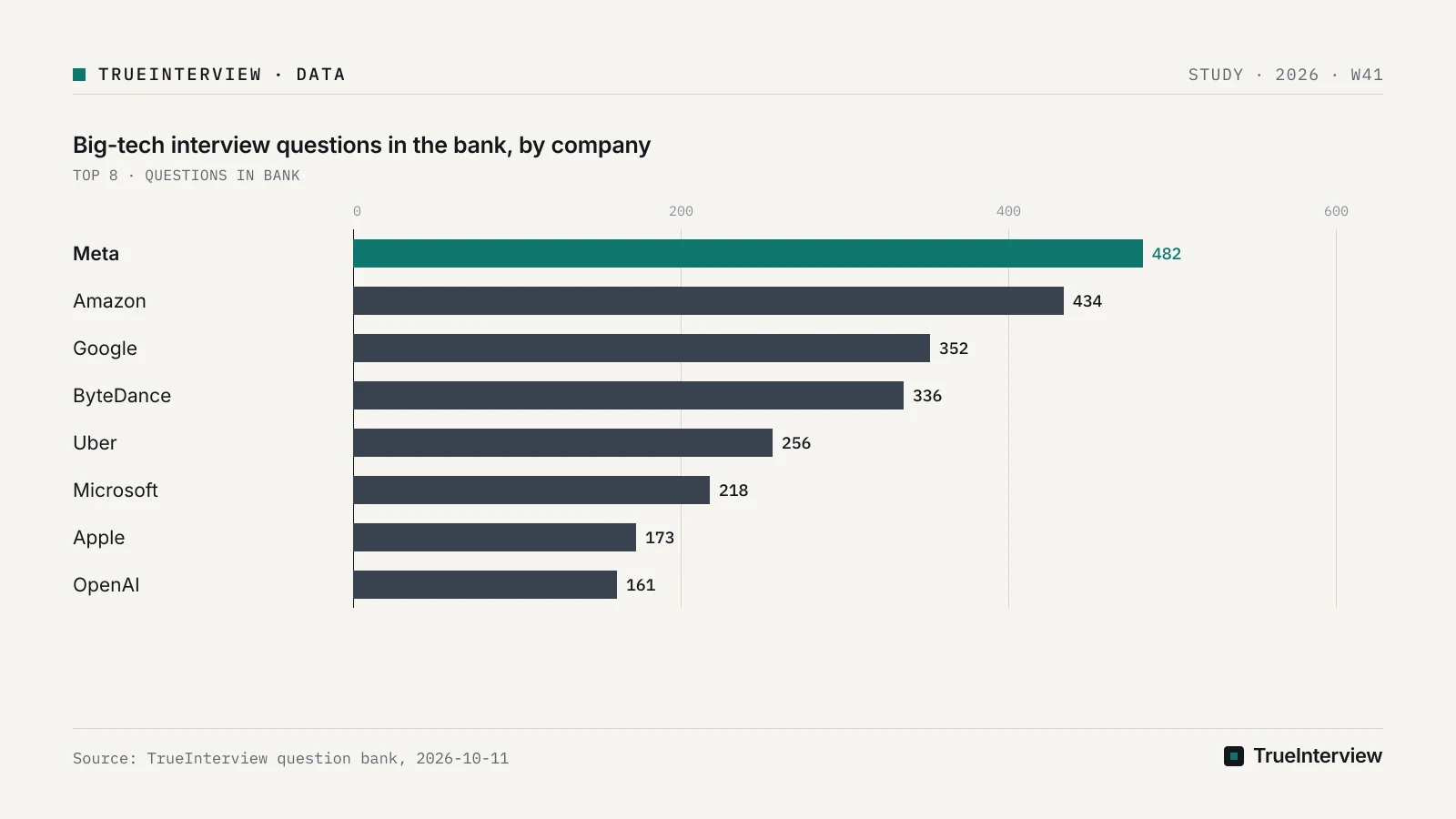
Let your target company's reported round mix set the split, because the mixes differ more than generic advice admits. Meta files 148 behavioral and knowledge questions and 62 SQL questions against 75 system design, while Google files 189 coding questions against 39 system design.
Amazon sits between them, with 195 coding, 114 behavioral and knowledge, 50 system design and 44 object-oriented design questions. A plan built only around fixing the design round fits none of the three exactly.
If your target reports a behavioral and SQL-heavy mix like Meta's, spend the first week on scope stories and project deep dives and the second on one ranking or experiment-design family. If it reports a coding-dominant mix like Google's, give the first week to its coding leaders, graphs (41), arrays (27) and hashing (23), and the second to one senior-tilted design family plus your stories.
Take a senior candidate targeting Meta as the worked example. Meta's design questions are led by ads, recommendation and ranking ML (14), A/B testing and experiment design (9) and news feed and social graph (5). That points to Reels / Short Video Recommendation plus an experiment prompt such as Design Pricing Model Experiment or Design a switchback and choose block length, both filed at Uber. Their coding block then goes to Meta's leaders, graphs (24), strings (22) and trees (20), rather than to dynamic programming.
Skip practice lists ranked by how many companies a question is filed under. Merge Intervals is filed under 12 big-tech companies but linked from 0 candidate write-ups.
What should you ask your recruiter before the loop?
Ask about level before the first recorded interview, because a former Amazon recruiter writing on Levels.fyi says "Level cannot be negotiated at the end of the process." Get the answer in writing, and ask which rounds will carry the level decision.
| Question to ask | Why it matters | What to do with the answer |
|---|---|---|
| Which level am I being considered for, and can you confirm it in writing? | InterviewLegend's Apple guide says the numeric level rarely appears on a posting and many recruiters will not state it before the offer | Ask once you are invited to the first round, as Levels.fyi's guide suggests, and ask for the answer in writing as InterviewLegend's guide advises |
| Is there a system design round at this level, and how many? | Levels.fyi's Amazon guide says L4 engineers have no system design round while L5 and above are expected to do exceptionally well in it | If there are two, move a week from coding into two senior-tilted design families |
| Is the hiring-manager or behavioral round scored for level? | Amazon's SDE III prep page says each interviewer typically asks two or three behavioral questions tied to the Leadership Principles | Build four or five scope stories in the company's own vocabulary |
| If the panel splits, do you offer the lower level or reject? | The split-loop pattern described above usually resolves downward | Decide your floor before the loop: the lowest level you would accept, and why |
| If the offer comes back lower, will you share the reasoning and allow a re-review or an extra round? | DataVidhya's lesson says to get the reasoning before you react, and that you can ask for a re-review or an additional round | Bring evidence rather than tenure (see the decision rule below) |
| When will I hear, and does team matching come before the level is final? | SpaceComplexity's guide gives decision timelines of 5-14 days for Amazon, 1-2 weeks plus team matching for Meta and 2-6 weeks for Google | Keep competing processes open through that window, since a comparable senior offer is your strongest appeal |
Should you accept a lower level or walk away?
Accept a lower level when the role still moves you forward; push back or walk when you already hold the target level somewhere comparable. Levels.fyi's Amazon guide says down-leveling is common and can still end in an offer, while fewer than one percent of candidates are up-leveled during the process.
Business Insider's report says, quoting Mai, that for someone already in Big Tech, accepting a down-level can pull a career back several years, and that someone with a seat at the table can afford to be pickier. DataVidhya's lesson says appeals succeed on interview evidence or new signal: a round you can argue was mis-scored, a senior offer from a comparable company, or a request for one more interview.
Our take: use this decision rule.
- Accept if you are moving into big tech for the first time, the team and scope are what you want, and the pay gap is one you can live with (see the FAQ on pay).
- Appeal once if the feedback points at a single round you can argue was mis-scored, or you hold a senior offer from a comparable company. Put the evidence in writing.
- Walk away if you already hold the target level at a comparable company and the offer would restart your promotion clock.
- Never appeal on tenure alone. An appeal that cites years of experience gives the committee nothing new to read; cite a round, a score or an offer.
How we counted
Counts come from TrueInterview's question bank as of 2026-10-11: 3432 candidate-reported questions from 25 big-tech companies, 2729 of them last reported in the 12 months before that date. Level splits use the level each candidate reported in their write-up, and they count links, not people: one write-up can link several questions, so the 3291 senior-or-above links are not 3291 candidates. These are candidate-reported questions reconstructed for practice, not any company's official question list.
FAQ
Can I negotiate the level after the offer?
Rarely, and the guides advise against waiting that long. InterviewLegend's Apple guide says to contest the level during the loop, while the impression is still forming, rather than after a verbal offer, when the call has effectively been made. After the offer, the realistic path is an appeal built on interview evidence or a comparable senior offer, not on years of experience, as the decision rule above sets out.
Can I negotiate pay instead of the level?
Partly. DataVidhya's lesson says top-of-band E4 with a strong sign-on can land within 10-15% of entry E5 total compensation in year one. That narrows the first-year gap, but it does not change the band you are measured against for promotion, refreshers or your next job search. Ask for top of band and a sign-on first, then judge the level as if the year-one gap did not exist.
How long does promotion take after a down-level?
Longer than most candidates assume when they sign. DataVidhya's lesson says E4 to E5 at Meta or Google typically takes 2 to 4 years, with twice-yearly cycles and real quotas. Commenters in a Taro thread about a Google down-level said Google promotes slowly and requires projects that land, and that if promotion takes too long you can leave and be considered mid-level elsewhere. Price the offer as if promotion takes the slow end of that range, and accept only if the lower band still works for those years.
Does more experience protect me from down-leveling?
No. InterviewLegend's Apple guide says year counts are rough minimums, because scope, not tenure, sets the rung. What protects you is evidence of scope in the interviewer's notes: decisions you owned, options you rejected and impact you can quantify. Build those into every story and design answer, because the committee reads the notes, not your résumé history.
Your practice plan
Three weeks, a few evenings each, built for someone working full time. The order follows the counts: scope first, a design family second, coding last.
- Before week one. Send your recruiter the first two questions from the table above. Then open your target in the question bank by company and write a one-line split for each week from its round mix.
- Week one: four scope stories. Write the most impactful project, a cross-team influence story, a failure with a lesson and a motivation story. According to one author's Medium post, each should name the options considered and rejected and quantify the impact. Rehearse them against Onsite BQ + Hiring Manager + Project Deep-Dive and Culture & Behavioral Interview Questions.
- Week one, last evening. Map each story to your target's vocabulary: the Leadership Principles Standard Set for Amazon or the Behavioral Round (Googliness Themes) for Google. Amazon's SDE III prep page advises framing answers with the STAR method.
- Week two: one senior-tilted design family. Pick it from the tilt table. For each prompt, write the volume math, two failure modes, the cost driver and the trade-off you would reject, and practise saying them before anyone asks.
- Week two, second half. Drill your most impactful project as a resume walkthrough with Project Deep Dive (Resume Drill), answering who decided, what you rejected and what you would change.
- Week three: coding at maintenance. Work your target's coding leaders with a few math problems, skip any new dynamic programming block, and add one object-oriented design rep such as Rate Limiter, plus one AI-assisted Maze Solver rep if your target reports that format.
- Week three, last evening. Write down your floor level and the evidence you would use in an appeal, so the decision after the offer is already made.
Sources
- TrueInterview question bank — big-tech interview at big-tech companies — counted 2026-10-11
- 'Downleveled' Coding Offers on the Rise, Says Former Meta Manager - Business Insider — checked 2026-10-11
- The Interviewers Liked You. Now the Hiring Committee Decides. · SpaceComplexity — checked 2026-10-11
- Downleveling · Data Engineering Interview Prep: The Complete Course | Data Vidhya — checked 2026-10-11
- The $100K+ Mistake: How to Avoid Getting Down-Leveled - Part 1 — checked 2026-10-11
- How Apple Makes Hiring Decisions | InterviewLegend — checked 2026-10-11
- Quick success after getting down leveled — checked 2026-10-11
- Insights from a Former Amazon Recruiter on Salary Negotiation — checked 2026-10-11
- Learnings from conducting ~1,000 interviews at Amazon — checked 2026-10-11
- Medium — checked 2026-10-11
- Software Engineer at Google (2026) — checked 2026-10-11
- SDE III Interview Prep — checked 2026-10-11
Last reviewed: 2026-10-11.