Study
Which System Design Problems Gained Share in 2026?
TrueInterview
October 11, 2026 · 11 min read
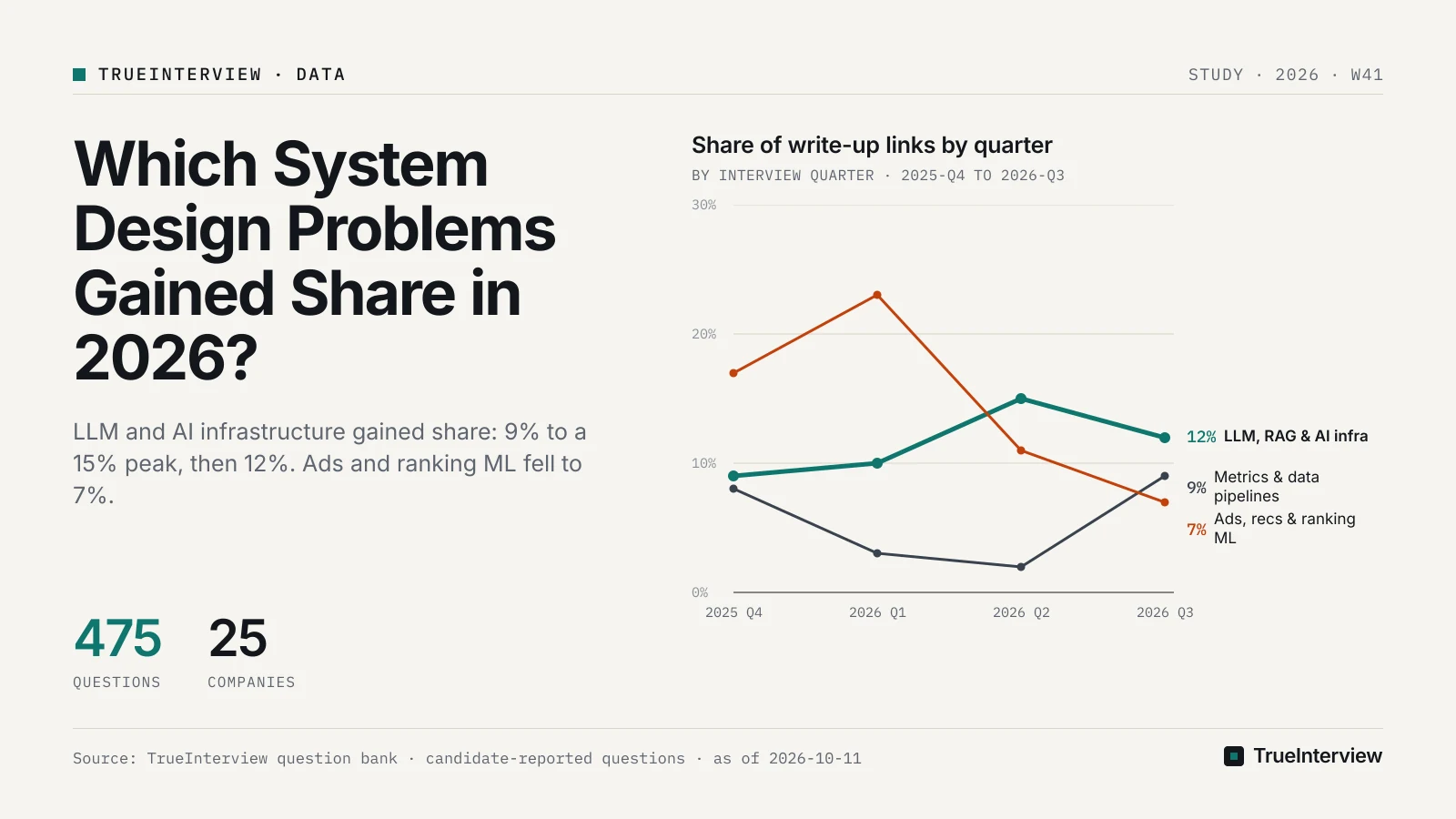
LLM, RAG and AI infrastructure is the only system design family to gain share of candidate write-up links over the last four quarters: its share rose from 9% in 2025-Q4 to a 15% peak in 2026-Q2, then eased to 12% in 2026-Q3. Ads, recommendation and ranking ML moved the other way, from 23% of links in 2026-Q1 to 7% in 2026-Q3. Our reading is that the mix is shifting rather than turning over, and that your target company and the round you face still decide your loop more than the calendar does.
Disclosure: TrueInterview is an interview-preparation product and publishes this article. Facts about other products come from their public pages on the dates listed under Sources.
Which system design families rose and fell across the last four quarters?
Two families swapped places this year. Ads, recommendation and ranking ML led the link share through the first quarter of this year, LLM and AI infrastructure overtook it in the second quarter and stayed ahead in the third, and metrics, logging and data pipelines dipped for two quarters and ended roughly where it started. The table gives each family's share of write-up links per interview quarter, with the link count in brackets.
| Design family | 2025-Q4 | 2026-Q1 | 2026-Q2 | 2026-Q3 | What we read |
|---|---|---|---|---|---|
| LLM, RAG and AI infrastructure | 9% (9) | 10% (25) | 15% (43) | 12% (16) | Peaked in Q2, eased in Q3 |
| Ads, recommendation and ranking ML | 17% (17) | 23% (58) | 11% (30) | 7% (9) | Falling since its Q1 peak |
| Metrics, logging and data pipelines | 8% (8) | 3% (7) | 2% (6) | 9% (12) | Flat on thin counts |
| A/B testing and experiment design | 0% (0) | 0% (1) | 0% (0) | 0% (0) | No link signal at all |
Read each row across, and do not compare raw counts down a column, because the quarters differ in how many write-ups were collected. The crossing in the second quarter is the one movement large enough to change a study plan. The third-quarter easing of the AI row is a few percentage points on a quarter with fewer links, so we would not call it a reversal.
Exponent's 2026 guide says, "System design interviews are harder to pass in 2026, but the questions themselves haven't changed much." Our numbers agree with the second half for most of the bank and disagree for one family. If you have a month, the AI movement justifies a dedicated block of sessions; it does not justify dropping the classic families.
What gained share: why did LLM and AI infrastructure grow?
LLM, RAG and AI infrastructure is the second-largest family in the bank at 42 questions, behind ads and ranking ML at 59. It gained share up to a second-quarter peak this year, and the most-linked prompts in it are infrastructure problems with a model inside, closer to a capacity-planning exercise than to an ML theory question.
Both GPU prompts are linked from 22 write-ups each, with different level profiles. Design GPU Inference Serving System is reported at one company in the bank, Anthropic. All of its links come from senior-or-above candidates, and the prompt was last reported in an Anthropic phone screen in 2026-07. Design GPU Scheduling Platform's write-up links come from 3 big-tech companies (OpenAI, Anthropic, Databricks). Of those links, 19 come from senior-or-above candidates and 3 from junior-or-below candidates, and it was last reported in a Databricks onsite in 2026-07. The bank also files Anthropic's Design AI Prompt Playground and Design Distributed AI Model Downloader in this family.
Our take: as general engineering practice, prepare an inference-serving design to settle batching against latency, meaning how you group requests to keep GPUs busy within a response-time target, and what you shed first when the request backlog grows. For a GPU scheduling design, prepare your answers on fairness and preemption: who gets the cluster when jobs exceed capacity, and what happens to a half-finished training job you evict. Practise both on the GPU inference serving prompt and the GPU scheduling prompt.
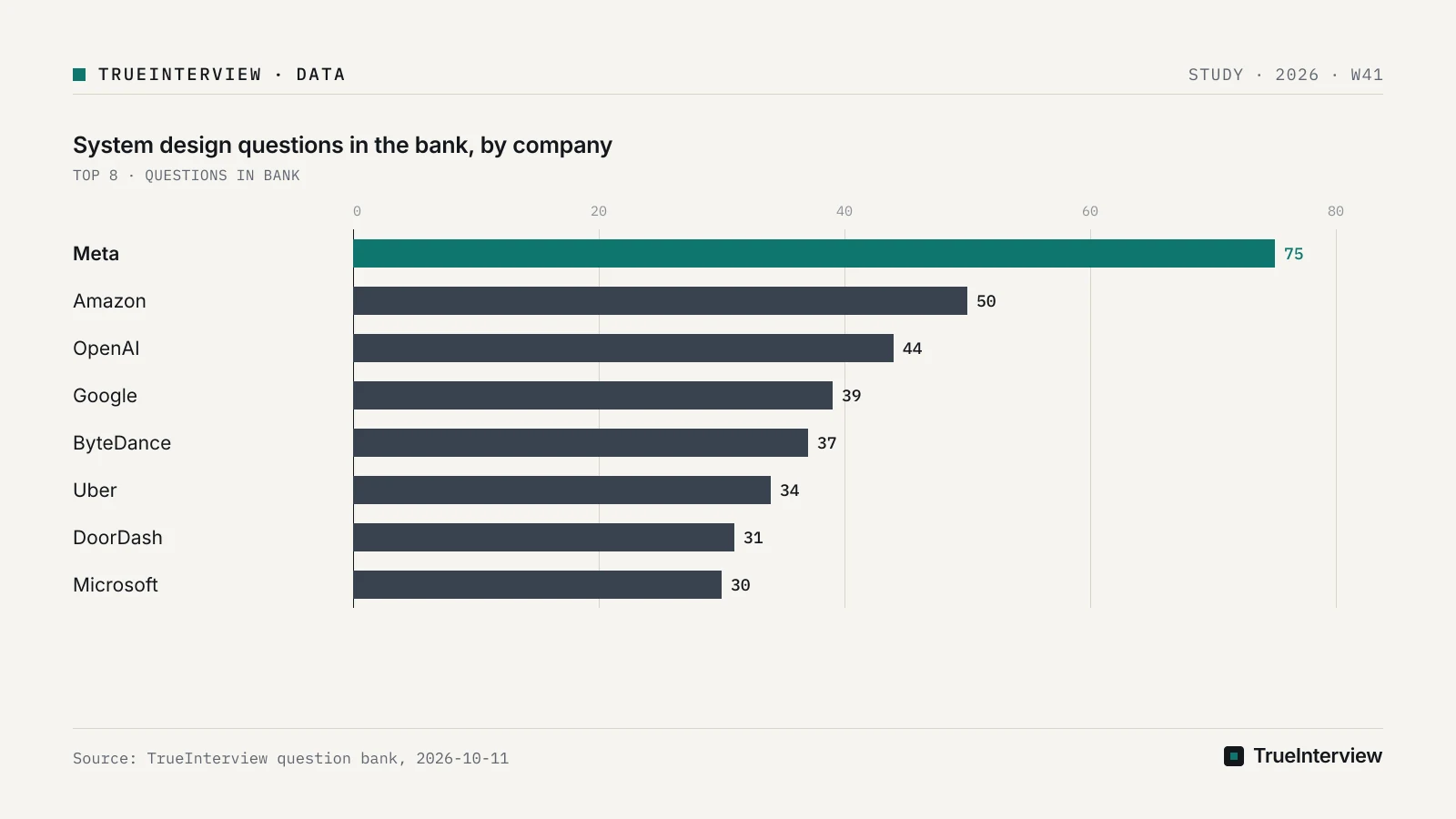
Exponent's guide says "LLM infrastructure prompts now reach general software engineer loops". The company split in our bank supports a narrower claim when you read each count against the company's filed total. OpenAI files 9 of its 44 design questions in this family. Amazon files 5 of its 50. Google files 2 of its 39 and Meta 2 of its 75, and Uber 1 of its 34.
Our take: the gain in share is concentrated at AI-native employers. Treat AI infrastructure as a three-session module you add to a distributed-systems core, unless OpenAI, Anthropic or Databricks is on your list, in which case it is the core.
What fell: is ads and ranking ML still worth your time?
Ads, recommendation and ranking ML dropped from 23% of write-up links in 2026-Q1 to 11% in 2026-Q2 and 7% in 2026-Q3. The last figure rests on the smallest link base of the four quarters, but the larger drop happened between the two biggest quarters. It is still the largest family in the bank, so the fall is a signal about general loops, not about the employers that file it heavily. If Meta, ByteDance or Uber is your target, keep it; otherwise move it down your queue.
The employer split is lopsided. Meta files 14 of its 75 design questions in this family, ByteDance 6 of its 37 and Uber 5 of its 34. Netflix's Design an Ads Frequency Cap System was last reported in an onsite in 2026-08, and every one of its 13 write-up links comes from a senior-or-above candidate. Our take: as general engineering practice, a frequency-cap design should state where the cap is enforced and how impressions per user per time window are counted without one hot counter becoming the bottleneck. Practise it on the ads frequency cap prompt.
A single quarter's spike can come from a handful of loops written up together, so we would not treat the first-quarter peak as the family's normal level. What matters for your plan is direction over two quarters, and that direction is down.
Is metrics and logging coming back?
Not on this evidence. Metrics, logging and data pipelines took 8% of write-up links in 2025-Q4 and 9% in 2026-Q3, with a dip to 3% and 2% in between, and the latest figure rests on 12 links. Read that as flat on thin counts, not as a return. The family's steadier support comes from the onsite round, covered in the round table below.
Amazon files 7 metrics, logging and data pipeline questions, its largest design family. Design Metrics System is linked from 10 write-ups, 9 of them from senior-or-above candidates. Our take: as general engineering practice, a metrics design should settle cardinality and cost: how many time series a new label creates, how you pre-aggregate before storage, and what you do with data that arrives after its window has closed.
What do the trend lines miss?
Link share only sees families that candidates write up in detail, and it measures something different from how questions are filed by round. Across all rounds, A/B testing and experiment design drew one write-up link in four quarters. Counted as filed questions instead, it is the largest family among the 162 design questions reported for the phone-screen round, at 24. The two numbers measure different things, links versus filed questions, so a flat line in the trend table does not mean a family is absent from your loop.
Filing breadth misleads in the other direction. Design TinyURL is filed under 6 companies in the bank but linked from only 5 write-ups. Design Job Scheduler is filed under 12 companies. It is linked from 21 write-ups, reported from six of those companies: LinkedIn, Robinhood, Databricks, Lyft, DoorDash and Airbnb. Of the 21, 16 come from senior-or-above candidates. Design Gurus' guide calls a distributed task scheduler "Increasingly common for senior roles." Robinhood's phone screen reported it as recently as 2026-09.
Payments is the other high-link family the trend table does not track. Design Payment System is linked from 27 write-ups from OpenAI and ByteDance. Payment / Coffee-Shop Ordering is a separate prompt. It was last reported in an OpenAI phone screen in 2026-06, and it is linked from 16 write-ups. From the title alone, our reading is that it is a payments problem set in a café; the reports in the bank do not describe its content. One candidate's write-up on Stackademic reports that Stripe cares about payment reliability and reconciliation. Our take: as general engineering practice, any payments design should carry an idempotency key on every write and a double-entry ledger you can reconcile.
What should you prep in the next month, by round and level?
Sort by round first, then by level. Candidate write-ups link these questions 676 times from senior, staff-plus or manager candidates and 132 times from junior, new-grad or intern candidates, so the senior evidence is about five times deeper. Phone screens and onsites draw from different families, and the tables below turn both splits into a first month.
| Round | Questions reported | Leading families |
|---|---|---|
| Phone screen | 162 | A/B testing and experiment design 24, LLM/RAG/AI infrastructure 16, ads/ranking ML 16, metrics/logging 10 |
| Onsite | 336 | Ads/ranking ML 45, LLM/RAG/AI infrastructure 28, booking/inventory/ticketing 24, metrics/logging 23 |
For a phone screen, spend your first sessions on experiment design and one AI infrastructure prompt. For an onsite, start with your target company's largest family, then add one booking or metrics design. Pinterest's Design Inventory Management System, last reported in an onsite in 2026-09, is a good booking-family rehearsal.
| Your level | What the write-ups show | First month |
|---|---|---|
| Junior, new grad or mid-level | Junior-or-below links are a minority even on the broadest prompts: Job Scheduler 5 of 21, Payment System 4 of 27, Slack-like Chat System 3 of 19 | Job Scheduler and one payments design first; AI infrastructure as a stretch session |
| Senior (L5/E5) | LLM/RAG/AI infrastructure draws 89 senior-or-above links against 12 junior-or-below | AI infrastructure is core; add your company's top family and payments |
| Staff-plus (L6+) | Staff-plus and manager links include GPU Inference Serving (2) and Job Scheduler (2) | The same prompts, carried to failure modes, cost and migration |
The family that gained share is senior-weighted, which changes how much of it a junior candidate needs. Below senior, the trend is a reason to know the vocabulary of model serving, not a reason to rebuild your plan.
What changes at senior and staff level?
At senior level the family that gained share stops being optional. Several problems are linked only from senior-or-above write-ups: besides GPU Inference Serving System, the list includes the Ads Frequency Cap, the Ads Demand Platform data model (12), Google News (11) and Reels / Short Video Recommendation (6). None of these has a single junior-or-below link.
LastRound AI's blog says "more than half the senior rounds we see in 2026 include at least one LLM-flavoured question". Our bank cannot measure a per-round rate, but the senior-only list above points the same way.
At staff level the shift is depth, not new families. The staff-plus and manager links also include an L6 staff-loop system design question, a LinkedIn data mining and ML system design question, and harmful-content detection, two links each. Our take: the same Job Scheduler prompt that a mid-level candidate answers with workers and a retry policy is judged at staff level on scheduling semantics, fairness between tenants, and what breaks first when traffic grows tenfold.
Down-leveling note (our view): the design round is where level is decided. A correct but shallow answer to GPU scheduling or payments reads as senior-minus. Pick one component per prompt and carry it to failure handling and cost before the interviewer asks.
How we counted
As of 2026-10-11, the bank holds 475 system design questions reported at 25 big-tech companies. Each link is a candidate write-up that points to a question, dated by the quarter of the interview; links number 99 in 2025-Q4, 254 in 2026-Q1, 284 in 2026-Q2 and 135 in 2026-Q3, and those totals mostly reflect how many write-ups were collected, which is why this article compares shares. Families are assigned from question titles, levels are the ones candidates reported themselves, and the counts describe what candidates wrote up, not how often a company asks a question.
FAQ
Has AI system design replaced the classic distributed-systems round?
No. Distributed systems still accounts for 256 of the 475 design questions in the bank, against 125 for ML system design. The AI family is a growing slice of an unchanged core. If your loop includes an AI prompt, it will most likely sit alongside a classic one, so a plan that skips caching, partitioning and consistency to make room for model serving trades a certain question for a possible one.
Do I need a machine learning background for LLM infrastructure prompts?
Less than the name suggests. A Stackademic article says these prompts are systems questions about latency, cost, failure modes and state, with one component that is a slow and expensive model. You need to reason about GPU capacity, batching, caching of repeated work and fallbacks when the model is slow or wrong. Model training details rarely decide these designs; capacity and failure handling do.
Are these the questions companies officially ask?
No. They are candidate-reported questions reconstructed for practice, not any company's official question list. A count tells you where candidates' write-ups cluster, which is the closest public signal of what a loop contains, but it is not a probability that you will receive a given prompt. Use the counts to order your practice, and use your recruiter to confirm the round format.
How fresh is the data behind these trends?
Recent enough to plan a month on. Of the 475 questions, 399 were last reported within the 12 months before 2026-10-11. The newest quarter has fewer links than the one before it, so a small move in the latest quarter deserves less weight than a move that holds across two quarters.
Your practice plan
A three-week plan for someone working full time, built from the trend and the round split above.
- First week, two sessions: Design GPU Inference Serving System. Write the batching policy and the load-shedding rule before you draw anything.
- First week, one session: Design GPU Scheduling Platform, with a written answer on preemption and what happens to an evicted job.
- Second week, one session: Design Job Scheduler, first at mid-level depth, then again with tenant fairness and failure recovery.
- Second week, one session: Payment / Coffee-Shop Ordering or Design Payment System. As general payments practice, name the idempotency key and the ledger entries for each write.
- Third week, if your loop has an onsite: one booking-family design such as Design Inventory Management System, then your target company's largest family.
- Third week, if Meta, ByteDance or Uber is on your list: Design an Ads Frequency Cap System. If not, spend that session on a metrics pipeline instead.
- Before each loop, filter the question bank by your target company and redo the two prompts you found hardest.
Sources
- TrueInterview question bank — system design at big-tech companies — counted 2026-10-11
- System Design Interview Prep & Questions (2026 Guide) - Aced (formerly Exponent) — checked 2026-10-11
- System Design Interviews at Google, Amazon, and Meta: The 2026 Guide — checked 2026-10-11
- Medium — checked 2026-10-11
- System Design Interview 2026: LLM Apps, Vector DBs, and What Changed | LastRound AI — checked 2026-10-11
- Medium — checked 2026-10-11
Last reviewed: 2026-10-11.