Voleon · Study
Voleon Interview Process & Questions
TrueInterview
October 13, 2026 · 9 min read
Voleon's coding rounds are rule-driven simulations rather than textbook puzzles: balls that change color as they pass marked points, or a broker program filling client orders on a fictional exchange. Each problem comes in parts that extend the same code, and the later parts demand a closed-form or linear-time shortcut. Research and data candidates take a separate, statistics-heavy track. Late in the process, candidates face a reference check with at least three references, probed at length.
This guide breaks down each stage of the Voleon interview, what interviewers evaluate in each round, and how to prepare, with questions candidates were actually asked.
Verified: Based on 5 candidate-reported interview experiences, cross-checked against recent public accounts.
Voleon interview process
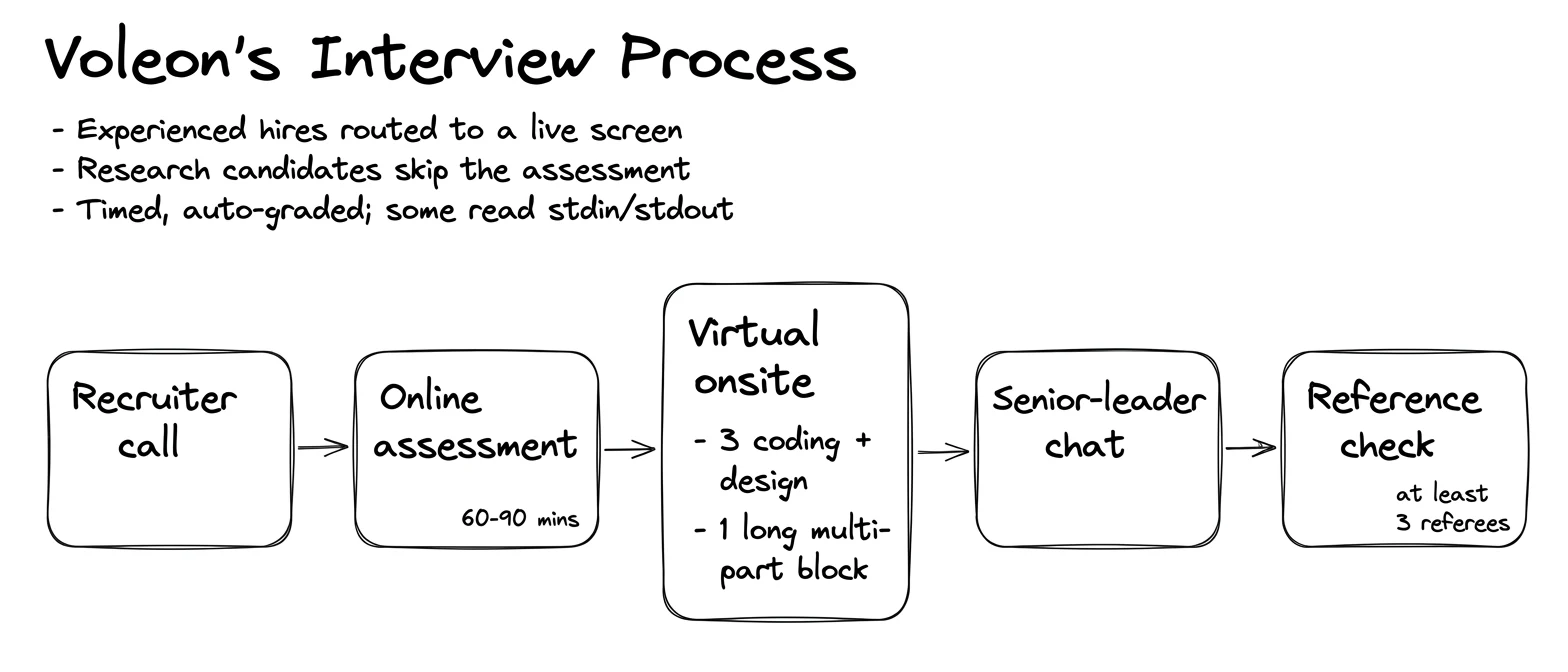
The loop depends on the track more than the team. Software and quantitative-developer candidates code at every technical step, and the design component is algorithmic rather than architectural. Machine-learning research and data-science candidates get statistics, linear algebra and ML theory plus hands-on pandas work, and research candidates typically skip the online assessment.
A software loop typically runs from a recruiter call to an online assessment or live screen, a virtual onsite of about four parts, a senior-leader conversation and the reference check. Early-career candidates usually enter through the assessment; experienced hires are more often routed to a live screen.
Here's what the interview process can look like:
- Online assessment (most software and early-career candidates): A 60–90 minute simulation problem in parts, each extending the previous code.
- Technical phone screen: About an hour of live coding on one problem with an optimization follow-up.
- Virtual onsite (software tracks): About four sessions of coding and design, including one long multi-part block.
- Research and data interviews (research and data tracks): Statistics and ML theory plus hands-on pandas or pipeline work.
Tip: Before coding any Voleon simulation, trace three or four steps of the update rule by hand. The errors candidates report come from update ordering (flip before or after moving) and off-by-one indexing, not from the algorithm.
Online assessment
The assessment is timed and auto-graded, and some versions read from standard input and write to standard output. Reported lengths are one hour for a software role and 90 minutes for a quantitative role, each a single problem split into parts.
The software version was a Kac ring: N points on a circle hold white balls, all balls move one place clockwise per step, and a ball leaving one of M marked points flips color. Part 1 asked for step() and an O(1) color() returning (white minus black) / N; Part 2 asked for an O(1) kstep(). The quantitative version, set on a "Berkeley Exchange," first tracked trade prints and answered volume queries, then added client orders capped at a percentage of the trailing minute's volume and filled at the previous trade price. That candidate ran out of time before Part 3.
Interviewers evaluate:
- Precise reading of the rules: The fill price, the trailing window and the order of operations all change the output.
- Extensible code: Part 2 reuses Part 1's per-security state, so a clean first part saves the most time.
- Complexity on demand: O(1) methods mean maintaining counts incrementally instead of looping.
- Partial progress: The 90-minute version was too short for every part, so working early parts count.
Practice multi-part simulations on a timer, writing Part 1 so it extends without a rewrite.
Note: A candidate who had practiced a stock-trading variant got a different one on test day. Prepare the pattern (event stream, per-key state, rolling window), not a memorized solution.
Sample questions for the online assessment
Here are some questions reported by recent candidates:
-
Implement a Kac ring with O(1) methods for the white-minus-black ratio and for advancing k steps.
-
Read trade prints and volume-check commands, and print each security's traded volume up to the query time.
-
Add client orders limited by a participation rate of trailing-minute volume, printing each fill.
-
Berkeley Exchange: Market Activity Tracker and Client Order Trading
Technical phone screen
The screen is a live session of about an hour with an engineer or researcher, usually one problem plus an optimization follow-up. A 2026 screen kept the simulation flavor: balls in a line toggled at moving marked positions, with a follow-up for the state after k steps in O(N). Another was a classic interval problem, the earliest time at which the most processes overlap. That interviewer gave several hints, but the candidate still missed the optimal sweep.
Interviewers evaluate:
- Reaching the optimal bound: For the toggling follow-up, count hits per index over k steps and use parity instead of simulating.
- Pattern fluency: Sweep lines, prefix counts and hashing should come quickly.
- Stated edge cases: Half-open intervals and "earliest on ties" are in the prompt and tested.
- Independence: Hints are offered, but needing many costs signal.
Drill interval sweeps and parity shortcuts until the optimal solution comes without help.
Sample questions for the technical phone screen
Here are some questions reported by recent candidates:
-
Toggle balls at (marked + k) mod N on step k, print each step, then compute the state after k steps in O(N).
-
Given process intervals, return the earliest time at which the most processes are running.
-
Decide whether a binary string fits the grammar where "0" is good and "1" followed by two good strings is good.
Virtual onsite
The software onsite is typically four remote sessions, including a block of roughly two hours that chains several parts of a practical problem. A 2026 offer recipient described the rounds as an automated assessment run live, with largely silent interviewers, and rated the difficulty closer to large tech companies than to quantitative firms. Another 2026 candidate found the pace fast and the questions hard, finished every round, and was rejected by a generic email. Design prompts are concrete: sparse-matrix arithmetic behind a dispatcher, or counting queen attacks before and after blocking rocks are added.
Interviewers evaluate:
- Working without dialogue: Expect little feedback; state assumptions briefly and keep moving.
- Validation: The sparse-matrix task requires summing duplicate cells and rejecting mismatched shapes.
- Data-structure choice: Keying rows, columns and diagonals (x − y, x + y) in hash maps makes the queen count linear.
- Stamina: The long session rewards a clean first part that later parts build on.
Practice two-hour, multi-part problems in one sitting, testing each part as you go.
Tip: Treat a silent interviewer as normal here. Candidates who pause for confirmation lose time they need for the later parts.
Sample questions for the virtual onsite
Here are some questions reported by recent candidates:
-
Implement sparse-matrix add and multiply through one dispatcher, returning an error on shape mismatches.
-
Count the queens attacking each query point on an infinite grid, then again with rocks that block line of sight.
Research and data interviews
Research candidates typically start with an hour-long statistics and ML call with a PhD researcher, then a virtual onsite with back-to-back statistics and ML rounds. The questions are short and proof-flavored: the possible range of a combined regression's R-squared given each single regression's; whether a matrix with all row and column sums equal to 1 must be square or can be nilpotent; Markov transition-matrix properties; and how train and test loss move with regularization or more data. Data-science candidates also get hands-on Python work: loading a 1.5 GB CSV of unknown delimiter under a 1 GB memory cap, or auditing a time-series pipeline for leakage.
Interviewers look for:
- Derivations, not recall: R-squared bounds and the "must be square" argument need short first-principles proofs.
- Stated assumptions: Strong answers say whether an intercept is included and whether a claim holds out of sample.
- Temporal discipline: In pipeline audits, defining when each prediction is made is the core signal.
- Practical pandas: Chunked loading, dtypes and time zones are graded on correctness.
Review OLS geometry, stochastic matrices and bias-variance reasoning, and practice pandas on large, messy files.
Sample questions for the research and data interviews
Here are some questions reported by recent candidates:
-
If y on x1 has R-squared 0.1 and y on x2 has 0.2, what range can y on both take?
-
Must a real matrix whose rows and columns each sum to 1 be square, and can it be nilpotent?
-
Audit an inherited time-series pipeline for leakage, retune it safely, and add inference on unseen data.
-
Reason About Train and Test Loss Under Regularization and More Data
How Voleon makes hiring decisions
The technical rounds feed a debrief, and the bar favors optimal solutions reached without heavy hinting; one candidate who answered every question was still rejected. Offer candidates then speak with a senior leader, which for one 2026 candidate was largely a pitch for moving into quantitative finance, and go through a reference check of at least three referees questioned at length. Compensation is negotiated afterward, and that candidate saw a verbal range lowered by roughly $100K over a week.
Note: Passing every interview does not end the process. Brief your references on the length of the calls, and get every compensation figure in writing.
How to prepare for the Voleon interview
- Master rule-driven simulations: Practice ring and line problems with moving markers, then derive the shortcut through counting, parity or periodicity.
- Build event-stream programs: Write a stdin parser with per-key state and a trailing-time window, then add a second record type.
- Design Part 1 for extension: Separate parsing, state and output so later parts slot in.
- Drill sweep lines and hashing: Interval overlap, anagram signatures and diagonal keys recur in screens and onsites.
- Rehearse in silence: Solve a two-hour problem alone, since onsite interviewers often say little.
- For research tracks, practice proofs aloud: R-squared bounds, stochastic matrices and bias-variance should be derivable on the spot.
- Line up three references early: Choose people who know your work in detail and have time for a long call.
About working at Voleon
Voleon is a Berkeley-based investment manager, founded in 2007, that applies statistical machine learning to financial prediction. Much of its leadership and staff hold doctorates in statistics, computer science or mathematics, and engineers sit close to research, turning research ideas into production code and running data and modeling infrastructure. One 2026 candidate was told of significant recent reorganization.
Voleon hires across research, engineering and operations; teams include:
- Research teams: Machine-learning engineers and researchers building trading-strategy models.
- Research Engineering and Research Analytics: Software engineers working with data scientists and researchers across the core strategies.
- Data Engineering: Sourcing and ingesting datasets and building data tooling for research and production.
- Trading Operations: Data scientists supporting live trading.
Experience and education requirements
Research roles typically require PhD-level coursework, prefer a PhD, and look for evidence of mathematical strength such as publications or competition results. Python is standard, with R accepted for research. Finance experience is not required, but interest in financial applications is expected. Software roles value algorithms, production code and large-scale data experience.
FAQs about the Voleon interview
How long does the Voleon interview process take?
The interviews typically span several weeks, and the reference check and negotiation add more. One offer recipient described the process as long and drawn out.
What is the hardest round of the Voleon interview?
For software candidates, the multi-part coding work, where later parts need an O(1) or O(N) insight under time pressure. For research candidates, the proof-style statistics round.
Is there an online assessment?
Yes, for most software and early-career candidates: a 60–90 minute multi-part simulation. Research candidates typically go straight to a statistics and ML call.
How much does a Voleon software engineer make?
Posted base salary ranges for senior software engineering roles in Berkeley have been about $225K–$255K, before bonus. Packages are negotiated after the reference check.