Visa · Study
Visa Interview Process & Questions
TrueInterview
August 22, 2026 · 9 min read
Visa's engineering loop is moderate on raw algorithm difficulty but tests what candidates under-prepare. The online assessment is proctored with camera and screen recording, even for staff hires. Interviewers reuse one classic problem and tighten the constraint in the same session. Recent resume deep dives keep returning to AI, and a passed loop still waits on team matching.
This guide breaks down each stage of the Visa interview, what interviewers evaluate in each round, and how to prepare, with questions candidates were actually asked.
Verified: Based on 6 candidate-reported interview experiences, cross-checked against recent public accounts.
Visa interview process
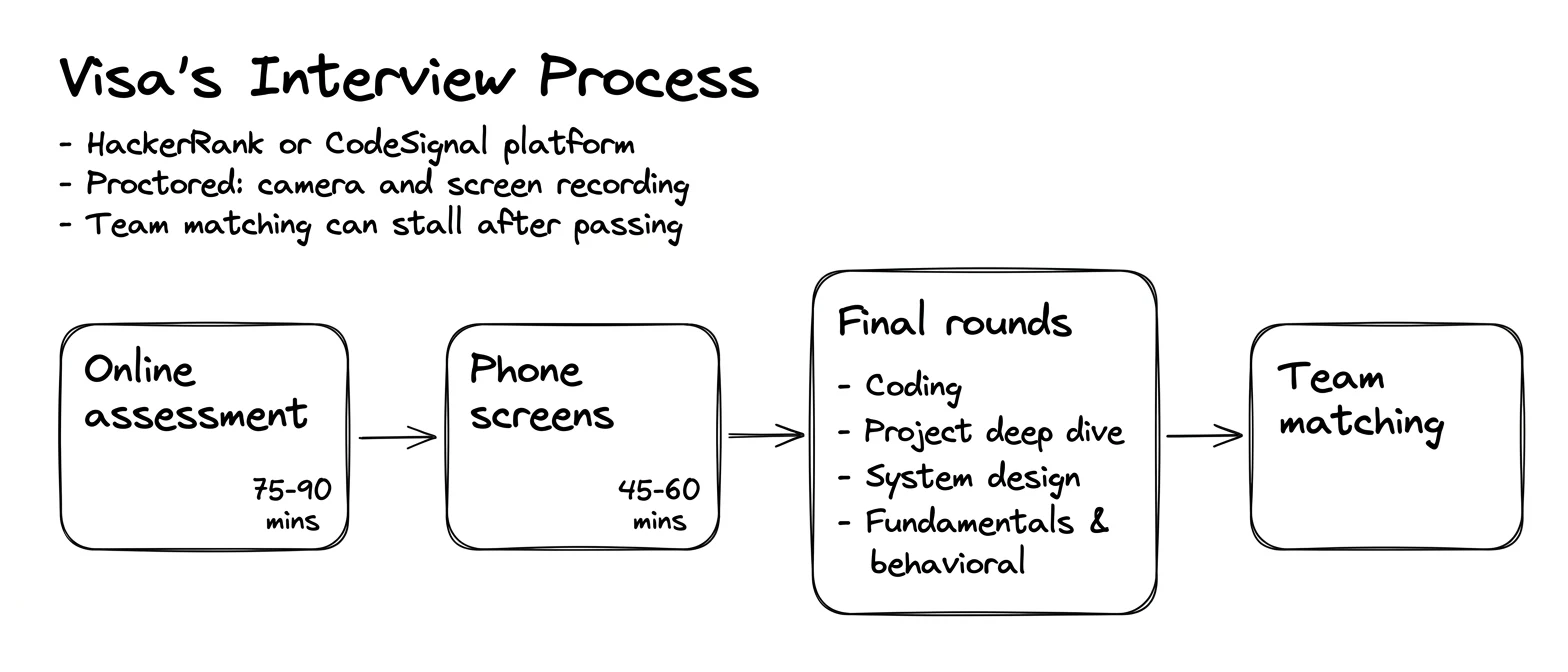
Each hiring team runs its own loop, so rounds vary by team. A typical pipeline has four to six touchpoints over three to eight weeks, each an elimination gate.
Interns and new grads usually take the assessment and then one or two short interviews that mix behavioral questions with an easy or medium problem. Senior and staff candidates take the same assessment, then two phone screens and a final round with system design. One senior loop added a fifth conversation after the onsite, on AI concepts and a second design, so the onsite is not always the last technical round.
Here's what the interview process can look like:
- Recruiter screen: A 15–20 minute call about background, goals and logistics, with no technical questions.
- Online assessment (new grad through staff): A proctored test, either two problems in 75–90 minutes or four shorter tasks in about 70 minutes.
- Technical phone screens (one or two): 45–60 minute calls pairing a project discussion with live coding.
- Final-round coding: One or two sessions built on a single well-known problem and its harder variants.
- System design and project deep dive (experienced hires): A ride-sharing-style design plus a detailed walkthrough of a resume project, often an AI one.
- Hiring manager interview: A behavioral and team-fit conversation that sometimes turns technical.
Tip: Ask the recruiter which assessment format you will get. The two-problem and four-task versions reward different pacing.
Online assessment
The assessment is Visa's main filter, and staff candidates take it too. One format is a HackerRank sitting with both problems shown at the start, 75 or 90 minutes, and camera and desktop recording throughout. The other is a four-task general coding assessment in about 70 minutes, roughly two easy and two medium-to-hard; solving three of four is typically needed to advance.
Problems are generic algorithms, not payments puzzles: digit substrings where every digit appears exactly k times, connected components from an N×N adjacency matrix, the weakest road on any path between two cities, and the cheapest way to cover a schedule with single-day and multi-day passes. A staff candidate counted subsequences of a left/right move string that end on a target point, taken modulo a large number. Hidden tests decide the grade.
Interviewers evaluate:
- Pattern recognition: Seeing union-find or BFS behind a city-and-roads story, and DP behind pass pricing.
- Counting discipline: Applying modulo at every step of a substring or subsequence count.
- Triage: Both problems are visible from the start, so choosing the order is part of the test.
- Edge cases: Disconnected graphs, impossible k values, empty schedules.
Drill timed pairs of one graph or string-counting problem and one DP problem.
Note: Camera and screen recording stay on for the full window. Use a quiet room and one monitor, and do not leave the editor.
Sample questions for the online assessment
Here are some questions reported by recent candidates:
-
Count the substrings of a digit string in which every digit present occurs exactly k times.
-
Given weighted roads, return the smallest edge weight on any path connecting two given cities.
-
Find the minimum cost to cover a set of days when each day can be bought alone or through multi-day passes.
Technical phone screens
Expect one or two 45–60 minute calls with an engineer in a shared editor. One screen was layered: easy array and string warm-ups as filters, then a memory allocator over a slot array, then a prefix-sum problem. Senior candidates got near-textbook classics such as Jump Game, and Find K Closest Elements with binary search expected. The talk covers latency in distributed systems, a past project's design decisions, and how you use AI and prompt engineering at work. One experienced candidate got behavioral questions plus an Uber-style design instead.
Interviewers evaluate:
- Clean warm-ups: A bug on the easy problem costs more than a partial answer on the hard one.
- State management: Handling fragmented free space, and asking about first fit versus best fit before coding.
- Optimization: Deriving the O(n) prefix-sum formula instead of stopping at O(n²).
- Systems vocabulary: Explaining where latency comes from in a distributed call path.
Practice simulations that keep state across a stream of queries.
Sample questions for the technical phone screens
Here are some questions reported by recent candidates:
-
Process allocate(size) and erase(start, size) queries over free and occupied slots, returning the start index or -1 for each allocation.
-
For each element of a sorted array, return the sum of its absolute differences with every other element.
-
Return the k elements closest to a target in a sorted array, using binary search to place the window.
Final-round coding
Final coding sessions build on one problem rather than switch topics. One interviewer asked for one-transaction stock profit, then at most two transactions, expecting the candidate to turn the minimum-price scan into left and right profit arrays and trace sample prices by hand. Another used Course Schedule framed as ML tasks with prerequisites: topological sort, cycle detection, and scaling to thousands of tasks. Some loops add fundamentals: object-oriented principles, Java concurrency, hash map internals, SQL and REST.
Interviewers evaluate:
- Extending a solution: Reaching the constrained variant without starting over.
- Verification: Walking test cases before being asked.
- Complexity reasoning: Time and space of the final version and its behavior at scale.
- Fundamentals: Explaining language and data-structure internals, not just using them.
Rehearse each base problem and one harder variant back to back within 30 minutes.
Tip: For each classic you practice, prepare the follow-up too: two transactions after one, cycle detection after ordering, the bottleneck path after the shortest path.
Sample questions for the final-round coding
Here are some questions reported by recent candidates:
-
Maximize profit from one buy and one sell, then from at most two non-overlapping transactions.
-
Given ML tasks with prerequisite pairs, decide whether all can finish, and discuss scaling to thousands of tasks.
System design and project deep dive
For experienced hires, two separate reports describe an Uber-like ride-sharing design: rider-driver matching, live location over WebSockets, geographic partitioning, the schema, global traffic, low latency and bursts. The round is conversational and rewards the core workflow and data flow with trade-offs, not long component lists. Elevator systems and large websites are also reported. The deep dive goes past impact: one candidate defended a generative AI project's architecture, data pipeline, evaluation, latency and hallucination handling, and another explained a knowledge base's data sources and the API serving it.
Interviewers evaluate:
- Core flow first: Matching and location updates end to end before caching or analytics.
- Scaling choices: Geographic sharding, burst absorption, a fast matching path.
- Reliability instincts: Failover and idempotent retries, which matter on a network that cannot go down.
- Implementation-level ownership: Loss functions, metrics and failure modes of what you built.
Prepare a 20-minute ride-matching design and know each resume project down to its data sources.
Note: One senior candidate met AI questions in a phone screen, the onsite deep dive and a final AI-concepts conversation. Treat AI fluency as a thread through the whole loop.
Sample questions for the system design and project deep dive
Here are some questions reported by recent candidates:
-
Design a ride-sharing service with rider-driver matching, live tracking, geographic partitioning and burst handling.
-
Walk through a generative AI project's architecture, data pipeline, evaluation and hallucination handling.
-
Designing Real-Time Instant Messaging Application with Media Support
Hiring manager interview
This round is usually behavioral and team-fit: challenging situations, disagreements, collaboration, ownership and why Visa. Some managers push on scaling and fault tolerance instead. Behavioral questions also open some phone screens.
Interviewers evaluate:
- Ownership: Concrete decisions you made and their outcomes.
- Conflict handling: How a disagreement was resolved and what changed afterward.
- Technical judgment: Fault-tolerance trade-offs when the manager probes.
Prepare five or six stories plus one technical walkthrough.
Sample questions for the hiring manager interview
Here are some questions reported by recent candidates:
- Describe a difficult technical decision and the alternatives you rejected.
- How do you use AI tools in your day-to-day work?
How Visa makes hiring decisions
Feedback typically goes to the hiring manager and team, who decide together; some candidates heard back the day after the final round. Passing is not an offer: one senior candidate called post-loop team matching the slowest, least predictable part, with delays and possible mismatches. Rejections come with little explanation.
How to prepare for the Visa interview
- Rehearse the proctored format: Two problems in 75 minutes, camera on, one screen, hidden-test edge cases first.
- Pair graphs with DP: Connected components, bottleneck paths and pass-pricing DP, with modulo in every count.
- Prepare the next variant: Solve each classic and its constrained follow-up within 30 minutes.
- Build stateful simulations: Write a slot allocator and settle the fit strategy before coding.
- Own a ride-matching design: Matching, live location, partitioning and bursts, with a trade-off for each.
- Know your AI work deeply: Architecture, evaluation, latency, hallucination handling and your daily prompt practice.
- Ask about team matching early: Learn whether the role is tied to a team or matched after the loop.
About working at Visa
Visa engineers build the systems behind one of the largest payment networks, with heavy emphasis on scalability, security and reliability. Backend work is mostly Java, Spring Boot and REST, with Kafka and cloud tooling on some teams. Hubs include Foster City, Austin, Bellevue, Highlands Ranch, Bengaluru, Warsaw and Belfast, and hybrid roles typically require two or three set office days a week.
| Level | Primary focus | Impact scope |
|---|---|---|
| Associate Software Engineer | Well-defined features with guidance | Tasks within one team |
| Software Engineer | Features, code reviews and testing | One team's services |
| Senior Software Engineer | Architecture and design decisions, mentoring | A product area |
| Staff Software Engineer | Product features and system architecture | Several teams |
Visa hires engineers across its processing and product businesses. Teams include:
- VisaNet: The global authorization and settlement network, handling tens of thousands of transaction messages per second.
- Cybersource: Merchant payment gateway and payment management services.
- Payment Services and Transaction Platforms: Core transaction processing and shared platforms.
- Real-Time Payments: Push payments and money movement.
- Buy Now Pay Later Technology: Installment payment products.
Experience and education requirements
Staff postings typically require five or more years with a bachelor's degree, two with an advanced degree, none with a PhD, or eight or more without a degree. Senior postings ask for data structures, algorithms, design patterns and SQL. One posted base range for a Senior Software Engineer in Austin was about $109K–$164K.
FAQs about the Visa interview
How long does the Visa interview process take?
Typically three to eight weeks from assessment to decision; team matching can add more.
What is the hardest round of the Visa interview?
The online assessment rejects the most candidates because it is proctored, timed and graded on hidden tests. For senior candidates, system design and the AI deep dive weigh most.
Is the Visa interview remote?
Assessments and screens are remote; final rounds are reported both virtual and onsite. Most offers are hybrid with set office days.