Study
Video and Media Design Questions at Big Tech: Two Tracks
TrueInterview
October 19, 2026 · 17 min read
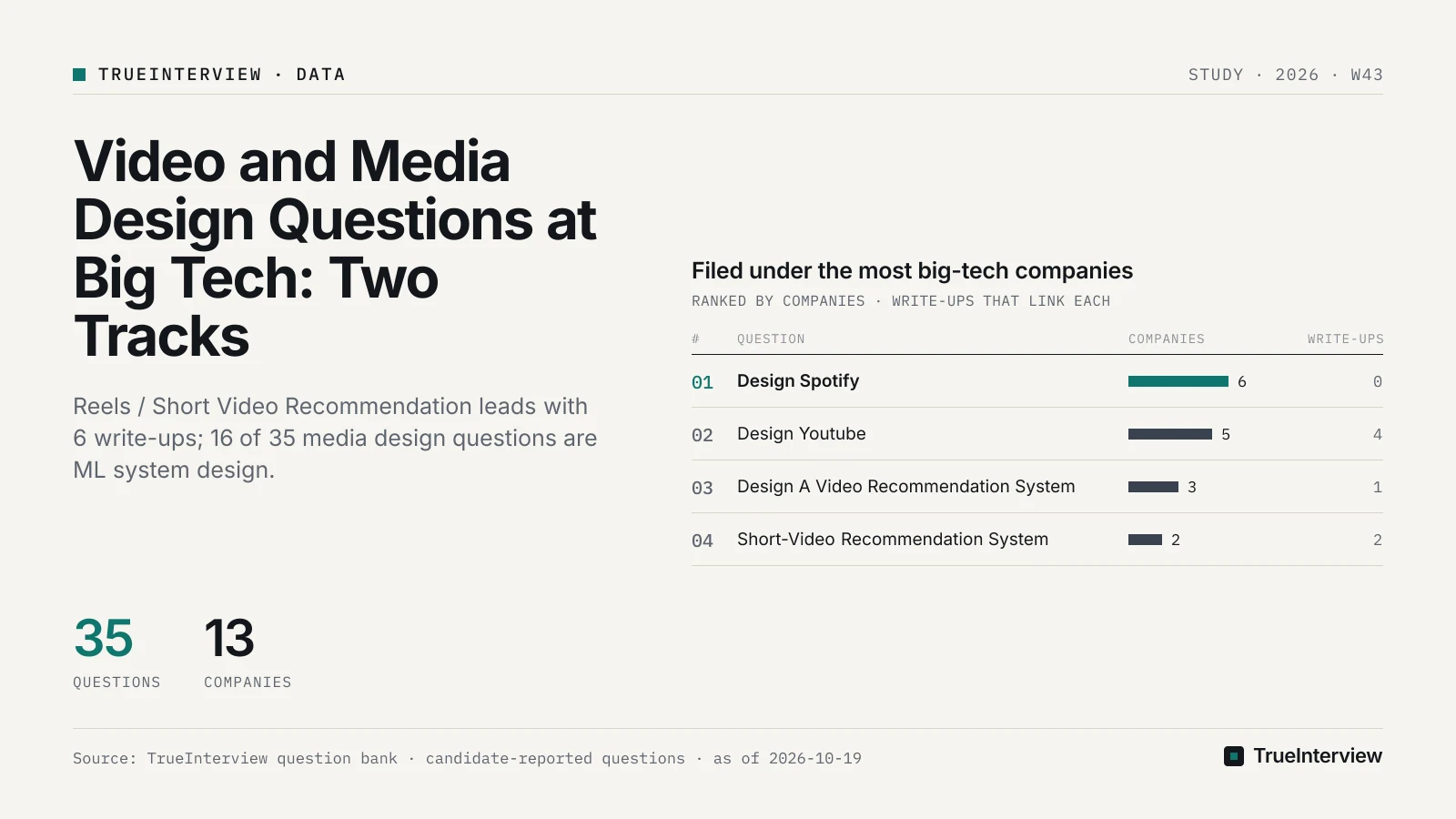
As of 2026-10-19, the TrueInterview bank holds 35 candidate-reported video and media system design questions from 13 big-tech companies; 16 are ML system design and 12 are distributed systems. Meta's Reels / Short Video Recommendation is the most-linked prompt, while OpenAI's Design Youtube and Robinhood's Photo Album System Design tie as the most-linked pipeline prompts. Our take: video system design is two interviews, an upload, transcode and deliver pipeline and a short-video ranking system, so work out which one your role will get first. In our view, drawn from PracHub's video streaming guide, senior candidates should then prepare less for the CDN box and more for the state boundaries: resumable offsets, completion reconciliation and real readiness.
Disclosure: TrueInterview is an interview-preparation product and publishes this article. Facts about other products come from their public pages on the dates listed under Sources.
Which video and media design questions are candidates reporting?
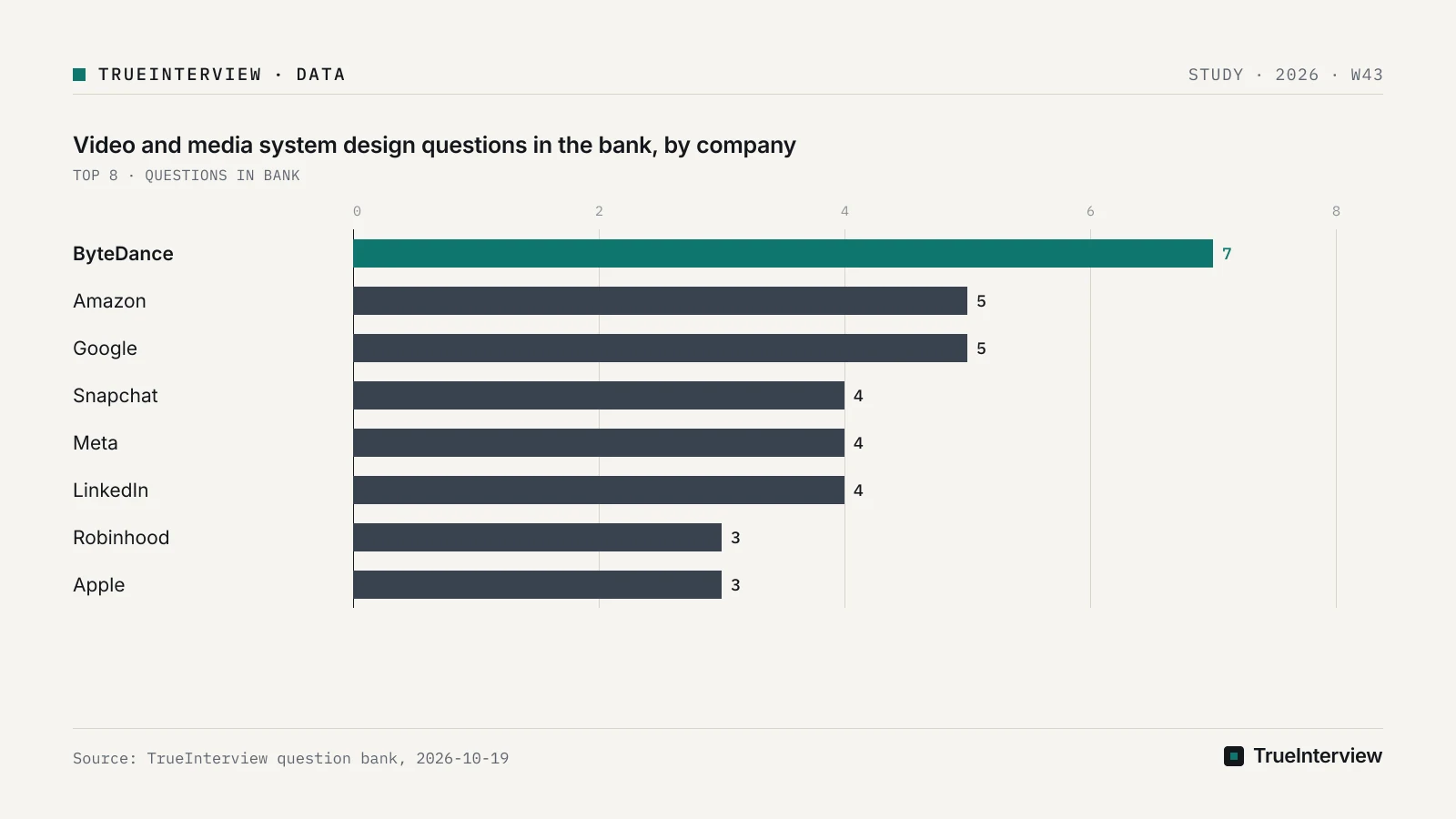
The reports cluster on a short list of prompts. ByteDance leads with 7 questions, then Amazon and Google with 5 each, and Snapchat, Meta and LinkedIn with 4 each. Of the 35 questions, 30 were last reported within the 12 months before 2026-10-19, so this list reflects current loops rather than an archive. Start from the ranked table, because write-up links are the closest thing to evidence of what candidates actually met.
| Rank | Question | Company | Round, last reported | Write-up links | Senior-or-above links | ML-side / SWE links |
|---|---|---|---|---|---|---|
| 1 | Reels / Short Video Recommendation | Meta | Onsite, 2026-06 | 6 | 6 | 4 / 2 |
| 2 | ML System Design (Recsys / Chatbot / Image Classifier) | Onsite, 2026-10 | 5 | 4, plus 1 junior-or-below | 4 / 1 | |
| 3 | Short Video Recommendation & Ranking | Snapchat | Phone screen, 2026-04 | 5 | 4, plus 1 junior-or-below | 5 / 0 |
| 4 | Design Youtube | OpenAI | Phone screen, 2026-05 | 4 | 4 | not split |
| 5 | Photo Album System Design | Robinhood | Onsite, 2026-05 | 4 | 4 | not split |
| 6 | Design a Product or Video Recommendation System | not dated here | 4 | 3, plus 1 junior-or-below | 3 / 1 | |
| 7 | Image Copyright Violation Detection | Meta | not dated here | 2 | 2 | 2 / 0 |
| 8 | Short-Video Recommendation System | ByteDance | Onsite, 2026-08 | 2 | 1 | not split |
By our reading of the titles, six of the eight are ranking, classification or detection problems, and only Design Youtube and Photo Album System Design are pipeline prompts. If you have time for only two deep rehearsals, take Reels / Short Video Recommendation for the ranking track and Design Youtube for the pipeline track; the notes below say what each top prompt is likely to test.
Reels / Short Video Recommendation (Meta)
This prompt asks you to rank a feed of short videos for each viewer. The data summarised here gives its company, round, date and link counts but not its follow-ups, so this is our preparation advice: be ready to defend the split between candidate generation and ranking, and how fresh engagement signals reach the ranker without stale features. Have a cold-start answer for new videos and new viewers, and a latency budget for the ranking call. Practise Reels / Short Video Recommendation.
Short Video Recommendation & Ranking (Snapchat)
The title is close to Meta's, but Snapchat's version was reported as a phone screen. Expect less time, so lead with the objective (what the ranker optimises), then the funnel from retrieval to ranking, then the feedback loop. We would prepare hardest on the metric: name the engagement signal you train on, such as watch completion or shares, and the guardrail that stops it from rewarding clickbait. Practise Short Video Recommendation & Ranking.
Design Youtube (OpenAI)
This is the classic upload, transcode and deliver pipeline. The decisions worth defending are resumable upload and the point at which a video counts as ready to play, both covered below. Practise Design Youtube.
Photo Album System Design (Robinhood)
Our reading of the title: the same pipeline with smaller files and more metadata, such as albums, sharing and listing order. We would prepare to defend the metadata model, permission checks on shared albums and thumbnail generation off the request path, rather than encoding. Practise Photo Album System Design.
Image Copyright Violation Detection (Meta)
This is a detection problem, not a delivery one. Defend how you find near-duplicates of a protected image at scale (perceptual hashes or embeddings, then a candidate check) and what happens to a match: block, review queue or appeal. Practise Image Copyright Violation Detection.
Is a media design round about infrastructure or about ML?
Close to half the time it is about ML. By subtype, the bank's video and media questions split into ML system design (16), distributed systems (12), experiment design (3), frontend system design (2) and low-level design (2). Grouped by problem family, video, media and uploads leads with 13 questions and ads, recommendation and ranking ML follows with 9. Decide your track by your job title and the subtype the recruiter names for the round.
The role split is roughly even. Write-up links to these questions come from Machine Learning Engineers (20) and Software Engineers (18), with a handful from frontend, AI, data-science and data-engineering candidates. Two prompts are linked only by ML, AI, research or data-science candidates: Short Video Recommendation & Ranking and Image Copyright Violation Detection. Meta's Reels prompt is mixed, with 4 ML-side links and 2 from software engineers.
| Your title | Prepare first | Keep as backup | Why |
|---|---|---|---|
| Machine learning, AI, research or data science | Short-video recommendation and ranking | One upload pipeline answer | Two ranking and detection prompts are linked only by ML-side candidates |
| Software engineer (backend or infrastructure) | Design Youtube, end to end | One adjacent upload prompt for your target company | Pipeline prompts sit in the video, media and uploads family |
| Frontend engineer | The client side of upload and playback | The pipeline at box level | Frontend system design is a small share of the subtype split |
| Best for | ML-side candidates at ranking-heavy companies | Software engineers whose target filed Design Youtube | Anyone unsure: ask the recruiter which design subtype the round uses |
Our take: do not merge the two tracks into one generic answer. A ranking interviewer does not want a transcoding diagram, and a pipeline interviewer will not credit a feature-store discussion. If you cannot learn your subtype from the recruiter, prepare your primary track deeply and the other at box level only.
Why is Design Youtube the anchor, and which prompts vary it?
Design Youtube is filed under 5 big-tech companies in the bank: OpenAI, Amazon, Google, Netflix and Snapchat. Its write-up evidence is narrower: all of its linked write-ups come from OpenAI. In our view it is still the right anchor for infrastructure candidates, because, going by their titles, most adjacent media prompts reuse part of the same path and change one variable.
Filing breadth and write-up evidence measure different things. Design Spotify is filed under 6 companies, Amazon, ByteDance, Google, Instacart, LinkedIn and Meta, yet no candidate write-up links to it. Design A Video Recommendation System is filed under LinkedIn, Instacart and Pinterest with a single linked write-up. Treat a wide filing as a reason to know the prompt exists, not as proof that it is asked often.
| Adjacent prompt | Company, round, last reported | What the title adds to the anchor (our reading) |
|---|---|---|
| Photo Album System Design | Robinhood, onsite, 2026-05 | Small images, album metadata, sharing |
| Design a Large-File Upload and Analysis Flow | Pinterest, onsite, 2026-09 | The upload path plus an analysis stage after it |
| Large-Scale Media Transfer to ML Compute | Apple, phone screen, 2026-08 | Bulk movement of media to training or inference jobs |
| Video Upload + Search with LLM | Oracle, phone screen, 2026-02 | Upload plus a search layer with an LLM in it |
| Netflix Sentiment Tracking | Netflix, onsite, 2026-04 | Signals about content rather than the content; reuses the least of the pipeline |
ByteDance's Video-Keyword Association Review System sits in the same video, media and uploads family, and by its title reads as a review workflow over video metadata. Prepare one end-to-end Design Youtube answer, then rehearse the adjacent prompt that matches your target company as a variation: say which stage changes and which stays the same.
Which media questions come up in the phone screen versus the onsite?
Most reports place these questions in the onsite, but the phone screen is not safe. Of the 35 questions, 25 were reported in an onsite, 12 in a phone screen and 1 in an OA, and one question can appear in more than one round. Among the onsite design questions, the video, media and uploads family leads with 10, ahead of ads, recommendation and ranking ML with 5.
The phone-screen examples cover both tracks: OpenAI's Design Youtube, Snapchat's Short Video Recommendation & Ranking, Apple's Large-Scale Media Transfer to ML Compute and Oracle's Video Upload + Search with LLM, each listed with its month in the tables above. The onsite examples include Meta's Reels prompt and Google's ML System Design (Recsys / Chatbot / Image Classifier), last reported in 2026-10.
Our take: for a phone screen, rehearse a compact version of your main answer rather than a different answer. Keep scope, the upload boundary and the readiness rule, and drop the long capacity discussion. In a phone screen, spend roughly the first fifth of the time on scope and the rest on one pass through upload, processing and delivery, naming the readiness rule before you finish.
What should you clarify before drawing anything?
Clarify the product contract first, then ask for the numbers that drive cost. PracHub's video streaming guide lists the questions: "Clarify VOD versus live, upload distribution, device support, regions, rights, moderation, captions, retention and acceptable publication delay." The same guide says to ask for viewer concurrency and average delivered bitrate before estimating egress.
Concurrency times average delivered bitrate gives peak egress, so those two inputs decide the delivery design more than any other number. Do not invent capacity numbers; ask for concurrency and bitrate, then derive storage, egress and encoding work from what the interviewer gives you. If the interviewer declines to give numbers, write your assumed concurrency and bitrate on the board, label them as assumptions, and derive egress from them in one line.
The author of one Medium write-up, who reports interviewing on both sides of the table, makes the same case. In that write-up, the author describes the biggest mistake as reacting to a Design YouTube prompt by instantly drawing a web server and a database, and advises five to ten minutes of requirement gathering first. The same write-up describes less prepared candidates naming familiar tools without justifying them, and recounts one candidate who drew up to 20 microservices and multiple databases within a couple of minutes. Treat this as one author's view; it agrees with PracHub's list, so open with those scope questions and only then draw the first box.
How should you handle large and resumable uploads?
Keep the large upload out of your application servers and make resumption a server-side fact, which is what PracHub's guide argues. The same guide frames the whole answer as connecting an accepted upload to a playable frame, adding: "The CDN is one part of that path." The guide organises the explanation as Ingest, Transcode, Package, Deliver, Observe. In our view, the upload is where infrastructure answers most often lose depth.
Build the upload in four steps:
- Issue an upload target, not a proxy. In the design the Medium author's write-up describes, the upload service gets a pre-signed URL from object storage such as S3 and returns it, and the client uploads the file directly to object storage. PracHub's guide warns against running a multi-gigabyte upload or a long encode inside one metadata request.
- Upload in parts and record them. AWS's S3 documentation says the client records each part's number and ETag and includes them in the request that completes the upload. The same documentation says that on completion, S3 builds the object by concatenating the parts in ascending part-number order.
- Resume from the server's offset. The tus protocol defines resumable uploads over HTTP: a HEAD request finds the offset at which to continue, and a PATCH request resumes from it. If the client's offset does not match, the tus spec says the server must respond with 409 Conflict without modifying the upload. PracHub's guide draws the design rule: on reconnect, trust the server's recorded progress, not the client's last attempted byte.
- Say who may write. The tus spec leaves authentication and authorization to the server implementation, so state where the upload session is authorised and how it expires.
Our take: the deciding questions here are idempotency of the completion call and what happens to orphaned parts. Name a cleanup policy for abandoned multipart uploads and a single service that moves an asset from parts uploaded to accepted.
Where does the processing pipeline fail, and how do you defend it?
Most of the pipeline's difficulty is correctness under failure, not throughput. PracHub's guide says object-store completion and a database state transition are different boundaries, and that a failed notification must not leave a sealed asset permanently unprocessed. For every stage, have an answer ready for what reconciles those two states and what re-drives lost work.
The guide adds three rules worth rehearsing:
- Fence late workers at registration. PracHub's guide says: "A lease alone cannot prevent an expired worker from returning late; enforce authority at registration." In practice, attach a version or fencing token to each job and reject output registered with a stale one.
- Separate retryable from poison input. PracHub's guide says to retry infrastructure failures with bounds and to quarantine media that is deterministically invalid. A corrupt file retried forever is a capacity leak.
- Publish required outputs first. PracHub's guide says to prioritise required outputs according to the publication contract so an expensive optional codec does not block every upload. The design in the Medium author's write-up has workers transcode to renditions such as 480p and 720p, generate thumbnails, extract metadata and run content analysis, which gives you a natural required set and an optional set.
Reprocessing and rollback retention are capacity decisions, not free metadata changes, in PracHub's framing. If an interviewer asks you to re-encode the back catalogue, answer with storage and compute cost before you answer with a queue.
Delivery has its own readiness trap. The HLS specification, RFC 8216, says a playlist is either a Media Playlist or a Master Playlist, and that a Media Playlist lists the segments that play the presentation in sequence. PracHub's guide says not to label a manifest ready merely because the expected object keys exist in storage. Verify the manifest against what the player will request, then flip the asset to ready. On consistency, the Medium author's write-up suggests eventual consistency for view counts and strong consistency for video ownership; that split is a clean answer to the "which data must be exact" follow-up.
What changes at senior and staff level?
The people reporting these questions are mostly senior. Candidate write-ups link these media questions 38 times from candidates who reported a senior, staff-plus or manager level, and 5 times from those who reported a junior, new-grad or intern level. Levels are self-reported, and the split shows who reported the questions, not what interviewers scored.
Three of the top prompts are linked only from senior-or-above write-ups: Reels / Short Video Recommendation, Design Youtube and Photo Album System Design. Short Video Recommendation & Ranking has one staff-plus or manager link among its senior-or-above links. If you are interviewing at senior or staff level, these are the prompts your peers met.
Our take: at senior level, a correct box diagram is the minimum. The counts in this article give companies, rounds, dates and levels for these media prompts, not their follow-up questions, so this is our expectation from the guides above: the push comes on scope set before drawing and on the failure boundaries, meaning the resume offset, completion reconciliation, late workers and readiness. The Medium author's write-up says of requirement gathering: "This phase, more than any other, separates senior engineers from junior ones." The same write-up says "interviewers look for deeper system thinking, especially at senior levels." That is one author's view, and it matches where the hard parts of the pipeline actually are.
The only staff-plus breakdown available here is one link on Short Video Recommendation & Ranking, and the senior-or-above total is not split by level, so this is our view only: for staff candidates, prepare for the conversation to move to cost and change: reprocessing a catalogue, rolling out a new codec, or shifting the ranking objective without breaking creators' reach. Prepare one example of each from your own work, with the cost you estimated and the rollback you planned.
Down-leveling note (our view): in a media loop, the level signal sits in the design round's depth and in the scope you set in the opening minutes. A candidate who draws a working pipeline but never names a failure boundary reads as mid-level, whatever the title on the résumé. In the ML track, the equivalent signal is whether you choose and defend the training objective rather than accept a default one.
Worked example: two candidates, two preparations
Take a senior software engineer with an OpenAI phone screen and a machine learning engineer with a Meta onsite. The first is preparing Design Youtube, last reported at OpenAI in 2026-05. The second is preparing Reels / Short Video Recommendation, a ranking problem with links from both ML-side and software-engineer candidates.
For the software engineer, the compact answer runs in order. Scope: VOD or live, devices, regions, moderation and publication delay, then concurrency and bitrate before any egress estimate. Upload: a pre-signed target, parts recorded with their ETags, resume from the server's offset. Processing: reconcile object-store completion with the database, re-drive lost notifications, fence late workers at registration, publish required renditions first. Delivery: a master playlist over media playlists, and an asset marked ready only after the manifest is verified. Each of those steps is sourced in the sections above; the point of the drill is saying them in that order inside a phone-screen budget.
For the machine learning engineer, none of that is the centre. The answer is candidate generation, ranking, the training objective, feedback signals and cold start for new videos. Keep a two-minute version of the upload pipeline only in case the interviewer asks how a new video becomes rankable.
How we counted
TrueInterview files each candidate-reported question by company, round, month, subtype, the candidate's role and self-reported level, and links it to the interview write-ups that mention it. Counts are what candidates reported, not how often a company asks a question, and a link count is not a count of distinct write-ups. These are reconstructed questions for practice, not any company's official list.
FAQ
Which companies ask Design YouTube or similar video platform questions?
In the bank, Design Youtube is filed under OpenAI, Amazon, Google, Netflix and Snapchat, but its linked write-ups all come from OpenAI, so treat the other filings as a reason to prepare rather than as evidence of frequency. Similar prompts appear at Robinhood, Pinterest, Apple, Oracle and Netflix as upload or media variants, listed with their rounds in the adjacent-prompt table above. If your target is not on either list, prepare Design Youtube anyway and swap in the adjacent prompt closest to your target's product.
How do I estimate storage, bandwidth and encoding capacity for a video platform?
Ask for the inputs instead of inventing them. PracHub's guide says to get viewer concurrency and average delivered bitrate before estimating egress. From those two numbers you can derive egress, and from upload volume and your rendition list you can derive storage and encoding work. Write each assumption on the board and keep the arithmetic to one line per quantity.
What are the most common mistakes in a Design YouTube interview?
The mistakes cluster at the start and at the boundaries. Drawing components before defining scope is the mistake the Medium author's write-up calls the biggest. Inside the design, PracHub's guide warns against running the upload or encode inside a metadata request, trusting the client's byte count on resume, and marking a video ready because its files exist. For each one, write the one-sentence rule you will say aloud, such as resuming from the offset the server returns.
How does adaptive bitrate streaming fit into a design answer?
RFC 8216, the HLS specification, says HLS lets a receiver adapt the media bit rate to current network conditions, and that it is compatible with large-scale HTTP caching infrastructure. In your answer, that means the packager writes several renditions plus playlists, the CDN caches segments like any other HTTP object, and the player chooses a rendition per segment. Spend your time on when the playlist is safe to publish, not on the player's switching logic.
Do ML engineers and software engineers get different media design questions?
In the reports, largely yes. The recommendation prompts draw most of their links from ML, AI, research and data-science candidates, as Google's two recommendation prompts show; the bank does not split the pipeline prompts by role, so read them as the default for software engineers by subtype, not by link count. Use the role table in the track section to choose. If your title spans both, ask the recruiter whether the design round is ML system design or distributed systems before you split your time.
How do I prepare for a video or media system design interview while working full time?
Pick your track, write one deep anchor answer such as Design Youtube or Reels / Short Video Recommendation, then add the adjacent prompt for your target company and a compact phone-screen version. That fits three weeks of evenings, as the plan below lays out. Practise out loud with a timer, and record one run so you can check that you named the resume offset and the readiness rule.
Your practice plan
- In the first two evenings, read your role against the track table and decide your primary track. ML-side candidates start with Reels / Short Video Recommendation; software engineers start with Design Youtube.
- In the first week, write your anchor answer end to end. For the pipeline, cover scope, upload, processing, delivery and observation. For ranking, cover objective, retrieval, ranking, feedback and cold start.
- In the second week, write the boundary answers for your pipeline on one page: resume from the server's offset, reconcile object store and database, re-drive lost notifications, fence late workers, verify the manifest before ready.
- ML-side candidates spend the second week on Short Video Recommendation & Ranking as a timed phone-screen drill, then Image Copyright Violation Detection for the detection variant.
- In the third week, rehearse one adjacent prompt that matches your target: Photo Album System Design, Design a Large-File Upload and Analysis Flow, Large-Scale Media Transfer to ML Compute or Video Upload + Search with LLM. Say aloud which stage changes.
- Finish with a compact version of your anchor answer that keeps scope, the upload boundary and the readiness rule, and run it once against a short timer. Browse more reported prompts on the practice question bank.
Sources
- TrueInterview question bank — video and media system design at big-tech companies — counted 2026-10-19
- Video Streaming System Design Interview Guide: Uploads, Transcoding, Adaptive Bitrate, and CDN Delivery | PracHub Knowledge Hub — checked 2026-10-19
- Medium — checked 2026-10-19
- Uploading and copying objects using multipart upload in Amazon S3 - Amazon Simple Storage Service — checked 2026-10-19
- Resumable upload protocol 1.0.x | tus.io — checked 2026-10-19
- RFC 8216 - HTTP Live Streaming — checked 2026-10-19
Last reviewed: 2026-10-19.