Verkada · Study
Verkada Interview Process & Questions
TrueInterview
August 22, 2026 · 12 min read
Verkada compresses its loop more than most companies. A single phone-screen hour often holds both a coding problem and a full system design discussion, and the design prompt is nearly always the company's own operating problem: a fleet of millions of cameras, each sending a heartbeat every minute. Coding prompts are framed in the same product terms (camera motion intervals, door permissions, nested camera groups), and practical work counts alongside algorithms: some screens are live API builds in a prepared local environment.
This guide breaks down each stage of the Verkada interview, what interviewers evaluate in each round, and how to prepare, with questions candidates were actually asked.
Verified: Based on 16 candidate-reported interview experiences, cross-checked against recent public accounts.
Verkada interview process
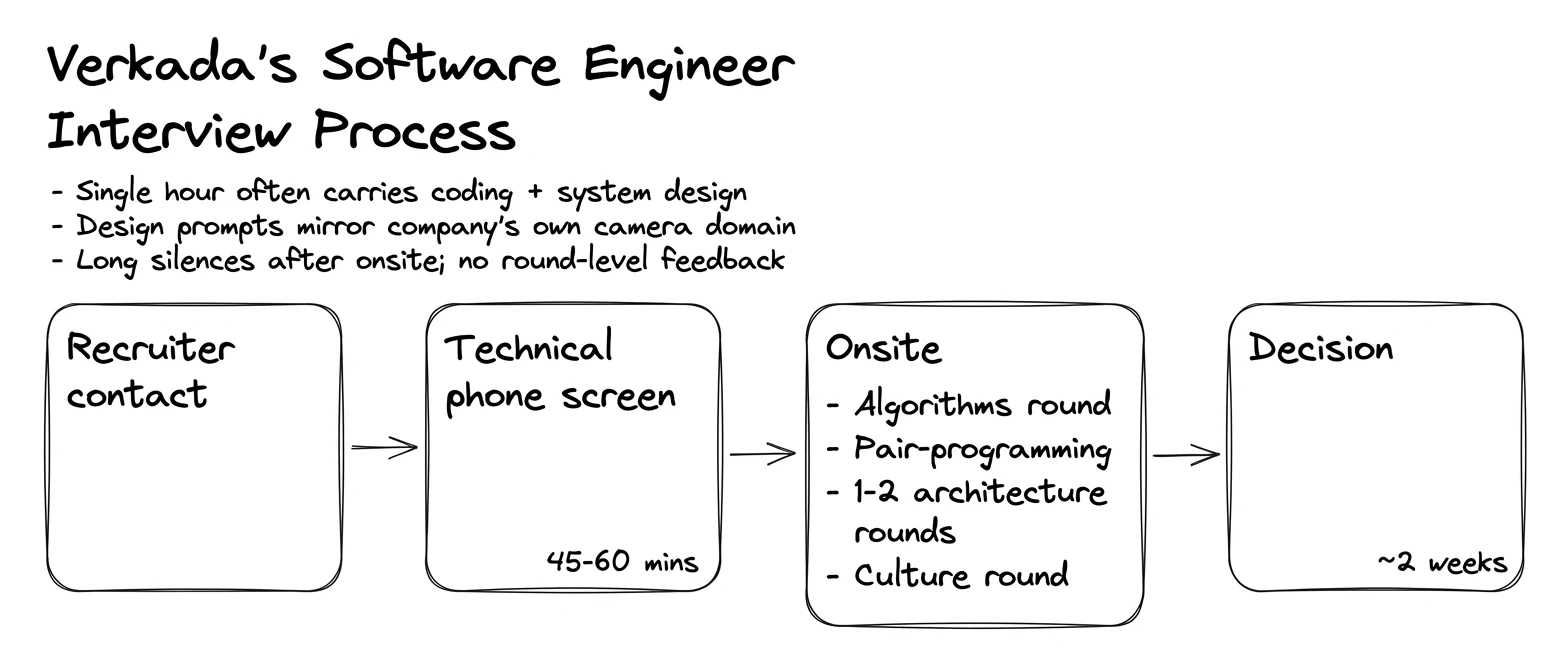
The skeleton is stable across backend, full-stack and frontend hiring: a recruiter contact, one or two technical screens, then an onsite of four to five rounds. What changes is the middle. Backend candidates get system design in the screen and again onsite; frontend candidates swap design for React and layout work. Device-facing teams have reportedly added networking and product-troubleshooting questions. End to end the process typically takes a few weeks to two months.
New grads are more likely to get a non-technical recruiter call and an algorithm-heavy onsite. Experienced hires see more design: one onsite had two architecture rounds plus a detailed review of scope in a previous job.
Here's what the interview process can look like:
- Recruiter screen: A short call on motivation, search timeline and logistics, often after the recruiter reached out first.
- Technical phone screen (one or two): 45–60 minutes with an engineer, either half coding and half design, two linked coding problems, or a hands-on API build.
- Onsite coding interview: Data-structure implementation from a blank file, such as LRU and LFU caches or coin change.
- Practical and pair-programming round: A small feature built collaboratively: schema, data access layer, request parsing and response formatting (frontend: extending an earlier component).
- System design interviews (one or two): Device-fleet and access-control architectures with ingestion, storage and query paths.
- Behavioral interview: A deep dive into a previous role: your scope, hard problems and how you worked with the team.
Tip: Treat every hour as two time boxes. In split-hour screens the coding half is about 20 minutes. In two-problem screens, one candidate who over-invested in the first problem could not finish the second and named that as the deciding factor.
Recruiter screen
Several candidates were contacted by a recruiter first, and some had the technical screen booked before sending a resume. A separate recruiter call, mostly for new-grad and frontend candidates, covers why Verkada and your search timeline. San Mateo roles are onsite, five days a week on some teams.
Interviewers evaluate:
- Motivation: A specific reason for physical security and connected devices, not a generic interest in startups.
- Timeline: Competing processes and how fast you can move.
- Shipping record: How much you have personally built and shipped, which shapes the rest of the loop.
Prepare a two-minute account of what you have shipped end to end and why device-plus-cloud products interest you.
Sample questions for the recruiter screen
Here are some questions reported by recent candidates:
- Why are you interested in Verkada?
- Where are you in your job search, and what other timelines do you have?
Technical phone screen
Screens run 45–60 minutes with an engineer in three shapes. The most common is a split hour of coding plus design: single-number-by-XOR with a device-status counter, an in-place merge of two sorted arrays with a camera health monitor, or linked-list big-integer addition (four digits per node) after a video-platform design. The second is two linked coding problems, such as motion-threshold intervals for one camera and then a merge across cameras, with a scaling discussion at the end. The third is a hands-on API build, covered in the practical round below.
Classic problems come with constraints. One screen fixed the entry-point name and return type for tree diameter; another required Java and a three-second runtime limit for a permissions-graph traversal. A word-guess problem left repeated letters and case sensitivity unstated, and one rejected candidate could not finish a buy-and-sell-stock variant in the coding half.
Interviewers evaluate:
- Pacing: A working baseline for each problem inside its time box, then a stated optimization.
- Clarification: Asking for signatures, input formats and worked examples before coding. The rejected word-guess candidate named skipping this as the lesson.
- Contract discipline: Matching the required function name, return type, language and runtime budget exactly.
- Edge cases: Malformed IP segments, single-element arrays, overlapping versus adjacent intervals.
- Scaling instinct: How the single-camera solution behaves across a fleet.
Practice interval and array problems against a 20-minute timer and say each clarifying question out loud.
Note: The shared editor does not always carry code from the first problem into the second. One candidate lost minutes rebuilding earlier code, so keep a local copy of anything you may need to reuse.
Sample questions for the technical phone screen
Here are some questions reported by recent candidates:
-
Given timestamped motion scores from one camera, return every interval at or above a threshold; then find the intervals where all cameras are above it at once.
-
Given permission triples (owner of a camera, member of a group, with nested groups), find the one user who can reach every camera, in Java within three seconds.
-
Score a word guess with green, yellow and gray feedback, adding input validation and exceptions.
-
Walk a directory tree, extract valid IPv4 addresses from file contents and return them sorted.
-
Simulate jumps through an array to the next element equal to the current height plus one, reversing direction after each jump.
-
Add Two Large Integers Stored in Linked Lists (4 digits per node)
Onsite coding interview
The onsite algorithms round leans on building data structures from scratch: one backend candidate wrote an LRU cache and then an LFU cache in one session, and a new-grad frontend onsite had separate LRU-cache and coin-change rounds. Another process opened with an in-place square-matrix transpose, then a distributed version where each worker's ID decides which blocks it reads and exchanges.
Interviewers evaluate:
- Correct eviction logic: O(1) get and put, plus correct LFU tie-breaking when frequencies match.
- Clean state management: A hash map and linked list that stay consistent through updates and evictions.
- Index handling: In-place swaps without overwriting values you still need.
- Distributed extension: Partitioning work across workers and avoiding duplicate exchanges.
Be able to write an LRU and an LFU cache from a blank file in under 25 minutes each.
Sample questions for the onsite coding interview
Here are some questions reported by recent candidates:
-
Implement an LRU cache, then an LFU cache, both from scratch.
-
Return the fewest coins needed to make an amount.
-
Transpose a square matrix in place, then partition the transpose across workers for a matrix larger than one machine.
Practical and pair-programming round
This round appears both as a screen and onsite. One candidate was told to prepare a repository checkout, container tooling and an IDE in advance, then built three API calls live. Another implemented Flask endpoints from a shared data-flow diagram and, new to Flask, leaned on the interviewer. The onsite version is collaborative: a simple schema, a data access layer, then request parsing and response formatting.
Frontend candidates do this in React: a screen implementing a design mockup with close attention to Flexbox, Grid and CSS, then an onsite task adding filtering to a component built earlier, so your earlier structure is graded again.
Interviewers evaluate:
- Setup readiness: A working environment at minute one, not minute fifteen.
- Translating specs: Turning a diagram or mockup into routes, handlers and components without being walked through it.
- Layering: A clear split between schema, data access and request handling that survives a new endpoint.
- Collaboration: Explaining choices while you code and taking suggestions well.
- Extensibility (frontend): Components that can accept filtering without a rewrite.
Before the screen, build two or three endpoints in a lightweight web framework inside the exact environment you were told to prepare.
Sample questions for the practical and pair-programming round
Here are some questions reported by recent candidates:
-
From a shared data-flow diagram, implement the API endpoints in Flask.
-
Design a small schema and data access layer, then write the request-parsing and response code for it.
-
Build a React layout from a design mockup, then add filtering to it in a later round.
System design interview
Design appears as half of a phone screen and as one or two onsite rounds. One prompt dominates: one or ten million devices send a heartbeat every minute, and the system reports status counts in near real time. Variants push different constraints: ten statuses with per-minute aggregation, healthy versus unhealthy from staleness, deduplication at low collection cost, or a dashboard that stays responsive. The second recurring prompt is door access management with lookups in both directions, and video-platform prompts (upload, failure handling, search) also appear.
Strong answers start small. One well-received answer used an in-memory status-to-count map behind a thin API: each heartbeat moves a device between counters, counters shard by device ID, and silent devices time out to offline. Follow-ups covered out-of-order heartbeats and consistency.
Interviewers evaluate:
- Write path first: What one heartbeat does, end to end, before boxes multiply.
- Absence as a signal: How a device that stops reporting becomes offline, and when.
- Cost awareness: Avoiding heavy infrastructure when a sharded in-memory counter is enough.
- Data modeling: Many-to-many access tables indexed for both directions of the query.
- Failure handling: Duplicate, late and out-of-order heartbeats, and failed uploads.
Rehearse the heartbeat design until you can sketch it in ten minutes and spend the rest on the interviewer's chosen constraint.
Tip: Ask early which constraint matters most: freshness, deduplication, ingestion cost or query latency. Each reported variant emphasized a different one, and the follow-ups were built around it.
Sample questions for the system design interview
Here are some questions reported by recent candidates:
-
One million devices with ten possible statuses send a heartbeat every minute; serve current counts per status instantly.
-
Ten million cameras report every minute; count healthy and unhealthy devices with minute-level freshness and deduplication at minimum cost.
-
Design door access management with lookups in both directions and a grant operation.
-
Design a video upload service, then search over the uploaded videos.
Behavioral interview
The behavioral round is a deep dive into one previous role: what you owned, the projects, the hardest problems and how you worked with your team. New-grad loops use more standard behavioral questions. Expect follow-ups on how much you shipped yourself.
Interviewers evaluate:
- Personal scope: What you did yourself, separated from what the team did.
- Ownership: Problems you carried from start to finish without being assigned them.
- Pace: How you made progress when requirements were unclear.
- Collaboration: A specific disagreement and how it was resolved.
Prepare one project you can explain in technical depth, along with a conflict story and a failure story.
Note: This round can decide the outcome. A frontend new-grad candidate who cleared both algorithm rounds and the frontend round was rejected and pointed to the behavioral conversation as the likely cause.
Sample questions for the behavioral interview
Here are some questions reported by recent candidates:
- Walk through your role at your last company: scope, projects and the hardest challenge.
- How did you collaborate with your team, and what challenges did you face along the way?
How Verkada makes hiring decisions
Little is known about the decision mechanics. Decisions follow the full loop, and rejections usually arrive without round-level feedback. Waits are uneven: one candidate had heard nothing two weeks after a four-round onsite, and several were still waiting after their screens. Level appears to follow experience and design depth rather than a separate leveling round, so confirm the target level with your recruiter before the onsite.
How to prepare for the Verkada interview
- Master the heartbeat design: Ingestion at one message per device per minute, last-seen tracking, offline derived from staleness, sharded counters and a cost argument for each choice.
- Drill interval problems fast: Threshold runs over a time series, merges across sources and common free windows are the most repeated coding family.
- Practice split hours: Rehearse 20 minutes of coding followed by 30 of design in one sitting, and move on once you have a correct baseline.
- Prepare your environment: If told to set up a repository, container tooling and an IDE, do a dry run building endpoints in Flask or your framework.
- Clarify before coding: Confirm signatures, required names, return types, language, runtime limits, duplicate rules and one example.
- Prepare the behavioral round seriously: A strong technical loop has still ended in rejection after a weak behavioral round.
About working at Verkada
Verkada sells cloud-managed physical security: cameras, access control, environmental sensors, alarms, intercoms and workplace products such as visitor management, all run from one web platform called Command. Engineering spans the device, the video and event pipeline and the web console, and San Mateo roles are in-office.
Verkada hires engineers across teams including:
- Core Command services: Backend services and APIs behind the unified web platform, in Python or Go.
- Device platform and device security: Fleet connectivity, provisioning and hardening for millions of connected devices.
- Platform infrastructure: Reliability and cost efficiency of the cloud infrastructure as the device count grows.
- Alerts and operations: Event and notification pipelines built on message queues.
- Product teams: Intercom, workplace products and growth.
- Embedded and computer vision: Firmware and on-camera software in C, C++, Go and Python, plus on-device detection models.
Experience and education requirements
New-grad backend postings ask for a BS or MS in computer science or a related field, shipping experience from internships, Python or Go and REST API familiarity. Mid-level roles ask for about three years in Go, Python, Java or C++ plus database experience, with message queues and containers as pluses. Senior roles ask for four to seven or more years, mastery of Python or Go and experience setting technical direction.
FAQs about the Verkada interview
How long does the Verkada interview process take?
Typically a few weeks to two months from first contact to decision. The wait after the onsite is the least predictable part and has run past two weeks with no update.
What is the hardest round in the Verkada interview?
For backend candidates, the split-hour phone screen: about 20 minutes of clean coding, then a fleet-scale design under shifting constraints. For frontend candidates, the onsite, where algorithms, extending your own component and a decisive behavioral round share one day.
Is there an online assessment?
Reported processes used live screens with an engineer rather than an automated test. Some screens are hands-on builds in a local environment you set up beforehand, so read the scheduling instructions carefully.
What language should I use?
Usually your choice, but one screen required Java with a runtime limit, and practical rounds assume a web framework such as Flask. Postings favor Python and Go.
How much does a Verkada software engineer make?
Posted annual pay ranges run about $120K–$160K for new-grad backend roles, about $160K–$260K for senior backend roles and about $190K–$300K for staff roles. Equity is offered on top, and the exact figure depends on level, location and experience.