Two Sigma · Study
Two Sigma Quantitative Finance Interview Process
TrueInterview
July 24, 2026 · 12 min read
Two Sigma's Quantitative Finance loop grades numerical code, statistics and open-ended modeling at derivation depth. The assessment has you hand-code an interpolator, summary statistics and least-squares fits without libraries; the screens turn the same material into a class with a streaming extension; later rounds push one modeling case or statistics question through a long chain of follow-ups. Coding is rarely the hard part: candidates were turned down after strong technical answers because an open-ended prompt went unstructured.
This guide breaks down each stage of the Two Sigma Quantitative Finance interview, what interviewers evaluate in each round, and how to prepare, with questions candidates were actually asked.
Verified: Based on 16 candidate-reported interview experiences, primarily from 2025 Q2 through 2026 Q2, cross-checked against recent public accounts.
Two Sigma Quantitative Finance interview process
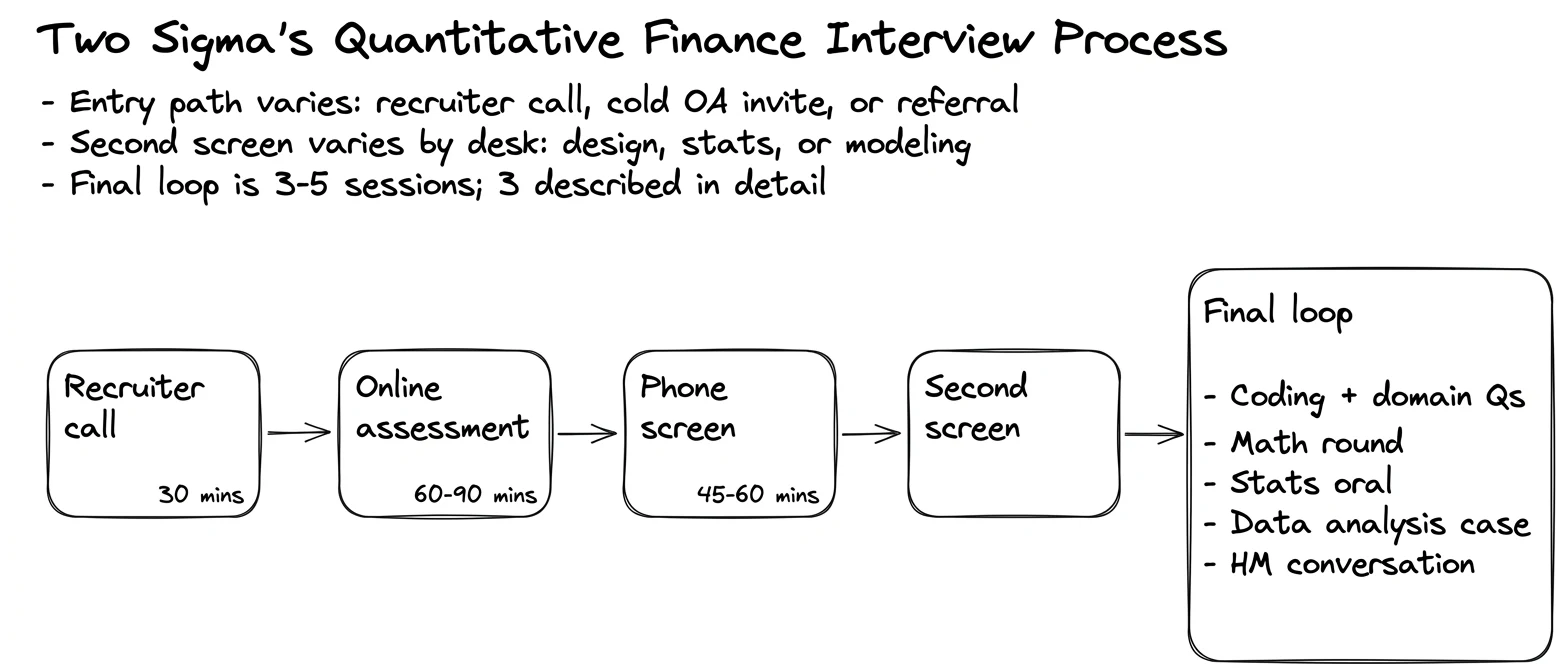
The track covers quantitative researchers and quantitative software engineers, who split at the assessment: researchers get a three-part numerical test and then modeling and statistics rounds, engineering-leaning candidates a two-problem algorithms test and implementation screens. Both end in a final loop mixing simple coding with deep domain questions.
Most candidates report one assessment, one or two phone screens and three onsite sessions over typically one to two months. PhD candidates have their own research probed in the screen and again onsite.
Here's what the interview process can look like:
- Recruiter call (not always): A short, non-technical introduction to the firm and the stages; cold applicants often receive the assessment by email with no call.
- Online assessment: A timed test with two or three problems, either numerical tasks (research) or algorithm problems (engineering).
- Technical phone screen: About 60 minutes in a shared editor, building a numerical or data-structure component and extending it.
- Data analysis and modeling interview: An open-ended prediction case driven by a long chain of follow-up questions.
- Statistics and math interview: A no-coding oral on probability, linear models and linear algebra.
- Onsite interviews (usually three): Each session pairs an easy coding problem with field-specific and unconventional questions.
Tip: Treat every question with no correct answer, such as predicting prices from social media posts, as a graded technical round, with a fixed structure ready: target, data, model, validation, failure modes.
Recruiter call
When there is a first call, it is short and non-technical: an overview of the firm, the stages and the timeline. Several candidates had none; an online application produced an emailed assessment invitation, and the next human contact was the phone screen.
Interviewers evaluate:
- Motivation for systematic investing: A specific reason for quantitative research at this firm rather than finance in general.
- Track fit: Whether your background points to research, quantitative engineering or a specific desk such as macro or credit.
- Communication: A concise, accurate summary of your research or engineering work.
Prepare a two-minute summary of your strongest project and a clear statement of which branch of the track you want.
Sample questions for the recruiter call
Here are some questions reported by recent candidates:
- Tell me about yourself and your research background.
- Why Two Sigma, and why quantitative research rather than software engineering?
Online assessment
The timed research version has three tasks that stay remarkably stable. First, a piecewise linear interpolator with a stated policy outside the range (clamp to the endpoint or extend the end segments) and for duplicate x values (average or keep the last). Second, a temperature dataset in sequential parts: standard deviation, median, a closed-form fit of temperature on day of year, its mean squared error, and a free-text answer on whether day of year is a sufficient feature; newer versions find the most volatile town and greedily add towns that best predict New York. Third, no-intercept OLS for every column pair across two data frames, updated per new batch without rereading history.
The engineering version pairs an IPO problem (capital-constrained project selection, or share allocation where bids grouped by price are served round-robin in timestamp order) with a sewer problem (grid depth-first search, or a tree split minimizing the subtree-sum difference). Grading is by hidden tests, and numerical libraries were disallowed in the research version.
Interviewers evaluate:
- Explicit edge-case policy: Extrapolation, duplicate x values, a single data point and even-length medians, each stated in a comment and applied consistently.
- Sufficient statistics for streaming: Updating running sums of products and squares per batch instead of recomputing.
- Time allocation across parts: Each part scores separately, so finishing all of them beats one immaculate task.
- Specification reading (engineering version): Price grouping, timestamp order within a group and loop termination in the round-robin.
Practice the three numerical tasks without libraries until each takes under 20 minutes, and dry-run the IPO allocation by hand before coding it.
Note: The common failure here is the clock, not the math: a candidate who perfected the interpolator's edge cases ran short on later parts, and each part scores separately.
Sample questions for the online assessment
Here are some questions reported by recent candidates:
-
Implement a piecewise linear interpolator that extends the first and last segments for out-of-range queries and defines behavior for a single known point.
-
From daily temperatures, compute the standard deviation and median, fit temperature on day of year by least squares, and report the mean squared error.
-
Allocate IPO shares to bids grouped by price, round-robin in timestamp order within a group, until shares or demand run out.
Technical phone screen
The screen runs about 60 minutes in a shared editor and is the live version of the assessment. One asked for the interpolator as a class that deduplicates x values and looks up by binary search, then the no-intercept slope, then a streaming version updated in constant time per batch. A geospatial variant estimated temperature from the three nearest stations by inverse-distance weighting, with follow-ups on a size-three heap versus sorting, fewer than three stations, and scaling gradient descent to billions of rows.
Other screens are algorithmic or mathematical: maximum independent set on a tree, then the general graph (NP-hard, so exponential search); Markov chain steady states and a cubic solved analytically, then distinct island shapes and a maximum-product path where a log transform enables a bitmask dynamic program. Engineering-leaning candidates built an in-memory database parsing creates, inserts and filtered selects, or an order matching engine.
Interviewers evaluate:
- Policy before code: The deduplication and extrapolation rules said aloud and implemented first.
- Complexity unprompted: Binary search over a linear scan, a size-k heap over a full sort, and the cost of each stated.
- Generalization: Recognizing when a follow-up makes the problem intractable and proposing exact search for small inputs.
- Composure without feedback: At least one interviewer gave no reaction or hints for the whole session.
Rehearse each numerical primitive as a small class with a streaming update, and narrate your reasoning even when the interviewer stays silent.
Note: On parsing-heavy screens, a working happy path comes first. A candidate rejected after the in-memory database screen had spent the early minutes validating invalid field values and never showed a complete create, insert and select flow.
Sample questions for the technical phone screen
Here are some questions reported by recent candidates:
-
Build a linear interpolator class that keeps the last value for duplicate x, then compute the no-intercept OLS slope and update it per streaming batch.
-
Estimate temperature at a latitude and longitude from the three nearest stations by inverse-distance weighting, handling an exact match and fewer than three stations.
-
Find the maximum independent set of a tree, then explain how the approach changes for a general graph.
-
Parse and execute create, insert and select commands with chained AND filters over integer columns.
Data analysis and modeling interview
This round spends an hour on one prediction case, as a phone screen or onsite: New York housing prices, whether a momentum factor is a real alpha, or stock prices from social media posts. Every choice draws a follow-up: target, features, missing values, metric, non-linearity, feature selection, then leakage, drift in distribution and variance, and what a pandemic-scale shock does to a model trained across it. Follow-ups continue until the assumptions behind each answer are exposed.
Interviewers evaluate:
- Problem framing: A precise target and horizon before any features.
- Validation discipline: Time-ordered splits, leakage checks and a stated baseline.
- Non-stationarity: How drift, regime changes and one-off shocks are detected and handled.
- Financial judgment: For alpha questions, transaction costs, overlapping returns and multiple-testing risk.
Practice three cases end to end out loud, including one return-prediction case, and make each answer survive two levels of "why".
Tip: The finance-flavored version of this round has replaced generic datasets for some candidates. Have a ready approach to testing a factor: define the signal, form portfolios, measure risk-adjusted returns net of costs, and check the result out of sample and across periods.
Sample questions for the data analysis and modeling interview
Here are some questions reported by recent candidates:
-
Build a New York housing price model end to end, covering missing values, non-linearity, feature selection, drift and leakage.
-
How would you test whether momentum is a real alpha signal in stocks?
-
How would you use social media posts to predict stock prices, and what would make the approach fail?
-
How Would You Test Whether Momentum Is a Real Alpha Signal in Stocks?
Statistics and math interview
At least one round is no-coding statistics and math, centered on traditional statistics and linear models rather than machine learning. Reported questions: the range of a correlation coefficient, determinants, eigenvalues, the cosine between vectors, the covariance of the maximum and minimum of n uniforms, and E[XY] as a double integral over the joint density. One onsite asked for a temperature model with Lasso, why L1 yields sparsity where Ridge does not, and how to choose the penalty. Probability reaches phone screens too, as in counting pairs whose direct edge is the shortest path in a randomly weighted complete graph.
Interviewers evaluate:
- Derivation, not definition: Setting up the integral or the matrix argument rather than naming the result.
- Linear-model fluency: Regression slopes in both directions, omitted variables and regularization.
- Linear algebra basics: Determinants, eigenvalues and positive semi-definiteness applied to correlation matrices.
- Numerical care: Precision and near-zero denominators, as in a ratio computed from interval patches.
Work through order statistics, correlation-matrix bounds and OLS algebra on paper until you can derive each without notes.
Sample questions for the statistics and math interview
Here are some questions reported by recent candidates:
-
For n independent uniform variables on (0, 1), find the covariance of the maximum and the minimum.
-
Explain why Lasso sets coefficients to zero while Ridge only shrinks them, and how you would choose the penalty.
-
In a complete graph with random edge weights, find the expected number of pairs whose direct edge is the shortest path between them.
-
Slopes of y-on-x vs x-on-y Regression: Relationship and When They Are Equal
-
Expected Number of Good Pairs in a Randomly Weighted Complete Graph
Onsite interviews
The final loop is usually three hour-long sessions, onsite or virtual, each with the same skeleton: a deliberately simple coding problem, deep questions on the candidate's own academic field, and an unconventional question closer to a thought experiment. Reported coding includes adding arbitrarily long integer strings and a directed acyclic graph problem. Interviewer-side equipment problems caused reschedules for at least one candidate.
Interviewers evaluate:
- Bug-free basics: Simple coding done cleanly and quickly, with complexity stated.
- Mastery of your own field: Concepts from your degree or thesis examined from angles a textbook does not use.
- Reasoning under ambiguity: How you structure an unfamiliar question before attempting it.
- Research depth: Your personal contribution, methodology and why results hold, rather than a project summary.
Review your own field's fundamentals from first principles, and practice a few unfamiliar puzzles aloud with a timer.
Note: Do not over-prepare onsite coding at the expense of domain depth. Candidates found the problems intentionally simple; the field-specific and unconventional questions decided the sessions.
Sample questions for the onsite interviews
Here are some questions reported by recent candidates:
-
Add two non-negative integers given as arbitrarily long strings, then analyze time and space.
-
Explain a core method from your field of study and where it breaks down.
-
Walk through the methodology and significance of your main research project, and what you personally contributed.
How Two Sigma levels and evaluates Quantitative Finance candidates
Feedback is pooled, and strong rounds do not offset a weak one: a candidate who did well on the research deep dive and the probability problem, with an engaged interviewer, was still rejected after an unstructured answer to the open-ended prediction question. Rejections arrive without reasons, and every rejection reported on this track came at the assessment or phone-screen stage. Level follows degree and experience; PhD and experienced hires are assessed on their research record. The firm uses numbered levels alongside titles such as Vice President, but the mapping is not published.
How to prepare for the Two Sigma Quantitative Finance interview
- Hand-code the numerical primitives: Interpolation, median, standard deviation, closed-form OLS with and without intercept, and mean squared error, without libraries.
- Make every batch algorithm streaming: For each formula, name the running sums that update it in constant time per batch.
- Write edge-case policies down first: Extrapolation, duplicates, a single point and ties, stated before any code.
- Rehearse open-ended cases with a fixed structure: Target, data, features, model, validation, drift, leakage and failure modes, for housing, factor testing and text-based prediction.
- Drill traditional statistics on paper: Order statistics, correlation bounds, regression slopes in both directions, omitted variables, Lasso versus Ridge and expectations from joint densities.
- Prepare your research for hostile follow-ups: Methodology, your contribution, why the results hold, and how your field's core methods fail.
- Practice talking to a silent interviewer: Narrate assumptions and checks, and finish every part of a problem before polishing one.
About the Two Sigma Quantitative Finance role
Quantitative researchers at Two Sigma build and test forecasting models and signals from large datasets; quantitative software engineers build the research and trading systems those models run on. The firm is organized more like a technology company than a bank, around separate modeling and engineering groups. Co-CEOs Carter Lyons and Scott Hoffman have led it since September 2024, and a 2025 review cut roughly 200 roles across corporate, engineering and modeling. Recent New York postings list base ranges of about $200K to $220K for campus researchers and $165K to $325K for experienced researcher roles, plus a large discretionary bonus.
Two Sigma hires Quantitative Finance candidates across its investment and trading businesses. Teams include:
- Investment Management: Systematic strategies across global asset classes, the firm's largest business.
- Macro and fixed income research: Researchers modeling rates, currencies and credit.
- ETFs and passive flows: Research on index and fund-flow effects in equity markets.
- Two Sigma Securities: Systematic market making and trade execution in listed equities.
- Portfolio research acceleration: Quantitative software engineers building tools that speed up research and portfolio construction.
Quantitative Finance experience and education requirements
Researcher postings ask for a master's or PhD in mathematics, statistics, computer science, operations research, physics or another quantitative field; some want publications or prior investment research, and senior quantitative software engineering roles prefer a PhD. Python dominates, with C++ or Java for engineering roles. Internships accept students at any degree level with about a year left.
FAQs about the Two Sigma Quantitative Finance interview
How long does the Two Sigma Quantitative Finance interview process take?
Typically one to two months from assessment to decision; rescheduled sessions extend some.
What is the hardest round of the Two Sigma Quantitative Finance interview?
For researchers, the open-ended modeling case and the statistics oral, both graded on depth under follow-up. For engineering-leaning candidates, the implementation screen, where an unfinished component counts as a fail.
Is there an online assessment?
Yes, for nearly all candidates: interpolation, temperature analysis and regression for researchers, the IPO and sewer problems for engineers. Both recur closely enough that practicing the known families pays off.
Can you use numerical libraries?
Usually not in the research assessment; formulas are written by hand, in Python or another mainstream language.