Study
Which Two-Pointer Problems Does Big Tech Actually Ask?
TrueInterview
October 18, 2026 · 13 min read
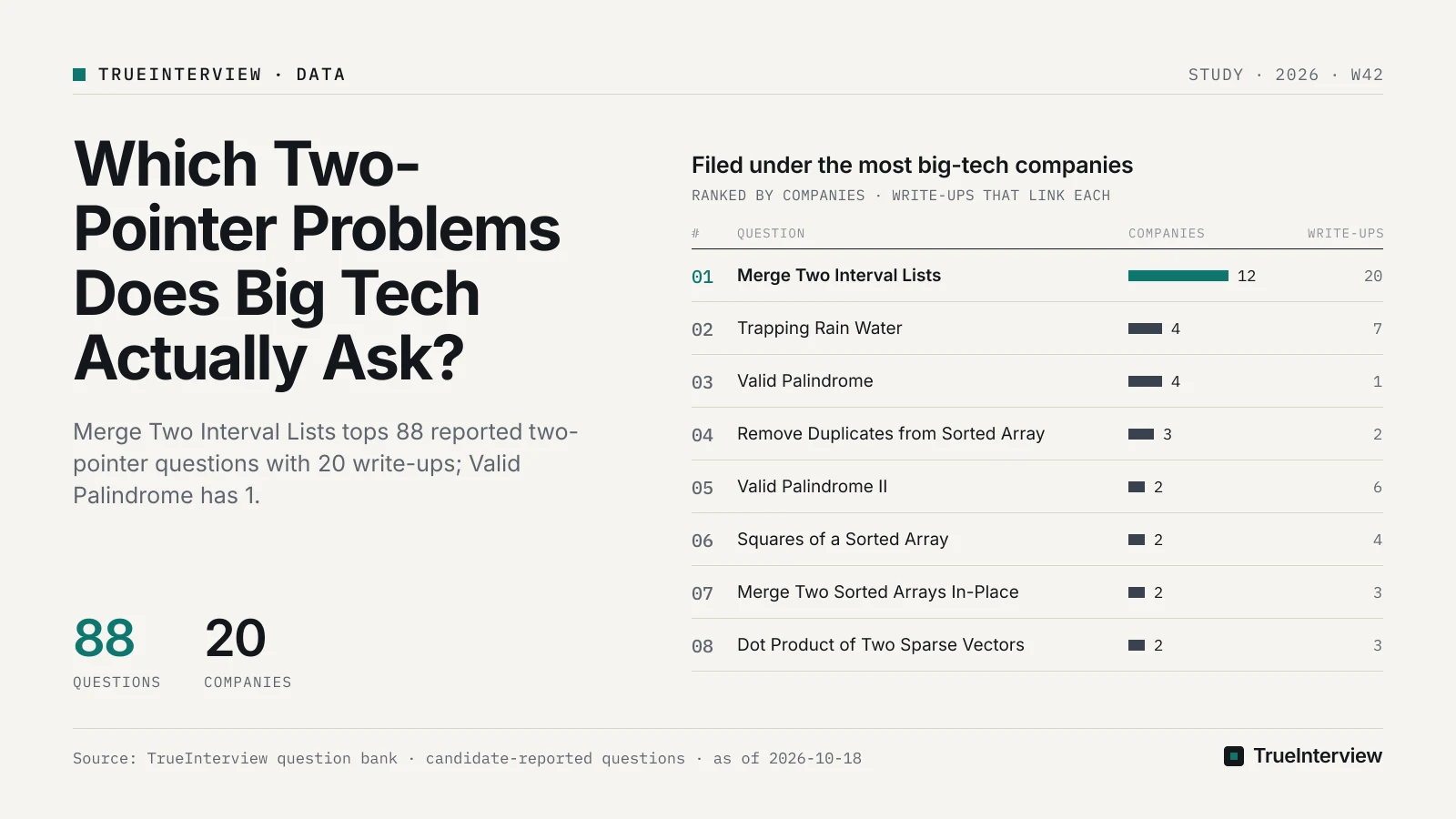
As of 2026-10-18, TrueInterview's bank holds 88 candidate-reported two-pointer questions from 20 big-tech companies, and 80 of them were last reported within the past 12 months. The most-linked one is a two-input merge, not a textbook pair sum: Merge Two Interval Lists is linked from 20 candidate write-ups and filed under 12 companies. Pick the pointer layout by asking how many sequences you are walking and what each pointer means, then spend your practice on the reported variants rather than the warm-ups.
Disclosure: TrueInterview is an interview-preparation product and publishes this article. Facts about other products come from their public pages on the dates listed under Sources.
Which two-pointer problems do candidates report most?
Eight questions lead the write-up links, and only two of them are classic opposite-ends problems. Interval merging leads, followed by company-specific scenarios at Anthropic, Google and Snowflake, then Trapping Rain Water and Valid Palindrome II. The ranking below counts candidate write-ups that link to each question, which measures what candidates reported, not how often a company asks it.
| Rank | Question | Companies in the write-ups | Write-up links | Layout (our read) | Practise |
|---|---|---|---|---|---|
| 1 | Merge Two Interval Lists | 10 companies, Meta onsite 2026-08 | 20 | One pointer per input | Merge Two Interval Lists |
| 2 | Stack Trace Reconstruction | Anthropic | 11 | Pointer over a log plus a stack | Stack Trace Reconstruction |
| 3 | Meeting Rooms / Interval Scheduling Variants | 9 | Sorted starts and ends walked together | Meeting Rooms variants | |
| 4 | Closest Cake and Global Assignment | Snowflake | 8 | Company-specific matching | Closest Cake |
| 5 | Trapping Rain Water | Amazon, Meta | 7 | Opposite ends | Trapping Rain Water |
| 6 | Valid Palindrome II | Meta | 6 | Opposite ends with one skip | Valid Palindrome II |
| 7 | Reverse Nodes in K-Group (incomplete tail variant) | ByteDance | 6 | Linked-list pointers | Reverse Nodes in K-Group |
| 8 | Longest Subarray with Bounded Diff | Uber | 5 | Window boundaries | Longest Subarray with Bounded Diff |
Read the table as four drills: interval walks, opposite ends, pointer surgery on a list and a window. If you own those four moves, most of the list becomes follow-up practice.
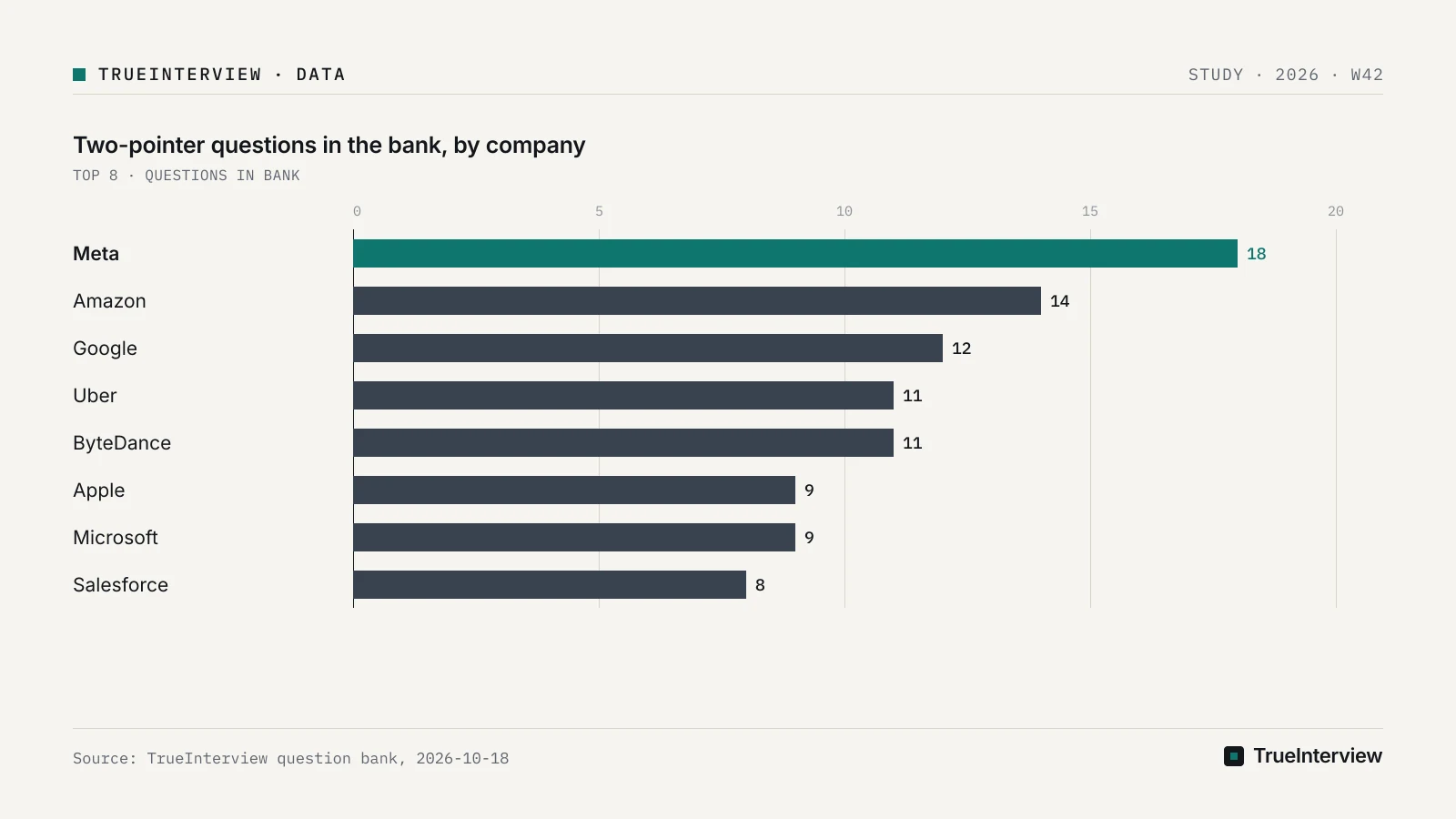
By company, Meta has 18 two-pointer questions in the bank, Amazon 14, Google 12, Uber and ByteDance 11 each, and Apple and Microsoft 9 each. If your target is Meta, treat strings as the secondary tag to drill, since 3 of its 18 carry it. These are candidate-reported questions reconstructed for practice, not any company's official question list.
Why learn the two-input merge layout first?
In our read, the single most-linked question is a two-input merge, and the opposite-ends and same-direction groups we quote do not name a two-input merge. Merge Two Interval Lists alone draws 20 write-up links, and related merges appear too: Merge Two Sorted Arrays In-Place and Dot Product of Two Sparse Vectors are each linked from 3 write-ups and filed under 2 companies. One sorted input per pointer is the pattern to drill first.
Compare that with the published lists. techinterview.org groups its opposite-ends set as "Two Sum II, Container With Most Water, Valid Palindrome, Reverse a String", and its same-direction set as Remove Duplicates, Move Zeroes, Remove Element and Squares of Sorted Array. Neither group names a merge of two inputs. Hello Interview's overview says the pointers most often start at opposite ends and move toward each other. Neither quoted grouping names a merge of two inputs.
Our take: give the one-pointer-per-input layout its own slot in your mental index. The rule is short: compare the current item in each input, record what the pair produces, and advance the pointer whose item can no longer matter. One Amazon report placed Merge Two Sorted Arrays In-Place in a phone screen in 2026-03, so do not save this layout for onsite preparation.
Are the textbook warm-ups worth your time?
Only as a way to learn a layout. Valid Palindrome is filed under 4 companies but linked from a single write-up. Remove Duplicates from Sorted Array is filed under 3 companies and linked from 2 write-ups, none from senior-or-above candidates. The variants carry the reports: Valid Palindrome II and the incomplete-tail K-Group reversal are linked from 6 write-ups each.
The gap is the twist. Valid Palindrome becomes Valid Palindrome II once you may delete one character, which turns a single opposite-ends scan into a scan with one branch. K-Group reversal becomes the incomplete-tail variant once the leftover nodes need different handling. In both cases, our view is that the twist, not the base layout, is where most of the work lies.
If you have a list of fifteen classics, cut it to the four that teach a distinct layout, then put the saved hours into the reported variants. In our view, repeating Two Sum II adds little once you can explain the elimination argument.
How do you tell which pointer layout a problem needs?
Name what each pointer represents before you code. Two ends of one sorted range means opposite ends; two separate ordered inputs means one pointer per input; a read position and a write position in one array means same direction; a range boundary under a constraint means a window. CodingInterviewHQ notes that interviewers use both main variants and "candidates who mix them up waste time in the interview."
| Signal in the prompt | Layout | What each pointer means | Reported example |
|---|---|---|---|
| One sorted range or a string, asking about a pair or symmetry | Opposite ends | The two ends still in play | Valid Palindrome II, Meta |
| Two sorted lists or interval sets | One pointer per input | Current item in each input | Merge Two Interval Lists, Meta onsite |
| Rewrite an array in place | Same direction, read and write | Next item to read, next slot to write | Remove Duplicates from Sorted Array |
| Reorder nodes in a list | Linked-list pointers | Group boundaries and the previous tail | Reverse Nodes in K-Group variant, ByteDance phone screen, 2026-08 |
| Longest or shortest contiguous range under a limit | Window | Left and right edges of the range | Longest Subarray with Bounded Diff, Uber phone screen, 2026-07 |
Opposite ends work because of elimination. CodingInterviewHQ calls it the signature of the pattern when a brute force would compare all pairs and "one comparison can rule out many pairs at once". Hello Interview's overview says that understanding why pairs can be eliminated is what matters about the technique. CodingInterviewHQ adds that the wide-container and trapped-water problems both depend on that property.
CodingInterviewHQ describes same-direction pointers as both moving forward, usually at different speeds or with different roles, which is how in-place rewrites such as removing duplicates work. GeeksforGeeks notes that on linked lists the same idea finds the middle node or detects a cycle, and that it locates the nth node from the end. In Move Zeroes, Sort Colors and Trapping Rain Water, Hello Interview describes each pointer as marking a logical region rather than one end of a pair.
Know when to stop. techinterview.org says two pointers fit when the array is sorted or can be sorted without losing information and the problem asks about pairs or subarrays. The same techinterview.org guide prefers a hash map when sorting would destroy index information you need, or when you must track frequencies. As CodingInterviewHQ puts it, "When the input cannot be sorted, two pointers lose their guarantees." GeeksforGeeks adds that two pointers cannot solve problems that require exploring every combination.
How does the layout rule play out on Merge Two Interval Lists?
Two interval lists are two inputs, so if each list arrives sorted by start, the layout is one pointer per list. Keep i on the first list and j on the second, compare the current pair, emit what the prompt asks for (the overlap or the merged span), and advance whichever interval ends first. Confirm the ordering and the expected output with the interviewer before you code. If each list is sorted and its intervals do not overlap one another, the interval that ends first cannot overlap anything later in the other list.
That sentence is the invariant an interviewer wants to hear, and it is the same elimination argument that justifies opposite ends, applied across two inputs instead of two ends of one array. techinterview.org notes that Trapping Rain Water uses a cousin of it: two pointers reach O(1) space by processing from the side with the smaller max height. When you can say why a move never skips an answer, the follow-ups (unequal lengths, touching endpoints, an empty list) become edge cases rather than surprises.
The level split on this question is even, with 10 links from senior-or-above candidates and 10 from junior-or-below. Treat it as a question everyone gets, where the senior bar is a clean invariant and a correct tail, not recognition of the pattern.
Which interview rounds use two-pointer questions?
Phone screens, by a wide margin. These questions were reported in phone screens 55 times, onsites 26 times and online assessments 16 times, and a question can appear in more than one round. Our take: two pointers decide whether you reach the onsite, so rehearse them early as single timed problems with a spoken invariant.
The secondary tags differ by round. Phone-screen two-pointer questions most often add arrays (13), strings (8) and greedy (5) tags. Onsite ones add arrays (9), strings (4) and linked-list (4). If your next round is a phone screen, the reported examples mix classic-based variants (covered in the decision table above) with company scenarios: Stack Trace Reconstruction at Anthropic in 2026-07, the Meeting Rooms variants at Google in 2026-06, and Put Boxes Into the Warehouse at Pinterest in 2026-06. If it is an OA, Salesforce's String Compression from 2026-04 is a good model of a string rewrite under time pressure.
What shifted in 2026?
Arrays-tagged questions are a shrinking share of two-pointer write-up links, while strings held steady, though the counts are small. Arrays-tagged links fell from 44% of two-pointer links in 2025-Q4 to 9% in 2026-Q3, which is 7 links down to 3. Strings stayed between 16% and 20% across the same quarters. The counts behind these shares are small, so read them as direction.
Totals per quarter were 16, 45, 45 and 34 links, which mostly track how many write-ups were collected, so compare shares, not totals. Our take: keep string variants such as Valid Palindrome II and String Compression in your rotation, since strings held their share while arrays-tagged links fell.
What changes at senior and staff level?
Senior candidates see two pointers too, and their links lean toward strings- and stack-tagged questions. Write-ups link these questions 69 times from candidates who reported a senior, staff-plus or manager level and 82 times from junior, new-grad or intern candidates. Strings-tagged links split 18 senior-or-above to 8 junior-or-below, and stack-tagged links 12 to 6.
| Question | Senior-or-above links | Junior-or-below links |
|---|---|---|
| Stack Trace Reconstruction | 9, one staff-plus or manager | 2 |
| Meeting Rooms / Interval Scheduling Variants | 6 | 3 |
| Valid Palindrome II | 5 | 1 |
| Longest Subarray with Bounded Diff | 4 | 1 |
| Trapping Rain Water | 3, one staff-plus or manager | 4 |
Questions linked from staff-plus or manager write-ups include Trapping Rain Water, Stack Trace Reconstruction and Merge Two Sorted Arrays In-Place. Levels here are what candidates reported on their own write-ups.
Our take: the senior bar on a two-pointer question is the explanation. State the invariant before you code, name the twist out loud, and handle the tail and empty input without prompting. In our view, reaching the right layout but patching edge cases after a failing test is a weaker senior signal than getting them right up front.
Down-leveling note (our view): a clean two-pointer screen does not set your level; it gets you to the onsite. In our view, the level signal sits mostly in other rounds, such as system design and the project deep dive. Where a coding round does contribute, it is through how you explain trade-offs, such as when you would pick a hash map over sorting.
Which two-pointer mistakes cost the most time?
Common slips are in loop control rather than in the idea. Use left < right, which CodingInterviewHQ notes is correct because it keeps the two indices distinct. CodingInterviewHQ also warns that in 3Sum-style problems, recording a triplet and moving only one pointer re-checks the same pair. The same CodingInterviewHQ guide says to guard empty input, or the dedup template returns 1 instead of 0.
Know the costs you will be asked to state. CodingInterviewHQ notes that the fixed-pivot variant adds an outer loop, so 3Sum and its relatives cost O(N^2). A GitHub coding-patterns guide puts the binary-search approach to a sorted pair sum at O(N*logN) time, and the same GitHub guide says the hash-table alternative uses O(N) space in the worst case. Saying these out loud before you code is cheap and answers the follow-up before it arrives.
How we counted
Counts come from TrueInterview's question bank as of 2026-10-18 and cover the two-pointer-tagged practice questions described above. A question can be filed under several companies and reported in several rounds, so tallies overlap. Write-up links count candidate write-ups that point to a question, split by the level and role each candidate reported; they measure what candidates wrote up, not how often a company asks a question.
FAQ
What is the two-pointer technique?
It is a way to walk a sequence with two indices instead of a nested loop. Expora's guide says two pointers usually start at opposite ends (left and right) or both at the start (fast and slow). The same Expora guide notes that with sorted input you know which pointer to move based on whether the current result is too small or too large. The gain comes from discarding many candidate pairs per step, so look for sorted or ordered input before you reach for it.
Does the input need to be sorted?
For opposite ends on a pair search, yes, or you must be allowed to sort it. Hello Interview's overview says the opposite-ends technique relies on the input array being sorted, and GeeksforGeeks says pair-search problems often require sorting first. Linked-list pointers and some same-direction rewrites, such as compacting values, track positions rather than value bounds and do not need sorting, though deduplication in place does rely on sorted input. If sorting would destroy information the answer depends on, such as original indices, switch to a hash map.
When should I use a sliding window instead?
Use a window when the question asks for the longest or shortest contiguous range that satisfies a limit. Expora describes the variable-size window as the most common variant in interviews and the one that trips people up. Longest Subarray with Bounded Diff from Uber's phone screen is the reported example to practise. Treat the window as a same-direction layout whose pointers mean the range's left and right edges.
Do senior engineers get two-pointer questions?
Yes. Senior-or-above candidates link to these questions often, and their reports skew toward string and stack variants rather than plain array pairs, as the table in the senior section shows. Expect the same layouts juniors see, with a twist such as one allowed deletion or an incomplete tail, and expect to be graded on how clearly you state why the pointer moves are safe.
Is there a list of real reported two-pointer questions?
The ranked table at the top of this article lists the most-linked reported questions with practice links, and you can keep practicing in the practice bank. Treat any list, including this one, as candidate-reported practice material rather than an official company list.
Your practice plan
A three-week plan for someone working full time, about an hour a day:
- Week one. Start with Merge Two Interval Lists and Merge Two Sorted Arrays In-Place. Before coding, write the one-line rule for which pointer advances and why it never skips an answer.
- Week one. Do Remove Duplicates from Sorted Array once, only to learn the read and write pointer layout, including the empty-input guard.
- Week two. Solve Trapping Rain Water and Valid Palindrome II. Say the elimination argument out loud and handle the one-deletion branch cleanly.
- Week two. Solve Reverse Nodes in K-Group (incomplete tail variant) and Longest Subarray with Bounded Diff to cover the linked-list and window layouts.
- Week three. Pick the company scenario that matches your target, such as Stack Trace Reconstruction, Meeting Rooms variants or Closest Cake and Global Assignment, and solve it as a timed phone screen.
- Week three. For every problem above, label its layout from the decision table and note the twist. Re-solve any problem where you could not state the invariant before writing code.
Sources
- TrueInterview question bank — two-pointer at big-tech companies — counted 2026-10-18
- Two Pointers Interview Patterns: A Complete Guide (2025) – techinterview — checked 2026-10-18
- Two-Pointer Overview | Hello Interview — checked 2026-10-18
- Two Pointers: Opposite and Same Direction with Examples – CodingInterviewHQ — checked 2026-10-18
- Two Pointer Technique Interview Questions - GeeksforGeeks — checked 2026-10-18
- Several-Coding-Patterns-for-Solving-Data-Structures-and-Algorithms-Problems-during-Interviews/✅ Pattern 02: Two Pointers.md at main · Chanda-Abdul/Several-Coding-Patterns-for-Solving-Data-Structures-and-Algorithms-Problems-during-Interviews · GitHub — checked 2026-10-18
- Sliding Window vs Two Pointers: Templates & When to Use Each | Expora Blog — checked 2026-10-18
Last reviewed: 2026-10-18.