Study
Staff Engineer Interviews: What Changes From the Senior Loop
TrueInterview
October 16, 2026 · 20 min read
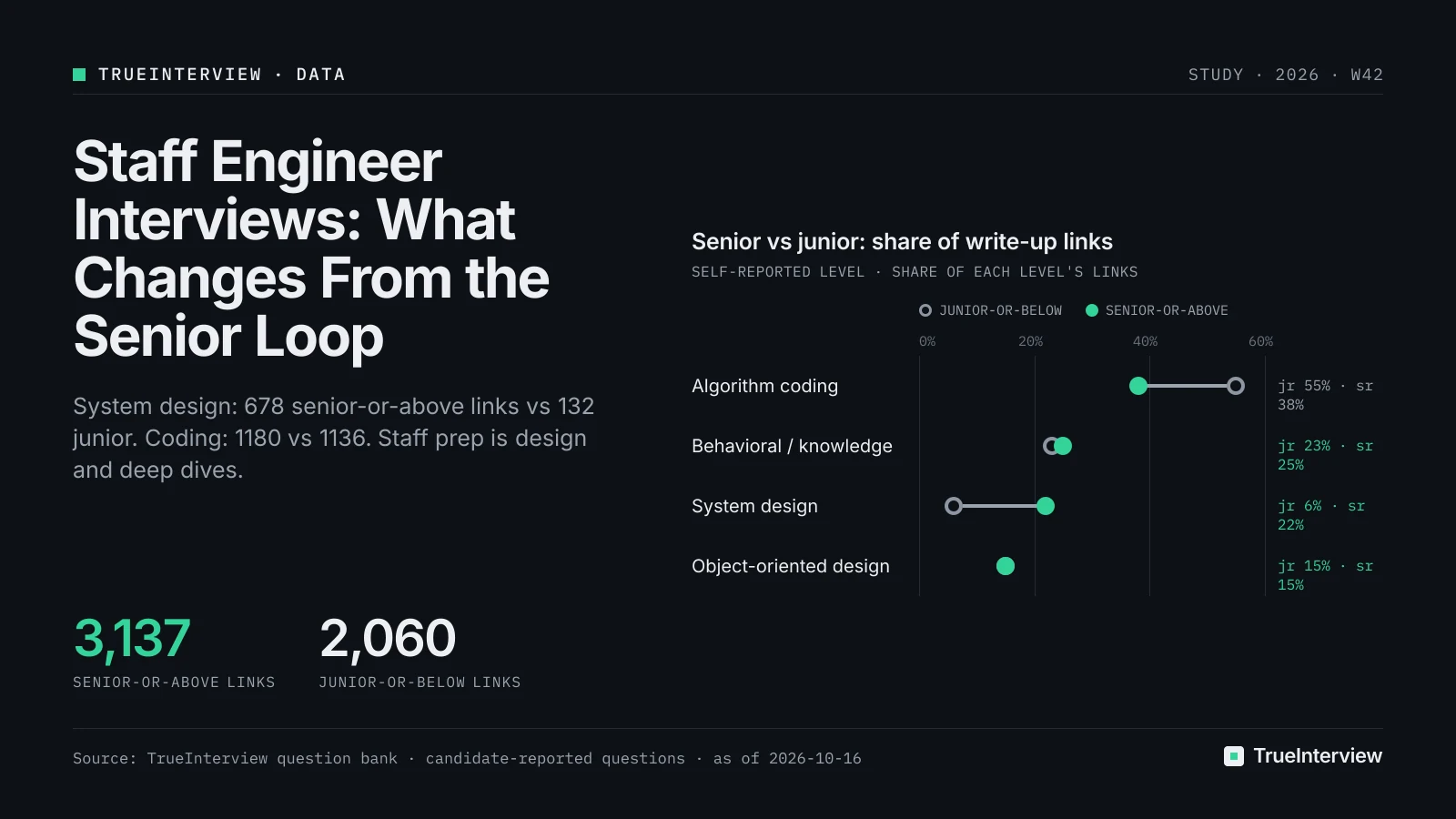
There is no single Staff loop: StaffEng's guide says a Staff-plus loop may be the same interview a Senior candidate gets, or a manager loop with a programming question added. As of 2026-10-16, TrueInterview's write-up links show candidates who self-reported senior-or-above levels linking system design 678 times against 132 for junior-or-below, with coding close at 1180 vs 1136. Our view: Staff extends that shift toward deep dives and domain design, so prepare those as written evidence and keep coding going.
Disclosure: TrueInterview is an interview-preparation product and publishes this article. Facts about other products come from their public pages on the dates listed under Sources.
Does a Staff loop use different rounds from a Senior loop?
Partly. The core rounds stay, and some Staff loops add a manager-style round. StaffEng's guide describes a Senior loop as about five interviews of programming exercises, technical architecture and behavioral or career questions, and says a Staff-plus loop may be that same loop or "an engineering manager loop with a programming question added". Plan for the same rounds, judged harder on scope.
PracHub's Staff guide also states that there is no single Staff interview sequence. StaffEng adds that most companies struggle with their Staff-plus interview loops. Read those two together as a warning: ask which rounds you will get, and expect the deep dive or presentation to be where the Staff case is made, since StaffEng says that without such rounds it is hard to demonstrate the expertise for a Staff-plus offer.
Our own level split shows where the weight moves. The table compares write-up links from candidates who self-reported senior, staff-plus or manager levels against those who self-reported junior, new-grad or intern levels.
| Question format | Senior-or-above links | Junior-or-below links | Senior share | What it means for your prep |
|---|---|---|---|---|
| Coding (algorithm) | 1180 | 1136 | 51% | Reported at every level and still a gate, though a smaller part of senior-or-above reports |
| Behavioral / knowledge | 798 | 477 | 63% | More weight, and more of it is about your own projects |
| System design | 678 | 132 | 84% | The widest gap; this is where most extra hours go |
| Object-oriented design | 474 | 308 | 61% | Roughly in line with the overall split |
| SQL | 7 | 7 | 50% | Not a level signal for engineers |
Across the whole set, senior-or-above candidates account for 3273 links and junior-or-below candidates for 2164, a 60% senior share. Coding sits below that average and system design far above it. As shares, coding is about 36% of senior-or-above links against 52% of junior-or-below links, while system design is about 21% against 6%, computed from the table and the link totals. Our interpretation is that design and behavioral weight grows with level while coding remains in the loop. If you have twenty prep hours a week, this split argues for spending more of them on design and the deep dive than a Senior loop would, while keeping coding hours where they were.
Staff-specific evidence is thin, and we say so plainly. The questions linked from staff-plus or manager write-ups include Behavioral / BQ Question Pack (10), Culture & Behavioral Interview Questions (4), Traditional Behavioral (3) and Design Job Scheduler (2). Those counts are too small to rank, so this article contrasts senior-or-above with junior-or-below and labels Staff-only guidance as our view.
Do Staff candidates still get LeetCode-style coding rounds?
Yes. Senior-or-above candidates report coding questions in the same absolute numbers as junior-or-below candidates, so coding stays a gate even though it is a smaller part of what senior candidates report. StaffEng notes that many Staff-plus engineers refuse to practise interview programming and are then often slower or more error-prone on algorithmic questions. Seniority does not exempt you from the phone screen.
The topics are the same in both rounds that matter. Among coding questions reported for phone screens, the most frequent algorithm topics are graphs (158), hashing (123), strings (120) and arrays (89). In onsite rounds the leaders are graphs (100), strings (74), hashing (73) and arrays (62). The same four topics lead in both phone screens and onsites across all levels. Our view is that a Staff candidate does not need a wider syllabus than a Senior one, only those four topics done fast and clean.
The level split by topic gives one useful adjustment. Senior-or-above links are relatively highest for math (70 vs 45), intervals (66 vs 50) and binary search (63 vs 48), and lowest for two-pointers (66 vs 80) and dynamic programming (60 vs 96). If your coding time is tight, trade some dynamic-programming drills for interval and graph problems; the heavy DP grind skews toward junior write-ups.
A good test case is Infection Spread Simulation, a coding question reported in an OpenAI phone screen and last reported 2026-06. It is linked from 26 senior-or-above write-ups and 8 junior-or-below. In our view, a problem of this shape is a natural fit for a multi-source breadth-first search that advances one time step per layer, so practise tracking state per step and deciding when the simulation ends. Course Schedule, linked from 22 write-ups with 10 from senior-or-above candidates, is the classic topological-sort check on the graph side.
One Staff candidate's Medium write-up says, "Getting to a working solution is indispensable." The same write-up says how you reach the solution matters as much as what you type. Treat that as one person's report. Our view: at Staff level, narrate the trade-offs as you code, because the interviewer is judging your thought process as much as the output.
Which questions do only senior-or-above candidates report?
A small set of questions appears only in senior-or-above write-ups, with none from junior-or-below candidates, and they are the closest thing in the bank to a Staff preview. They separate senior-and-up candidates from junior ones, not Staff from Senior; the staff-plus or manager counts in the table are the only Staff-specific signal, and they are small. Most are domain-specific design prompts or questions about your own work, which is exactly where a Senior-style prep plan is thin.
| Question | Senior-or-above write-ups | Of those, staff-plus or manager | Practice page |
|---|---|---|---|
| Design GPU Inference Serving System | 22 | 2 | Practise GPU inference serving |
| HM BQ: Why OpenAI / AI Safety / AGI | 20 | Practise the OpenAI HM question | |
| Describe your most impactful project | 18 | 2 | Practise the impact question |
| Durable Key-Value Store Serialization | 13 | Practise key-value serialization | |
| Design an Ads Frequency Cap System | 13 | Practise the frequency cap design | |
| Design the Data Model for an Ads Demand Platform | 12 | Practise the ads data model | |
| Design Google News | 11 | 1 | Practise Google News |
| AI Code Craft Challenge: Delayed-Delivery Workflow Engine | 10 | Practise the workflow engine |
Read the list as three different tests. Take a senior engineer aiming at an AI-heavy loop, and add Infection Spread Simulation from the coding section as a contrast case from outside the list: it checks that you can still produce working code quickly, Design GPU Inference Serving System checks domain depth and trade-offs, and Describe your most impactful project checks scope. A Senior-style plan covers the first and leaves the other two to improvisation. Our view is that the second and third are where a Staff panel decides the level.
How is Staff system design different from Senior system design?
Design is the widest senior-versus-junior gap, and onsite design prompts across all levels lean toward specific product domains. In onsite rounds, the most frequent design families are ads, recommendation and ranking ML (45), LLM, RAG and AI infrastructure (28), booking, inventory and ticketing (24) and metrics, logging and data pipelines (23). Prepare the families your company asks, not a generic list.
The families that skew most senior make the point sharper. Collaboration and productivity apps are linked 22 times by senior-or-above candidates against 1 by junior-or-below, video, media and uploads 11 vs 1, and ads, recommendation and ranking ML 107 vs 10. Ads and ranking ML is both large and senior-heavy, so if your target runs an ads business, it deserves two full practice designs before anything else.
The bank's examples show what those families look like in practice. Design GPU Inference Serving System is filed under Anthropic, and Design an Ads Frequency Cap System and Design the Data Model for an Ads Demand Platform are filed under Netflix. Our take on the decisions you should expect to defend in each, as general engineering pressure points rather than anything candidates reported:
- GPU inference serving: how you trade batch size against tail latency, and how you place models on GPUs and scale when traffic is bursty.
- Ads frequency cap: whether counts can be approximate, and how you keep a per-user cap consistent when impressions land in several regions at once.
- Ads demand data model: how campaigns, budgets and spend records relate, and how pacing reconciles with what was actually billed.
- Google News: how near-duplicate stories are grouped, and how freshness competes with relevance in ranking.
In our view, follow-ups are where the level shows, and one example illustrates the pattern. A candidate report quoted on TrueInterview's compare page describes a Stripe onsite in which the interviewer started from a single-server sliding window and then asked what happens across three app servers, forcing a redesign with a shared store. The same report lists follow-ups on staying correct under clock skew and on what breaks first at ten times the traffic. Separately, the bank's Rate Limiter question is linked from 25 write-ups across six big-tech companies.
PracHub's Staff guide puts it in one line: "A clean architecture drawing is only the starting point." It lists components with no accountable operator as a common system design gap. Our take: for every box you draw at Staff level, be ready to say who runs it, how it fails and how you would migrate to it, because those answers are what separate a Staff design from a correct Senior one.
What is a project deep dive, and how do you prepare a technical retrospective?
A project deep dive asks you to walk one past project in enough detail that the panel can judge your scope, and it skews heavily senior in our data. Technical Deep Dive (slide-based) is linked from 21 senior-or-above write-ups and 1 junior-or-below. Treat it as a design round about your own history, prepared in writing.
| Round or question | Senior-or-above write-ups | Junior-or-below write-ups | Practice page |
|---|---|---|---|
| Onsite BQ + Hiring Manager + Project Deep-Dive (Uber) | 26 (2 staff-plus or manager) | 6 | Practise the Uber onsite |
| Hiring Manager Round: Behavioral & Collaboration | 22 (1 staff-plus or manager) | 2 | |
| Technical Deep Dive (slide-based) | 21 | 1 |
The ByteDance version is the most linked of all. Project Deep Dive (Resume Drill) is linked from 47 candidate write-ups, all from ByteDance, was last reported in a phone screen in 2026-09, and comes from 38 software-engineer write-ups against 9 from machine-learning, AI, research or data-science candidates. That last split matters: the resume drill is an engineering round, not an ML-only ritual. Practise it with the Project Deep Dive drill.
StaffEng says that without deep-dives into past accomplishments or presentation opportunities, it is hard to demonstrate the expertise for a Staff-plus offer. PracHub's guide says a useful answer explains what you owned, how dependencies changed the decision and what others could operate independently, and advises writing a short decision record before debating implementation. Both point to the same preparation: the retrospective is written before it is spoken.
Our template for the written retrospective has seven parts, and it fits on one page:
- The problem and the constraint that made it hard at the time.
- Your role, separated from the team's.
- The alternatives you rejected, with the reason for each.
- The evidence you had then, not what you learned afterwards.
- The person who disagreed, their best argument and how the decision changed because of it.
- The outcome, including what did not work.
- What partner teams now run without you.
Apply it to Describe your most impactful project, linked only from senior-or-above write-ups. Your role, the disagreement and what partners now run carry most of the level signal, because they show scope that a project title cannot. Rehearse the page as a short slide-style walk-through, then let a colleague interrupt you to ask why you did not pick the other option, until the answers stop sounding prepared.
What do interviewers reward at Staff level?
One staff engineer who runs interviews describes rewarding autonomy and trade-off judgment over polished output, and the guides cited here point the same way. That author writes, "I expect higher levels to operate more autonomously." The same author adds that with higher-level candidates, "during the interview I may course-correct less." If you wait for hints at Staff level, the silence is the feedback.
The same blog lists the behaviors behind the signal: discussing solutions that optimize for different things and still pragmatically choosing a path, debugging effectively when you hit issues, and predicting runtime and memory as inputs scale. The same post says the focus is thought process and ability more than the exact output. In practice, name two options out loud, pick one with a reason and drive the next step yourself.
Leadership answers are judged on disagreement. PracHub's guide says a Staff interview gets harder when the interviewer asks why another capable engineer disagreed with you, and lists claiming that everyone agreed after one persuasive meeting as a common leadership gap. PracHub's guide also advises preparing evidence of correct implementation, technical judgment and the ability to make other engineers effective. Bring one real disagreement where the other person was partly right.
Motivation questions skew senior in our data: they are linked 152 times by senior-or-above candidates against 43 by junior-or-below. Culture & Behavioral Interview Questions is linked from 40 senior-or-above write-ups, 4 of them staff-plus or manager, against 4 junior-or-below, and is filed under DoorDash and Anthropic. Prepare a specific answer to why this company and why now, since motivation questions show up far more often in senior-or-above write-ups. You can rehearse with the Culture & Behavioral question set.
What changes at senior and staff level, round by round?
The rounds are the same, and the standard inside each one rises from whether the answer works to whether the panel would trust you to decide without them. The table is our view, built from the counts above and the cited guides; use the last column to check your own answers in a mock.
| Round | What a Senior answer shows | What a Staff answer adds | Down-level signal |
|---|---|---|---|
| Coding | Working, tested code in the time limit | The same code, plus unprompted complexity and scaling notes | Slow or buggy on a graph or interval problem |
| System design | A correct architecture for the stated scale | Domain choices, failure behavior, ownership and a migration path | A clean diagram with no operator or failure story |
| Project deep dive | A project you shipped | Alternatives, evidence at the time and what others now own | A team success told as a personal one |
| Hiring manager / behavioral | Good collaboration stories | A real disagreement and the mechanism that settled it | Claiming everyone agreed after one meeting |
| Process | Showing up prepared | Asking how the loop and the level are decided | Not asking at all |
Down-level signals to avoid
Most down-levels we would expect come from the deep dive and design rounds, because that is where the senior-or-above skew in our data is largest. The specific failure modes the sources name are these:
- Skipping coding practice and then running slow on algorithmic questions, the pattern StaffEng describes.
- Telling a success story reconstructed entirely in hindsight, which PracHub lists as a common retrospective gap.
- Borrowing credit for the whole program, PracHub's common scope gap.
- Not asking about the process; StaffEng says that at the Staff-plus level, not asking for more details is almost a point of concern.
- Accepting a panel of mostly early-career and mid-level engineers; StaffEng says such a panel "will rarely generate a Staff-plus offer".
Our take: the generic advice is to show leadership at Staff level. We disagree with the emphasis. Our senior-versus-junior data and the StaffEng and PracHub guides suggest the extra weight sits in design and in rounds about your own work, so in our view the best leadership evidence is a written retrospective with a named disagreement and a clear ownership boundary, plus two deep designs in your company's families. Our view is that leadership stories without that evidence tend to read as Senior.
How do Meta, Amazon, Google, Uber and Microsoft loops differ?
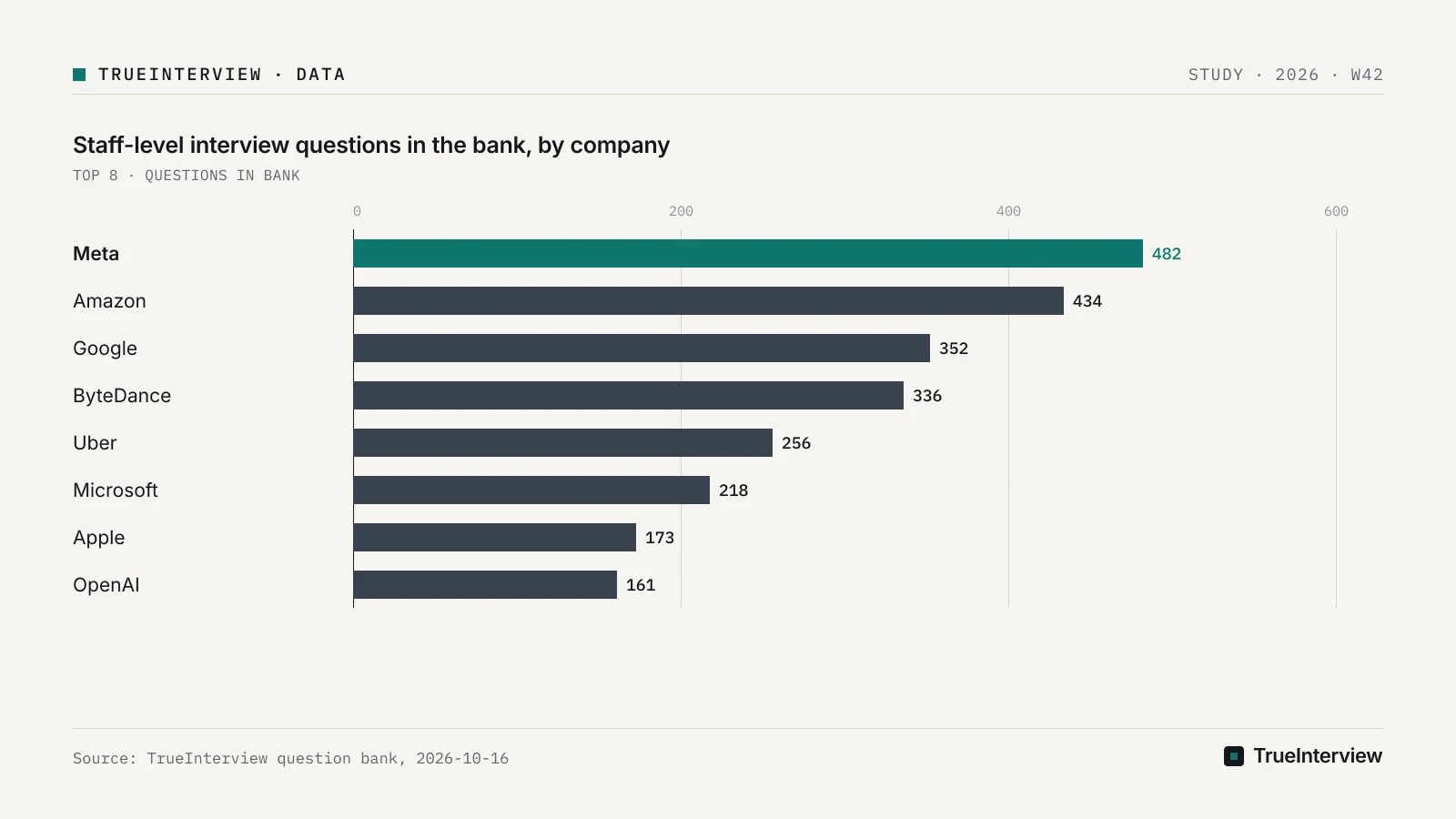
Each company's reports point to different design families, which is where your design hours should go. Meta's design questions skew toward ads and ranking ML, Amazon's toward metrics and logging pipelines, Uber's toward maps and ride-hailing, and Microsoft's toward LLM and AI infrastructure. Counts below are what candidates reported, and they are small at company level.
| Company | Top design families (questions) | Top other-format subtypes | Also reported or published |
|---|---|---|---|
| Meta | Ads, recommendation and ranking ML (14), A/B testing and experiment design (9) | SQL (62), statistics (58), behavioral (39) | |
| Amazon | Metrics, logging and data pipelines (7), maps, ride-hailing and delivery (6) | Behavioral (53), object-oriented design (38) | Leadership Principles Standard Set, linked from 31 write-ups; Amazon's guide describes four to six interviews of 45-60 minutes |
| News feed and social graph (4), chat, messaging and comments (3) | Behavioral (39), object-oriented design (26) | Coding led by graphs (41) | |
| Uber | Maps, ride-hailing and delivery (7), ads and ranking ML (5) | Object-oriented design (21), statistics (20) | Onsite BQ + Hiring Manager + Project Deep-Dive, linked from 32 write-ups |
| Microsoft | LLM, RAG and AI infrastructure (4), booking, inventory and ticketing (3) | Object-oriented design (26), behavioral (11) |
Amazon's interview guide describes the Bar Raiser as an objective interviewer from outside the hiring team, and says technical roles dedicate roughly half of the process to technical assessments. Amazon's guide also advises using "I" statements for your own contributions when describing team work. Our reading is that much of the remaining time is behavioral, so for an Amazon Staff loop, write your Leadership Principles stories with your role first. The Leadership Principles set is the place to rehearse them.
These are candidate-reported questions reconstructed for practice, not any company's official question list. Use the table to choose families, not to predict a specific prompt.
How has the Staff interview format changed in 2025 and 2026?
Coding was flat at about 40% of reported links for three quarters and rose to 51% only in 2026-Q3, while system design fell in the same quarter; one quarter is not yet a trend. AI-related questions are reported in coding, behavioral and design formats. Read the shares, not the totals: links number 613 in 2025-Q4, 1624 in 2026-Q1, 1743 in 2026-Q2 and 1195 in 2026-Q3, and those totals mostly reflect how many write-ups were collected.
| Share of write-up links | 2025-Q4 | 2026-Q1 | 2026-Q2 | 2026-Q3 |
|---|---|---|---|---|
| Coding (algorithm) | 40% | 39% | 40% | 51% |
| Behavioral / knowledge | 21% | 24% | 24% | 23% |
| System design | 16% | 16% | 16% | 11% |
| Object-oriented design | 19% | 15% | 13% | 11% |
Treat both third-quarter moves the same way: neither the coding rise nor the design dip shows companies changing their rounds, because shares move with which write-ups were collected. The steadier signal is behavioral, which stayed within a few points across all four quarters, and that supports giving it fixed weekly time.
The AI-era markers are concrete. The set holds 78 AI-assisted coding questions, such as LRU Cache in an Apple phone screen and Maze Solver in a Meta onsite, both last reported 2026-09. On the behavioral side, GenAI Usage (How / Failure / Tradeoff) is linked from 29 Amazon write-ups. LLM, RAG and AI infrastructure is the second-largest design family, with 42 questions. If your target company reports AI-assisted rounds, do at least one, such as Maze Solver, and prepare a short, honest answer about how you use AI tools and where they failed you.
How is the level decided, and what should you ask the recruiter?
Ask before the onsite, because the level is often settled later than the offer title suggests. StaffEng notes that many companies treat level-specific titles as provisional and finalize them later, while others are rigid. The only way to know which applies is to ask, and at Staff level asking is itself part of the signal.
StaffEng lists the first thing to understand as the interview formats and what they evaluate, and advises preparing materials for any presentation interviews and researching the interviewers. PracHub's guide suggests asking about design or project presentations, level calibration, interviewers and permitted tools. Send these four questions in one email:
| Question to the recruiter | Why it matters | What to do with the answer |
|---|---|---|
| Which rounds are in the loop, and what does each evaluate? | Tells you whether coding, design or behavioral carries the most weight | Set your weekly hour split |
| Is there a project deep dive or presentation? | Deep dives skew heavily senior in reported write-ups | If yes, write the one-page retrospective first |
| Who is on the panel, and at what level? | A junior-heavy panel rarely produces a Staff offer | Ask for a Staff-plus interviewer if it is missing |
| When and how is the level decided? | Some titles are provisional | Know whether a down-level can still change after the offer |
How we counted
The numbers come from TrueInterview's question bank as of 2026-10-16: 3432 practice questions reported at 25 big-tech companies, and the candidate interview write-ups that link to them. A write-up's level is the level the candidate self-reported, and the set is not limited to Staff candidates, so the level evidence is the split between senior-or-above and junior-or-below links. Link counts measure what candidates reported, not how often a company asks a question, and a link count is not a count of write-ups.
FAQ
Do Staff software engineer interviews include LeetCode questions?
Yes. Coding stays a gate at every level, as the level table shows, and StaffEng warns that Staff-plus engineers who skip interview practice are often slower or more error-prone on algorithmic questions. The practical difference is that a Staff panel expects you to explain your trade-offs without being asked and to finish with working code. Keep daily practice in graphs, hashing, strings and arrays through the whole prep window, and add a couple of interval problems, since those skew toward senior-or-above write-ups. Do not plan on seniority buying you a lighter phone screen.
What does a Meta Staff engineer loop look like in the reports?
The Meta questions in the bank split into 172 coding, 147 behavioral or knowledge, 75 system design, 62 SQL and 15 object-oriented design. Those are what candidates reported across levels and roles, not Meta's official structure. For a Staff engineer, the design families listed in the company table matter most, so put your design time into ads and ranking ML and experiment design. Because SQL and statistics questions are filed under Meta in large numbers, check with your recruiter whether your role includes a data round before you prepare for one.
How do Google Staff interviews differ from other companies'?
In the bank, Google's questions split into 189 coding, 86 behavioral or knowledge, 39 system design, 30 object-oriented design and 8 SQL. Coding is a larger share of Google's filed questions than of Meta's, so a Staff candidate there should protect coding hours above all. On the behavioral side, the Googliness-themed behavioral round was last reported in a phone screen in 2026-08; practise it with the Googliness behavioral set. Design reports at Google are spread thin across families, so prepare broadly there.
Can you be down-leveled from Staff to Senior during the loop?
It depends on the company. Some treat the level as provisional and finalize it after the loop, while others are rigid, as noted in the leveling section. In our view the level signal sits mostly in the design and deep-dive rounds, so a strong coding performance alone rarely holds a Staff level. The best protection is to ask the recruiter how the level is decided, then prepare the retrospective and the company's design families with the same seriousness as the coding rounds.
Is a principal engineer interview just a harder Staff interview?
Our data cannot answer this directly, because staff-plus and manager write-ups are a small slice of the bank and do not separate principal from staff. In our view, the same pattern likely continues upward: the rounds keep their names, and the deep dive and design discussion carry even more of the decision. If you are interviewing at principal level, ask the recruiter whether there is a presentation round and who sits on the panel, and prepare the retrospective as the centre of the loop.
Your practice plan
A three-week plan for someone working full time, with about ten hours a week:
- First week, first day: email your recruiter the four questions from the leveling table. Adjust the rest of the plan to the answers.
- First week: write the one-page retrospective for your most impactful project using the seven-part template, then rehearse it against Describe your most impactful project and the Project Deep Dive drill.
- Every day for all three weeks: one coding problem in graphs, hashing, strings or arrays, starting with Infection Spread Simulation and Course Schedule. Time yourself and narrate the trade-offs aloud.
- Second week: pick your target company's top two design families from the company table and do two full designs in each. If AI infrastructure is one of them, start with Design GPU Inference Serving System; if ads, start with the Ads Frequency Cap System.
- Second week: for every design, add a failure-and-migration pass: who operates each component, what breaks first at ten times the load and how you would roll it out. Use Rate Limiter to practise follow-ups.
- Third week: rehearse the deep dive as a short slide walk-through with a colleague who keeps asking why you did not choose the alternative.
- Third week: write behavioral stories with your role first, including one real disagreement where the other engineer was partly right, and run them through the Culture & Behavioral set or the Behavioral / BQ Question Pack.
- Third week, if your company reports AI-assisted rounds: do one session on LRU Cache or Maze Solver and prepare an answer on how you use AI tools, using GenAI Usage if Amazon is your target.
Sources
- Interviewing for Staff-plus roles | Staff Engineer: Leadership beyond the management track — checked 2026-10-16
- TrueInterview question bank — staff-level interview at big-tech companies — counted 2026-10-16
- Staff Software Engineer Interview Guide 2026: Coding, System Design, Technical Retrospective, and Leadership | PracHub Knowledge Hub — checked 2026-10-16
- Medium — checked 2026-10-16
- Interview prep compared: your application, end to end · TrueInterview — checked 2026-10-16
- A Staff Engineer's Guide to Conducting Interviews | joshpaulchan — checked 2026-10-16
- Amazon interview process: A step-by-step guide — checked 2026-10-16
Last reviewed: 2026-10-16.