Stackadapt · Study
StackAdapt Interview Process & Questions
TrueInterview
October 13, 2026 · 8 min read
StackAdapt's technical rounds draw on what an ad platform does all day: state that expires on a time window, statistics over a stream, and clean in-memory models of business rules. Precision matters more than difficulty. One interviewer demanded strict worst-case O(1) operations and probed hash-table internals before any code, and one rejection came from over-discussing edge cases on a simple object-oriented problem. Data-track candidates instead get a verbal algorithm walkthrough plus probability.
This guide breaks down each stage of the StackAdapt interview, what interviewers evaluate in each round, and how to prepare, with questions candidates were actually asked.
Verified: Based on 4 candidate-reported interview experiences, cross-checked against recent public accounts.
StackAdapt interview process
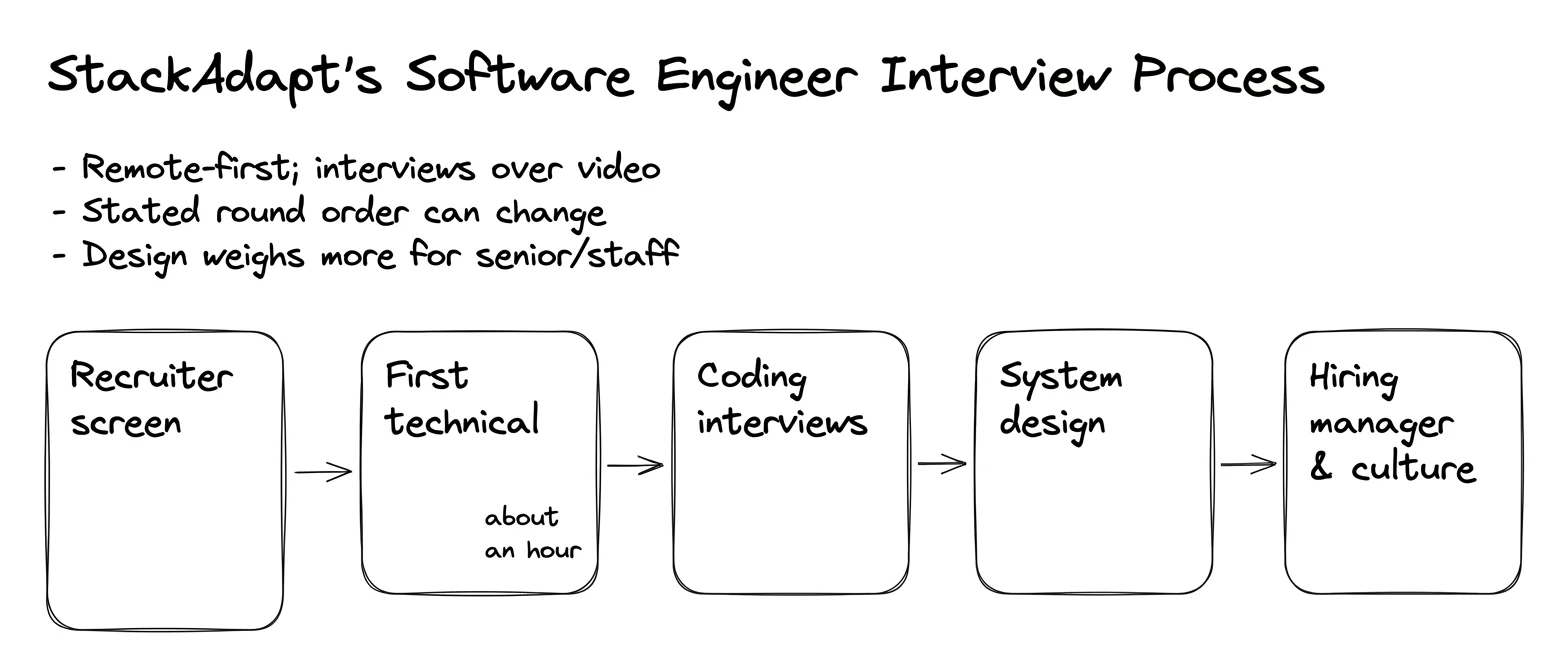
Candidates interview for a specific team, such as ingestion, bidding or audiences, and the first technical round can reflect that team's domain. A full loop is typically four or five conversations over a few weeks: a recruiter call, a first technical round, one to three more technical rounds mixing live coding and design, and a hiring-manager or culture interview. One candidate sat several rounds back to back in a single block of about three hours. One data science loop ran two screens and then a virtual onsite of four rounds spread across different days.
Coding is described as medium to medium-hard, and design weighs more for senior and staff candidates. The stated round order can change: one candidate was told one sequence and got another.
Here's what the interview process can look like:
- Recruiter screen: A short call on background, team interest, location and timeline.
- First technical interview: One round that typically opens with a resume or project deep dive, then a coding, design or statistics problem.
- Coding interviews: Live problems built around hash maps, sliding windows, heaps and object-oriented modeling.
- System design interview: Mid-level design of streaming or crawling components, with deep questions on data-structure internals.
- Hiring manager and culture interview: Past projects, how you work, and the kind of team you want.
Tip: Ask which team the first technical round is for. In one report the "system design" round for the ingestion team was really a timed data-structure implementation.
Recruiter screen
The recruiter call is short and non-technical. StackAdapt is remote-first, with many roles open across Canada or North America, so expect questions on location and work authorization as well as background and team interest.
Interviewers evaluate:
- Team fit: Which part of the platform you want to work on (bidding, data ingestion, audiences, integrations or creative) and why.
- Stack overlap: Experience with Go, Ruby on Rails, TypeScript or high-throughput data systems.
Prepare a short pitch connecting your past work to one specific StackAdapt team.
Sample questions for the recruiter screen
Here are some questions reported by recent candidates:
- Tell me about yourself and what you are looking for next.
First technical interview
For software engineers, this is typically about an hour of live problem-solving with an engineer. One ingestion-team candidate built a windowed map: values arrive at irregular timestamps, only entries inside the latest fixed window are visible, put refreshes a key's timestamp but get does not, and an average over unexpired values is required. The interviewer required worst-case, not amortized, O(1) for get and put, and rejected a deque-based approach outright. Before any coding, the interviewer probed hash collisions at length: when they happen, what they cost, and how Java's hash map rebalances long chains.
For the data science track, the round opens with a 15–20 minute deep dive into one resume project. The candidate then talks through, without coding, the median of a data stream, its complexity, and an extension to any percentile. Probability follows: the expected value of a geometric distribution and how a mean can exceed the median. One candidate heard they had passed the next evening.
Interviewers evaluate:
- Precise complexity claims: Distinguishing worst-case from amortized and expected time, and knowing why hash-map operations are only expected O(1).
- Eviction design: Expiring stale entries with a hash map plus an insertion-ordered linked list and a running sum, instead of scanning.
- Explanation without code: Walking through a two-heap design and its percentile generalization clearly enough that code is unnecessary.
- Statistical intuition: Fast, correct answers on standard distributions and skew.
Prepare to defend every complexity claim at the level of the underlying data structure.
Note: One candidate described the windowed-map interviewer as interrupting repeatedly to demand justifications while they were coding. Keep explanations brief and keep coding. State your assumption (for example, that lazy expiry on
getkeeps that operation strictly O(1)) and move on rather than debating it.
Sample questions for the first technical interview
Here are some questions reported by recent candidates:
-
Implement a time-windowed key-value store with strict O(1)
getandputand an average over unexpired values, where total data over time exceeds memory. -
Talk through the median of a data stream, give its complexity, then adapt it to return the 90th percentile.
-
Give the expected value of a geometric distribution, and explain how a mean can sit above the median.
-
Windowed Map (Time-Windowed Key-Value Store) with O(1) Operations and Window Average
Coding interviews
Later rounds are live coding, typically medium to medium-hard, mixing object-oriented modeling with classic algorithms. One prompt is a restaurant system of recipes (name, preparation time, supplies used) and supplies (raw ingredients with stock counts), where a dish can be an ingredient of another recipe. You add recipes and supplies, place orders against real inventory, and filter dishes, such as those taking over 20 minutes. Other StackAdapt prompts include a song shuffler that never repeats a recently played track.
Data science rounds typically pair two medium coding problems or brainteasers at about 30 minutes each, sometimes with a probability question.
Interviewers evaluate:
- Clean state: Well-chosen hash maps for dishes and inventory, and classes that keep the order logic simple.
- Recursive modeling: Handling nested recipes without double-counting or partially consuming inventory on a failed order.
- Pace: A working solution early. On a clearly specified problem, a long requirements discussion reads as hesitation.
- Correctness: Bug-free code that you trace yourself, since interviewers expect fluency over partial credit.
Practice small object-oriented systems for 30 minutes at a time, getting to running code within the first ten minutes.
Note: One rejected candidate called the recipe problem very straightforward, but spent much of the hour on boundary cases and clarifications instead of coding. Confirm two or three key assumptions, write the solution, then raise further edge cases while testing.
Sample questions for the coding interviews
Here are some questions reported by recent candidates:
-
Build a recipe and inventory system in which dishes can be ingredients of other dishes, orders check stock, and getters filter dishes by preparation time.
-
Design a song shuffler that returns random tracks but blocks any track played within the last k picks.
System design interview
Design is pitched at a mid level, focuses on components, and is often paired with coding in the same session. One reported prompt is a web crawler that fetches URLs by priority under per-domain rate limits. Because the bidder handles millions of requests per second, ingestion, deduplication and time-windowed aggregation are natural extensions to prepare.
Interviewers evaluate:
- Data-structure grounding: Priority queues, per-host buckets and hash maps chosen and justified, with their costs.
- Throughput and latency: Backpressure, batching and what happens when a downstream store slows down.
- Correctness under time: Expiry, ordering and late-arriving events handled deliberately.
Prepare one streaming design and one crawler or scheduler design, down to the core data structures.
Sample questions for the system design interview
Here are some questions reported by recent candidates:
-
Design a crawler that schedules URLs by priority while enforcing a rate limit per domain.
-
Extend a time-windowed store so stale data is evicted while total volume far exceeds memory.
Hiring manager and culture interview
The hiring manager conversation covers your projects in detail, a difficult situation and how you handled it, your best and worst work experiences, and the kind of team you want to join. Interviewers have described the environment as fast-paced.
Interviewers evaluate:
- Project depth: Your decisions, the alternatives you rejected, and measurable results.
- Resilience: How you handled a hard situation or a project that went wrong.
- Pace and ownership: Comfort shipping quickly with little process.
- Team fit: A clear view of the team and work you want next.
Prepare three project stories that each include a trade-off and a metric.
How StackAdapt makes hiring decisions
The hiring team decides after the loop, based on the technical interviewers' feedback and the hiring manager's view. Decisions can be fast: one data-track candidate heard within about a day and a half. The reports say nothing about formal leveling or committees. Candidates' experiences varied widely from one interviewer to the next, so a strong first technical round matters.
How to prepare for the StackAdapt interview
- Know hash-map internals: Explain collisions, resizing, expected versus worst-case cost, and how Java handles long collision chains, especially if you code in Java.
- Drill windowed state: Hash map plus linked list plus running aggregates, with lazy versus eager expiry and their complexity.
- Master two heaps: Explain stream median and percentile without code, including how to rebalance for a target percentile.
- Code object-oriented systems quickly: Get a working recipe or shuffler model running early, then discuss edge cases.
- Refresh probability basics: Geometric and binomial expectations, conditional probability and skew.
- Prepare a streaming design: Ingest, aggregate and expire events at high throughput, down to the data structures.
About working at StackAdapt
StackAdapt runs a self-serve programmatic advertising platform across native, display, video, connected TV, audio and retail media. Product teams each own part of a real-time system: the bidder handles millions of requests per second, and event data flows through Go services and Kafka into reporting, billing and bidding. The company is remote-first and headquartered in Toronto.
StackAdapt hires engineers across its bidding, data and product teams. Teams include:
- Bidding: The real-time bidder and the auction logic.
- Stats, analytics and ingestion: Ingesting impressions, clicks and conversions, and distributing them to reporting, billing and bidding.
- Audiences and user data: Audience building and the customer data platform.
- Integrations and data hub: First- and third-party data integrations with external platforms.
- Creative: Go services that handle millions of requests per second under a 100 ms latency target.
Experience and education requirements
Postings range from junior to staff. Backend roles center on Go, and product teams also use Ruby on Rails, TypeScript, React and GraphQL. Staff postings ask for a record of building scalable, low-latency pipelines and services; adtech or martech experience is an asset, not a requirement.
FAQs about the StackAdapt interview
How long does the StackAdapt interview process take?
Typically a few weeks; one data science process took two weeks.
What is the hardest round of the StackAdapt interview?
The first technical round for software engineers. It can demand strict worst-case complexity and hash-table theory before any code is written. For data science candidates, it is the combination of verbal algorithm explanations and probability.
Is there an online assessment?
None of the reports mention an automated assessment. The first technical step is a live interview with an engineer.
Is the StackAdapt interview remote?
Yes. StackAdapt is remote-first, and interviews are held over video.