SoFi · Study
SoFi Interview Process & Questions
TrueInterview
July 24, 2026 · 14 min read
SoFi often outsources its first technical screen to Karat: a scripted hour with a rapid concept block, then a multi-part coding problem checked against hidden tests. Some candidates now get an AI-assisted version built on an existing codebase. After that, the loop is practical. Coding prompts are product-shaped, and design prompts follow the hiring team's domain, such as loan withdrawals or market-price broadcasts. Backend applicants are sometimes routed into full-stack loops with frontend work, and rejected candidates repeatedly report that encouraging feedback during a round did not mean a pass.
This guide breaks down each stage of the SoFi interview, what interviewers evaluate in each round, and how to prepare, with questions candidates were actually asked.
Verified: Based on 22 candidate-reported interview experiences, cross-checked against recent public accounts.
SoFi interview process
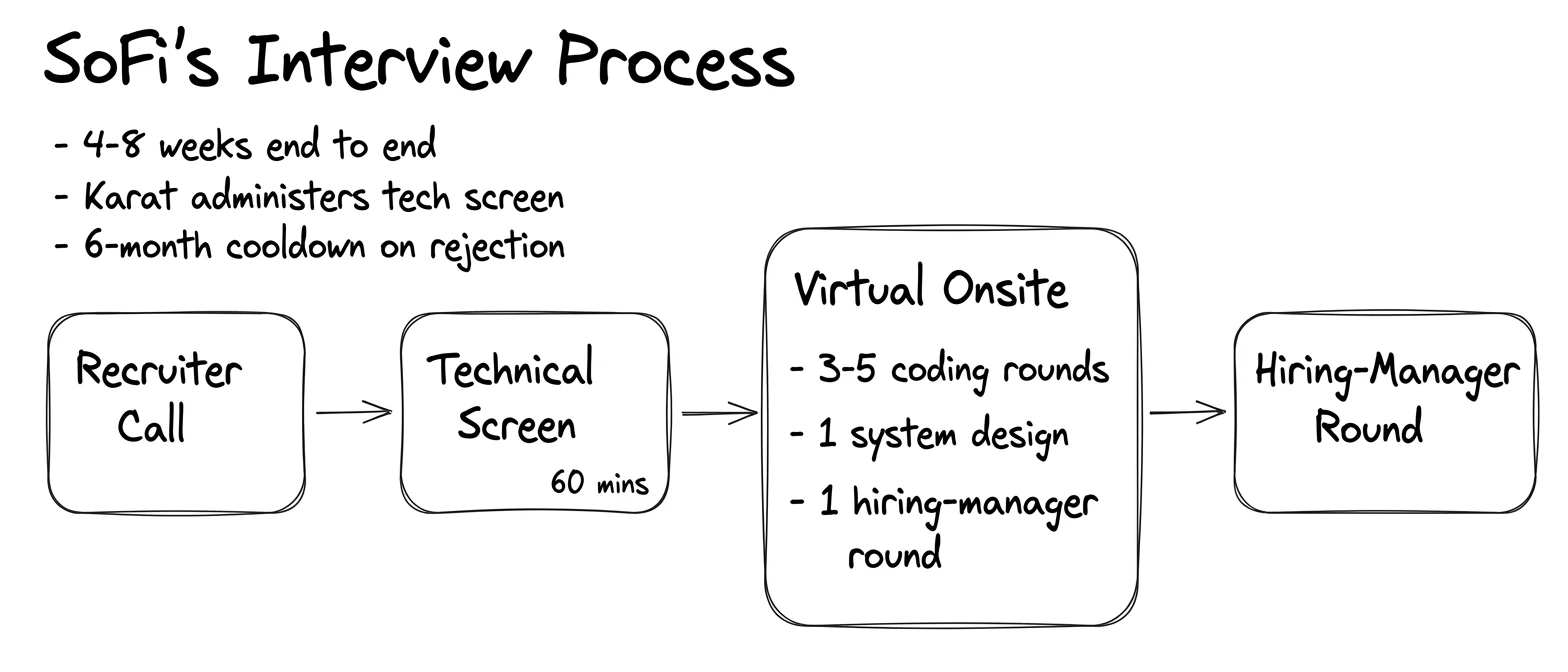
The loop depends on the team. The recruiter matches candidates to a department (lending, invest, money or platform) before the technical screen, and that team sets the domain of later prompts. Reported loops ran one to five rounds. The most common shape was a recruiter call, one or two technical screens, and a virtual onsite of three or four sessions. One loop ran over two consecutive days, and one onsite was in person at a whiteboard. The process usually takes one to two months.
Early-career candidates more often start with an online assessment. Senior and Staff loops add domain-specific design, deeper project dives and, for backend roles, Java internals. Frontend and full-stack loops swap part of the algorithm work for HTML, CSS, vanilla JavaScript and React builds.
Here's what the interview process can look like:
- Recruiter screen: A non-technical call on background, team matching and logistics.
- Online assessment (some candidates): Three algorithm problems with multiple-choice questions, or two small frontend builds for UI roles.
- Technical phone screen (one or two): 45–60 minutes, often run by Karat, with short concept or behavioral questions and then a multi-part coding problem.
- Coding interviews: One or two onsite rounds of practical algorithms, object-oriented implementation or UI builds.
- System design interview: A domain-flavored design round graded on depth: failure handling, back-pressure and data modeling.
- AI-assisted coding interview (some loops): Extending a partly built application with an AI assistant while explaining your choices.
- Hiring manager interview: A project deep dive and behavioral questions, sometimes with a coding task.
Tip: Ask the recruiter which team you are matched to and whether the loop is backend or full-stack, then prepare for every format anyway. One candidate was told the second round would be system design and got a second coding round instead.
Recruiter screen
The call covers background, availability and team fit. Several candidates were matched to a department before the technical screen was scheduled, and backend applicants have been placed in full-stack loops without being asked, so state a preference early. When a screen goes well, things move quickly: one candidate heard back the next day.
Interviewers evaluate:
- Team fit: Whether your experience maps to the matched department's domain.
- Track preference: Backend, full-stack or frontend, which decides whether frontend rounds appear later.
- Resume claims: Later rounds challenge what you list, so list only work you can defend in detail.
- Logistics: Location, timeline and competing processes.
Decide which track you want and research the business line you are likely to be matched to.
Sample questions for the recruiter screen
Here are some questions reported by recent candidates:
- Tell me about yourself and what you want in your next role.
- Why SoFi, and which product area interests you?
Online assessment
Not every candidate takes one. The general version has three coding problems plus multiple-choice questions on data-structure properties, complexity and code tracing. Reported problems: the most frequent character in a string, a greedy rearrangement that maximizes strictly positive prefix sums, and counting integers up to n with the same number of set bits as n, which needs combinatorics rather than a scan at large n.
UI candidates have instead taken a Karat-administered build: a typeahead in plain HTML and CSS, and a list that lazy-loads exactly ten items per request and stops cleanly on a short last page. A Chrome-versus-Firefox placeholder padding bug misaligned one candidate's dropdown; reproducing it in a sandbox and reporting it did not hurt, and that candidate got an offer.
Interviewers evaluate:
- Edge cases under hidden tests: Ties for the top character, all-negative arrays and a short final page.
- Algorithm choice at scale: A per-number bit count times out, while a binomial-coefficient count does not.
- Greedy reasoning: Explaining why placing the largest values first maximizes positive prefix sums.
- Browser fundamentals: Intersection observers, framework-free fetching and consistent CSS across browsers.
Practice a timed three-problem set mixing counting, greedy sorting and bit manipulation, and build one vanilla-JavaScript infinite scroll.
Sample questions for the online assessment
Here are some questions reported by recent candidates:
-
Rearrange integers, including negatives, so the number of strictly positive prefix sums is as large as possible.
-
Count the integers in [1, n] whose binary form has as many set bits as n.
-
Build a list that fetches ten items per page on scroll and stops once a short page arrives.
Technical phone screen
This is the most frequently reported stage. The Karat version runs 60 minutes and opens with about ten minutes of rapid questions, including brief high-level design prompts, before coding graded against hidden tests. One session had no live interviewer: JavaScript warm-ups (why lockfiles matter, predicting snippet output, fixing a function from failing tests) and then a highway-sensor problem with several sub-questions. In-house screens run 45–60 minutes and often open with 15–20 minutes of behavioral questions, leaving about 25 minutes for code.
Problems are medium or easier but wrapped in product scenarios: counting entry-to-exit vehicle journeys in noisy sensor logs, the second most frequent tag in a flattened id-name-tag stream with a sentinel for tied top counts, following an index chain until it exits or loops (then with two choices per node), text justification with input preprocessing, anagram replacement in a sentence, and the k-th maximum among values appearing once across two sorted arrays. Full-stack screens add a vanilla search bar and fetch-and-lazy-load task. Senior backend screens may be design-heavy instead: a key-value store with O(1) getLast extended to consistent hashing, a semaphore-based task executor, or a schema-plus-microservices design for friends' trading activity.
Interviewers evaluate:
- Input-contract questions: Lengths not divisible by three, ties and empty inputs. One candidate failed hidden tests on tie rules never discussed.
- Pacing across sub-parts: Several candidates finished only the first one or two parts.
- Simplicity: An unneeded parent map in a reachability DFS, or quickselect where two linear passes suffice, drew pushback.
- Traversal trade-offs: Recursion depth versus queue memory, and when iterative DFS or BFS is safer.
- Frontend fundamentals (full-stack): Closures, async error handling, lockfiles and framework-free UI.
Rehearse a full hour of rapid concept questions followed by a multi-part, story-wrapped problem, and write your own edge-case tests before submitting.
Note: The second-most-frequent-tag problem appeared in two separate screens and an onsite round, each time with tie rules that decided the outcome. One candidate believed the solution was correct and was rejected after hidden tests failed.
Sample questions for the technical phone screen
Here are some questions reported by recent candidates:
-
Given time-ordered records of vehicle id, timestamp and entry, exit or checkpoint, count every complete journey.
-
From a list repeating id, name, tag, return the second most frequent tag in linear time, or a sentinel if the top frequency is shared.
-
From index 0 of an array of next-step indices, report whether you exit or cycle, then extend to two choices per node.
-
Design an in-memory store with O(1) add, get, remove and getLast, then partition it across servers.
Coding interviews
Onsite coding is one or two 45–60 minute rounds that favor implementation over puzzles. Backend examples: a long rock-paper-scissors array problem solved by brute force and then pushed to a greedy minimum number of moves, an abstract class with two subclasses whose string output must validate, and deduplicating tagged items with filtering and pagination. In one 2026 loop, two back-to-back GIF-themed rounds both hinged on an insertion-ordered LinkedHashMap. Nested List Weight Sum and duplicate detection also appear.
Frontend rounds are hands-on React: a star rating with half stars and distinct click and double-click behavior, a Kanban board with reordering, deletion and new tasks, and an accessible loan calculator. One senior candidate could search for algorithm templates but not use AI tools. Interviewers flag typos but leave logic bugs for you.
Interviewers evaluate:
- Reading long prompts: Requirements were buried in long descriptions.
- Brute force, then optimize: A correct baseline, then a reasoned improvement such as the greedy minimum.
- Language depth (backend): Garbage collection, thread-safe singletons and collection semantics in Java, even when the posting lists Kotlin.
- Fitting the tool to the problem: A heap for the second most frequent tag was judged overkill; ordered maps were expected where order matters.
- UI state and events (frontend): Separating click from double-click, partial rendering states and avoiding stale list state.
Know ordered-map and LRU patterns in your language, and practice building small stateful React components quickly.
Sample questions for the coding interviews
Here are some questions reported by recent candidates:
-
Simulate a rock-paper-scissors lineup from a long statement, then reduce the brute force to a greedy fewest-moves count.
-
Implement an abstract class and two subclasses whose string output passes validation.
-
Build a React star rating with half stars that treats click and double-click differently.
System design interview
There is usually one design round, at the onsite or as a later screen, and senior candidates may meet it in the first screen. Prompts follow the team's domain: a REST API for loan withdrawals (loan group), real-time market prices fed by a third-party API that supports only long polling (Invest), a stock page with friends' trading activity including table schemas and service boundaries, a news feed, emoji and sticker search, and shareable GIF collections with permissions and access notifications. Frontend loops got a client-only notification system: component tree, API contract, reactive state, debounced bursts and cross-tab sync through the Broadcast Channel API.
Grading rewards depth, and interviewers challenge choices on purpose. Two rejected candidates had positive feedback during the round. One partitioned a key-value store with consistent hashing but skipped concurrent writes and failure detection. The other designed a pub/sub broadcast with no plan for failure recovery or slow consumers.
Interviewers evaluate:
- Failure handling: Poller crashes, upstream rate limits and broker outages, raised unprompted.
- Back-pressure and fan-out: Keeping slow or disconnected subscribers from stalling a stream.
- Data modeling: Concrete tables, keys and indexes, and which service owns which data.
- Money-movement correctness: Idempotent withdrawals, auditability and status transitions.
- Defending choices: Answering pushback with trade-offs instead of abandoning the design.
Prepare one money-movement design and one real-time fan-out design end to end, each closing with failure modes and back-pressure.
Tip: Treat friendly nods as neutral. Before time runs out, name what you have not covered yet (consistency, failure detection, back-pressure, monitoring) and ask which one to deepen.
Sample questions for the system design interview
Here are some questions reported by recent candidates:
-
Broadcast real-time market prices to many users when the only source is a long-polling third-party API.
-
Design a REST API for withdrawing funds from a loan.
-
Design a frontend notification system that debounces bursts and stays in sync across tabs.
AI-assisted coding interview
SoFi has run AI-assisted rounds at two points. In a 2026 Karat screen, a backend candidate added an accessibility feature to a partly built bus-station application, and after each requirement the interviewer paused to ask where the logic belonged and what it affected. In a frontend onsite, a candidate started from a Vite and shadcn template about 25 percent complete, used an AI tool to outline the component tree and data flow, built the features one at a time, and received an offer. The grade is on judgment, not on whether the AI produces working code: override it on state management and edge cases, and say why.
Interviewers evaluate:
- Codebase reading: How quickly you find the architecture and where the feature belongs.
- Review discipline: Catching and correcting generated code.
- Design rationale: Explaining the trade-off at each step.
- Incremental delivery: Finishing each requirement before the next.
Practice finishing a partly scaffolded app with an AI assistant while narrating your choices.
Sample questions for the AI-assisted coding interview
Here are some questions reported by recent candidates:
-
Extend an existing bus-station application with an accessibility feature, justifying where the logic lives after each requirement.
-
Finish a partly built Vite and shadcn app with an AI assistant, starting from a plan of the component tree and data flow.
-
Extend an Existing Codebase to Support Accessibility Requirements
Hiring manager interview
The last round, usually 45–60 minutes, is with a manager from the matched organization. It opens with a deep dive into one project (architecture, technology choices, milestones, cross-team work, your own contribution) and then turns behavioral. Some managers add a coding task. Reported questions: why SoFi, proudest and most challenging projects, biggest failure, a missed deadline and how you told stakeholders, advocating for the end user over a perfect technical solution, fixing something outside your scope, and disagreeing with very senior people without alienating them. One manager asked the candidate to teach a recently learned concept in detail.
Interviewers evaluate:
- Ownership and impact: Your decisions and measurable results. One candidate said vague impact left the seniority signal unclear.
- User advocacy: Trading technical perfection for member outcomes.
- Handling conflict upward: Disagreeing with senior people while keeping the relationship.
- Clear explanation: Teaching a concept from fundamentals to application.
- Motivation: Whether your goals fit the team's current work.
Prepare six to eight stories with metrics before the first screen, since behavioral questions appear in screens too.
Sample questions for the hiring manager interview
Here are some questions reported by recent candidates:
-
Describe a missed deadline and how you communicated it to stakeholders.
-
Tell me about a disagreement with very senior people and how you resolved it.
-
Teach me something you learned recently, in detail.
How SoFi makes hiring decisions
Interviewers submit feedback and the recruiter delivers the decision, sometimes with a brief reason such as a design lacking depth or incomplete follow-ups. Rounds are judged as a set, and one rejected candidate concluded the bar is close to flawless across every round. HR sometimes says the team will review your performance before deciding. Responses have taken from one day to several weeks. In the manager round, the scope of impact in your stories signals seniority. A rejection carries a six-month cooldown.
Tip: Treat every follow-up as graded. Rejection reasons named unanswered follow-ups (memory use, tie handling, failure recovery) more often than wrong core solutions.
How to prepare for the SoFi interview
- Drill tie-aware frequency problems: Second most frequent and k-th unique, with ties, empty inputs and malformed groups, in linear time.
- Practice stateful log parsing: Pair entry and exit events per entity through noisy records, including repeated journeys.
- Rehearse the Karat hour: Rapid concept questions, then a multi-part problem. Sketch every part first and treat each as a checkpoint.
- Prepare two design threads: A money-movement API with idempotency and an audit trail, and a real-time fan-out with back-pressure and failure recovery.
- Refresh Java internals for backend loops: Garbage collection, thread-safe singletons, semaphores and
LinkedHashMap, even if the posting lists Kotlin. - Build UI without a framework for full-stack loops: A typeahead, a ten-item lazy loader and a fetch-on-click list, then the same in accessible React.
- Practice AI-assisted feature work: Extend an unfamiliar codebase with an assistant and explain each accept or override.
- Quantify your stories: Bring metrics for failure, conflict upward, user advocacy and a concept you can teach.
About working at SoFi
SoFi is a digital financial services company with a national bank charter. It reports three segments: lending (personal, student and home loans), financial services (SoFi Money, Invest, Credit Card and Crypto), and a technology platform (Galileo and Technisys) that provides payment processing and core banking to other fintechs. Engineering is organized by product line, which is why loops are matched to a department. Postings describe Java and Kotlin with Spring, PostgreSQL and React, on Kubernetes with more than 100 services in production.
| Level | Primary focus | Impact scope |
|---|---|---|
| Software Engineer | Delivering well-scoped features with guidance | Tasks within one team |
| Senior Software Engineer | Owning features end to end and making design decisions | A team's services |
| Staff Software Engineer | Leading cross-team architecture and mentoring | Several teams in a product line |
| Senior Staff Software Engineer | Setting technical direction for a platform | A business unit |
SoFi hires engineers across its product lines. Teams include:
- Lending and Loans Platform: Loan origination, servicing and disbursement.
- SoFi Money and Credit Card: Accounts, payments, entitlements and member-facing services.
- SoFi Invest and Crypto: Trading, market data and portfolio features.
- Galileo and Technisys: Card issuing, payment processing and core banking for other fintechs.
- Member experience: Web and mobile frontends shared across products.
Experience and education requirements
Postings ask for a bachelor's degree in computer science or a related field, or equivalent experience. Mid-level and senior roles ask for two or more years of Java, Kotlin or Scala, and Staff roles six to eight or more years. Backend candidates should know service frameworks, relational modeling and distributed systems; frontend and full-stack roles add React, TypeScript, accessibility and browser fundamentals. Financial-services experience helps but is not required.
FAQs about the SoFi interview
How long does the SoFi interview process take?
Usually one to two months from the recruiter call to a decision. Single stages can turn around the next day, but some candidates waited weeks after the onsite.
What is the hardest round of the SoFi interview?
For mid-level and senior candidates, system design, where rejections most often cite a lack of depth despite positive feedback in the room. For early-career candidates, the Karat screen's multi-part problems and hidden tests are the main filter.
Is there an online assessment?
Sometimes: a three-problem assessment with multiple-choice questions, or a two-task frontend build for UI roles. Most experienced candidates start with a technical phone screen.
What language should I use?
Backend loops are Java-heavy even when the posting says Kotlin, so confirm with the recruiter before using another language. Full-stack and frontend loops require JavaScript and React.
What happens after a rejection?
There is a six-month cooldown before you can reapply.
How much does a SoFi engineer make?
2026 Senior Software Engineer postings listed base salaries of roughly $200K to $233K, with wider ranges in some locations. Packages add bonus and long-term incentive eligibility.